

NFHS Voice: Fall Fridays for HS Football
October 28, 2019
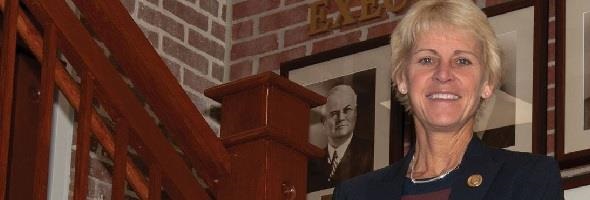
By Karissa Niehoff
NFHS Executive Director
Some of the top football matchups featuring Ohio teams Friday, Oct. 18, were Mentor vs. Shaker Heights, Cleveland St. Ignatius vs. Cincinnati Archbishop Moeller, Cincinnati St. Xavier vs. Massillon Washington and Northwestern vs. Ohio State.
That’s correct, Northwestern University vs. Ohio State University, on Friday night. While the game was in Evanston, Illinois, and not Columbus, it was televised on the Big Ten Network. Ohio State, one of the nation’s top-ranked college teams with one of the strongest fan bases, played on Friday night in direct competition with the several hundred high school games across the state.
And that wasn’t the only college football game on Friday night. There were three other FBS (I-A) matchups, including an Atlantic Coast Conference game between Pittsburgh and Syracuse. Through the first eight weeks of the season, there have been about 25 major college football games on Friday night.
A number of high schools in Ohio moved their games earlier in the hope of finishing before the start of the Ohio State-Northwestern game. Others moved their games to Thursday or Saturday. At least one school – Ursuline Academy in greater Cincinnati – urged its fans to not watch the Ohio State game:
“Please make a statement to Ohio State by NOT watching their Friday night game this week. Friday nights are for HS football. Let’s keep it that way. Support your local team. We play Boardman, and would love to have you in our stands, but that’s not the point. Support HS football.”
High schools should not have to adjust their schedules to accommodate colleges playing on Friday nights. High school coaches, administrators and fans are opposed to colleges playing on Friday nights. The NFHS and its member state associations are opposed. Even leaders in the Ohio State administration did not initially support the idea of the Buckeyes playing on Friday night. Friday nights are for high school football and should remain that way.
Two years ago, the NFHS membership adopted the following resolution:
“Be it RESOLVED that every Friday night during the fall in America is ‘High School Football Night.’
“Be it FURTHER RESOLVED that college and professional football teams should refrain from scheduling contests on Friday nights. Such restraint would be an investment in their own future success. It would also demonstrate that high school football has value well beyond the field of play. Schools, communities and scholastic teams for girls and boys all benefit when football is strong.
“THEREFORE, the National Federation of State High School Associations urges all parties to observe the central premise of this resolution.”
In addition to the Big Ten Conference, teams in the Pac-12, Mountain West, Atlantic Coast and American conferences, as well as Conference USA, have played on Friday nights. When these current television contracts expire, it is the desire of everyone within the high school community that new deals would preserve Friday nights for high school football.
Friday nights offer communities a traditional time and place to congregate and support their students. As was the case last week in Ohio, a college game on Friday night impacts interest and attendance at high school games.
Let’s maintain Friday nights in the fall for high school football. It is a win-win for everyone.
Dr. Karissa L. Niehoff is in her second year as executive director of the National Federation of State High School Associations (NFHS) in Indianapolis, Indiana. She is the first female to head the national leadership organization for high school athletics and performing arts activities and the sixth full-time executive director of the NFHS, which celebrated its 100th year of service during the 2018-19 school year. She previously was executive director of the Connecticut Association of Schools-Connecticut Interscholastic Athletic Conference for seven years.
1st & Goal: 2024 Week 6 Review
By
Geoff Kimmerly
MHSAA.com senior editor
October 7, 2024
We don’t track margin of victory week to week during the Michigan high school football season. So only anecdotally we will say that Week 6 felt like it was filled with several more close games than usual across the state.
 Total, 57 games were decided by eight points or fewer – in essence, a touchdown and 2-point conversion, or less – and those 57 games including 113 Michigan teams (with River Rouge playing an Ohio opponent).
In other words, 19 percent of our varsity teams were part of games decided by such a slim margin – including many of the results of intriguing matchups we highlight below.
Bay & Thumb
HEADLINER Almont 29, Armada 28 Almont’s last-minute go-ahead score may end up deciding the Blue Water Area Conference championship as the Raiders (6-0) held on to win this matchup of undefeated teams. They can clinch a share of the title this week against Richmond, while Armada (5-1) fell into a second-place tie with North Branch – but with some hope as North Branch plays Almont in Week 8. Click for more from the Port Huron Times Herald.
Watch list Marysville 39, Marine City 20 Marysville (5-1) rebounded from a 35-0 opening-night loss to Almont to win five straight and clinch a share of the Macomb Area Conference Silver title – with an opportunity to win it outright this week against second-place St. Clair.
On the move Davison 35, East Lansing 10 Davison (5-1) built a strong nonleague schedule again for this season, and this final nonconference win bumped the Cardinals up to No. 9 in Division 1 playoff-point average while keeping East Lansing (3-3) still firmly in the Division 2 mix. Grand Blanc 35, Lapeer 21 The undefeated atop the Saginaw Valley League Red standings are down to Grand Blanc (5-1) and Davison, with Lapeer (4-2) holding on to a sliver of title share hope after taking its second league loss. Fenton 24, Linden 21 Fenton (6-0) took a field goal lead during the first quarter and continued to maintain that advantage to the end to clinch a share of the Flint Metro League Stripes title and send Linden to 3-3 – but with some title share hope as Fenton faces the other second-place team, Flushing, this week.
Greater Detroit
HEADLINER Trenton 28, Gibraltar Carlson 14 Trenton (4-2) has strung together a nice comeback over the last month, with this win the necessary first step toward a possible – and what not long ago probably seemed improbable – opportunity to claim a share of the Downriver League title. The Trojans started this fall 0-2 with both losses in the league, but handed Carlson (5-1) its first. This week Trenton faces Downriver leader Allen Park – and with Allen Park and Carlson still to play as well. Click for more from the Southgate News-Herald.
Check out the highlights of Trenton's 28-14 win over Gibraltar Carlson from October 4th, 2024. Delivered by @hungryhowies. After starting the season 0-2, Trenton has won 4 straight games.@OnwardTrenton | @AshtonRooney_1 pic.twitter.com/z5Owy7l54x
— STATE CHAMPS! Michigan (@statechampsmich) October 5, 2024
Watch list Clawson 27, Clinton Township Clintondale 14 Reigning MAC Bronze champion Clawson (4-2) broke this season’s league standings open again, denying Clintondale (4-2) the opportunity to clinch a share of the title and setting up the possibility of three winners this season with Hazel Park also tied for first, one league game left for all three, and none of those three playing each other.
On the move Detroit Lincoln-King 50, Mount Clemens 0 Lincoln-King (6-0) posted its third straight shutout on the field (with a forfeit win during that run as well) and can clinch the Charter School Conference Silver title this week after sending Mount Clemens (4-2) into a tie for third place. Clinton Township Chippewa Valley 34, Utica Eisenhower 31 (2 OT) All of a sudden the Big Reds (2-4) are only five spots out of making the Division 1 playoff field after stunning Eisenhower (5-1), which can still claim a share of the MAC Red title by defeating first-place Macomb Dakota this week. Oxford 18, Rochester Adams 17 After opening Oakland Activities Association Red play with an eight-point loss to Clarkston, Oxford has pushed back into a tie for first with a chance to clinch a share of the title this week against West Bloomfield. Oddly enough, Adams – with two league losses by a combined four points – could be part of a five-team title share if all five in the division finish 2-2 in league play.
Mid-Michigan
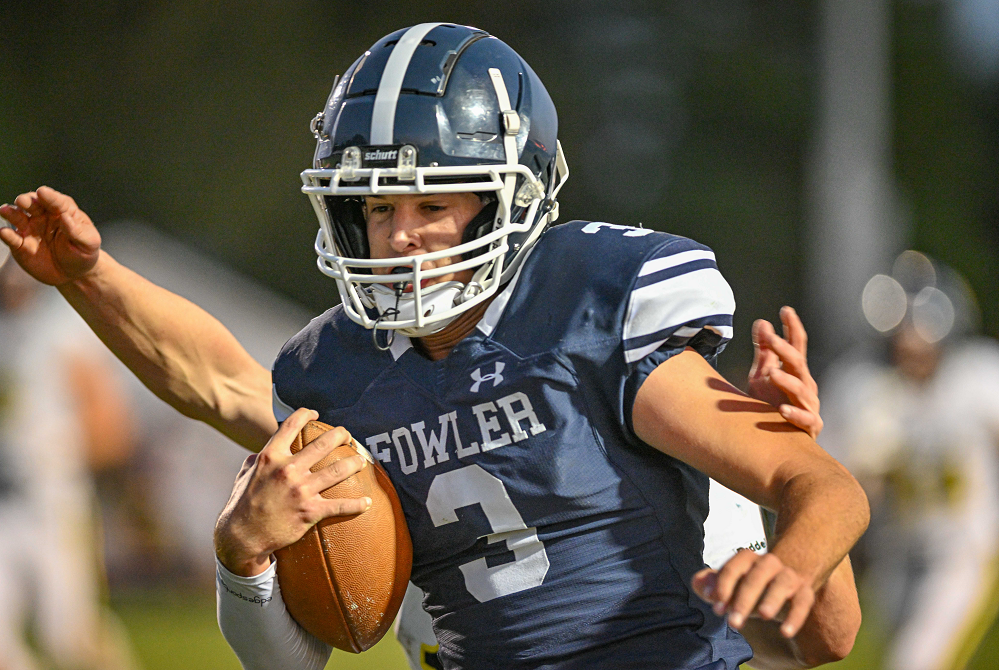
HEADLINER Fowler 14, Pewamo-Westphalia 11 Fowler (6-0) pulled into first place in the Central Michigan Athletic Conference and nearly pulled even with P-W (5-1) in their longstanding series. This was the Eagles’ second win in their last 10 meetings with the Pirates, but pulled Fowler to within one of tying P-W for wins in the 59-year rivalry. Click for more from the Lansing State Journal.
Watch list Leslie 36, Napoleon 28 With this win over reigning Cascades Conference East champion Napoleon (3-3), Leslie pulled within one more of clinching a share of this year’s title and with winless East Jackson up next. The Blackhawks (6-0) also have their most victories in a season since 2012, the last time they finished with a winning record.
On the move Ionia 21, Lansing Sexton 20 After this second-straight one-point win, Ionia (4-2) has avenged three of its losses from a year ago and needs two more victories to guarantee its best finish since 2013. Lansing Everett 35, Grand Ledge 12 Everett (5-1) bounced back from its loss to Grand Blanc with its first win over Grand Ledge (4-2) since 2019 – and with one more victory, would have its best finish since 2014. Mason 40, St. Johns 10 Mason (5-1) clinched a share of a sixth-straight Capital Area Activities Conference Red title by winning this matchup of league leaders, and also delivered St. Johns (5-1) its lone loss during what has been the Redwings’ best season since 2019.
Northern Lower Peninsula
HEADLINER Petoskey 42, Cadillac 18 The Northmen played themselves into a championship matchup in the Big North Conference this week, as they’ll face co-leader Marquette with two leagues games remaining for both. Petoskey also is 6-0 for the first time since 2011, tied last season’s win total with this one, and remains seventh in Division 3 playoff-point average while Cadillac (3-3) fell only one spot to No. 29. Click for more from the Petoskey News-Review.
Watch list Boyne City 21, Grayling 18 Boyne City (4-2) kept its destiny in its own hands, and it will face first-place Traverse City St. Francis in Week 9 with a chance to earn a share of the Northern Michigan Football League Legends championship.
On the move East Jordan 43, Mancelona 28 The Red Devils (4-2) bounced back from two-straight one-score losses to solidly reassert themselves in the middle of the potential Division 8 playoff field, with Mancelona (3-3) remaining in that mix as well. Traverse City St. Francis 55, Cheboygan 6 The Gladiators (5-1) won their third straight to clinch a share of the NMFL Legends title and send Cheboygan to 3-3. Charlevoix 28, Elk Rapids 0 The Rayders (4-2) are league champions as well with this clinching a share in the NMFL Leaders.
Southeast & Border
HEADLINER Monroe St. Mary Catholic Central 34, Riverview 15 Two straight power-packed weeks in the Huron League have left Monroe St. Mary Catholic Central in first place and Riverview and Flat Rock both a game back, with SMCC facing Flat Rock this week with at least a share of the league title on the line. This was billed as Riverview’s powerful offense against the Falcons’ unyielding defense, and the latter won out to give SMCC its first victory over the Pirates since 2019. Click for more from the Monroe News.
Watch list Dexter 42, Ann Arbor Pioneer 6 Dexter (6-0) clinched the Southeastern Conference Red championship, in part by sending Pioneer (4-2) into a tie for second place. The Dreadnaughts can claim the title outright this week at Monroe.
On the move Jackson Lumen Christi 63, Toledo St. Francis de Sales 35 In a winner-take-all for the Catholic High School League AA championship, Lumen Christi (5-1) clinched it and has won all six of its CHSL games since entering the league last fall. Ottawa Lake Whiteford 65, Erie Mason 8 Petersburg Summerfield clinched a share of the Tri-County Conference title by way of this Whiteford win, but the Bobcats (5-1) no doubt will be cheering for Mason next week to defeat Summerfield, which would create a shared title among all three. Chelsea 38, Tecumseh 14 Chelsea has strung together five straight wins after losing its season opener, and this one, combined with Adrian’s 17-14 victory over Jackson, gave the Bulldogs (5-1) the outright SEC White title.
Southwest Corridor
HEADLINER Kalamazoo United 33, Constantine 21 United’s first win over Constantine since 2018 ended the Falcons’ 23-game winning streak in the Southwestern Athletic Conference Lakeshore and put the Titans (5-1) in position to clinch a share of the league title this week if Constantine (5-1) defeats co-leader Parchment. United faces Parchment in Week 8. Click for more from the Kalamazoo Gazette.
Kalamazoo United wins big against Constantine. Final score 33-21! @kalamazoounited https://t.co/VNAbf9bl9Y pic.twitter.com/smtlnCVFBQ
— FOX 17 Blitz (@FOX17Blitz) October 5, 2024
Watch list Schoolcraft 17, Lawton 3 Schoolcraft (5-1) will face Saugatuck this week for a share of the SAC Valley title after sending Lawton (4-2) into third place by ending a five-game losing streak against the Blue Devils. Lawton had defeated the Eagles in both the regular season and playoffs the last two years.
On the move Battle Creek Harper Creek 32, Parma Western 13 Harper Creek (5-1) has played itself into a similar spot as last season – set to face Hastings with major Interstate 8 Athletic Conference implications. But this time, the Beavers have a win over Parma Western out of the way as they avenged last year’s loss to the third-place Panthers. Paw Paw 21, Edwardsburg 7 The Wolverine Conference race is likely to go to the end of the regular season, but this was a major obstacle to overcome as Paw Paw (6-0) moved closer to a Week 9 matchup with current co-leader and reigning champion Niles – which faces Edwardsburg (4-2) this week. Berrien Springs 31, Buchanan 6 Berrien Springs (3-3) won its second straight over the Bucks (3-3) and will face Dowagiac this week for a share of the Lakeland Conference championship.
Upper Peninsula
HEADLINER Marquette 28, Escanaba 7 As Petoskey accomplished against Cadillac (noted above), Marquette (5-1) did its work to set up this weekend’s Big North Conference matchup of coleaders. The seven points scored by Escanaba (3-3) were the first given up by the Sentinels in BNC play – impressive again versus an offense that was averaging 31 per game. Click for more from the Marquette Mining Journal.
Watch list Bark River-Harris 54, L’Anse 0 After opening with losses to Ishpeming Westwood and Iron Mountain, Bark River-Harris (4-2) has won four straight and its last three games by shutout. The 54 points scored were a season high.
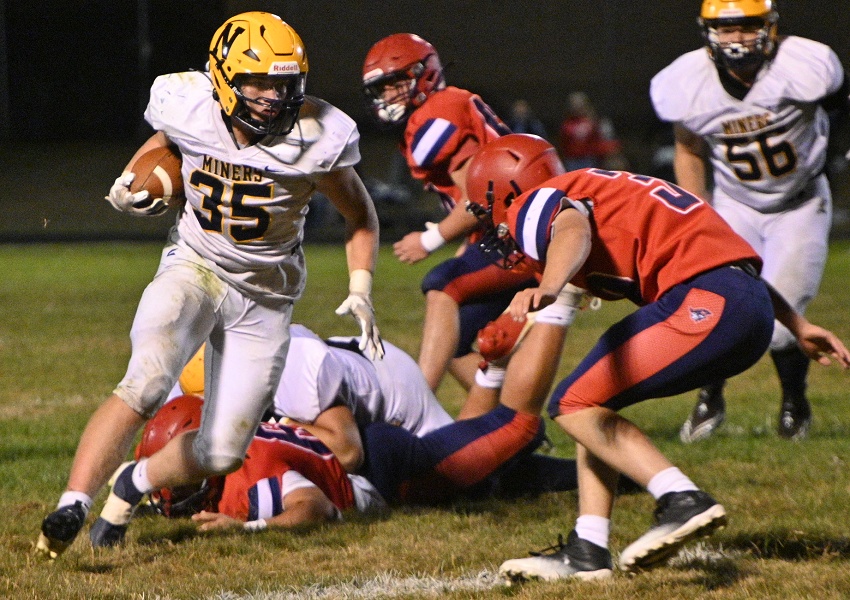
On the move Calumet 29, Houghton 0 The Copper Kings (3-3) broke a three-game losing streak and in doing so bumped up from No. 40 in Division 6 playoff-point average to No. 32. Manistique 33, West Iron County 0 The Emeralds will finish off the regular season with a pair of still-undefeated opponents and will get a nice bump from those matchups win or lose, but this one paid off big as well as they jumped six spots to No. 30 in Division 8 playoff-point average. Negaunee 42, Ishpeming Westwood 6 With a Week 4 loss to co-leader Kingsford, but co-leader Menominee coming up this week, Negaunee still has some hope for a share of the title in Western Peninsula Athletic Conference Copper – and if that doesn’t work out, wins like this one over Westwood (2-4) will continue to boost the Miners in Division 6. They currently rank No. 12 on that playoff-point average list, up two spots from last week.
West Michigan
HEADLINER Grand Rapids Catholic Central 42, Holland Christian 18 The Cougars may have made the Ottawa-Kent Conference Black title pursuit a two-team race by sending Holland Christian out of a tie for first and with co-leader Grand Rapids Northview up next for the Cougars (5-1). Holland Christian (5-1) also will see Northview, in Week 8, as it continues building its guaranteed best season since 2018. Click for more from the Grand Rapids Press.
Check out the highlights of Grand Rapids Catholic Central beating Holland Christian 42-17 on October 4th, 2024. @GRCC_CougarsFB improved to 5-1 on the season. Powered by @miarmyguard pic.twitter.com/rHjUDxXZx8
— STATE CHAMPS! Michigan (@statechampsmich) October 5, 2024
Watch list Zeeland East 22, Grand Rapids South Christian 15 The O-K Green is loaded and several other contenders have received a lot of the attention this fall. But the Chix (4-2) are right there as well, with this easily their most impressive win of the fall and a great way to push into the final two league games against Grand Rapids Forest Hills Central and leader Hudsonville Unity Christian. South Christian (4-2) has lost two straight after a strong start.
On the move Zeeland West 28, Grand Rapids Forest Hills Central 7 The Dux (5-1) bounced back after losing to Unity Christian in Week 5 and remain one game back in the Green with two league games to play. Rockford 34, Caledonia 14 Rockford (4-2) bounced back from its first back-to-back losses since 2018 by downing the Fighting Scots (4-2) to move back up to No. 15 in Division 1 playoff-point average. Grandville 33, East Kentwood 25 After opening with three losses, Grandville has three wins and the No. 22 spot in Division 1 playoff-point average thanks to a jump of 10 spots. East Kentwood (3-3) would be part of the field as well if the season ended today.
8-Player
HEADLINER Norway 40, Munising 28 The Great Lakes Eight Conference East has plenty of power with four of six teams .500 or better, and at the top are Norway and Pickford with the Knights (5-1) handing Munising (5-1) the latter’s first loss of the season. Circle Norway vs. Pickford in Week 8 as one of the biggest 8-player regular-season games of this fall. Click for more from the Iron Mountain Daily News.
Watch list Grand Rapids Sacred Heart 28, St. Joseph Our Lake of the Lake Catholic 20 Sacred Heart (6-0) emerged from one of its toughest tests of this program-defining season, the Falcons’ second overall and first playing a full varsity schedule. Our Lady (4-2) is one of five Sacred Heart opponents so far that sits at .500 or better.
On the move Mendon 66, Bellevue 42 Two strong offensive teams not surprisingly combined to score a lot of points, with Owen Gorham totaling 256 yards and six touchdowns rushing for Mendon (6-0) and Seth Keson running for two touchdowns, scoring a third on a kick return and throwing for two more for Bellevue (4-2). Fulton 60, Mount Pleasant Sacred Heart 33 The Pirates (5-1) have finished with winning seasons three of their four in 8-player football, and this has been their best start with this victory avenging a seven-point loss to the Irish (4-2) from a year ago. Marion 48, Suttons Bay 0 Marion (6-0) has won its games by an average of 38 points per, and this first shutout of the season came against one of its most successful opponents so far in the Norsemen (4-2).
MHSAA.com's weekly “1st & Goal” previews and reviews are powered by MI Student Aid, a division within the Department of Lifelong Education, Advancement, and Potential (MiLEAP). MI Student Aid encourages students to pursue postsecondary education by providing access to student financial resources and information. MI Student Aid administers the state’s scholarship and grant programs that help make college Accessible, Affordable and Attainable for you. Click to connect with MI Student Aid and find more information on Facebook and Twitter @mistudentaid.
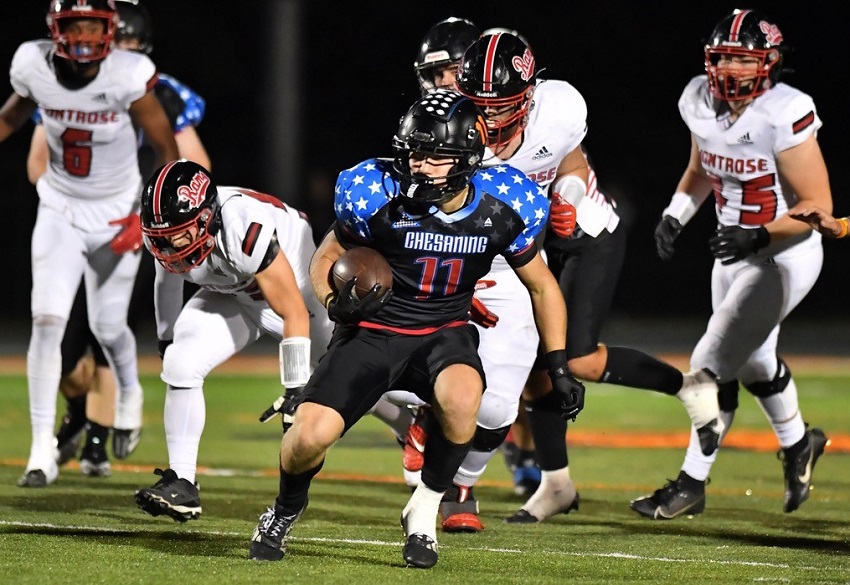
PHOTOS (Top) Fowler's Jacob Halfmann pulls away from a Pewamo-Westphalia defender Friday. (Middle) Chesaning's Brayden Florian (11) finds a seam during his team's 50-0 win over Montrose. (Below) c (Top photo by Jim Pivarnik. Chesaning/Montrose photo by Terry Lyons. Negaunee/Westwood photo by Cara Kamps.)