


NFHS Voice: Fall Fridays for HS Football
October 28, 2019
By Karissa Niehoff
NFHS Executive Director
Some of the top football matchups featuring Ohio teams Friday, Oct. 18, were Mentor vs. Shaker Heights, Cleveland St. Ignatius vs. Cincinnati Archbishop Moeller, Cincinnati St. Xavier vs. Massillon Washington and Northwestern vs. Ohio State.
That’s correct, Northwestern University vs. Ohio State University, on Friday night. While the game was in Evanston, Illinois, and not Columbus, it was televised on the Big Ten Network. Ohio State, one of the nation’s top-ranked college teams with one of the strongest fan bases, played on Friday night in direct competition with the several hundred high school games across the state.
And that wasn’t the only college football game on Friday night. There were three other FBS (I-A) matchups, including an Atlantic Coast Conference game between Pittsburgh and Syracuse. Through the first eight weeks of the season, there have been about 25 major college football games on Friday night.
A number of high schools in Ohio moved their games earlier in the hope of finishing before the start of the Ohio State-Northwestern game. Others moved their games to Thursday or Saturday. At least one school – Ursuline Academy in greater Cincinnati – urged its fans to not watch the Ohio State game:
“Please make a statement to Ohio State by NOT watching their Friday night game this week. Friday nights are for HS football. Let’s keep it that way. Support your local team. We play Boardman, and would love to have you in our stands, but that’s not the point. Support HS football.”
High schools should not have to adjust their schedules to accommodate colleges playing on Friday nights. High school coaches, administrators and fans are opposed to colleges playing on Friday nights. The NFHS and its member state associations are opposed. Even leaders in the Ohio State administration did not initially support the idea of the Buckeyes playing on Friday night. Friday nights are for high school football and should remain that way.
Two years ago, the NFHS membership adopted the following resolution:
“Be it RESOLVED that every Friday night during the fall in America is ‘High School Football Night.’
“Be it FURTHER RESOLVED that college and professional football teams should refrain from scheduling contests on Friday nights. Such restraint would be an investment in their own future success. It would also demonstrate that high school football has value well beyond the field of play. Schools, communities and scholastic teams for girls and boys all benefit when football is strong.
“THEREFORE, the National Federation of State High School Associations urges all parties to observe the central premise of this resolution.”
In addition to the Big Ten Conference, teams in the Pac-12, Mountain West, Atlantic Coast and American conferences, as well as Conference USA, have played on Friday nights. When these current television contracts expire, it is the desire of everyone within the high school community that new deals would preserve Friday nights for high school football.
Friday nights offer communities a traditional time and place to congregate and support their students. As was the case last week in Ohio, a college game on Friday night impacts interest and attendance at high school games.
Let’s maintain Friday nights in the fall for high school football. It is a win-win for everyone.
Dr. Karissa L. Niehoff is in her second year as executive director of the National Federation of State High School Associations (NFHS) in Indianapolis, Indiana. She is the first female to head the national leadership organization for high school athletics and performing arts activities and the sixth full-time executive director of the NFHS, which celebrated its 100th year of service during the 2018-19 school year. She previously was executive director of the Connecticut Association of Schools-Connecticut Interscholastic Athletic Conference for seven years.
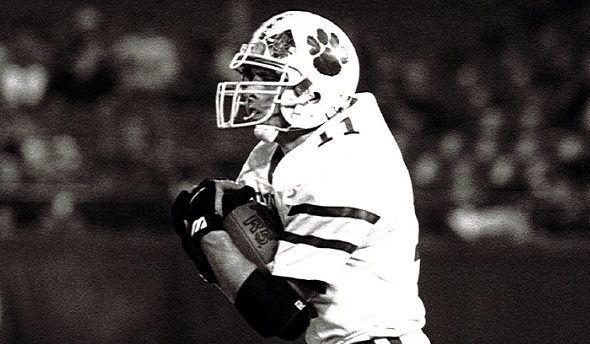
Moment: 100-Yard TD Lifts Pennfield
September 17, 2020
By John Johnson
MHSAA Director of Broadcast Properties
NOTE: This week we begin a series of MHSAA Moments from Football Playoff Finals of years past. Over the coming weeks, we’ll offer video highlights including some of the longest plays and game-deciding moments from 1988 to the present.
In high school football, there are only two plays where you can score a 100-yard touchdown – both by the defense bringing the ball out of the end zone on a turnover.
For Battle Creek Pennfield in the 1991 Class CC Football Playoff Final at the Pontiac Silverdome, such a big defensive play got the Panthers out of the hole in a 14-8 victory over Negaunee.
A bad snap on a Pennfield punt resulted in a safety for a 2-0 Miners lead in the first quarter, and they had driven into the red zone after the ensuing free kick. But on a fourth-down play, the Cereal City contingent came up big.
Negaunee quarterback Ron Logan rolled left and threw to the end zone, where Pennfield linebacker Jason Livengood stepped in front of the intended receiver for the interception. Two yards deep in the end zone, Livengood found an alley and was off to the races for a 100-yard return. (High school statistics rules do not count end zone yardage.)
“I couldn’t believe it,” Livengood told the Battle Creek Enquirer after the game. “All I had to do was fake one guy and then it was open the rest of the way.”
The big play steadied the Panthers after their shaky start.
“It showed us we could do something,” running back Jim Martens told the Enquirer. “We needed a stop and we got more than that. We got six points.”
Still, the Panthers had to come up with a big drive in the third quarter – 67 yards in 17 plays taking 9:58 off the clock, with three fourth-down conversions – to take the lead to stay on Martens’ five-yard scoring run.
Negaunee mounted a drive from its own 37 to the Pennfield 18 during the final two minutes of the game. But after they completed a pass to the 11, the clock ran out on the Miners.