

NFHS Voice: Fall Fridays for HS Football
October 28, 2019
By Karissa Niehoff
NFHS Executive Director
Some of the top football matchups featuring Ohio teams Friday, Oct. 18, were Mentor vs. Shaker Heights, Cleveland St. Ignatius vs. Cincinnati Archbishop Moeller, Cincinnati St. Xavier vs. Massillon Washington and Northwestern vs. Ohio State.
That’s correct, Northwestern University vs. Ohio State University, on Friday night. While the game was in Evanston, Illinois, and not Columbus, it was televised on the Big Ten Network. Ohio State, one of the nation’s top-ranked college teams with one of the strongest fan bases, played on Friday night in direct competition with the several hundred high school games across the state.
And that wasn’t the only college football game on Friday night. There were three other FBS (I-A) matchups, including an Atlantic Coast Conference game between Pittsburgh and Syracuse. Through the first eight weeks of the season, there have been about 25 major college football games on Friday night.
A number of high schools in Ohio moved their games earlier in the hope of finishing before the start of the Ohio State-Northwestern game. Others moved their games to Thursday or Saturday. At least one school – Ursuline Academy in greater Cincinnati – urged its fans to not watch the Ohio State game:
“Please make a statement to Ohio State by NOT watching their Friday night game this week. Friday nights are for HS football. Let’s keep it that way. Support your local team. We play Boardman, and would love to have you in our stands, but that’s not the point. Support HS football.”
High schools should not have to adjust their schedules to accommodate colleges playing on Friday nights. High school coaches, administrators and fans are opposed to colleges playing on Friday nights. The NFHS and its member state associations are opposed. Even leaders in the Ohio State administration did not initially support the idea of the Buckeyes playing on Friday night. Friday nights are for high school football and should remain that way.
Two years ago, the NFHS membership adopted the following resolution:
“Be it RESOLVED that every Friday night during the fall in America is ‘High School Football Night.’
“Be it FURTHER RESOLVED that college and professional football teams should refrain from scheduling contests on Friday nights. Such restraint would be an investment in their own future success. It would also demonstrate that high school football has value well beyond the field of play. Schools, communities and scholastic teams for girls and boys all benefit when football is strong.
“THEREFORE, the National Federation of State High School Associations urges all parties to observe the central premise of this resolution.”
In addition to the Big Ten Conference, teams in the Pac-12, Mountain West, Atlantic Coast and American conferences, as well as Conference USA, have played on Friday nights. When these current television contracts expire, it is the desire of everyone within the high school community that new deals would preserve Friday nights for high school football.
Friday nights offer communities a traditional time and place to congregate and support their students. As was the case last week in Ohio, a college game on Friday night impacts interest and attendance at high school games.
Let’s maintain Friday nights in the fall for high school football. It is a win-win for everyone.
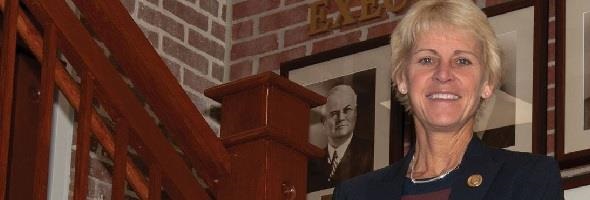
Dr. Karissa L. Niehoff is in her second year as executive director of the National Federation of State High School Associations (NFHS) in Indianapolis, Indiana. She is the first female to head the national leadership organization for high school athletics and performing arts activities and the sixth full-time executive director of the NFHS, which celebrated its 100th year of service during the 2018-19 school year. She previously was executive director of the Connecticut Association of Schools-Connecticut Interscholastic Athletic Conference for seven years.
This Week In High School Sports: 3/13/20
March 12, 2020
This week’s show tells of how fun fueled Hudson to the Division 4 competitive cheer championship, presents Game Balls to Mason's girls bowling team and Traverse City Christian bowler Hunter Haldaman, offers a basketball "You Make the Call" and explains why attending MHSAA Finals is a family tradition worth starting.
The 5-minute program, powered by MI Student Aid, leads off each week with feature stories from around the state from the MHSAA’s Second Half or network affiliates. "Be The Referee," a 60-second look at the fine art of officiating, comes in the middle of the show and is followed by a closing MHSAA "Perspective."
Listen to this week's show by Clicking Here.
Past editions
March 6: Clinton wrestling's first championship, U.P. boys basketball scoring legends - Listen
Feb. 28: Battle of the Fans IX champion, MHSAA Basketball Finals buzzer beaters - Listen
Feb. 21: Carson City-Crystal wrestler Jamison Ward, District basketball seeding - Listen
Feb. 14: Farmington United gymnast Elena Vargo, Kansas City multi-sport star Patrick Mahomes - Listen
Feb. 7: Trenton swimmer Michael Wolsek, need for women in leadership positions in athletics - Listen
Jan. 31: Utica Ford bowling's Kensington Holland, winter lessons on civility - Listen
Jan. 24 White Pigeon multi-sport standout Claycee West, 2020 Youth Football Forum - Listen
Jan. 17: Promoting and protecting youth football, amateurism in educational athletics - Listen
Jan. 10: Livonia Stevenson hockey's Seth Lause, multi-media and social media impacts - Listen
Dec. 27: Mona Shores "Sailor Nation" life-saving success - Listen
Dec. 20: Battle of the Fans IX, details on purchasing Finals broadcasts - Listen
Dec. 13: Port Huron United hockey, what matters most in high school sports - Listen
Dec. 6: Highlights from 2019 11-Player Football Finals, instant replay in review - Listen
Nov. 29: Highlights from 2019 8-Player Football, Girls Volleyball and Girls Swimming & Diving Finals - Listen
Nov. 22: Ida volleyball record-setter Taylor Wegener, new Football Finals video review - Listen
Nov. 15: Reading lineman Nick Affholter, coaches as leaders in sportsmanship - Listen
Nov. 8: Lower Peninsula Cross Country and Boys Soccer Finals highlights - Listen
Nov. 1: Muskegon Orchard View football, bolstered MHSAA broadcast schedule - Listen
Oct. 25: Grand Rapids NorthPointe Christian girls golf, MHSAA Football Playoff selection - Listen
Oct. 18: Mendon volleyball's title drive, recognition for longtime announcer Erik O. Furseth - Listen
Oct. 11: Negaunee cross country's Emily Paupore, MHSAA mental health awareness efforts - Listen
Oct. 4: South Lyon soccer's Josh Mason, improving youth football - Listen
Sept: 27: Utica Eisenhower golfer Ariel Chang, adult fan behavior - Listen
Sept: 20: Pinckney football inspiration, decisions made at the local level - Listen
Sept. 13: Muskegon's offensive line, soccer substitution rule change - Listen
Sept. 6: Jenison girls golf's inspiration, new football practice contact restrictions - Listen
Aug. 30: St. Johns quarterback-now-coach Andy Schmitt, benefits of a multi-sport experience - Listen