

North Central's Jets Take Off in 8-player
October 1, 2015
By Dennis Grall
Special for Second Half
POWERS – Fielding Yost and his "Point-A-Minute" University of Michigan football powerhouse of more than a century ago had nothing on the supersonic Jets of Powers North Central.
In their first season of 8-player football, the Menominee County team is averaging a meteoric 73.6 points a game during a 5-0 start. The Jets, who play Eben Junction Superior Central on Saturday, have outscored their opponents 368-70.
 This team is playing at a level not seen in Powers since, well, last March when the boys basketball team won the Class D championship with a 27-0 record. Six members of that team, led by all-state basketball guard and quarterback Jason Whitens, play football.
"When you are winning and you are playing good, it is always fun," said Whitens, a junior who was a wide receiver/defensive back on last season's 3-5 team. "When you come to practice, it is nice to know what it feels like (to win)."
In both sports, Whitens has the ability to adjust and adapt as the game situation dictates. "It is nice to know you can change what you want and get the best possible result," he said.
Coach Kevin Bellefeuil, in his 11th season during a tenure that includes four winning seasons and one postseason victory, said the transition from 11-player to 8 has been seamless and timely.
The Jets have been battling small football turnouts for years, with as few as 13 players available a few seasons ago. This year there are 18 players, which enables full-scale scrimmages under the 8-player version.
"In reality, we're just this little school of 120 kids," Bellefeuil said, noting more students came out for football this season with the change to the 8-player game. The shift also allowed the Jets to retain a junior varsity program, which is playing seven games under the 11-player format and the final two in the 8-player version.
Football began in 1972 at North Central, and the program has just 23 winning seasons. Of those, only nine ended with two or fewer losses, including a 9-0 run in 1980.
Athletic director Joe Pontbriand said, "there were two keys" to installing the 8-player game: number of participants and maintaining a jayvee program. "I think the process is working," he said.
"It becomes unhealthy," Pontbriand said of the injury factor caused in part by fatigue that occurs with small numbers of athletes trying to play 11-player football. "It is not all about winning. Eleven-man with no numbers means a long season."
 Bellefeuil said the jayvees haven't played more than three games in any of the past five years, noting several players have been elevated to varsity to replace injured players.
The Jets use basically the same offense this season. Rob Granquist, now the starting quarterback for Concordia University in Chicago, earned all-Upper Peninsula Class D honors last season. Whitens this season has completed 42 of 53 passes for 939 yards and 17 touchdowns while directing a ground attack that has gained 1,297 yards in 129 attempts for a whopping 9.88 average.
The Jets have scored on every offensive possession in the first half this season, a staggering statistic. "The first half of a game we're pretty much 50-50 (run-pass)," said Bellefeuil, noting it is run-oriented in the running clock second half.
Bellefeuil, who calls the plays, indicated the Jets likely would be using more no-huddle offense this season to take advantage of their speed and overall athleticism. He said only five players would be considered linemen.
"We run the same things we have done before," said Bellefeuil. "We play the pistol, shotgun offense. It is a lot of fun calling plays. Having the kind of athletes we have, we can move in-and-out and out-and-in, whatever we want.
"We just dropped the tackles and the slot receiver for eight-man. It has not been different from what we did already. It has not been much of a transition."
Whitens said "we're having a lot of fun. We are all enjoying it."
Senior captain and tight end Brett Baird, who only plays football, said he enjoys the 8-player game more. "Once you get through the first two weeks and know the plays and how everything works, it is just football."
He said the 11-player game is harder because "there are a lot more linemen and there are bigger guys. The eight-man game has more (playing) room. There are strengths and weaknesses both ways. Football is football; it doesn't matter."
The 8-player game is a better fit for the Jets because now they are playing comparable-sized teams and schools. Under the 11-player version the Class D school had games against such Class C opponents as Norway, Manistique, Munising and Newberry.
 The change has also been beneficial for the students. Bellefeuil said Morgan Cox, a tight end-defensive end who also plays basketball, has embraced the new format and gained confidence and maturity this year after the MHSAA title run in basketball. "Now he is one of the guys out in front for the drills. He is definitely a leader," said Bellefeuil.
"We talked about going eight-man for a couple of years," he added, noting now the Jets do not have to elevate freshmen or sophomores to the varsity. "You are asking 14-15 year old kids to tackle 18-19 year old kids. They were not ready for that, and it is dangerous."
He said practice does not "seem like drudgery to them" under 8-player football. "They like playing the football brand of basketball they play because it is familiar to them," noting the fast-break basketball style and up-tempo football approach.
Having more depth allows the Jets to have fresh players available for more plays, which also fits the up-tempo style. "Now we get to play all of our kids and we wear teams out, like teams used to wear us out," said Bellefeuil. "A lot of injuries happen when you are tired and fatigued."
Although the Jets are having success in their first season of 8-player, Pontbriand admits the change has not been totally accepted in the school district.
"Not everyone is buying in, but we have to do what is best for the kids," he said. "The varsity team has really bought in."
The carryover from the phenomenal basketball season has also been important. "Carrying that attitude and enthusiasm over to the grass sport can be a deadly combination," Pontbriand said. "Those six kids (from basketball) are born leaders, and the other kids who sit in the front row cheering section now get to be part of that on the front line.
"It definitely sets a tone" in the classroom and community, he said of that success to start the school year. "It builds confidence and gives the kids a sense of entitlement and a chance to succeed. If you're the best on the field, you want to be the best in the classroom."
 Denny Grall retired in 2012 after 39 years at the Escanaba Daily Press and four at the Green Bay Press-Gazette, plus 15 months for WLST radio in Escanaba; he served as the Daily Press sports editor from 1970-80 and again from 1984-2012. Grall was inducted into the Upper Peninsula Sports Hall of Fame in 2002 and serves as its executive secretary. E-mail him at [email protected] with story ideas for the Upper Peninsula.
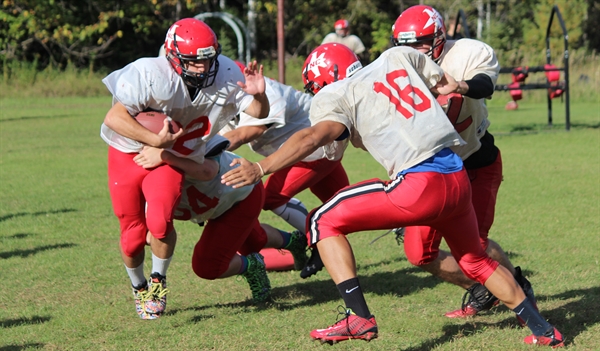
PHOTOS: (Top) Members of the North Central football team go through blocking and tackling drills at practice Wednesday in Powers. (Middle) North Central football coach Kevin Bellefeuil indicates a pass route he wants his receivers to take. (Below) Like North Central's helmets indicate, the Jets are flying high in their first season of 8-player, off to a 5-0 start while averaging 73.6 points a game. (Photos by Denny Grall.)
Drive for Detroit: Week 9 in Review
October 25, 2016
By Geoff Kimmerly
Second Half editor
The MHSAA football playoffs are upon us. From 617 teams that began this season, we’re down to watching our final 272.
But before we get too far ahead, there’s plenty to review from the final week of the regular season – including a number of upsets that altered the playoff field and brackets created Sunday.
Bay & Thumb
Fenton 28, Linden 21
The Tigers (7-2) scored with three minutes to play to move past Linden (6-3) for good and claim an outright Flint Metro League championship; a Linden win would’ve created a three-way tie for the title with these two and Ortonville Brandon. Fenton has won 29 straight league games and opened this season with two nonleague losses. Click for more from the Flint Journal.
Also noted:
Lapeer 24, Flint Carman-Ainsworth 14 – Carman-Ainsworth (6-3) won the Saginaw Valley League Blue and Lapeer was only second in the Red, but the Lightning (7-2) did remain undefeated in their three-year series with the Cavaliers.
Freeland 7, Frankenmuth 3 – The Tri-Valley Conference Central champion Falcons (9-0) made it three wins in two years over TVC East winner Frankenmuth (8-1), with a chance they could meet again in a Division 5 District Final.
Pinconning 20, Whittemore-Prescott 6 – The Spartans (6-3) claimed their first playoff berth since 2009, which also was their last season with a winning record; Whittemore-Prescott (5-4) did still make the postseason with an at-large bid.
Saginaw Michigan Lutheran Seminary 24, New Lothrop 20 – The Cardinals (7-2) got a major boost heading into the playoffs, handing New Lothrop (8-1) its first regular-season loss since 2009.
Greater Detroit
Detroit Catholic Central 17, Orchard Lake St. Mary’s 14
The last 11-player game of Michigan’s high school regular season had drama right until the end. The undefeated Shamrocks (9-0) were less than a minute from falling to St. Mary’s (5-4) in a Prep Bowl A-B Final rematch of the Detroit Catholic League Central first and second-place teams this fall. DCC scored with 21 seconds remaining for its second win over the Eaglets in three weeks after losses to them the last two seasons. Click for more from the Detroit News.
Also noted:
Bloomfield Hills 21, Lake Orion 0 – The 4-year-old Black Hawks (9-0) bounced back from 1-8 last season to win the Oakland Activities Association Blue title and make the playoffs for the first time; Lake Orion (5-4) did earn an at-large bid with four losses to teams that are a combined 27-9.
Detroit Cass Tech 41, Detroit Martin Luther King 20 – The Technicians (9-0) finished off another tremendous regular season with a second win over Martin Luther King (7-2), this time in the Public School League I final at Ford Field; Cass Tech has beaten all opponents by at least 13 points.
Detroit Denby 8, Detroit Mumford 0 – The Tars (8-1) guaranteed their best record since 2006 and claimed a PSL I/II championship by handing Mumford (7-2) its first loss since opening night.
Dearborn Divine Child 35, Detroit Loyola 24 – The Falcons (7-2) had lost seven times to Loyola (7-2) over the last five seasons including 34-24 in Week 5, but came back to break the streak in the Catholic League Prep Bowl.
Mid-Michigan
Williamston 38, Lake Fenton 35
Williamston needed to win its final regular-season game and some help to earn an at-large bid to the playoffs – but really helped itself by upsetting previously-undefeated Lake Fenton (8-1). A late defensive stand kept the Hornets (5-4) in the playoff mix, and they were selected to the field after missing at 4-5 a year ago. Lake Fenton, meanwhile still finished two wins better than 2015. Click for more from the Tri-City Times.
Also noted:
Holt 30, Grand Ledge 20 – The Rams (5-4) missed the playoffs by one spot among at-large teams from Class A, but the rebounding program can go into the offseason having handed Grand Ledge (6-1) the latter’s only loss in the Capital Area Activities Conference Blue.
Ionia 35, Lake Odessa Lakewood 30 – The Bulldogs (4-5) mostly struggled in league play, but started this season with two wins and ended with two straight including this upset of longtime rival and Greater Lansing Activities Conference champion Lakewood (8-1)
Lansing Catholic 42, Monroe St. Mary Catholic Central 20 – The Cougars (8-1) won their fifth straight, good momentum for this week’s matchup with reigning Division 5 champion Grand Rapids West Catholic, and also might have eliminated SMCC (4-5).
Fowler 27, Merrill 14 – The Eagles (6-3) continued their string of eight straight playoff berths by holding Merrill (6-3) to its second-fewest points this season.
Northern Lower Peninsula
Traverse City St. Francis 22, Boyne City 0
St. Francis (9-0) repeated as Northern Michigan Football Conference Legends champion with a second straight shutout and by ending a six-game winning streak by runner-up Boyne City (6-3). It was the second straight season this matchup determined the league title winner. The Gladiators have won 22 straight regular-season games. Click for more from the Traverse City Record-Eagle.
Also noted:
Frankfort 46, Onekama 20 – The Portagers (9-0) completed their first perfect regular season since 2004 and an outright title in the NMFC Leaders by avoiding a spoiler attempt by Onekama (6-3).
Traverse City Central 49, Cadillac 6 – Central (8-1) bounced back from a Week 8 triple-overtime loss to Birmingham Brother Rice to finish a Big North Conference championship run against third-place Cadillac (6-3).
Grayling 34, Kalkaska 27 – The Vikings (6-3) clinched a seventh playoff berth in eight seasons but only after edging the playoff-bound Blazers (6-3), who are in for the first time since 2013.
Hillman 32, Indian River Inland Lakes 29 – By the slimmest of margins, Hillman (5-4) was able to extend its playoff streak to 11 seasons, earning an at-large bid with five wins over the last six games.
Southeast & Border
Saline 38, Birmingham Groves 3
The Hornets further strengthened their status as a Division 1 championship contender, winning big in a matchup of undefeated teams. Saline (9-0) completed its second straight perfect regular season with its second-best defensive performance this fall, holding Groves (8-1) to the latter's fewest points in a game since 2013. Click for more from the Ann Arbor News.
Also noted:
Grass Lake 43, Springport 27 – The Warriors (8-1) got clipped by Michigan Center in Week 8, but came back to down Springport (7-2) in the Big 8/Cascades Conference championship game.
Ottawa Lake Whiteford 38, Clinton 12 – The Bobcats (9-0) completed their first perfect regular season since 1965 and an outright Tri-County Conference title by sending fourth-place Clinton to 6-3.
Napoleon 25, Concord 20 – The Pirates (7-2) have won seven straight to guarantee their best finish since 2002, first winning season since 2006 and first playoff berth since 2005; Concord also finished the regular season 7-2.
Morenci 42, Adrian Madison 7 – The Bulldogs (6-3) have three losses by a combined eight points, but are back in the playoffs for the third straight season after ending any chance for Madison (4-5).
Southwest Corridor
Portage Central 24, St. Joseph 14
Portage Central (8-1) secured the Southwestern Michigan Athletic Conference West championship outright after these teams shared the title in 2015. The Mustangs took a 14-0 lead late into the third quarter and extended it to 17 in the fourth before St. Joseph (6-3) added a late score. Portage Central hasn’t lost more than once during a regular season since 2012, building a record of 35-6 over the last four years.
Also noted:
Benton Harbor 54, Muskegon Heights Academy 6 – This is worth mention because it gave the Tigers (9-0) their first undefeated regular season since going 7-0-2 in 1962.
Three Rivers 14, Vicksburg 13 – The Wildcats (7-2) added to their comeback from 3-6 a year ago by just edging Vicksburg (7-2) to tie the Bulldogs for second in the Wolverine Conference.
Coldwater 31, Traverse City West 14 – The Cardinals (7-2) continued a nice run after their one-point loss in Week 6, sending West (6-3) home with a defeat.
Battle Creek Pennfield 22, Olivet 19 – Pennfield (5-4) got the needed boost from beating Olivet (5-4) to earn an at-large playoff berth after seasons of 2-7 in 2014 and 3-6 in 2015.
Upper Peninsula
St. Ignace 62, Newberry 20
The Saints (8-1) made another argument as the top 11-player title contender from the Upper Peninsula with a dominating performance against Mid-Eastern Conference runner-up Newberry (7-2). St. Ignace won the NMFC Legacy title this fall, and its only loss was to reigning Division 8 champion Muskegon Catholic Central, 21-6. Those two could meet again in a Semifinal next month. Click for more from 9&10 News.
Also noted:
Gwinn 38, Ishpeming 6 – With its first winning record since 2000, Gwinn (6-3) clinched its first playoff berth since 1999 while guaranteeing Ishpeming (3-5) wouldn’t be in the playoffs for the first time since 2001.
Escanaba 49, Kingsford 42 – The Eskymos (7-2) secured their best record since 2011 despite losing by a point in Week 8 and ended up locking up a home playoff game by getting past also playoff-bound Kingsford (6-3).
Felch North Dickinson 56, Bark River-Harris 24 – This is reportedly the last season of 11-player for the Nordics (6-3), but they’re going out on a high note after earning their first playoff berth since 2013 with four wins over their last five games.
Iron Mountain 28, Norway 7 – Four of six Mid-Peninsula Athletic Conference teams made the playoffs, including these two both at 7-2 for the regular season.
West Michigan
Hudsonville 14, Rockford 7
The Eagles (8-1) bounced back after a Week 4 loss to Grandville to win four straight in commanding fashion and earn the opportunity to take a share of the Ottawa-Kent Conference Red title in Week 9. Hudsonville finished the run with a late score on Rockford that created a three-way share of the championship with the Rams (6-3) and Grandville – and the Eagles also cemented home-field advantage through a District that includes both, with Rockford up again this week. Click for more from the Grand Rapids Press.
Also noted:
Allendale 30, Grand Rapids West Catholic 27 – Allendale’s first win over West Catholic since 2008 created a three-way championship in the O-K Blue between those two (both 7-2 overall) and Grand Rapids Catholic Central (8-1).
Byron Center 40, Hudsonville Unity Christian 19 – The Bulldogs (8-1) finished their O-K Green title by sending Unity Christian (7-2) into a tie for second in a league that will send five of seven teams to the playoffs.
Grand Rapids Forest Hills Northern 27, Greenville 16 – Scheduling tough does matter; Forest Hills Northern (5-4) was 0-4 against teams with winning records heading into Week 9 but earned an at-large bid thanks in part to this victory over also playoff-bound Greenville (5-4).
Whitehall 37, Battle Creek Harper Creek 30 – The Vikings (6-3) came back from two straight one-point losses Weeks 6 and 7 to get into the playoffs for the third season in a row; Harper Creek (7-2) is headed back after going 3-6 last season.
8-Player
Powers North Central 68, Stephenson 32
The reigning MHSAA champ Jets (9-0) finished their Western Eight Conference run and moved into the top seed in 8-player with a solid boost from beating third-place Stephenson (7-2). North Central is only a little behind the pace of its incredible numbers from a year ago – the Jets are outscoring opponents on average 69-17, and Stephenson was the first to score more than 18 since Week 3. Click for more from the Marinette EagleHerald.
Also noted:
Lawrence 22, Battle Creek St. Philip 14 – The final game to finish in 8-player over the weekend saw Lawrence (8-1) come back from two losses last season to St. Philip (5-4) to knock the reigning MHSAA runner-up out of the playoff mix.
Camden-Frontier 44, Waldron 18 – The Redskins (6-1) played their way into the playoffs after two straight 0-9 finishes by getting a key win over Waldron (4-5).
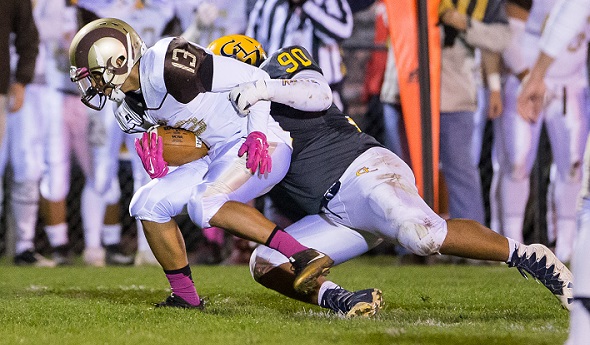
PHOTO: Holt over Grand Ledge was one of a number of upsets during Week 9 of the football regular season. (Click to see more from HighSchoolSportsScene.com.)