

North Central's Jets Take Off in 8-player
October 1, 2015
By Dennis Grall
Special for Second Half
POWERS – Fielding Yost and his "Point-A-Minute" University of Michigan football powerhouse of more than a century ago had nothing on the supersonic Jets of Powers North Central.
In their first season of 8-player football, the Menominee County team is averaging a meteoric 73.6 points a game during a 5-0 start. The Jets, who play Eben Junction Superior Central on Saturday, have outscored their opponents 368-70.
 This team is playing at a level not seen in Powers since, well, last March when the boys basketball team won the Class D championship with a 27-0 record. Six members of that team, led by all-state basketball guard and quarterback Jason Whitens, play football.
"When you are winning and you are playing good, it is always fun," said Whitens, a junior who was a wide receiver/defensive back on last season's 3-5 team. "When you come to practice, it is nice to know what it feels like (to win)."
In both sports, Whitens has the ability to adjust and adapt as the game situation dictates. "It is nice to know you can change what you want and get the best possible result," he said.
Coach Kevin Bellefeuil, in his 11th season during a tenure that includes four winning seasons and one postseason victory, said the transition from 11-player to 8 has been seamless and timely.
The Jets have been battling small football turnouts for years, with as few as 13 players available a few seasons ago. This year there are 18 players, which enables full-scale scrimmages under the 8-player version.
"In reality, we're just this little school of 120 kids," Bellefeuil said, noting more students came out for football this season with the change to the 8-player game. The shift also allowed the Jets to retain a junior varsity program, which is playing seven games under the 11-player format and the final two in the 8-player version.
Football began in 1972 at North Central, and the program has just 23 winning seasons. Of those, only nine ended with two or fewer losses, including a 9-0 run in 1980.
Athletic director Joe Pontbriand said, "there were two keys" to installing the 8-player game: number of participants and maintaining a jayvee program. "I think the process is working," he said.
"It becomes unhealthy," Pontbriand said of the injury factor caused in part by fatigue that occurs with small numbers of athletes trying to play 11-player football. "It is not all about winning. Eleven-man with no numbers means a long season."
 Bellefeuil said the jayvees haven't played more than three games in any of the past five years, noting several players have been elevated to varsity to replace injured players.
The Jets use basically the same offense this season. Rob Granquist, now the starting quarterback for Concordia University in Chicago, earned all-Upper Peninsula Class D honors last season. Whitens this season has completed 42 of 53 passes for 939 yards and 17 touchdowns while directing a ground attack that has gained 1,297 yards in 129 attempts for a whopping 9.88 average.
The Jets have scored on every offensive possession in the first half this season, a staggering statistic. "The first half of a game we're pretty much 50-50 (run-pass)," said Bellefeuil, noting it is run-oriented in the running clock second half.
Bellefeuil, who calls the plays, indicated the Jets likely would be using more no-huddle offense this season to take advantage of their speed and overall athleticism. He said only five players would be considered linemen.
"We run the same things we have done before," said Bellefeuil. "We play the pistol, shotgun offense. It is a lot of fun calling plays. Having the kind of athletes we have, we can move in-and-out and out-and-in, whatever we want.
"We just dropped the tackles and the slot receiver for eight-man. It has not been different from what we did already. It has not been much of a transition."
Whitens said "we're having a lot of fun. We are all enjoying it."
Senior captain and tight end Brett Baird, who only plays football, said he enjoys the 8-player game more. "Once you get through the first two weeks and know the plays and how everything works, it is just football."
He said the 11-player game is harder because "there are a lot more linemen and there are bigger guys. The eight-man game has more (playing) room. There are strengths and weaknesses both ways. Football is football; it doesn't matter."
The 8-player game is a better fit for the Jets because now they are playing comparable-sized teams and schools. Under the 11-player version the Class D school had games against such Class C opponents as Norway, Manistique, Munising and Newberry.
 The change has also been beneficial for the students. Bellefeuil said Morgan Cox, a tight end-defensive end who also plays basketball, has embraced the new format and gained confidence and maturity this year after the MHSAA title run in basketball. "Now he is one of the guys out in front for the drills. He is definitely a leader," said Bellefeuil.
"We talked about going eight-man for a couple of years," he added, noting now the Jets do not have to elevate freshmen or sophomores to the varsity. "You are asking 14-15 year old kids to tackle 18-19 year old kids. They were not ready for that, and it is dangerous."
He said practice does not "seem like drudgery to them" under 8-player football. "They like playing the football brand of basketball they play because it is familiar to them," noting the fast-break basketball style and up-tempo football approach.
Having more depth allows the Jets to have fresh players available for more plays, which also fits the up-tempo style. "Now we get to play all of our kids and we wear teams out, like teams used to wear us out," said Bellefeuil. "A lot of injuries happen when you are tired and fatigued."
Although the Jets are having success in their first season of 8-player, Pontbriand admits the change has not been totally accepted in the school district.
"Not everyone is buying in, but we have to do what is best for the kids," he said. "The varsity team has really bought in."
The carryover from the phenomenal basketball season has also been important. "Carrying that attitude and enthusiasm over to the grass sport can be a deadly combination," Pontbriand said. "Those six kids (from basketball) are born leaders, and the other kids who sit in the front row cheering section now get to be part of that on the front line.
"It definitely sets a tone" in the classroom and community, he said of that success to start the school year. "It builds confidence and gives the kids a sense of entitlement and a chance to succeed. If you're the best on the field, you want to be the best in the classroom."
 Denny Grall retired in 2012 after 39 years at the Escanaba Daily Press and four at the Green Bay Press-Gazette, plus 15 months for WLST radio in Escanaba; he served as the Daily Press sports editor from 1970-80 and again from 1984-2012. Grall was inducted into the Upper Peninsula Sports Hall of Fame in 2002 and serves as its executive secretary. E-mail him at [email protected] with story ideas for the Upper Peninsula.
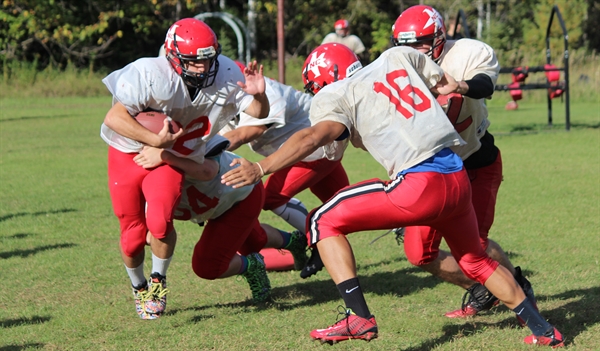
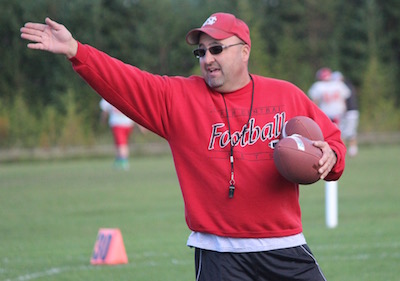
PHOTOS: (Top) Members of the North Central football team go through blocking and tackling drills at practice Wednesday in Powers. (Middle) North Central football coach Kevin Bellefeuil indicates a pass route he wants his receivers to take. (Below) Like North Central's helmets indicate, the Jets are flying high in their first season of 8-player, off to a 5-0 start while averaging 73.6 points a game. (Photos by Denny Grall.)
Western's White Enjoys 'Special' Career
By
Tom Markowski
Special for Second Half
May 4, 2016
WALLED LAKE – Seeking a higher level of performance, many high school athletes have channeled their energy to one sport.
 Many refer to this concentration as specialization – and Cody White, for one, isn’t buying it.
White, a junior at Walled Lake Western, is a three-sport athlete and he loves every minute of it. He plays basketball during the winter, baseball in the spring and football in the fall. During the summer he competes in AAU basketball, travel baseball, 7-on-7 football games with his Western teammates, and he participates in a few summer football camps.
White has played these same sports all throughout high school. His freshman year he competed in track and field, along with baseball. White hasn’t ruled out returning to track and field, in addition to baseball, as a senior – but this season he’s sticking with just baseball.
It’s a hectic schedule but, again, White wouldn’t have it any other way.
“I couldn’t see myself not competing in those sports,” he said. “I love them so much. I want to finish my senior year playing all three.”
White estimates that he’ll have two days off, away from sports, in June. In July he’ll take a week off, between his summer baseball team schedule ending and the start of football practice.
There’s no question White is driven, but it’s more than that. In some high schools, and with some coaches, playing multiple sports can be a challenge. There are some coaches who would prefer the students to play one sport and only one sport.
According to Western football coach Mike Zdebski, that isn’t the case at his school.
“We encourage them to play more than one sport,” Zdebski said. “For one, we want them to get their money’s worth. We have a pay-to-play policy of $425. You play one sport and it costs $425. You play three sports and it costs the same. And, two, playing other sports helps them develop other skills. In basketball you create space. In baseball you chase fly balls, and that helps with depth perception. Besides you get to work with other coaches and other teams.
“We’re lifting weights during the summer. If a kid is playing summer baseball or AAU basketball, if they have time they can come by and lift weights. And what we always tell them, if you’re tired let us know. You can take a break.”
Zdebski – whose team finished 12-1 last fall – was quick to point out some excellent athletes in the past, like former Kansas City Royals outfielder/Oakland Raiders running back Bo Jackson, who were multiple-sport athletes. And, more recently, there’s Luke Glendenning of the Detroit Red Wings. Glendenning was an all-state running back at East Grand Rapids.
 When his high school career is done, White will play football in college. Two months ago he committed to sign with Michigan State this winter. At 6-foot-3 and 200 pounds, White played receiver, defensive back and also returned kicks last fall. He played a big role in Western’s run to the Division 2 Semifinals.
During baseball season, White pitches and plays middle infield and right field. He plays the wing and shooting guard in basketball.
His interest in playing a variety of sports came at an early age and, as is the case with most children, a family member was the one who introduced White to athletics. Former NFL player and Detroit Lions executive Sheldon White is his father, but the first sport White played, at age 3, was baseball. Two years later he began playing football and basketball.
Sheldon White also played three sports at his high school in Dayton, Ohio, (Meadowdale High) and helps his son manage his busy schedule, particularly during the offseason.
“Growing up was a little different (for me) than the usual kid,” Cody White said. “Going to Lions games and just being around football all the time. I think I love the game more because I was around it so much.
“But I think playing three sports helped me, too. The twisting of your hips in baseball, when you swing the bat, you’re using different muscles. And all the jumping you do in basketball. You have to move in tight spaces.
“With football, you’re with the football guys. By doing all three you meet different people.”
Playing multiple sports has definitely been the right road for White to follow. And his busy schedule hasn’t hindered his work in the classroom.
White has a 3.54 grade-point average pending his grades for this semester.
 Tom Markowski is a columnist and directs website coverage for the State Champs! Sports Network. He previously covered primarily high school sports for the The Detroit News from 1984-2014, focusing on the Detroit area and contributing to statewide coverage of football and basketball. Contact him at [email protected] with story ideas for Oakland, Macomb and Wayne counties.
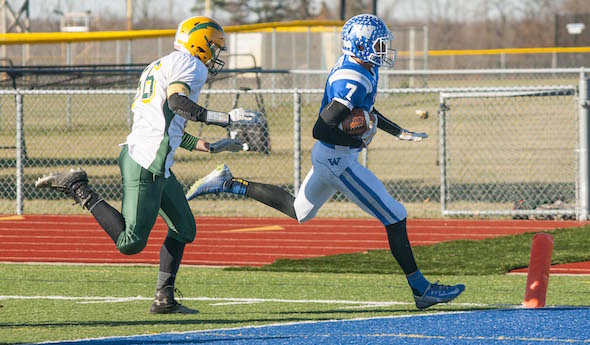
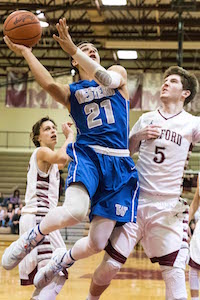
PHOTOS: (Top) Cody White (right) runs away from a Midland Dow defender during their Regional Final this fall. (Middle) White works for a shot against Milford. (Photos by Teresa Presty.)