

Northern Powers Building on Tradition
October 28, 2016
By Dennis Chase
Special for Second Half
TRAVERSE CITY – Matt Stapleton jokes when he talks about his 19-year run as the Frankfort football coach.
 “If you ask how many games we’ve won while I’ve been here, the answer would be, ‘Not enough,’” he quipped. “And if you ask how many we’ve lost, it would be “Too many.’”
Well, nobody is asking that second question, particularly this season. Frankfort heads into tonight’s MHSAA Division 8 playoffs with a perfect 9-0 record. The Panthers are one of two unbeaten in the northern Lower Peninsula. Traverse City St. Francis is the other.
That should come as no surprise to those who follow football in the north. The two schools are the winningest programs, percentage-wise, in the area. St. Francis ranks seventh in the state with a winning percentage of 76.8 percent since the school started playing football in 1951. Frankfort ranks 24th with a 71.4 winning percentage since 1950.
St. Francis, which has won six MHSAA championships, just put together back-to-back unbeaten regular seasons for the second time in school history. The 1991-92 teams also accomplished the feat. Gladiators head coach Josh Sellers played on the 1991 team as did offensive line coach Aaron Biggar and offensive coordinator Scott Doriot, who was also the quarterback on the 1992 Class C title squad.
“After (last Friday’s win) I told the team, ‘Hey, welcome to the club, guys,” Sellers said.
“They took it in stride, but they should be happy and excited about it,” Doriot added. “It’s super special, a heck of an accomplishment.”
Frankfort, meanwhile, completed its first 9-0 regular season since 2004.
Now the two programs are back in familiar territory – the playoffs. St. Francis, which hosts Harbor Springs on Saturday in a Division 7 contest, is in the postseason for the 30th time since 1983. During one stretch, the Gladiators, who have reached the MHSAA Finals nine times, qualified 22 years in a row. Frankfort, which hosts Evart tonight, is in the playoffs for the 28th time in the last 32 years. The Panthers own two MHSAA crowns, and during one six-year stretch played for the title five times.
Maintaining that tradition is a powerful motivator at the two schools.
“It’s a ‘your turn’ mentality,” Stapleton said. “Each team has its own identity, but the goals remain the same. For this team, it’s our turn, our opportunity.”
The same holds true at St. Francis.
“We want to follow in the footsteps of the guys before us,” senior back Gabe Callery, a water boy on some previous MHSAA championship teams, said. “That’s why we set our goals so high, because we’ve seen what those teams did. Now we want to taste it for our own.”
Like many, Callery had an older brother play in the Gladiators program. So he and his teammates know the bar is set high.
“It’s expectations,” Sellers said. “The coaches don’t have to push (playoffs) as one of our goals. It’s engrained in the kids, especially in the multi-generational families that have been a part of the program here.”
St. Francis and Frankfort made strong playoff runs last season. The Gladiators reached the Division 6 Semifinals before losing to eventual champion Ithaca. Frankfort fell to Division 8 champion Muskegon Catholic Central in the Regional. St. Francis and Frankfort led those games in the second half.
Both teams have had just one tight game this season, and it came at home with Maple City Glen Lake. St. Francis downed the Lakers 21-13 in Week 2, while Frankfort rallied for a 26-21 triumph in Week 6. Those were the only two losses Glen Lake, a Division 6 qualifier, suffered during the regular season.
For the Panthers, that game was a defining moment. Not only did it put Frankfort in position to win the Northern Michigan Football League Leaders division, but it proved the Panthers could play with character and toughness under fire.
“That was an incredible (game), a good test for us to see if we could play at a high level for four quarters,” Stapleton said.
It helped to create an identity, he added.
 “In those (pressure) situations, do you crumble or step up?” he said. “We stepped up pretty well.”
The players thought so, too.
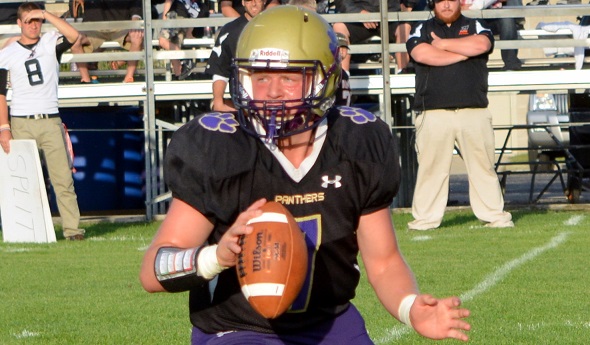
“After that game, we thought, ‘Wow, we could make something happen this year,’” Panthers senior quarterback Tige Stockdale said.
“It meant a lot to us,” junior running back/linebacker Griffin Kelly added. “That was one of our goals – to beat Glen Lake. We worked hard and (played) with a lot of heart. We were the underdogs. I don’t think they expected it.”
St. Francis, meanwhile, cruised to the Northern Michigan Football League’s Legends crown, taking the title outright with a 22-0 win over Boyne City last Friday.
The Gladiators are an experienced team with 19 seniors on the roster.
“Experience is our strength,” Sellers said. “A good number of our seniors were on varsity as sophomores, especially up front on the offensive line. We have two juniors on the front seven, and one is a third-year varsity starter.”
St. Francis lost some key cogs to graduation in the backfield, but Callery returned for his third varsity season.
“He didn’t get a lot of touches last year,” Sellers said, “so he’s making up for lost time.”
Callery leads the ground game with 891 yards in eight games (one win was a forfeit), averaging 9.1 yards per carry. Tim Bott’s average is even better at 12.5 yards per carry. He’s picked up 401 yards on just 32 carries. Joey Muzljakovich has 390 rushing yards.
Sophomore quarterback Danny Passinault, who won a three-way battle for the job, oversees the offense, which averages 40 points per game. He’s completed 26 of 44 passes for 509 yards and 12 touchdowns. Chris Kolarevic (seven) and Michael Hegewald (four) have caught 11 of the 12 TD passes.
“We’ve been on an upward trend (offensively) the last four or five games, although I didn’t think we played our best against Boyne,” Doriot said.
Defensively, the Gladiators are limiting opponents to six points and just under 170 yards in total offense per contest. Ryan Lints, Kolarevic, Muzljakovich and Matt Biggar are the team’s leading tacklers. Lints, a lineman, has five sacks, Callery three interceptions.
The Gladiators are relatively healthy entering the postseason.
“We had a hold-your-breath moment against Cheboygan when we lost (back) Connor McGee,” Sellers said. “He dislocated his elbow, and we thought he would be out five to six weeks. But we found out today (Monday) he’s back. He missed two games.”
 At Frankfort, Stapleton’s been pleased with his squad’s consistency in improving every week. He said that loss to Muskegon Catholic last November was a “springboard” for his players.
“Our kids were like, ‘We just went toe-to-toe with the team that won the last three (Division 8) state championships,’” Stapleton said. “Our kids felt disappointed because we could have won that game. We just didn’t finish.”
And that’s been the mindset this season.
Unlike St. Francis, the Panthers are not senior heavy. At times, Stapleton’s started four seniors on offense, four on defense.
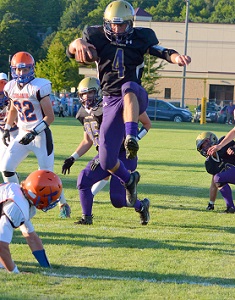
Kelly is the sparkplug. He’s rushed for 1,250 yards on 132 carries (a 9.5-yard average) in eight games (one win was a forfeit).
“What’s nice about Grif is that he’s not consumed by statistics,” Stapleton said. “There’s only been three games he’s had carries in the fourth quarter.
“He’s a special player. He makes calling plays pretty easy. You want the ball in his hands. If he gets stuffed one play, he’s going to make something happen the next.”
Kelly runs behind a line that features 6-foot-3, 300-pound junior tackle Matt Stefanski, a “legitimate” college prospect, Stapleton said. The Panthers start three seniors and two juniors up front.
“I have a lot of trust in them,’ Kelly said of his line. “They’re outstanding.”
Stockdale is another weapon. He’s rushed for nearly 600 yards and passed for 300. He’s accounted for 15 touchdowns. Junior receiver Matt Loney is averaging 16 yards a reception for an offense that is scoring 43 points a game.
Kelly leads the defense with 85 tackles. Stefanski anchors the middle with seniors Colton Ryder and Wil Darling providing the pressure from their end positions and channeling plays to the interior.
Not unexpectedly, the future continues to look bright at St. Francis and Frankfort, too. The Gladiators junior varsity team finished unbeaten for the third year in a row, while the Frankfort JV team went 8-1, on the heels of two unbeaten campaigns.
For now, though, it’s a one-game-at-a-time mantra in the playoffs.
“We have one week guaranteed,” Frankfort’s Kelly said. “You never know if you’re going to have practice (the following) Monday.”
At St. Francis, Callery, for one, is savoring the final stretch of his high school career.
“Maybe it’s the weather getting cold, but it’s a different feel,” he said. “And if you don’t feel different during the playoffs, something’s wrong with you. It’s a special time.”
 Dennis Chase worked 32 years as a sportswriter at the Traverse City Record-Eagle, including as sports editor from 2000-14. He can be reached at [email protected] with story ideas for Manistee, Wexford, Missaukee, Roscommon, Ogemaw, Iosco, Alcona, Oscoda, Crawford, Kalkaska, Grand Traverse, Benzie, Leelanau, Antrim, Otsego, Montmorency, Alpena, Presque Isle, Cheboygan, Charlevoix and Emmet counties.
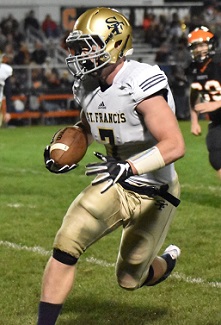
PHOTOS: (Top) Frankfort quarterback Tige Stockdale prepares to pitch during an Aug. 26 win over Manton. (Middle) St. Francis' Chris Kolarevic works upfield during his team's win over Cheboygan on Oct. 7. ( Below) Griffin Kelly (4) hurdles a would-be tackler for a touchdown against Central Lake on Sept. 2. (Photos by Amy Plumstead [Frankfort] and Leslie Julian [St. Francis].)
Reeths-Puffer's 'Marvin Moore Experience' On Track for Memorable Finish
By
Tom Kendra
Special for MHSAA.com
May 14, 2026
Not many high school kids have started their own non-profit organization.
 But, then again, there are not many kids quite like Muskegon Reeths-Puffer senior Marvin Moore – who as a sophomore founded Rocket-Powered Positive Path Forward, Inc. (Rocket-Powered.org) a nonprofit committed to igniting young people’s confidence, fueling their potential and launching them toward brighter futures.
“I wanted to help kids not get discouraged by seeing negative things online or get down on themselves if it seems like other kids are having all of the success,” said the soft-spoken Moore. “I just want to be there for other people.”
Moore somehow finds time to grow and develop the organization while playing three sports and maintaining a 3.977 GPA, with a schedule packed with Advanced Placement classes.
He is best known as a basketball player, a three-year varsity starter and 1,000-point career scorer for the Rockets. Moore, a 6-foot, 175-pound guard, will play college basketball next year at Kalamazoo College.
“I challenged the younger guys in our program,” said R-P boys basketball coach JR Wallace, who recently completed his second year as varsity coach. “I told them: Marvin is leaving us, but he showed you how to do it, with great humility and the attitude of doing whatever he can for the team.”
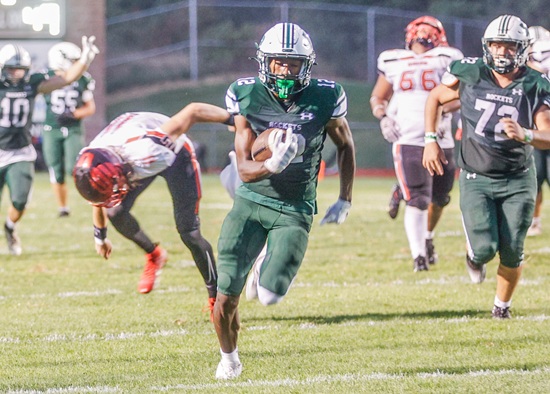 Moore was also a standout receiver in football who was having a breakout season as a junior – including during a memorable win over Grand Rapids Union when he caught a touchdown pass, ran for another TD, intercepted a pass and had a long kickoff return. Unfortunately, his season was cut short by a dislocated shoulder against Byron Center – and he decided to not play football his senior year for fear of re-injuring that shoulder and jeopardizing his senior basketball season.
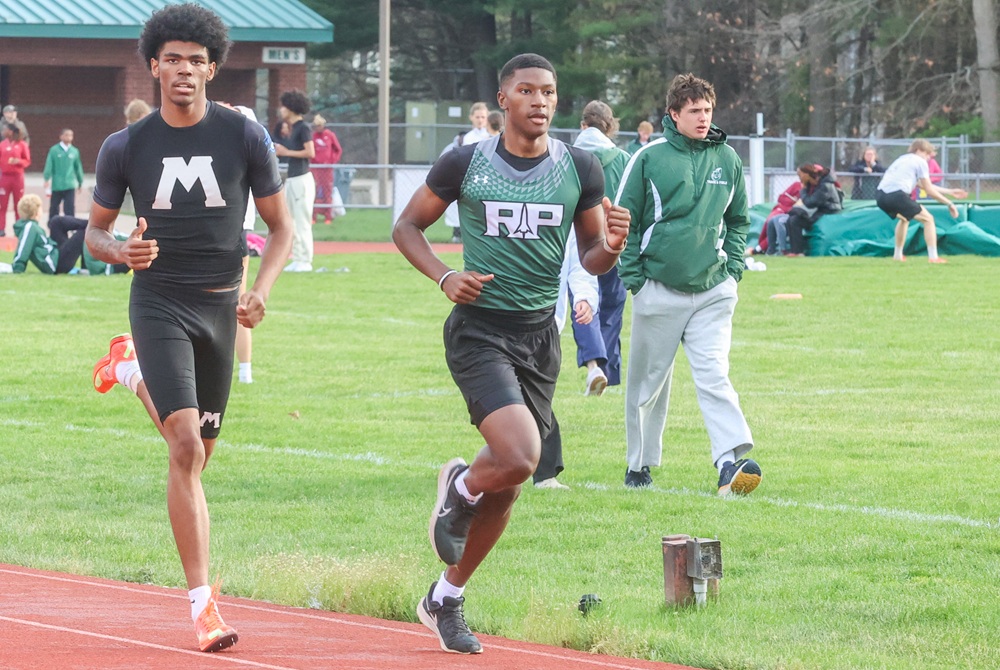
He is now one of the Muskegon area’s top track & field athletes, entering Friday’s Lower Peninsula Division 1 Regional at Zeeland as the top seed in the 400-meter dash after a couple of big wins over the past couple of weeks.
Moore achieved one of his main goals earlier this month by winning the 400 at the Greater Muskegon Athletic Association city meet.
Last week, he edged Jenison’s Kole Bassler to win the 400 at the Ottawa-Kent Conference Green meet with a personal-best time of 49.97.
He was able to post that sub-50 second time despite running it right after helping his team to a conference title in the 800-meter relay and also running the second leg of the 400-meter relay.
“He’s always been a little bit tired running the 400 in our big meets so far,” explained R-P boys track coach Don Ketner, who is also hoping for a big day Friday from senior Mason Darke, the top seed in both the 110- and 300-meter hurdles. “This Friday, we will finally be getting the full Marvin Moore experience, and we’ll see how low he can go.”
Ketner believes Moore has a shot to eclipse the 300 school record of 48.88, set by Jared Meier in 2008.
Moore, who ranks sixth on the school’s career basketball scoring list with 1,095 points, would love to add his name to the track school record board in the gym which has meant so much to him throughout his life.
He was first moved up to the varsity basketball team late in his freshman year, and truly emerged as a sophomore – averaging 10 points for a Puffer team which finished 19-4 and co-champion of the O-K Green.
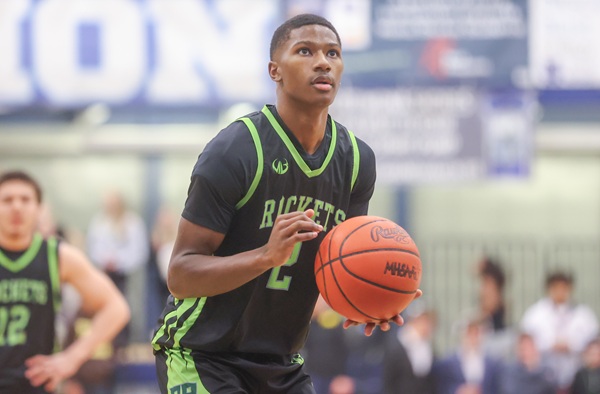 R-P lost a loaded senior class after that season (notably current Central Michigan athletes Jaxson Whitaker and Travis Ambrose), and with the Rockets in somewhat of a rebuilding mode, several athletes transferred to other schools.
“There were some schools that reached out and asked me to go there, but I started my whole career at Reeths-Puffer and I wanted to end it here at Reeths-Puffer,” said Moore, the son of Marvin and Kathy Moore, who plans to major in accounting in college. “I wanted to stay with my friends and be there for them and support them any way possible.”
The Rockets struggled on the basketball court the past two seasons, but Moore certainly provided some bright spots. He was a three-time all-conference pick and an MLive Muskegon Area Dream Team selection this past year, averaging 20 points per game despite facing constant double teams.
Moore helped his team snap an 11-game losing streak on Jan. 24, scoring 15 of his game-high 24 points during the fourth quarter including a floater off the glass as time expired in a 65-63 win over visiting East Grand Rapids.
Two weeks later, Moore scored 37 points and almost single-handedly helped the Rockets erase a 10-point deficit against Caledonia over the final three minutes, driving for a bucket during the final seconds in a 65-62 win. He remembers a huge student section was going crazy that night at R-P’s Dan Beckeman Arena, and that excitement carried over to a school dance after the game.
“That was such a fun night all the way around and something I will never forget,” said Moore, who was awarded the prestigious Lux Esto Scholarship at Kalamazoo College.
“We had a lot of losses the past couple of years, but honestly, I will never forget so many of those Friday nights. It was so much fun playing at home and having the whole community there for us.”
 Tom Kendra worked 23 years at The Muskegon Chronicle, including five as assistant sports editor and the final six as sports editor through 2011. E-mail him at [email protected] with story ideas for Muskegon, Oceana, Mason, Lake, Oceola, Mecosta and Newaygo counties.
PHOTOS (Top) Muskegon Reeths-Puffer’s Marvin Moore, middle, runs the inside lane during a meet this season. (Middle) Moore lines up for a free throw. (Below) Moore breaks away on a run against Grand Rapids Union. (Photos by Joe Lane.)