

Northern Schools Find Solution in NMFL
September 6, 2019
By Chris Dobrowolski
Special for Second Half
With 17 schools spread across 11 counties, the Northern Michigan Football League has created an indelible footprint since it was born into existence five years ago.
 The conference, made up of three divisions of schools in varying size, has been able to sustain and evolve despite an ever-changing football landscape up north that has made for a revolving door of membership from year to year.
“It continues to morph,” said Frankfort athletic director Dave Jackson, the conference’s commissioner and one of the founders of the league.
From the biggest schools in the Legends division — Benzie Central, Boyne City, Cheboygan, Grayling, Kalkaska, Kingsley and Traverse City St. Francis — to the smaller schools in the Leaders (Charlevoix, Elk Rapids, Frankfort, Mancelona and Maple City Glen Lake) and Legacy divisions (Harbor Springs, East Jordan, Inland Lakes, Johannesburg-Lewiston and St. Ignace) the NMFL has provided easy avenues for scheduling as well as good, competitive balance for the programs that call it home.
“The scheduling aspect is where I go back to it,” said Johannesburg-Lewiston football coach and athletic director Joe Smokevitch. “It’s just been huge for us. Going into 2020 and 2021 my schedule is full, basically with teams from within the conference. They’re not all division games. I am crossing over and playing those other schools. It’s really helped with scheduling. Not having to go far away to play somebody. You look at our schedule. We play some quality opponents. I think the conference is very strong from top to bottom.”
The idea for the league was hatched in 2012 between schools in the Lake Michigan and Northwest conferences. Both leagues were seeing problems from smaller schools trying to compete with larger ones, and neither side benefitting from the affiliation. So, the two merged as a 13-team league comprised of two divisions of similar-sized enrollments.
The league has rarely stayed intact from year to year, switching to the three-division alignment with the growth to 20 teams in 2016 when it absorbed the remaining teams in the Ski Valley Conference, as well as withstanding the loss of six schools to 8-player football in the span of four years.
“We’ve taken schools in the league that didn’t last very long,” said Jackson. “We took in Newberry and they lasted just a year, then suddenly they’re 8-man. We took in Gaylord St. Mary. We took in Central Lake. Those teams were just a year or two and suddenly they’re gone. Our constitution calls for a two-year process of getting out, but those teams that had to go 8-man, they’re out for the next year. So, suddenly you’re scrambling again, which is the one thing we were trying to keep from having to do because there is no planning when that last-minute 8-man decision comes along and schools decide to make that plunge. There’s nothing you can really do when a school says they’re going to do that. You can’t say, ‘Well, the constitution says … .’ They’re going to do what they need to do.”
 Fortunately for the league, it has been able to find suitable replacements at every turn. In fact, Ogemaw Heights and Sault Ste. Marie are set to join in 2020 to become part of the Legends division, bolstering the league to a robust 19 schools. Kalkaska and Boyne City will slide over to the Leaders division and Frankfort — one of the smallest 11-player football teams in the state — is moving to the Legacy division.
“It made sense to apply,” said Ogemaw Heights athletic director Jon Studley, noting four future conference foes already are on this year’s schedule. “We’re very excited about the opportunity to be a part of that. We’re going to be able to create some rivalries.
“I think fans of northern Michigan football benefit the most. They’re seeing competitive football week in and week out.”
As the NMFL has shown, the quality of football being played within the conference is at a high level, too. At least one team from the league has reached the Semifinal round of the MHSAA playoffs every season. Boyne City was a semifinalist in Division 6 in 2014, while St. Francis has represented the league in the Semifinals in 2015, 2017 and 2018. In 2016 two teams advanced that far — St. Ignace in Division 8 and Maple City Glen Lake in Division 6 — with Glen Lake reaching the Finals before falling to Jackson Lumen Christi 26-14.
“I think we’re really starting to get some respect,” said Glen Lake coach Jerry Angers. “I’ve talked to the teams downstate that we’ve played, they want to come up and play us. They’re not saying, ‘This is going to be an easy game.’ They’re saying, ‘This is going to be a fun game, and they’re going to give us something.’”
There remains the possibility the league will undergo more changes before it more comfortably stabilizes. Some schools have expressed interest in joining, and the threat of losing members to 8-player football remains for a few of the smallest schools. It’s nothing the league hasn’t dealt with before, however. Jackson said it comes down to maintaining a commitment to the schools that are in the conference and carefully examining any growth that could occur.
“We had our big meeting in December, and one thing we talked about is how we have to look out for each other,” said Jackson. “We’re trying to guarantee that the league will provide eight of your nine games. In most cases the league is providing all nine of the games. So, you know you’re going to have somebody to play and you’re not going to have to go looking. There’s a time we may control 11-man football for everything north of Lansing. I don’t know. It continues to grow because teams are looking for that stability and consistency year in and year out, so they know who their games are with and they know who they play.”
 Chris Dobrowolski has covered northern Lower Peninsula sports since 1999 at the Ogemaw County Herald, Alpena News, Traverse City Record-Eagle and currently as sports editor at the Antrim Kalkaska Review since 2016. He can be reached at [email protected] with story ideas for Manistee, Wexford, Missaukee, Roscommon, Ogemaw, Iosco, Alcona, Oscoda, Crawford, Kalkaska, Grand Traverse, Benzie, Leelanau, Antrim, Otsego, Montmorency, Alpena, Presque Isle, Cheboygan, Charlevoix and Emmet counties.
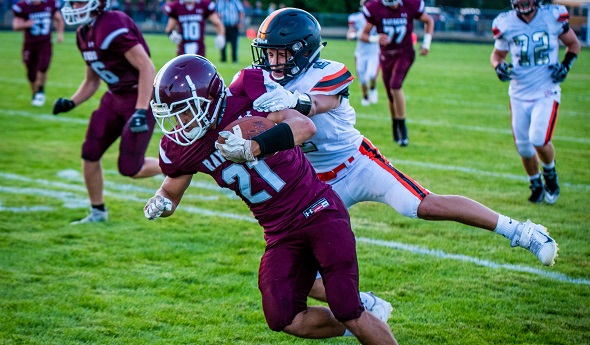
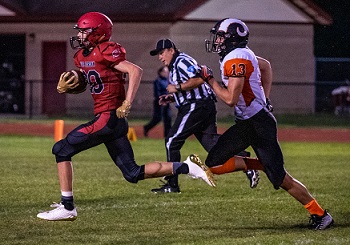
PHOTOS: (Top) Charlevoix, carrying the ball, opened this season with a 40-26 win over Elk Rapids. (Middle) East Jordan got a step on Harbor Springs on this play last week, but the Rams emerged with a slim 34-33 win. (Photos by Sports in Motion.)
1st & Goal: 2021 Week 1 Preview
By
Geoff Kimmerly
MHSAA.com senior editor
August 26, 2021
Welcome to what might be the most anticipated opening weekend in Michigan high school football history.
No one is saying life is back to pre-pandemic normal, of course. But after last football season saw multiple delays, an abbreviated regular season and altered playoff format, it’s hard not to be excited about most things beginning “as they always have” this weekend across our state.
And there are plenty of opportunities to dig in and enjoy.
Check out your local game, or one of those highlighted below – including a number of games from three showcase events, the Battle at the Big House at University of Michigan, the Xenith Prep Kick Off Classic at Wayne State and the Vehicle City Gridiron Classic at Kettering’s Atwood Stadium. There are also plenty of opportunities to tune in from home – more than 150 games will be streamed live on the NFHS Network or by partner Bally Sports Detroit, including two televised live on BSD’s primary cable channel. (Click for details.)
As in seasons past, our weekly football previews will point out intriguing games from every region of the state – opportunities to see a great story unfold no matter where fans live or are visiting that weekend. Records below are from the 2020 season. (Games from the aforementioned showcases are listed in the region of one of the competitors.)
Bay & Thumb
Davison (10-1) vs. Clarkston (7-1), Friday at U-M
A number of teams from the I-75 corridor and particularly the Flint suburbs will be playing showcase games this weekend, and this might be the biggest as well as a preview of a more significant rematch to come. Clarkston’s lone loss last season came by seven to Grand Blanc in a District Semifinal – a week before the Wolves would have faced Davison, which suffered its only defeat at Ford Field against West Bloomfield in the Division 1 championship game. The Cardinals also were Division 1 champs in 2019, with Clarkston most recently making the Finals as Division 1 runner-up in 2018.
Keep an eye on these THURSDAY Lapeer (3-4) vs. Grand Rapids Catholic Central (10-0) at U-M, Frankenmuth (11-1) vs. Goodrich (6-2) at Atwood Stadium. FRIDAY East Lansing (8-1) vs. Grand Blanc (7-2) at Atwood Stadium, Midland Dow (5-3) vs. Fenton (7-1) at U-M.
Greater Detroit
Detroit Catholic Central (9-1) vs. Clinton Township Chippewa Valley (3-4), Thursday at WSU
This might be the premier matchup of the Wayne State games, and also one where a 2020 record should be ignored when making that argument. Chippewa Valley may have lost four games last season, but those defeats came by a combined 21 points and none by more than nine. DCC, meanwhile, suffered its only loss to Davison, in a Division 1 Regional Final. The Shamrocks were especially tough defensively last fall, giving up 10 points per game, while winning a Detroit Catholic League Central that sent Warren De La Salle Collegiate to the Division 2 championship game.
Keep an eye on these THURSDAY Canton (8-1) vs. Dearborn Fordson (5-3) at Wayne State, Bloomfield Hills Brother Rice (7-2) at Macomb Dakota (6-2). FRIDAY Oak Park (5-6) at Orchard Lake St. Mary's (2-4). SATURDAY Southfield Arts & Technology (3-4) vs. Detroit Cass Tech (8-1) at Wayne State.
Mid-Michigan
DeWitt (12-0) vs. Traverse City Central (9-2), Thursday at U-M
The Panthers are coming off their first Finals championship, claiming the Division 3 title last season, and might be even better on offense this fall with multiple playmakers returning after the team scored at least 37 points in all but one game. Central missed making Ford Field by one win, falling to eventual champion Muskegon Mona Shores in a Division 2 Semifinal. The Trojans scored at least 30 points in all but one game last season and should be a handful in an intriguing Michigan Stadium clash.
Keep an eye on these THURSDAY Olivet (7-2) at Charlotte (2-5). FRIDAY Freeland (8-2) at Clare (7-1), Fowler (6-3) at Carson City-Crystal (6-2), Lansing Everett (did not play) at Lansing Sexton (did not play).
Northern Lower Peninsula
Reed City (8-0) at Cadillac (7-3), Thursday
Rewind again to when the MHSAA football season concluded at Ford Field, and Cadillac was one of the surprises of championship weekend. The Vikings reached the Finals for the first time, and while being held scoreless by Detroit Country Day in the Division 4 championship game they also put up one of their most impressive defensive performances holding the Yellowjackets to 13 points. Reed City’s story, though, had to feel a little unfinished – after starting out with eight straight wins, the Coyotes’ last playoff game before the COVID-related break in November was canceled, as was their Regional Final when play resumed in January.
Keep an eye on these THURSDAY Traverse City West (6-2) vs. Midland (8-1) at U-M, Beaverton (6-2) at Lake City (2-4), Houghton Lake (4-3) at Maple City Glen Lake (5-3), Kingsley (8-0) at McBain (6-1).
Southeast & Border
New Lothrop (11-0) at Jackson Lumen Christi (5-5), Thursday
These two have made a combined six trips to Ford Field with five championships over the last five seasons. New Lothrop is coming off its second Division 7 title in three seasons in January, while Lumen Christi was stopped short in the Regional Finals – a week before it would have met New Lothrop with a Finals bid on the line. This is also an intriguing matchup between the state’s longest-serving and third-winningest football coach, Lumen’s Herb Brogan (373-89 over 42 seasons), against a younger leader on the path to join the all-time greats in Clint Galvas (129-15 over 13).
Keep an eye on these THURSDAY Ithaca (8-1) at Hudson (4-4). FRIDAY Ottawa Lake Whiteford (6-3) at Blissfield (8-1), Michigan Center (6-2) at Homer (5-3), Saline (8-2) vs. Hudsonville (5-3) at U-M.
Southwest Corridor
Portage Central (3-5) at Stevensville Lakeshore (6-3) , Thursday
After not awarding a league champion last season because of the abbreviated regular-season schedule, the Southwestern Michigan Athletic Conference gets rolling immediately with two frequent contenders facing off. Central and Lakeshore didn’t play last season, but Central has won two straight in the otherwise-annual series.
Keep an eye on these THURSDAY Lake Odessa Lakewood (3-4) at Battle Creek Pennfield (5-4), Grand Ledge (5-3) at Coldwater (5-2), Cassopolis (2-5) at Schoolcraft (9-2). FRIDAY Battle Creek Lakeview (5-3) vs. Battle Creek Harper Creek (5-3).
Upper Peninsula
Negaunee (6-4) at Iron Mountain (7-2), Thursday
Once the regular season finally got started last fall, the Upper Peninsula proved quickly captivating as the status of best team north of Mackinac Bridge seemed to change hands weekly. Iron Mountain was the last remaining in the playoffs, reaching the Division 8 Regional Finals and missing the Semifinals with a one-point defeat. Both of these teams stand to be in the conversation again not only across the peninsula and statewide but more locally as the Western Peninsula Athletic Conference Copper (and Silver) reinstates league play after also not awarding a 2020 champ.
Keep an eye on these FRIDAY Gladstone (2-4) at Calumet (4-4), Bark River-Harris (5-3) at Gwinn (4-4), Houghton (2-3) at Ishpeming Westwood (5-2), Sault Ste. Marie (6-3) at St. Ignace (1-6).
West Michigan
Edwardsburg (9-1) at Montague (12-0), Thursday
The anticipation for this matchup should rival any this weekend including for the games being played at the three opening showcases. Montague put together one of the most impressive 2020 runs in any division on the way to claiming the Division 6 title but enters this fall with a new coach and quarterback. Edwardsburg missed returning to Ford Field with a two-point loss to Cadillac in a Division 4 Semifinal and likely would have reached double-digit wins for a sixth-straight season if not for the abbreviated schedule.
Keep an eye on these THURSDAY Zeeland West (5-1) at East Grand Rapids (6-4), Muskegon Mona Shores (12-0) at Lowell (4-4). FRIDAY Grand Rapids South Christian (8-2) at Grand Rapids Christian (4-4), Hudsonville Unity Christian (7-0) at Hopkins (5-2).
8-Player
Gaylord St. Mary (7-2) at Pickford (7-2), Friday
These two won’t see each other again when the playoffs roll around – Pickford is in Division 1 this season and St. Mary in Division 2. But if recent history serves, this opener could be a primer for the kind of matchup both could earn a few months from now. Pickford made the Regional Finals last season and has pushed at least that far into the playoffs the last five seasons. Gaylord St. Mary is coming off two straight Regional Finals trips, both in Division 1 as well before moving into Division 2 for this fall.
Keep an eye on these THURSDAY Mendon (6-2 in 11-player) at Vandercook Lake (4-2). FRIDAY Merrill (6-2) at Marion (8-2), Wyoming Tri-unity Christian (3-5) at Martin (8-2), Onaway (6-1) at Indian River Inland Lakes (8-2).
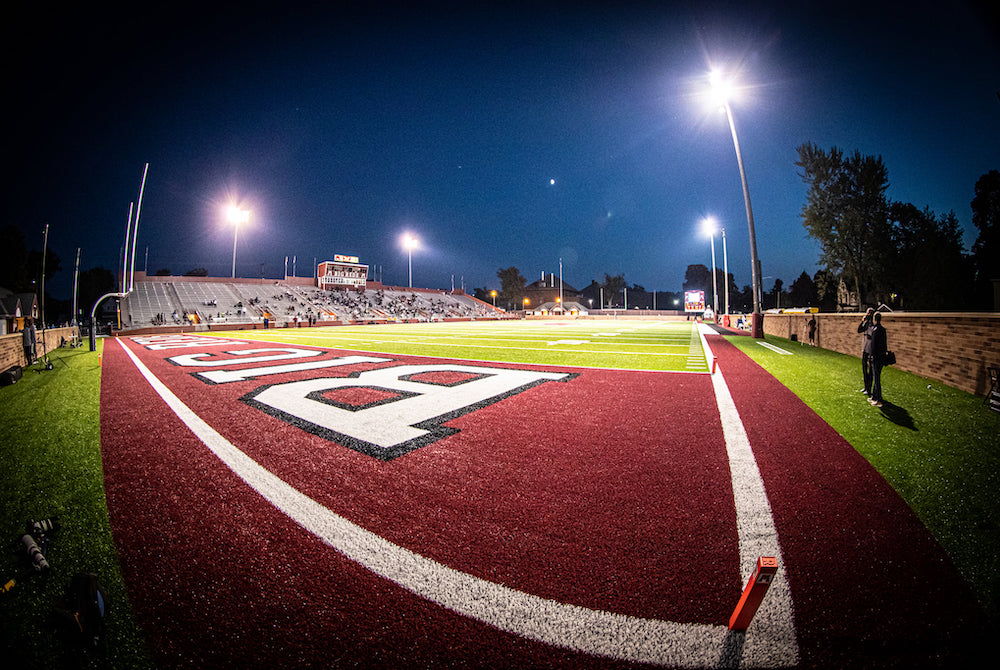
PHOTO: Football stadium lights, like these last season at Muskegon High School, will brighten the sky again for the 2021 season beginning this weekend. (Photo by Tim Reilly.)