

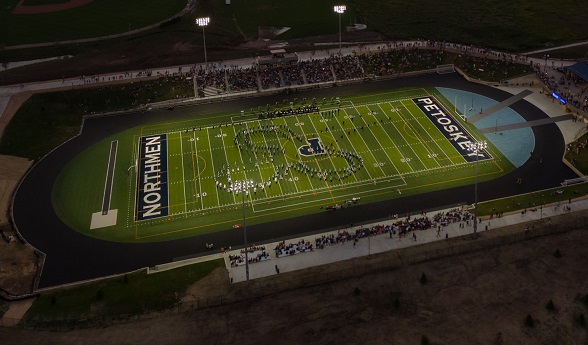
Northmen Stadium Opens to Excitement, 'Awe'
September 1, 2016
By Dennis Chase
Special for Second Half
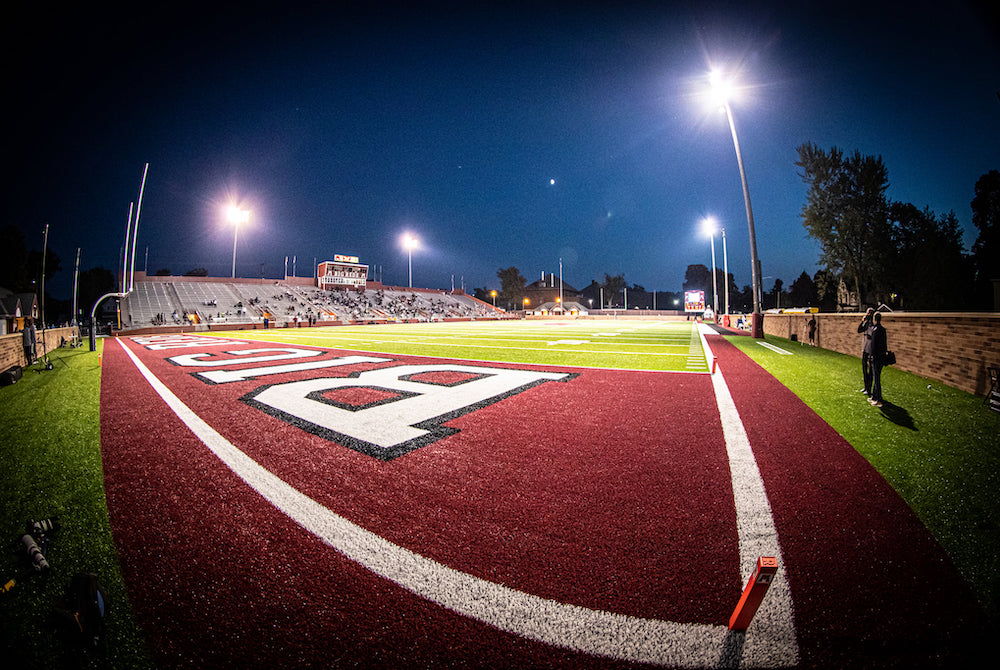
PETOSKEY – Petoskey kicked off a new era in football last Thursday with the unveiling of Northmen Stadium, a multi-use facility that will be home for football, soccer, lacrosse, band and track & field.
 More than 4,000 spectators turned out on a beautiful late August night to watch Petoskey open its season against Ada Forest Hills Eastern. School officials believe it was the largest home football crowd in Petoskey history.
Even a 35-14 setback could not dampen the enthusiasm and pride displayed by those in attendance.
“To see the stadium from the road is one thing – and that excited people,” Superintendent John Scholten said. “But once they got inside and saw it first-hand, there was an awe factor. It was like, ‘Wow!’”
Northmen Stadium replaces Curtis Field, which was built in 1927 and served as the home for Petoskey football for 88 years.
“Our community is very tradition-oriented, very values-oriented,” Dan Ledingham, president of the football boosters, said. “Curtis Field means a lot to us. It’s very symbolic – the roots from where we started. Multiple generations played on that field. I know families who go three to four generations deep. But it was time.”
“It’s time” was actually the theme for the $10 million bond proposal that the electorate approved by a 64 to 36 percent vote in 2014.
“It (Curtis Field) served the community well, but it was pretty tired,” Scholten said.
In addition to the $10 million bond, the school received significant donations and coordinated efforts with other sinking fund projects.
“The whole (campus) renovation is closer to $15 million,” Scholten said.
The project includes the stadium, reconstruction of six tennis courts, a rebuilt softball field, two new soccer practice fields, and a cross country 5K trail that ties into a community walkway and includes three culvert tunnels under realigned Northmen Drive.
It’s all part of a concerted effort to bring the school’s athletic facilities – once scattered around the city – to the campus location. The school had already built a stunning new high school gymnasium and an on-site baseball field.
“When I moved up here (from Maple City Glen Lake) two of the old icons from the Glen Lake days, Denny Dame and Ivan Ford, said you’re moving to the nicest gym in the north,” Scholten said. “I’m a little biased, but I think we now have one of the nicest football facilities in the north, too.”
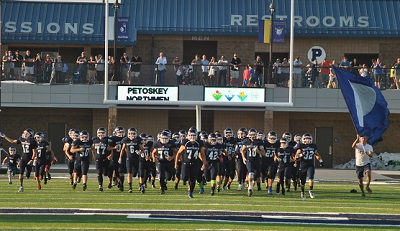 The stadium is the centerpiece of the latest project. The property’s topography featured a “semi-natural bowl” on the southeast side. Construction workers moved 300,000 cubic yards of dirt to build up the other side, creating a complete bowl appearance.
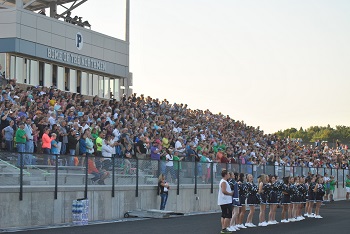
“The fact it sits down in a bowl makes it unique,” athletic director Dave Smith said. “There are lots of places that have nice stadiums, but they’re flat and the bleachers go up. With this, there’s not a bad seat in the house because it sits down in that bowl.”
The main entrance is near the mezzanine in the north end zone, which is where the concessions and restrooms are located. It features a plaza that overlooks the field. A tunnel runs underneath the mezzanine where the players and band enter and exit the field.
“It’s a very cool place to see a game,” football coach Kerry VanOrman said. “When the band marches through the tunnel, it’s like you’re at Michigan State or Michigan.”
Team rooms, a training room and an officials room are located off the tunnel.
A 40-foot video scoreboard anchors the south end zone. There’s also a messaging board attached to the mezzanine.
The synthetic turf is lined for football, soccer and lacrosse. The soccer team opens its home season Tuesday.
The stadium seats 2,950, but there is additional lawn seating on the hillside. Plus, based on opening night, fans seem to enjoy watching from the mezzanine.
“That elevation overlooking the field gives you the best view,” Ledingham said. “You can see everything, and you can feel the energy coming from the crowd.”
Workers scrambled to get the stadium ready for opening night. In fact, just 48 hours beforehand Ledingham wondered if it would be game ready.
 “There were tractors and trucks, concrete and tiles,” he said. “Everything was everywhere. It looked like a true construction site that maybe in a month would be close (to done). I was wondering, ‘What’s Plan B?’ Kent (Cartwright, the school’s chief financial officer) said, ‘There is no Plan B. We are on this field.’ It was neat to see it all come together.”
Smith agreed.
“It was unbelievable the number of people there, from the construction crew to the subcontractors, working extra hours, late hours, that last month to make sure we could get in there and play on that (Thursday),” he said. “Two days out, I was also wondering how this is going to happen. But it did.”
The school received a temporary occupancy permit to open the stadium. Finishing touches were still being completed this week.
The opening culminates nearly 10 years of work. A bond proposal to fund separate football and soccer stadiums was rejected by voters in 2007.
“We had a nice plan,” Scholten said, “but it was just when the recession was starting. We did all the pre-work with the surveys and it looked like the confidence was there, but when the economy went south, (the vote) went south, too.”
Officials regrouped and, after the lingering recession ended, pared back the plan and took it to the voters.
“It was unfortunate timing (in 2007),” VanOrman said. “They were smart in waiting for things to pick up. They did a good job planning it, locating it and even tying it into the city walkways. It kind of includes everybody into it.”
Officials changed the location of the stadium, building it on what was two practice fields so it could utilize existing locker rooms and showers at the school. Two additional locker rooms will be added.
“We listened to the community,” Scholten said. “We were a little extravagant (in 2007) so we came back with a different plan. We worked real hard to say, ‘We listened to you, we trimmed it back, we feel we’re being responsible.’ We worked hard to build that confidence back up.”
The cross country trail will facilitate skiers as well as runners and walkers. The new eight-lane track replaces the outdated six-lane version at Curtis Field.
“We couldn’t host anything big because of that,” Scholten said.
Scholten expects the new facility will make Petoskey an attractive choice for hosting MHSAA tournaments.
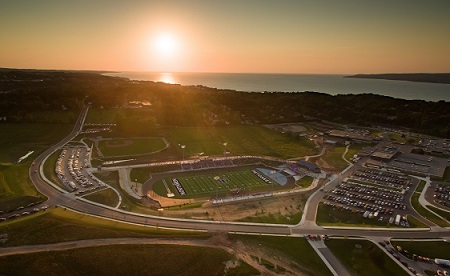 Parking, an issue at Curtis Field, was addressed, too. Spectators can now use the high school and middle school lots, as well as new parking spaces near the stadium.
The improvements now leave hockey and downhill skiing as the only sports played off campus, Smith said.
“From an athletic director’s standpoint, I love how most of our facilities are now on school grounds,” he said.
He also loves the positive buzz the stadium’s generated. Ledingham called opening night “surreal.”
“It was amazing to see our community come together to enjoy it,” he said.
The unveiling attracted fans from nearby communities as well.
“The energy and support was great,” junior kicker Noah Ledingham said. “You run on to that field, see the lights, see (the crowd) and it just makes you want to play harder.
“To be the first team to play on that field is an amazing feeling because it’s a new chapter (in Petoskey football) and you know you’re making history.”
The Northmen, with just two key returnees back, struggled early, falling behind Forest Hills Eastern 28-0 before rallying to make it a game.
“I was pleased with the way we played in the second half,” VanOrman said. “It was 28-14 with 3:30 left in the game. We went for an onside kick and it blew up in our face. They recovered and ran it back to our 15 and then scored. (Eastern’s) a good football team. It was a good measuring stick for us to see where we have to get better.”
The night might also pay dividends. Forest Hills Eastern officials are talking about extending the two-year deal with Petoskey that is set to expire after the Northmen travel down there next season.
“They liked it so much they want to come back in two years,” Smith said. “I would say that’s a compliment right there.”
 Dennis Chase worked 32 years as a sportswriter at the Traverse City Record-Eagle, including as sports editor from 2000-14. He can be reached at [email protected] with story ideas for Manistee, Wexford, Missaukee, Roscommon, Ogemaw, Iosco, Alcona, Oscoda, Crawford, Kalkaska, Grand Traverse, Benzie, Leelanau, Antrim, Otsego, Montmorency, Alpena, Presque Isle, Cheboygan, Charlevoix and Emmet counties.
PHOTOS: (Top) Petoskey's stadium, at dusk, hosted Ada Forest Hills Eastern for its debut. (Middle above) The Northmen take to their new field for the first time. (Middle below) Fans packed the home stands, which are part of a "bowl" circling the playing surface. (Below) The new football field is just one part of the renovated Petoskey athletic complex. (Aerial photos by Charles Dawley/Up North Imaging. Game photos by Scott Moore.)
1st & Goal: 2021 Week 1 Preview
By
Geoff Kimmerly
MHSAA.com senior editor
August 26, 2021
Welcome to what might be the most anticipated opening weekend in Michigan high school football history.
No one is saying life is back to pre-pandemic normal, of course. But after last football season saw multiple delays, an abbreviated regular season and altered playoff format, it’s hard not to be excited about most things beginning “as they always have” this weekend across our state.
And there are plenty of opportunities to dig in and enjoy.
Check out your local game, or one of those highlighted below – including a number of games from three showcase events, the Battle at the Big House at University of Michigan, the Xenith Prep Kick Off Classic at Wayne State and the Vehicle City Gridiron Classic at Kettering’s Atwood Stadium. There are also plenty of opportunities to tune in from home – more than 150 games will be streamed live on the NFHS Network or by partner Bally Sports Detroit, including two televised live on BSD’s primary cable channel. (Click for details.)
As in seasons past, our weekly football previews will point out intriguing games from every region of the state – opportunities to see a great story unfold no matter where fans live or are visiting that weekend. Records below are from the 2020 season. (Games from the aforementioned showcases are listed in the region of one of the competitors.)
Bay & Thumb
Davison (10-1) vs. Clarkston (7-1), Friday at U-M
A number of teams from the I-75 corridor and particularly the Flint suburbs will be playing showcase games this weekend, and this might be the biggest as well as a preview of a more significant rematch to come. Clarkston’s lone loss last season came by seven to Grand Blanc in a District Semifinal – a week before the Wolves would have faced Davison, which suffered its only defeat at Ford Field against West Bloomfield in the Division 1 championship game. The Cardinals also were Division 1 champs in 2019, with Clarkston most recently making the Finals as Division 1 runner-up in 2018.
Keep an eye on these THURSDAY Lapeer (3-4) vs. Grand Rapids Catholic Central (10-0) at U-M, Frankenmuth (11-1) vs. Goodrich (6-2) at Atwood Stadium. FRIDAY East Lansing (8-1) vs. Grand Blanc (7-2) at Atwood Stadium, Midland Dow (5-3) vs. Fenton (7-1) at U-M.
Greater Detroit
Detroit Catholic Central (9-1) vs. Clinton Township Chippewa Valley (3-4), Thursday at WSU
This might be the premier matchup of the Wayne State games, and also one where a 2020 record should be ignored when making that argument. Chippewa Valley may have lost four games last season, but those defeats came by a combined 21 points and none by more than nine. DCC, meanwhile, suffered its only loss to Davison, in a Division 1 Regional Final. The Shamrocks were especially tough defensively last fall, giving up 10 points per game, while winning a Detroit Catholic League Central that sent Warren De La Salle Collegiate to the Division 2 championship game.
Keep an eye on these THURSDAY Canton (8-1) vs. Dearborn Fordson (5-3) at Wayne State, Bloomfield Hills Brother Rice (7-2) at Macomb Dakota (6-2). FRIDAY Oak Park (5-6) at Orchard Lake St. Mary's (2-4). SATURDAY Southfield Arts & Technology (3-4) vs. Detroit Cass Tech (8-1) at Wayne State.
Mid-Michigan
DeWitt (12-0) vs. Traverse City Central (9-2), Thursday at U-M
The Panthers are coming off their first Finals championship, claiming the Division 3 title last season, and might be even better on offense this fall with multiple playmakers returning after the team scored at least 37 points in all but one game. Central missed making Ford Field by one win, falling to eventual champion Muskegon Mona Shores in a Division 2 Semifinal. The Trojans scored at least 30 points in all but one game last season and should be a handful in an intriguing Michigan Stadium clash.
Keep an eye on these THURSDAY Olivet (7-2) at Charlotte (2-5). FRIDAY Freeland (8-2) at Clare (7-1), Fowler (6-3) at Carson City-Crystal (6-2), Lansing Everett (did not play) at Lansing Sexton (did not play).
Northern Lower Peninsula
Reed City (8-0) at Cadillac (7-3), Thursday
Rewind again to when the MHSAA football season concluded at Ford Field, and Cadillac was one of the surprises of championship weekend. The Vikings reached the Finals for the first time, and while being held scoreless by Detroit Country Day in the Division 4 championship game they also put up one of their most impressive defensive performances holding the Yellowjackets to 13 points. Reed City’s story, though, had to feel a little unfinished – after starting out with eight straight wins, the Coyotes’ last playoff game before the COVID-related break in November was canceled, as was their Regional Final when play resumed in January.
Keep an eye on these THURSDAY Traverse City West (6-2) vs. Midland (8-1) at U-M, Beaverton (6-2) at Lake City (2-4), Houghton Lake (4-3) at Maple City Glen Lake (5-3), Kingsley (8-0) at McBain (6-1).
Southeast & Border
New Lothrop (11-0) at Jackson Lumen Christi (5-5), Thursday
These two have made a combined six trips to Ford Field with five championships over the last five seasons. New Lothrop is coming off its second Division 7 title in three seasons in January, while Lumen Christi was stopped short in the Regional Finals – a week before it would have met New Lothrop with a Finals bid on the line. This is also an intriguing matchup between the state’s longest-serving and third-winningest football coach, Lumen’s Herb Brogan (373-89 over 42 seasons), against a younger leader on the path to join the all-time greats in Clint Galvas (129-15 over 13).
Keep an eye on these THURSDAY Ithaca (8-1) at Hudson (4-4). FRIDAY Ottawa Lake Whiteford (6-3) at Blissfield (8-1), Michigan Center (6-2) at Homer (5-3), Saline (8-2) vs. Hudsonville (5-3) at U-M.
Southwest Corridor
Portage Central (3-5) at Stevensville Lakeshore (6-3) , Thursday
After not awarding a league champion last season because of the abbreviated regular-season schedule, the Southwestern Michigan Athletic Conference gets rolling immediately with two frequent contenders facing off. Central and Lakeshore didn’t play last season, but Central has won two straight in the otherwise-annual series.
Keep an eye on these THURSDAY Lake Odessa Lakewood (3-4) at Battle Creek Pennfield (5-4), Grand Ledge (5-3) at Coldwater (5-2), Cassopolis (2-5) at Schoolcraft (9-2). FRIDAY Battle Creek Lakeview (5-3) vs. Battle Creek Harper Creek (5-3).
Upper Peninsula
Negaunee (6-4) at Iron Mountain (7-2), Thursday
Once the regular season finally got started last fall, the Upper Peninsula proved quickly captivating as the status of best team north of Mackinac Bridge seemed to change hands weekly. Iron Mountain was the last remaining in the playoffs, reaching the Division 8 Regional Finals and missing the Semifinals with a one-point defeat. Both of these teams stand to be in the conversation again not only across the peninsula and statewide but more locally as the Western Peninsula Athletic Conference Copper (and Silver) reinstates league play after also not awarding a 2020 champ.
Keep an eye on these FRIDAY Gladstone (2-4) at Calumet (4-4), Bark River-Harris (5-3) at Gwinn (4-4), Houghton (2-3) at Ishpeming Westwood (5-2), Sault Ste. Marie (6-3) at St. Ignace (1-6).
West Michigan
Edwardsburg (9-1) at Montague (12-0), Thursday
The anticipation for this matchup should rival any this weekend including for the games being played at the three opening showcases. Montague put together one of the most impressive 2020 runs in any division on the way to claiming the Division 6 title but enters this fall with a new coach and quarterback. Edwardsburg missed returning to Ford Field with a two-point loss to Cadillac in a Division 4 Semifinal and likely would have reached double-digit wins for a sixth-straight season if not for the abbreviated schedule.
Keep an eye on these THURSDAY Zeeland West (5-1) at East Grand Rapids (6-4), Muskegon Mona Shores (12-0) at Lowell (4-4). FRIDAY Grand Rapids South Christian (8-2) at Grand Rapids Christian (4-4), Hudsonville Unity Christian (7-0) at Hopkins (5-2).
8-Player
Gaylord St. Mary (7-2) at Pickford (7-2), Friday
These two won’t see each other again when the playoffs roll around – Pickford is in Division 1 this season and St. Mary in Division 2. But if recent history serves, this opener could be a primer for the kind of matchup both could earn a few months from now. Pickford made the Regional Finals last season and has pushed at least that far into the playoffs the last five seasons. Gaylord St. Mary is coming off two straight Regional Finals trips, both in Division 1 as well before moving into Division 2 for this fall.
Keep an eye on these THURSDAY Mendon (6-2 in 11-player) at Vandercook Lake (4-2). FRIDAY Merrill (6-2) at Marion (8-2), Wyoming Tri-unity Christian (3-5) at Martin (8-2), Onaway (6-1) at Indian River Inland Lakes (8-2).
PHOTO: Football stadium lights, like these last season at Muskegon High School, will brighten the sky again for the 2021 season beginning this weekend. (Photo by Tim Reilly.)