

Oakridge 3-Sport Star Potts Applying Lessons to 'Second Chapter' in Sales
By
Tom Kendra
Special for MHSAA.com
July 20, 2023
Jamie Potts put a major strain on his feet and ankles for many years.

Potts was constantly twisting and contorting in cleats and sneakers as a three-sport standout at Muskegon Oakridge and later as a rare two-sport star at Grand Valley State University, where he is still listed in the school’s football and baseball record books.
So it’s fitting that the 30-yeaar-old Potts is now helping to heal feet and ankles as a medical device salesman for Stryker.
“It’s a very competitive, fast-paced job and lifestyle,” said Potts, who graduated from Oakridge in 2011.
“I am very thankful for that because there is a huge void there. When you put so much of your time and energy into it, transitioning out of competitive sports is difficult.”
Potts is the youngest of four boys, so he practically grew up in the bleachers at Oakridge. By the time he got to high school, he fell effortlessly into the rhythm of football in the fall, basketball in the winter and baseball in the spring – all while maintaining a 4.1 GPA, good for fifth overall in his class.
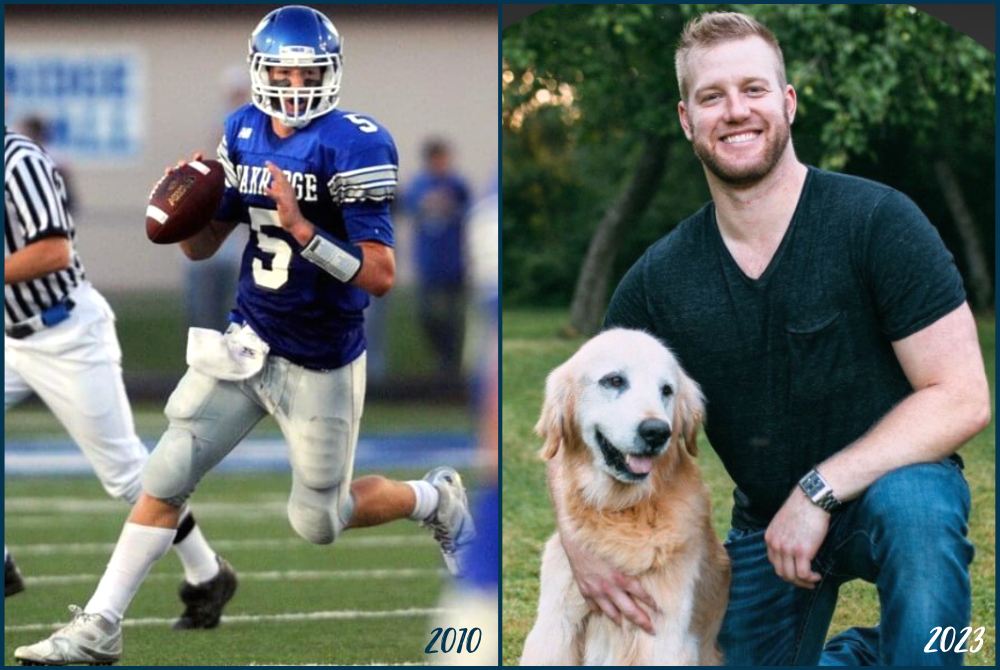
Potts did everything on the football field at Oakridge, as a 6-foot-3, 200-pound dual-threat quarterback. As a senior, he rushed for 1,561 yards and 24 touchdowns and threw for 696 yards and 10 TDs – along with totaling 64 tackles and successfully booting 9-of-13 field goal attempts.
“He was a fantastic high school athlete and one of the best athletes to ever come out of Oakridge,” said former Eagles coach Jack Schugars, the all-time winningest high school coach in the Muskegon area who is now the special teams coordinator at Ferris State. “He was a tremendous leader and the epitome of a role model for younger kids.”
Potts was a solid, if not spectacular, basketball player, known as a defensive specialist who wasn’t afraid to guard anybody.
Then in the spring, he was back to all-state status in baseball as an outfielder, batting .584 his senior year with six home runs, 38 RBIs and 34 stolen bases.
That meant it was decision time when it came to college – would it be football or baseball?
Potts received several Division I offers, including from Central Michigan University for football and Oakland University for baseball.
But it was Division II Grand Valley, particularly then-assistant coach Matt Yoches (now the director of football operations at Miami of Ohio) that floated the possibility of playing both sports – a very rare feat at the DII level.
Potts made the GVSU coaches look like geniuses. He was a four-year starter at tight end and receiver, finishing his career second all-time for the Lakers in TD receptions (35) and third in career receptions (169). In baseball, he finished with 241 career hits, the fifth-most in school history at the time.
“People told me that playing both in Division II wasn’t realistic,” said Potts, who now lives on the east side of the state in Fenton, with his 1-year-old daughter, Brooklyn. “But I wanted to give it a shot and I think I did all right with it. Growing up in Oakridge, my life was all about sports, so it prepared me.”
 Potts was drafted by the Texas Rangers shortly after his senior collegiate baseball season in 2015 and played that summer for Class A Spokane (Wash.), batting .217 with four home runs in 57 games. He missed training camp and the first two games of the 2015 football season, but returned to help the Lakers to the DII Semifinals his senior year.
He prepared to resume his baseball career and left in late February for the Rangers spring training complex in Surprise, Ariz., before announcing his retirement in March with a long and heartfelt Facebook post, which concluded:
“My best advice I can give is that you should always chase your dreams until your heart says it’s time to stop,” Potts wrote. “No matter how far out of reach you think it is or how old you are, you can do it with enough hard work and preparation.”
Potts, who completed his degree in allied health sciences with a minor in psychology during the Lakers’ 2015 football run, then had to shift gears and find his place in the “real world,” outside of competitive sports.
Potts said Oakridge, in addition to being a hard-working sports community, also did a mighty fine job preparing him and his three older brothers, sons of Tom and Kathy Potts, for life after athletics. Oldest brother Chris is an engineer, Andy works as a logistics manager and Aaron is an orthopedic surgeon.
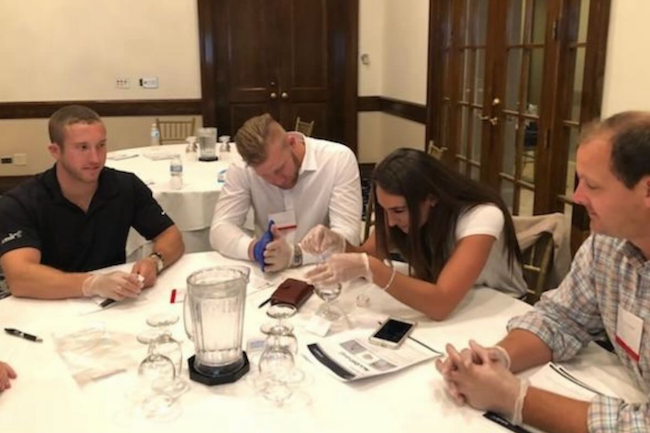
It was actually Aaron who pointed him in the direction of medical device sales. He went through five interviews shortly after his retirement before landing his first job in the field at Arthrex in Grand Rapids, before moving on to Kalamazoo-headquartered Stryker last year.
“A big part of my job is being in the operating room with the surgeons and making sure that everything is working,” explained Potts, who is part of a six-member team which covers much of eastern Michigan. “It’s very intense, very much like the feel of a close game. No doubt all of those years of sports help me every day.”
But Potts could not leave sports behind completely after his baseball retirement.
He was back in Muskegon in the spring of 2016 and attended a Muskegon Ironmen indoor football game. He spoke with team owner TJ Williams, who Potts used to watch playing for Oakridge as a kid, and a few weeks later, he was in an Ironmen uniform.
Potts played two years with the Ironmen as a receiver, linebacker and kicker.
“It was a lot of fun, really, getting to play in front of fans in Muskegon again,” said Potts. “The worst part was the walls. I’ve never experienced getting tackled into walls before and, I tell you, that takes some getting used to.”
More recently, Potts helped out last month as a coach at Schugars’ kicking camp at Oakridge, getting him back on the turf at Russell Erickson Stadium, where the field is now known as Jack Schugars Field.
“I’m happy to be a role model for kids,” said Potts. “You learn so many life lessons from playing sports. It really gets you ready for the second chapter of life.”
2023 Made In Michigan
July 18: Frankfort Hoops Staff Bolstered by Past Stars Giving Back in Banktson, Kreski - Read
July 12: Championship Memories, High School Tennis' Impact Stick with Hackett Pair - Read
July 6: Brother Rice Finals Hero Aiming to Ace Family Life, Financial World - Read
July 5: Lapeer West 4-Time Finals Winner Set to Build Champions at Oklahoma - Read
PHOTOS (Top) Jamie Potts runs the offense for Muskegon Oakridge as a senior in 2010, and now. (Middle) Potts, second from left, is advancing in his career in medical device sales. (Photos courtesy of Jamie Potts.)

Parking, Entrance Protocols Announced for 2025 11-Player Football Finals
By
Geoff Kimmerly
MHSAA.com senior editor
November 24, 2025
To provide for the convenience and safety of spectators attending the Michigan High School Athletic Association 11-Player Football Finals on Nov. 28 and 30 at Ford Field in Detroit, attendees are being advised of a variety of items related to transportation and security – including policies regarding parking, seating and types of bags allowed into the stadium.
Parking will be available in Ford Field facilities and lots to the east and north of the stadium and costs $8. A map identifying the designated Ford Field lots (4, 5 and 6) and parking deck can be found on the Football page under “2025 Road to the Finals.” (There also are a number of privately-operated parking facilities close to Ford Field, but their pricing may differ.)
Fans also are advised that the consumption of alcohol is prohibited in Ford Field parking facilities and lots, and smoking – including use of electronic cigarettes and vaporizers – is prohibited inside the stadium. Tailgating, including the setting up and use of grilling equipment, also is not allowed.
Tickets are priced at $20 and allow a fan to see all four games in a single day. Tickets are available for purchase at the door (cash or credit accepted), or online from Ford Field via Ticketmaster – links to order tickets both days also are on the MHSAA Website football page. Spectators leaving the stadium will be required to purchase another ticket for re-entry. Babes in arms will be admitted without charge for this event.
Spectators may enter Ford Field at Gates A, D & G. Upon arrival in the building, fans will find their designated seating areas on the South side of the field if their team is the designated home team for their contest and on the North side for the designated visiting team. Home teams this weekend are Detroit Catholic Central, Dexter, DeWitt, Hudsonville Unity Christian, Pontiac Notre Dame Prep, Jackson Lumen Christi, Menominee and Hudson. Brightly-lit video boards above the seating areas will display the names of the participating teams each day, and fans should sit on the side of the stadium where they see their school’s name. For general fans, the entire lower bowl of Ford Field will be open for the event.
Security measures also will be in place to help assure spectator safety. Fans will be subject to metal detector screening, and Ford Field personnel reserve the right to request patrons open their coats, bags and other item-carrying vessels for visual inspection and deny entrance to individuals who do not cooperate. Spectators should remove cell phones, cameras, keys and other large metal objects before passing through the metal detectors.
Items which fans will be prohibited from bringing into the building include, but are not limited to, the following:
* Purses larger than a clutch bag, coolers, briefcases, backpacks, book bags, diaper bags, fanny packs, cinch bags, grocery & paper bags; duffle bags, computer bags or luggage of any kind.
* Aerosol cans (hairspray, mace, pepper spray, etc.)
* Animals (except service animals to aid guests with disabilities)
* Balloons (air or helium)
* Balls (beach balls, footballs, etc.)
* Banners or large flags
* Cameras with lenses longer than five inches or any detachable lens. Selfie Sticks also are prohibited.
* Chairs including folding chairs or stools
* Decals, stickers, confetti or glitter
* Drones and/or remote-controlled aircraft
* Electronic equipment including laptop computers, video recorders (hand-held video cameras are allowed), tripods and wearable video cameras including Go Pros.
* Fireworks
* Flashlights
* Food, beverages – including water – or liquids (cans, bottles, boxes, flasks, etc.)
* Illegal substances
* Knives, pocketknives, box cutters, scissors, etc.
* Laser pointers
* Marijuana including medically prescribed electronic accessories or paraphernalia associated with marijuana or illegal narcotics use.
* Markers (permanent) and/or paint
* Noisemaking devices (bells, horns, kazoos, whistles, etc.)
* Objects that can be used as missiles or projectiles (sticks, poles, bats, clubs, Frisbees, etc.)
* Strollers and infant car seats or carriers
* Umbrellas (large size)
* Weapons
* Wrapped gifts
The following items may be permitted after inspection:
* Bags that are clear plastic, vinyl or PVC and do not exceed 12 inches by 6 inches by 12 inches, or a one-gallon clear plastic freezer bag (Ziploc or similar). An exception will be made for medically necessary items after proper inspection at the Gate.
* Infant items in a clear bag (bottles and formula) only if accompanied by a child
* Binoculars and binoculars cases not exceeding 4½ inches by 6½ inches may be brought in via one of the clear plastic bag options.
* Cameras (lenses may not measure longer than five inches or be detachable, and no tripods or extension cords)
* Small radios (no larger than the size of a football and used with an earpiece)
* Small, compact umbrellas (must be placed securely under seat)
* Posters and signs without poles or sticks, or larger than what one person can hold.
* Tablets (iPads, Kindles, etc.)
* Seat cushions not exceeding 15 inches by 15 inches. Seat cushions also must not contain arm rests, zippers, pockets, flaps or metal backs.
The complete list of prohibited items can be found on the Detroit Lions Website. Prohibited items that are discovered during security inspections at stadium entrances must be returned to the owner's vehicle or discarded. Items will not be held for later pickup.
Fans are reminded that all image taking (still and video) may be only for personal, non-commercial use.