

Oakridge's Schugars Always To Be 'Coach'
April 26, 2013
By Geoff Kimmerly
Second Half editor
Jack Schugars led five Muskegon Oakridge teams to MHSAA football championship games during his 32 seasons running the program. He finished his high school coaching career in 2010 with a record of 262-78.
And of course, he impacted hundreds of lives in a community that, according to a former assistant, considers him a "saint."
Schugars was honored last week with the Duffy Daugherty Award for his outstanding achievements in high school football. Each spring, the Duffy Daugherty committee – made up of football supporters and media from the Lansing area – recognizes a high school coach along with a past or current college coach. The college award is among those recognized by the College Football Hall of Fame.
Among previous high school honorees present to congratulate Schugars during Thursday's banquet in East Lansing were Farmington Hills Harrison’s John Herrington, Birmingham Brother Rice’s Al Fracassa and former East Lansing coach Jeff Smith.
Schugars – now an assistant at Ferris State University – led his 1997, 2005 and 2008 teams to MHSAA titles, while his 1990 and 2003 teams finished MHSAA runners-up. He is a member of the Muskegon Sports Hall of Fame (class of 2009), the Michigan High School Coaches Association Hall of Fame (2008) and the Michigan High School Football Coaches Association Hall of Fame (1993). He received the MHSFCA’s highest honor, the Jim Crowley Award, in 2000.
The Schugars family is rooted in education. He also taught biology at the high school for 38 years, while his wife Julie taught English. Their daughter Amanda teaches in Battle Creek, and son Eric teaches and is the defensive coordinator at Traverse City Central.
Below are brief excerpts from the introduction of Schugars by his former football assistant and current Oakridge softball coach Joe Coletta, followed by Schugars' closing words of wisdom.
‘Faith, Family, Football’
(Coletta) “To Jack, those are not just words of hollow meaning. They are his compass.
 “Jack has won countless awards for his accomplishments on the football field. He absolutely refused to let anyone outwork him or his teams in preparation for a football game.
“But in my opinion, his strength as a football coach is his ability to take a kid that most people would give up on: a kid that some might label as no good, troublemaker, not worth the effort. He found a way to love the unlovable.
“He would give those kids direction; he would mentor them to be young men and young women and take them to where they could not possibly take themselves.
"When you can do that for a person, you let them see their worth as a human being and make a lasting impact so you can change the rest of their lives.
“That, to me, is what sets Jack apart from most coaches.”
What's most important
(Schugars) “The reason I'm on this Earth is to love the Lord your God with all my heart and soul and love your neighbors as yourself.
“So when I speak at clinics, when I talk to coaches, I tell them the greatest thing they can do for their team is to love their players.
“That is the greatest thing a coach can do. Love your players and be true role models each day.
“I could not ask for a better career than when ... a (former) player in the Navy Seal team calls me Coach. Lawyers, doctors, bankers, they call you Coach.
"Wow, that's a great word: Coach. That's what it's all about. Being a coach. Building relationships that will last a lifetime.
"I love the hundreds of players that are part of the Oakridge football family. And I hope I continue to build men out of boys, continue at the college level."
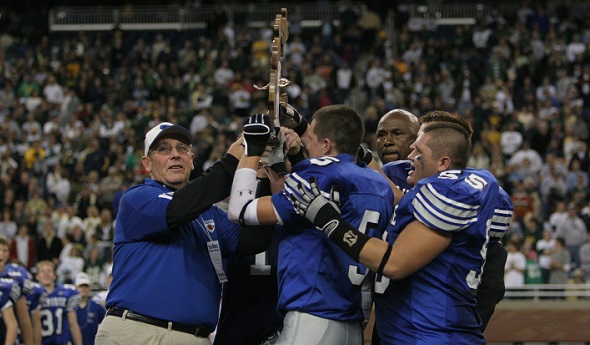
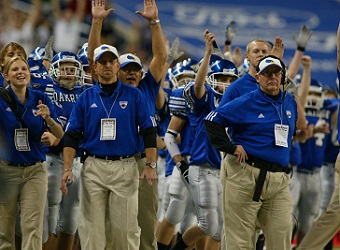
PHOTOS: (Top) Former Muskegon Oakridge football coach Jack Schugars holds up the 2005 Division 5 championship trophy with his players after their victory at Ford Field. (Middle) Schugars (right, with headset) monitors his team's play on the field against Jackson Lumen Christi.
Drive for Detroit: Week 8 in Review
October 20, 2014
By Geoff Kimmerly
Second Half editor
Just when we think we’ve got this season figured out … Week 8 happens.
How are these for scores that command a double-take?
- Mattawan, fighting for a playoff berth, beats a league champion in Stevensville Lakeshore 12-10.
- Caledonia hands Lowell its first shutout in 16 years, 33-0.
- Dearborn, also fighting for a playoff berth, delivers local rival Robichaud its first loss, 28-12.
The second-to-last week of the regular season did have more happy than sad as another batch of automatic qualifiers was added and the group of possible at-large teams grew:
- Felch North Dickinson saw the longest playoff streak in MHSAA history officially end as it fell to 3-5; the team no longer can qualify for the postseason for the 24th straight season.
- But in New Boston, there was celebration as the team set a school record for wins in moving to 7-1.
- And Burton Atherton backers surely enjoyed clinching their first playoff berth ever after missing by a win two of the last four years.
Read on for details behind more of the most intriguing results to emerge from Week 8 from all over the state:
Bay and Thumb
Flint Beecher 19, Montrose 14
The long-anticipated Genesee Area Conference Red finale played to its billing, with Beecher scoring with 17 seconds left on the clock to earn its first league title since 2009. Montrose (6-2), league champs the last three seasons, could’ve forced a three-way share of this season’s title with a win – Goodrich would’ve been the third team, but finished second. Beecher can finish the regular season undefeated also for the first time since 2009 with a win over Byron on Friday. Click for more from the Flint Journal.
Also noted:
Marine City 39, Warren Woods Tower 14 – Marine City (8-0) got back the Macomb Area Conference Gold championship, keeping second-place Warren Woods-Tower (6-2) from gaining a share.
Bay City Central 26, Mount Pleasant 22 – The Wolves (4-4) can still earn a first playoff berth since 2007 after beating the Oilers (5-3) for the first time in their recent eight-game series.
Lapeer 34, Flint Carman-Ainsworth 31 (OT) – The Lightning (8-0) finished a perfect run through the Saginaw Valley Association Red, but not without some necessary extra work against Carman-Ainsworth (6-2).
Birch Run 27, Millington 21 – The Panthers (7-1) edged the Cardinals (7-1) in the final game on the Tri-Valley East Conference schedule to make those two and Frankenmuth tri-champions after Millington led by a win coming in.
Lower Up North
Whittemore-Prescott 31, Hillman 14
While not a league game, this one unofficially recognized the top team on the northeast side of the Lower Peninsula – and once again it’s Whittemore-Prescott (8-0), which is one more winnable game from its first perfect regular season since 2002. Hillman (7-1) also entered undefeated and a league champion. Click for more from the Bay City Times.
Also noted:
Traverse City West 22, Gaylord 7 – Gaylord (5-3) has been working toward its first playoff berth since 2007, but had to put its celebration off while West (4-4) kept itself in the mix for an at-large bid.
Boyne City 28, Elk Rapids 23 – The Ramblers (8-0) won their eighth game for the third straight season and need one more for a first perfect regular season since 2001; Elk Rapids (4-4) will need help to return to the playoffs.
Mancelona 30, Central Lake 22 – Mancelona (5-3) is still alive for an automatic playoff berth, while Central Lake (4-4) is not and must win this week for a chance at an at-large bid.
Charlevoix 27, Frankfort 6 – The Rayders (5-3) quietly have won three straight to set up for their first playoff appearance since 2009, while forcing Frankfort (5-2) into a must-win situation to return to the postseason after missing the last two years.
Southwest and Border
Watervliet 28, Decatur 19
Make that six straight wins for Watervliet over Decatur, this one for the Southwestern Athletic Conference South championship. The Panthers (7-1) earned a share, giving them at least part of the league title for four straight seasons and seven straight wins this fall after opening with a one-point loss at Gobles. Decatur (7-1) will have more to play for next month, having already qualified for the playoffs as well. Click for more from the St. Joseph Herald-Palladium.
Also noted:
Union City 42, Homer 19 – The Chargers (8-0) finished their second Big 8 Conference title in four years, winning big to keep second-place Homer (6-2) from earning a share.
Fennville 22, Gobles 12 – This, combined with Bangor’s upset of Saugatuck, created a three-team tie atop the SAC North standings between Saugatuck (5-3), Fennville (5-3) and Gobles (6-2).
Constantine 35, Olivet 14 – The Kalamazoo Valley Association champ Falcons (7-1) bounced back from its first loss by doubling up former league rival Olivet (6-2), the champ in the first-year Greater Lansing Activities Conference.
Edwardsburg 42, Berrien Springs 21 – The Eddies earned a share of the Wolverine B Conference West championship against second-place Berrien Springs (5-3), which will need a major upset of Edwardsburg by Coloma this week to also gain a share.
Upper Peninsula
Marquette 9, Negaunee 8
The wind and rain couldn’t distract Marquette kicker Max Bednarek, who drilled a game-winning 22-yard field goal as time ran out to push the Redmen to 7-1. Marquette trailed 8-0 and went for two unsuccessfully after scoring its lone touchdown. Negaunee has now lost three games this season by five points or fewer, and at 4-4 will need some help to earn an at-large playoff bid. Click for more from the Marquette Mining Journal.
Also noted:
Lake Linden-Hubbell 36, Felch North Dickinson 30 – The Lakes (7-1) have built their best record since 2010 with three wins by eight or fewer points, while North Dickinson (3-5) officially won’t make the playoffs for the first time since 1990 after its third loss of six points or fewer.
Bark River-Harris 44, Powers North Central 22 – The Broncos (6-2) bounced back from a disappointing loss to Mid-Eastern Football Conference champ Munising to earn its first playoff appearance since 2009.
Iron Mountain 23, Hurley, Wis. 22 – The Moutaineers (5-3) put themselves in a win-and-in playoff scenario this week in part by going for two after a late score against Hurley (7-2) to create a two-possession game, and then holding the ball until nearly the end so Hurley didn’t get another chance.
Crystal Falls Forest Park 53, Bessemer 14 – The Trojans (6-1) can’t win the Great Western Conference this time, but are undefeated in Michigan with their lone loss to Hurley; Bessemer, at 4-3 but playing only eight 11-player games, can still qualify with a win this week against Ironwood.
Mid-Michigan
Clare 30, Harrison 29
Clare (6-2) has come up with the right recipe for winning the Jack Pine Conference. For the third straight season, the Pioneers have opened 0-2 against top nonleague competition and gone on to win the league, and can clinch it outright this week against Roscommon. But Harrison gave Clare its toughest challenge of any team during this eight-season title run – Clare trailed by as many as 16, and a potential game-winning field goal for the Hornets (7-1) fell just short. Click for more from the Mount Pleasant Morning Sun.
Also noted:
Fowler 20, Pewamo-Westphalia 13 – One of the best rivalries in this region decided a league championship again; Fowler (8-0) claimed the Central Michigan Athletic Conference title, while Pewamo-Westphalia (6-2) fell to second place.
Lansing Sexton 21, Lansing Everett 12 – This was all a neighborly rivalry game should be, with Everett holding Sexton to its second-fewest points this season and the Big Reds (8-0) keeping the Vikings (5-3) to their fewest.
Haslett 43, Williamston 23 – The Vikings (4-4) looked likely to miss the playoffs for the second time in three seasons, but upsetting Williamston (6-2) helps their at-large chances significantly.
Hanover-Horton 34, Grass Lake 28 – Not only had Hanover-Horton not beaten Grass Lake (5-3) since 2005, the Comets (7-1) had scored only a combined 15 points in their last five losses to the Warriors.
West Michigan
Caledonia 33, Lowell 0
The Fighting Scots just keep piling up impressive wins. After Caledonia (6-2) lost to Grand Rapids Forest Hills Central by 12 in Week 3, there probably weren't many who would've believed the Scots would go on to beat Rockford and now Lowell by a combined 75-0. Because of that Forest Hills Central loss, Caledonia only shares first place in the Ottawa-Kent Conference White with the Red Arrows (7-1), but both can clinch a share of the title this week. Click for more from the Grand Rapids Press.
Also noted:
Reed City 60, Remus Chippewa Hills 32 – The Coyotes (7-1) earned a share of the Central State Activities Association Gold title while keeping Chippewa Hills (6-2) from the same.
Cedar Springs 48, Greenville 16 – The Red Hawks (7-1) earned a share of the O-K Bronze title, its first league championship since 1978, while forcing Greenville (4-4) into an at-large playoff scenario.
East Kentwood 35, Rockford 3 – The Falcons (7-1) looked capable of beating Rockford (6-2) to push both into a tie atop the O-K Red standings, but the final margin was much more unexpected.
East Grand Rapids 31, Grand Rapids Christian 7 – The Pioneers (5-3) look good for the playoffs with 1-7 Jenison up this week, and left Christian (5-3) in a tougher position with the Eagles now facing Caledonia.
Greater Detroit
Southfield 20, Oak Park 16
The Bluejays (6-2) swooped in for a share of their second straight Oakland Activities Association White championship after falling a game behind with a Week 5 loss to Farmington Hills Harrison. Oak Park (6-2) had beaten Harrison and entered Week 8 atop the league, but couldn’t break Southfield’s defense – which held the Knights 22 points below their average. Harrison ended up with a share of the league title as well with Oak Park’s loss. Click for more from the Detroit Free Press.
Also noted:
Harper Woods Chandler Park 22, Warren Michigan Collegiate 13 – Chandler Park (6-2) won this deciding game in the Charter School Conference, sending Michigan Collegiate (7-1) into second place; Chandler Park is 34-1 in league play since its start in 2009.
Farmington 24, Birmingham Groves 20 – The Falcons (7-1) finished their bounce-back from 2-7 last season to OAA Blue champs this fall by edging second-place Groves (6-2).
Ypsilanti Lincoln 28, Ypsilanti Community 27 – Lincoln (6-2) won the Southeastern Conference White outright for the second straight year despite trailing Community (5-3) at one point by three scores.
Detroit Cass Tech 19, Detroit East English 12 – The Technicians (8-0) advanced to meet Martin Luther King in the Detroit Public School League Final thanks to three fourth-quarter touchdowns by standout running back Mike Weber; East English (5-3) must win this week to guarantee an MHSAA playoff berth.
8-Player
Peck 30, Deckerville 28 (OT)
This has become arguably the best rivalry in 8-player football (the argument being against Rapid River/Cedarville). Peck (8-0) made it 21 straight wins including three straight over Deckerville, although the Eagles made it plenty tough by scoring first in overtime and also leading into the fourth quarter. The win gives Peck the North Central Thumb League title outright while dropping Deckerville (6-2) into second place.
Also noted:
Battle Creek St. Philip 48, Portland St. Patrick 0 – This battle of undefeateds didn't match up to that expectation, but these two have history of meeting again during the playoffs.
Cedarville 57, Bellaire 14 – This one too didn't necessarily match up to a matchup of teams with a combined one loss, with Cedarville dominating to match Bellaire at 7-1 overall and second place in the Bridge Football Alliance.
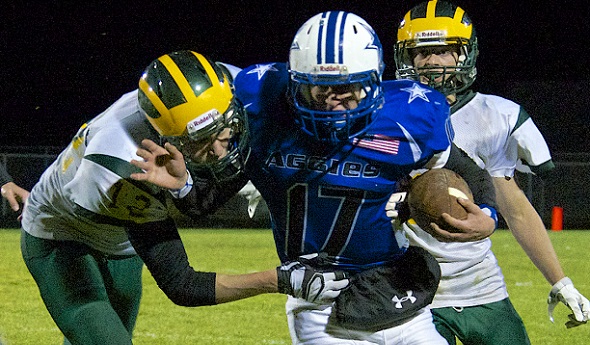
PHOTO: Beal City, carrying the ball, defeated McBain on Friday to claim a share of the championship in the Highland Conference. (Click to see more from HighSchoolSportsScene.com).