

Oakridge's Schugars Always To Be 'Coach'
April 26, 2013
By Geoff Kimmerly
Second Half editor
Jack Schugars led five Muskegon Oakridge teams to MHSAA football championship games during his 32 seasons running the program. He finished his high school coaching career in 2010 with a record of 262-78.
And of course, he impacted hundreds of lives in a community that, according to a former assistant, considers him a "saint."
Schugars was honored last week with the Duffy Daugherty Award for his outstanding achievements in high school football. Each spring, the Duffy Daugherty committee – made up of football supporters and media from the Lansing area – recognizes a high school coach along with a past or current college coach. The college award is among those recognized by the College Football Hall of Fame.
Among previous high school honorees present to congratulate Schugars during Thursday's banquet in East Lansing were Farmington Hills Harrison’s John Herrington, Birmingham Brother Rice’s Al Fracassa and former East Lansing coach Jeff Smith.
Schugars – now an assistant at Ferris State University – led his 1997, 2005 and 2008 teams to MHSAA titles, while his 1990 and 2003 teams finished MHSAA runners-up. He is a member of the Muskegon Sports Hall of Fame (class of 2009), the Michigan High School Coaches Association Hall of Fame (2008) and the Michigan High School Football Coaches Association Hall of Fame (1993). He received the MHSFCA’s highest honor, the Jim Crowley Award, in 2000.
The Schugars family is rooted in education. He also taught biology at the high school for 38 years, while his wife Julie taught English. Their daughter Amanda teaches in Battle Creek, and son Eric teaches and is the defensive coordinator at Traverse City Central.
Below are brief excerpts from the introduction of Schugars by his former football assistant and current Oakridge softball coach Joe Coletta, followed by Schugars' closing words of wisdom.
‘Faith, Family, Football’
(Coletta) “To Jack, those are not just words of hollow meaning. They are his compass.
 “Jack has won countless awards for his accomplishments on the football field. He absolutely refused to let anyone outwork him or his teams in preparation for a football game.
“But in my opinion, his strength as a football coach is his ability to take a kid that most people would give up on: a kid that some might label as no good, troublemaker, not worth the effort. He found a way to love the unlovable.
“He would give those kids direction; he would mentor them to be young men and young women and take them to where they could not possibly take themselves.
"When you can do that for a person, you let them see their worth as a human being and make a lasting impact so you can change the rest of their lives.
“That, to me, is what sets Jack apart from most coaches.”
What's most important
(Schugars) “The reason I'm on this Earth is to love the Lord your God with all my heart and soul and love your neighbors as yourself.
“So when I speak at clinics, when I talk to coaches, I tell them the greatest thing they can do for their team is to love their players.
“That is the greatest thing a coach can do. Love your players and be true role models each day.
“I could not ask for a better career than when ... a (former) player in the Navy Seal team calls me Coach. Lawyers, doctors, bankers, they call you Coach.
"Wow, that's a great word: Coach. That's what it's all about. Being a coach. Building relationships that will last a lifetime.
"I love the hundreds of players that are part of the Oakridge football family. And I hope I continue to build men out of boys, continue at the college level."
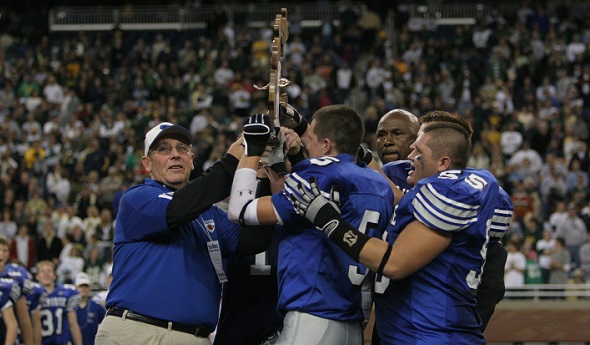
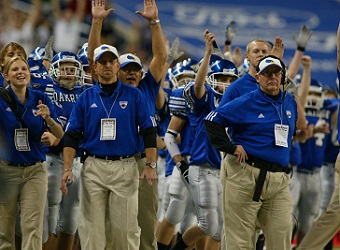
PHOTOS: (Top) Former Muskegon Oakridge football coach Jack Schugars holds up the 2005 Division 5 championship trophy with his players after their victory at Ford Field. (Middle) Schugars (right, with headset) monitors his team's play on the field against Jackson Lumen Christi.
Drive for Detroit: Week 5 in Review
September 29, 2014
By Geoff Kimmerly
Second Half editor
No set up is needed to explain the significance of many of the games played across Michigan during Week 5 of the MHSAA football season.
The scores speak for themselves.
Read on for some of the details behind a wide array of results that wowed many over this weekend.
In addition, Ishpeming (5-0) became the first playoff qualifier for 2014, and Battle Creek St. Philip put up one of the most incredible point totals in MHSAA history – 89 points after trailing early in its 8-player win.
Total, seven games this weekend saw teams combine to score more than 100 points – while six games saw both teams score in single digits, including one of the matchups highlighted below.
Bay and Thumb
Goodrich 41, Montrose 39
The game of the season in the Genesee Area Conference Red was shaping up as Montrose vs. Flint Beecher on Oct. 17 – until Goodrich changed things up substantially by ending the Rams’ 22-game league winning streak. That Beecher/Montrose matchup might still decide part of the league title – but Goodrich is back in play as a contender. Click for more from the Flint Journal.
Also noted:
Almont 23, Richmond 6 – The Raiders (5-0) remained perfect while ending a 12-game Blue Water Area Conference winning streak for Richmond (4-1).
Lapeer 63, Mount Pleasant 0 – This is the most impressive win of an early run by the first-year Lightning (5-0), which looks like the Saginaw Valley Association Red favorite after dominating the Oilers (3-2).
Burton Atherton 34, Flint Hamady 22 – Atherton (4-1) still trails in the Genesee Area Conference Blue by a win, but knocked Hamady (4-1) out of a tie for first.
Millington 30, North Branch 29 – Only a week after a huge win over rival Frankenmuth, Millington (5-0) just survived against the Broncos (1-4) to remain atop the Tri-Valley Conference East.
Southwest and Border
Battle Creek Lakeview 27, Stevensville Lakeshore 0
Lakeview has had plenty of success the last few seasons and is 19-3 over its last 22 games, two playoff losses included. But this might be the most impressive win of the run – although Lakeshore plays in the Southwest Michigan Athletic Conference East and Lakeview in the West, the Spartans (3-1) still should celebrate their first win (and in impressive fashion) over the Lancers (4-1) since 2001. Click for more from the Battle Creek Enquirer.
Also noted:
Battle Creek Central 21, St. Joseph 10 – The Bearcats (3-2) already have their most wins since 2008 and now an upset of one of the best teams annually from the southwest in St. Joseph (3-2).
Plainwell 31, Vicksburg 21 – The Wolverine B Conference East title may have been decided Friday, with Plainwell (4-1) bouncing back from a Week 4 loss to slow the upstart Bulldogs (4-1).
Paw Paw 62, Edwardsburg 57 – The favorites in the Wolverine B West also met and combined for more than 100 points for the second straight season as Paw Paw (3-2) took a 2-1 advantage on Edwardsburg (4-1) in their recent series.
South Haven 34, Dowagiac 28 – South Haven (2-3) hadn’t beaten Dowagiac since 2007 – or scored a point on the Chieftains (2-3) since 2011.
Lower Up North
Boyne City 28, Traverse City St. Francis 27 (OT)
This victory will become "legendary" if it ends up deciding the first Northern Michigan Football Conference Legends title. Boyne City (5-0) held on to first place after choosing to go for a 2-point conversion instead of an extra point that would’ve instead sent the game into a second overtime. Both losses for St. Francis (3-2) this season have come in OT. Click for more from the Petoskey News.
Also noted:
Traverse City Central 18, Gaylord 7 – The Big North Conference race is getting whittled down, with Central (4-1) putting much improved Gaylord (4-1) a game back of the leaders.
Suttons Bay 48, Charlevoix 19 – The Norsemen (4-1) with a win over East Jordan this week can clinch a share of the NMFC Legacy title; Charlevoix (2-3) must win out to guarantee a playoff berth.
Manistee 30, McBain 20 – The Chippewas (4-1) broke a four-game losing streak to McBain (2-3) to surpass last season’s win total with four more games to play.
Whittemore-Prescott 34, Lincoln Alcona 0 – The Cardinals (5-0) clinched a share of the North Star League’s Huron Shores title, although Alcona (3-2) can still gain a share with some Week 7 help from Rogers City.
Greater Detroit
Clarkston 42, Oxford 14
Clarkston (5-0) left no doubt which is the top team again in the Oakland Activities Association Red, downing Oxford (4-1) to go with previous wins over Rochester Hills Stoney Creek and surprise contender West Bloomfield. The Wolves, defending MHSAA Division 1 champions, broke open the game at the end of the first half and pulled away during the second. Click for more from the Detroit Free Press.
Also noted:
West Bloomfield 39, Lake Orion 0 – The Lakers (4-1) are off to their best start since 2000 with their only loss to Clarkston; Lake Orion (2-3) finds itself needing to win out to avoid missing the playoffs for the first time since 2000.
Farmington Hills Harrison 34, Southfield 27 (3 OT) – Harrison (4-1) kept its hopes alive for a share of the OAA White title, but now needs help from Southfield (3-2) against league leader Oak Park in Week 8.
Waterford Mott 20, Walled Lake Western 17 – Mott (4-1) equaled its highest win totals of the last six seasons and kept a share of the top spot in the Kensington Lakes Activities Association North by upending reigning champion Western (4-1).
Warren Woods-Tower 16, Madison Heights Madison 14 – Madison (4-1) had won 20 straight regular-season games, although Woods-Tower (5-0) nearly broke the streak in 2013 after becoming the first to fall in 2012.
West Michigan
Caledonia 42, Rockford 0
Caledonia opened this season with two impressive wins and looked like a team to watch until then falling to 2-2 (although those losses were to talented teams as well). Put the Fighting Scots (3-2) back on the watch list; over the last decade, only powerhouse Muskegon has managed to put this kind of loss on Rockford (4-1). Click for more from the Grand Rapids Press.
Also noted:
Grand Rapids Christian 35, Hudsonville 34 – Only the shock of the above result kept this from being the area’s most intriguing game of the weekend; Christian (4-1) scored the go-ahead points during the final minutes, delivering Hudsonville (3-2) its second one-point loss in successive weeks.
Grandville Calvin Christian 29, Wyoming Godwin Heights 28 – The Squires (2-3) trail by a win in the O-K Silver standings but still have hope for the playoffs after giving Godwin Heights (4-1) its first loss.
Grand Rapids South Christian 41, Grand Rapids Catholic Central 14 – Just when it looked like the Sailors (3-2) might struggle after opening with two losses (albeit against strong teams), they’re looking good to win out in the O-K Gold; GRCC (2-3) must do the same to guarantee a seventh straight playoff berth.
Muskegon Oakridge 36, Ravenna 20 – Oakridge (4-1) still owns supremacy in the West Michigan Conference although Ravenna (4-1) is poised to take a share of the league title if the Eagles fall over the next three weeks.
Mid-Michigan
Manchester 18, Hanover-Horton 16
The Flying Dutchmen dissolved a little of the thrill of Hanover-Horton’s turnaround season with a goalline stand that set up this week’s likely Cascades Conference championship game against Grass Lake. Both are undefeated in conference play – Manchester (4-1 overall) has played one more game – while Hanover-Horton sits tied for third but still 4-1 overall and with a strong shot at its first playoff berth since 2008. Click for more from the Jackson Citizen-Patriot.
Also noted:
Charlotte 42, Parma Western 35 – The Orioles (2-3) delivered another heart-breaker to Western (2-3) which has three losses by seven points or fewer.
Fowler 27, Dansville 6 – The Eagles (5-0) are setting up a Week 8 championship game against Pewamo-Westphalia after the two more or less eliminated Dansville (3-2) from Central Michigan Athletic Conference contention over the last two weeks.
Eaton Rapids 9, Portland 7 – This was another sign Eaton Rapids (3-2) has turned a corner as a program; after falling badly to Williamston in Week 4, the Greyhounds hung in a nail-biter against improving Portland (3-2).
Homer 40, Jonesville 16 – The Big 8 Conference looks to be a two-team race after Homer (5-0) dropped Jonesville (3-2) into third behind the Trojans and also-undefeated Union City.
Upper Peninsula
Bark River-Harris 22, Felch North Dickinson 18
Bark River-Harris (4-1) hasn’t won more than two games in a season since 2009 – and its four wins this fall equal the total of the last four seasons combined. The Broncos have won all four after losing on opening night to Crystal Falls Forest Park, but beating North Dickinson was by far the most impressive as the Nordics (3-2) are playoff regulars and went 8-3 a year ago. Click for more from the Escanaba Daily Press.
Also noted:
Iron Mountain 13, Ishpeming Westwood 8 – The Mountaineers (3-2) are shaping up as second-best in the Mid-Peninsula Athletic Conference, with Westwood (3-2) falling after two straight losses.
Marquette 21, Gladstone 13 – The Great Northern U.P. Conference race is again looking like Marquette (4-1) vs. Menominee, with Gladstone (3-2) falling to both in successive weeks.
St. Ignace 28, Johannesburg-Lewiston 0 – The Saints (5-0) are alone atop the Ski Valley Conference with the Cardinals (4-1) now in a tie for second place.
Hurley, Wis., 32, Bessemer 26 – Hurley (5-1) clinched a share of the Great Western Conference title while Bessemer (3-2) fell to third place despite a strong effort.
8-Player
Waldron 66, Webberville 46
When these two have met the last two seasons, it's been busy for the scoreboard operator. Waldron (4-1) scored its most points since Week 6 in 2012, and also scored its season-high points in 2013 in a 56-54 win over the Spartans (3-2). Click for more from the Hillsdale Daily News.
Also noted:
Kingston 26, Dryden 24 – The Cardinals (3-2) surpassed last season’s win total and kept a foot in the North Central Thumb 8-Man League race while handing Dryden (3-2) its second straight loss.
Big Rapids Crossroads Academy 26, Burton Madison 24 – The Cougars (1-4) earned their first win in 8 or 11-player since 2010.
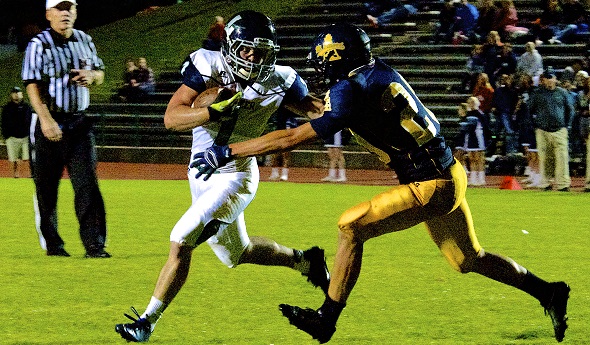
PHOTO: Lapeer, in its first season after former schools West and East combined this summer, is off to a 5-0 start. (Click to see more from HighSchoolSportsScene.com).