

Oakridge's Schugars Always To Be 'Coach'
April 26, 2013
By Geoff Kimmerly
Second Half editor
Jack Schugars led five Muskegon Oakridge teams to MHSAA football championship games during his 32 seasons running the program. He finished his high school coaching career in 2010 with a record of 262-78.
And of course, he impacted hundreds of lives in a community that, according to a former assistant, considers him a "saint."
Schugars was honored last week with the Duffy Daugherty Award for his outstanding achievements in high school football. Each spring, the Duffy Daugherty committee – made up of football supporters and media from the Lansing area – recognizes a high school coach along with a past or current college coach. The college award is among those recognized by the College Football Hall of Fame.
Among previous high school honorees present to congratulate Schugars during Thursday's banquet in East Lansing were Farmington Hills Harrison’s John Herrington, Birmingham Brother Rice’s Al Fracassa and former East Lansing coach Jeff Smith.
Schugars – now an assistant at Ferris State University – led his 1997, 2005 and 2008 teams to MHSAA titles, while his 1990 and 2003 teams finished MHSAA runners-up. He is a member of the Muskegon Sports Hall of Fame (class of 2009), the Michigan High School Coaches Association Hall of Fame (2008) and the Michigan High School Football Coaches Association Hall of Fame (1993). He received the MHSFCA’s highest honor, the Jim Crowley Award, in 2000.
The Schugars family is rooted in education. He also taught biology at the high school for 38 years, while his wife Julie taught English. Their daughter Amanda teaches in Battle Creek, and son Eric teaches and is the defensive coordinator at Traverse City Central.
Below are brief excerpts from the introduction of Schugars by his former football assistant and current Oakridge softball coach Joe Coletta, followed by Schugars' closing words of wisdom.
‘Faith, Family, Football’
(Coletta) “To Jack, those are not just words of hollow meaning. They are his compass.
 “Jack has won countless awards for his accomplishments on the football field. He absolutely refused to let anyone outwork him or his teams in preparation for a football game.
“But in my opinion, his strength as a football coach is his ability to take a kid that most people would give up on: a kid that some might label as no good, troublemaker, not worth the effort. He found a way to love the unlovable.
“He would give those kids direction; he would mentor them to be young men and young women and take them to where they could not possibly take themselves.
"When you can do that for a person, you let them see their worth as a human being and make a lasting impact so you can change the rest of their lives.
“That, to me, is what sets Jack apart from most coaches.”
What's most important
(Schugars) “The reason I'm on this Earth is to love the Lord your God with all my heart and soul and love your neighbors as yourself.
“So when I speak at clinics, when I talk to coaches, I tell them the greatest thing they can do for their team is to love their players.
“That is the greatest thing a coach can do. Love your players and be true role models each day.
“I could not ask for a better career than when ... a (former) player in the Navy Seal team calls me Coach. Lawyers, doctors, bankers, they call you Coach.
"Wow, that's a great word: Coach. That's what it's all about. Being a coach. Building relationships that will last a lifetime.
"I love the hundreds of players that are part of the Oakridge football family. And I hope I continue to build men out of boys, continue at the college level."
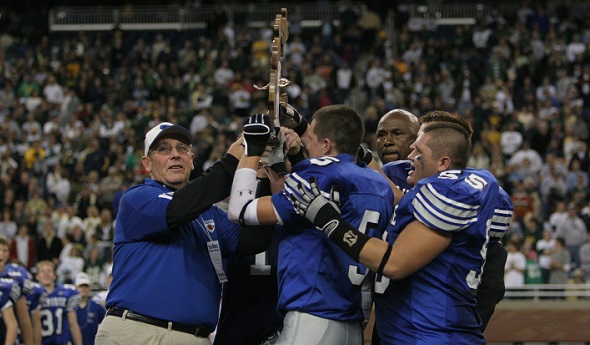
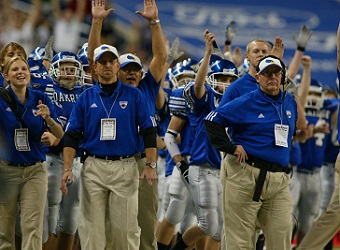
PHOTOS: (Top) Former Muskegon Oakridge football coach Jack Schugars holds up the 2005 Division 5 championship trophy with his players after their victory at Ford Field. (Middle) Schugars (right, with headset) monitors his team's play on the field against Jackson Lumen Christi.
A Game for Every Fan: District Openers
October 31, 2013
By Geoff Kimmerly
Second Half editor
A handful of MHSAA football teams always are safe to expect at Ford Field when we finish the annual five-week Finals run into Thanksgiving weekend.
But if the record number of at-large qualifiers – 31 – or the difficulty in picking the best first-round matchups are indications, this weekend could be ripe for plenty of the unexpected.
A total of 38 teams enter the playoffs perfect for the regular season. Ithaca is riding a national-record 51-game winning streak and seeking its fourth straight Division 6 title, while Detroit Cass Tech and Birmingham Brother Rice are going for their third straight each in Divisions 1 and 2, respectively.
How they might fare this time will be easier to predict over the next few weeks. But first things first, and in this case it’s our forecast of the best District openers all over the state this weekend. (Click to see the entire schedule, with dates, times and locations.)
Division 1
Detroit Catholic Central (7-2) at Northville (8-1)
Arguably the most competitive District in any division also includes Canton and Walled Lake Western, but Northville finished ahead of both to win the Kensington Lakes Activities Association. That doesn’t necessarily make the Mustangs favored. DCC’s only marks against came against reigning Division 2 champion Birmingham Brother Rice, and the Shamrocks have plenty of know-how in the postseason – they’ve finished Division 1 runner-up the last two seasons.
Others that caught my eye: East Kentwood (5-4) at Hudsonville (6-3), Rochester Hills Stoney Creek (6-3) at Rochester Adams (6-3), Belleville (6-3) at Saline (8-1), Canton (8-1) at Walled Lake Western (8-1).
Division 2
Southfield (7-2) at Birmingham Seaholm (8-1)
This is a meeting of Oakland Activities Association champions, with OAA White winner Southfield hoping to bounce back after last week’s loss to Red champ Clarkston. Blue champ Seaholm also lost in Week 9, to Detroit U-D Jesuit. The Bluejays have been considered MHSAA contenders since the preseason, but the Maples quietly are 16-3 over the last two years and poised to take the next step.
Others that caught my eye: Midland Dow (7-2) at Fenton (8-1), Muskegon Reeths-Puffer (7-2) at Muskegon (8-1), Ypsilanti Lincoln (7-2) at Wyandotte Roosevelt (9-0), Taylor Truman (7-2) at Allen Park (7-2).
Division 3
Zeeland East (5-4) at Zeeland West (8-1)
It’s fair to assume this won’t be much of a game – East got in with an at-large bid and its worst record since 2009. But there’s too much history to ignore. East did win their first matchup this season, in Week 2, 50-44. And after the Chix cruised to a 9-0 regular season in 2012, West upset them during the District opener. More payback would be the best way to end a four-game losing streak for East – although West hasn’t lost again this fall since that early defeat.
Others that caught my eye: Detroit Denby (7-2) at Detroit Mumford (7-2), Eaton Rapids (5-4) at Charlotte (7-2), Haslett (6-3) at DeWitt (9-0), Riverview (7-2) at Melvindale (7-2).
Division 4
Battle Creek Pennfield (8-1) at Paw Paw (8-1)
League champions clash in the best Division 4 game of opening night, Paw Paw from the Wolverine B Conference East and Pennfield from the Kalamazoo Valley Association. Pennfield has made the playoffs every season under the current format, which began in 1999 – but enters this run with perhaps its best defense of the bunch after giving up seven or fewer points in six games. Paw Paw is coming off a disappointing loss to Edwardsburg last week, but has been similarly sturdy stopping opponents – Week 9 was the first the Redskins gave up more than 14 points in a game.
Others that caught my eye: Harper Woods Chandler Park (7-2) at Richmond (8-1), Dowagiac (6-3) at Edwardsburg (9-0), Dearborn Heights Robichaud (6-3) at Pontiac Notre Dame Prep (7-2), Yale (6-3) at Saginaw Swan Valley (9-0).
Division 5
Grand Rapids West Catholic (5-4) at Portland (7-1)
Just as this matchup was tough to predict when these teams met for the Division 5 championship last season, it’s hard to read again this fall. The Raiders rebuilt quickly, with their lone loss two weeks ago to Division 3 contender DeWitt, 13-7. West Catholic made the playoffs with an at-large bid after a one-point win in Week 9 – but has won four straight after opening 0-3.
Others that caught my eye: Kingsford (7-2) at Grayling (8-1), Clare (7-2) at Reed City (9-0), Olivet (8-1) at Hopkins (7-2), River Rouge (8-1) at Monroe St. Mary Catholic Central (8-1).
Division 6
Reese (8-1) at Montrose (9-0)
Judging by last week’s Genesee Area Conference Blue deciding game, it's fair to guess this might not be much of a contest – Montrose ran past second-place Lake Fenton 37-0 to claim the title outright and also beat Reese 38-8 on opening night. But the Rockets haven’t loss since or scored fewer than 41 points since the first week of October.
Others that caught my eye: Elk Rapids (6-3) at Boyne City (7-2), Marlette (8-1) at Saginaw Nouvel (8-1), Schoolcraft (8-1) at Niles Brandywine (8-1), Manchester (7-2 at Grass Lake (8-1).
Division 7
Saugatuck (8-1) at Pewamo-Westphalia (8-1)
One of these teams has reached MHSAA semifinals each of the last three seasons and both have advanced to Ford Field once during that time. And each has prepared well this season against similar or bigger foes – Saugatuck’s lone loss was to playoff qualifier Decatur and it beat Division 6 qualifier Hartford. Pewamo-Westphalia beat Division 5 qualifier Lansing Catholic and lost only to Division 8 powerhouse New Lothrop.
Others that caught my eye: Traverse City St. Francis (5-4) at Iron River West Iron County (9-0), Royal Oak Shrine (6-3) at Madison Height Bishop Foley (6-3), St. Joseph Lake Michigan Catholic (6-2) at Cassopolis (6-3), Whittemore-Prescott (6-3) at Lake City (8-1).
Division 8
Bessemer (6-3) at Crystal Falls Forest Park (9-0)
We discussed this game at length when these teams met only two weeks ago and Forest Park celebrated avenging a 2012 loss to the Miners to this time clinch the Great Western Conference title outright. A win for Bessemer in this game would be even bigger as the Trojans are attempting to bounce back after failing to reach the District Finals last season for the first time since 2002.
Others that caught my eye: Munising (6-3) at Powers North Central (7-2), Mio (7-2) at Beal City (9-0), Clarkston Everest Collegiate (7-2) at Waterford Our Lady (7-2), Mount Pleasant Sacred Heart (6-3) at Coleman (7-2).
8-Player
Deckerville (5-4) at Peck (9-0)
Last season’s champion opens these playoffs against one of the favorites according to playoff points average. Deckerville won the MHSAA championship in 2012, the team's first season of 8-player, and won two of its final three regular season games this fall. Peck is one of three 9-0 teams in 8-player and owns the third-highest playoff point average in the division. The Pirates beat Deckerville 56-8 only two weeks ago.
Others that caught my eye: Akron-Fairgrove (7-2) at Owendale-Gagetown (8-1), Casonville Port-Sanilac (6-3) at Portland St. Patrick (7-2), Bellaire (5-4) at Kinde-North Huron (6-3), Engadine (5-4) at Cedarville (8-1).
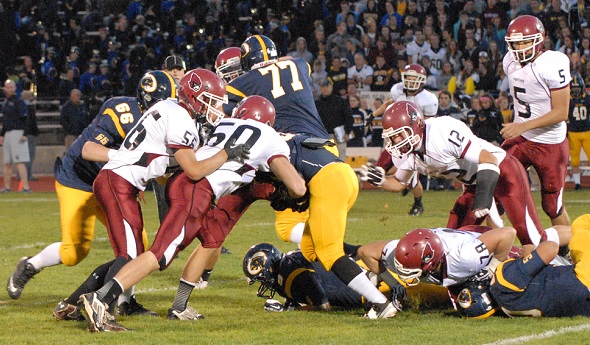
PHOTO: DeWitt (blue helmets) and Portland met in a Week 7 battle of undefeated teams, and both are considered Ford Field possibilities – DeWitt in Division 3 and Portland in Division 5. (Click to see more from High School Sports Scene.)