

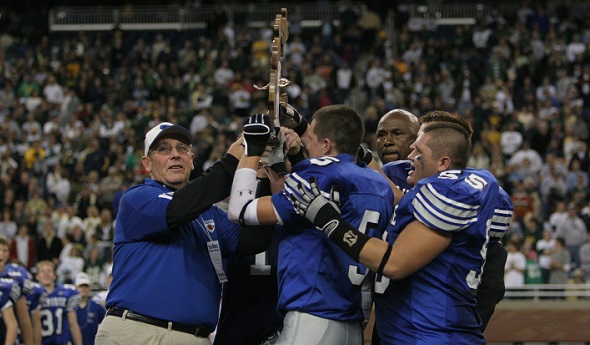
Oakridge's Schugars Always To Be 'Coach'
April 26, 2013
By Geoff Kimmerly
Second Half editor
Jack Schugars led five Muskegon Oakridge teams to MHSAA football championship games during his 32 seasons running the program. He finished his high school coaching career in 2010 with a record of 262-78.
And of course, he impacted hundreds of lives in a community that, according to a former assistant, considers him a "saint."
Schugars was honored last week with the Duffy Daugherty Award for his outstanding achievements in high school football. Each spring, the Duffy Daugherty committee – made up of football supporters and media from the Lansing area – recognizes a high school coach along with a past or current college coach. The college award is among those recognized by the College Football Hall of Fame.
Among previous high school honorees present to congratulate Schugars during Thursday's banquet in East Lansing were Farmington Hills Harrison’s John Herrington, Birmingham Brother Rice’s Al Fracassa and former East Lansing coach Jeff Smith.
Schugars – now an assistant at Ferris State University – led his 1997, 2005 and 2008 teams to MHSAA titles, while his 1990 and 2003 teams finished MHSAA runners-up. He is a member of the Muskegon Sports Hall of Fame (class of 2009), the Michigan High School Coaches Association Hall of Fame (2008) and the Michigan High School Football Coaches Association Hall of Fame (1993). He received the MHSFCA’s highest honor, the Jim Crowley Award, in 2000.
The Schugars family is rooted in education. He also taught biology at the high school for 38 years, while his wife Julie taught English. Their daughter Amanda teaches in Battle Creek, and son Eric teaches and is the defensive coordinator at Traverse City Central.
Below are brief excerpts from the introduction of Schugars by his former football assistant and current Oakridge softball coach Joe Coletta, followed by Schugars' closing words of wisdom.
‘Faith, Family, Football’
(Coletta) “To Jack, those are not just words of hollow meaning. They are his compass.
 “Jack has won countless awards for his accomplishments on the football field. He absolutely refused to let anyone outwork him or his teams in preparation for a football game.
“But in my opinion, his strength as a football coach is his ability to take a kid that most people would give up on: a kid that some might label as no good, troublemaker, not worth the effort. He found a way to love the unlovable.
“He would give those kids direction; he would mentor them to be young men and young women and take them to where they could not possibly take themselves.
"When you can do that for a person, you let them see their worth as a human being and make a lasting impact so you can change the rest of their lives.
“That, to me, is what sets Jack apart from most coaches.”
What's most important
(Schugars) “The reason I'm on this Earth is to love the Lord your God with all my heart and soul and love your neighbors as yourself.
“So when I speak at clinics, when I talk to coaches, I tell them the greatest thing they can do for their team is to love their players.
“That is the greatest thing a coach can do. Love your players and be true role models each day.
“I could not ask for a better career than when ... a (former) player in the Navy Seal team calls me Coach. Lawyers, doctors, bankers, they call you Coach.
"Wow, that's a great word: Coach. That's what it's all about. Being a coach. Building relationships that will last a lifetime.
"I love the hundreds of players that are part of the Oakridge football family. And I hope I continue to build men out of boys, continue at the college level."
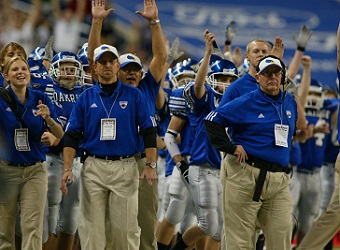
PHOTOS: (Top) Former Muskegon Oakridge football coach Jack Schugars holds up the 2005 Division 5 championship trophy with his players after their victory at Ford Field. (Middle) Schugars (right, with headset) monitors his team's play on the field against Jackson Lumen Christi.

A Game for Every Fan: Week 6
September 27, 2012
By Geoff Kimmerly
Second Half editor
Time isn't running out yet on the 2012 MHSAA football season.
But for those with high aspirations, the time has come to make months of preparation pay off.
Four weeks remain in the regular season, meaning every team with at least two wins still has a shot to qualify for the playoffs automatically. It also means most league titles are still in play – although a lot of those opportunities will be lost by the time Saturday's games are done.
Following are this week's best matchups from your corner of the state. And remember to visit the MHSAA Score Center all weekend for updated scores and standings.
(All are tonight unless noted. Go to Score Center for additional dates and kickoff times.)
Mid-Michigan
Carrollton (5-0) at Ithaca (5-0)
It’s not that Ithaca has laid low during this season’s extension to its 33-game winning streak. It’s just that before this week, none of the games was an intriguing enough matchup to mention here – the Yellowjackets beat their strongest opponents so far, Williamston and Saginaw Valley Lutheran, 46-0 and 55-0, respectively. Quarterback Travis Smith, a hero from last season’s Division 6 Final win, has completed 66 percent of his passes for 865 yards and 12 touchdowns and run for eight scores. He’s tough to stop, but Ithaca’s defense might have the bigger challenge this time – Carrollton running back Derrick Nash, who has committed to Central Michigan, is averaging 10 yards per carry with 1,048 yards and 16 touchdowns rushing this fall.
Others that caught my eye: Manchester (4-1) at Grass Lake (4-1), Lake City (5-0) at Beal City (5-0), Lansing Waverly (4-1) at Charlotte (3-2), East Lansing (4-1) at Lansing Everett (5-0).
Southwest and Border
Battle Creek Pennfield (5-0) at Schoolcraft (5-0)
These two have taken slightly different routes to this point, making this game a true test for both. Pennfield has beaten five of the bottom six teams in the Kalamazoo Valley Association standings (two are among three tied for fifth), and those opponents have combined for five wins so far this season. But the Panthers also are the reigning league champions. Schoolcraft owns wins over likely playoff qualifiers Olivet and Constantine, but hasn’t beaten Pennfield since 2009.
Others that caught my eye: Niles Brandywine (4-1) at Buchanan (4-1), Mattawan (5-0) at St. Joseph (3-2), Climax-Scotts (5-0) at Pittsford (4-1), Marcellus (5-0) at Watervliet (5-0).
Greater Detroit
Orchard Lake St. Mary (4-1) at Birmingham Brother Rice (4-1), Saturday
Of all the great matchups that take place in the Detroit Catholic League Central every season, this one might be the best of 2012. Both still must face Detroit Catholic Central – the reigning MHSAA Division 1 runner-up. But so far, thes Eaglets and the Warriors have made the biggest waves and done so coming off MHSAA championships last fall – St. Mary in Division 3 and Brother Rice in Division 2. The Warriors fell to reigning Division 1 champ Detroit Cass Tech 25-18 on opening night in what looked then like the potential game of 2012 in the Detroit area. Then St. Mary beat Cass Tech 13-6 last week. If all of that doesn’t provide enough hype, there’s always the result of last season’s game – a 10-9 Eaglets victory.
Others that caught my eye: Rochester (4-1) at Lake Orion (5-0), Allen Park Cabrini (4-1) at Royal Oak Shrine (4-1), Detroit Central Collegiate (3-2) at Detroit East English (4-1), Ottawa Lake Whiteford (4-1) at Petersburg-Summerfield (4-1).
West Michigan
Grand Rapids Forest Hills Central (4-1) at Lowell (4-1)
Wins over traditional powers Zeeland West (59-58) and East Grand Rapids (43-17) have made this a solid season so far for Forest Hills Central – but this week, the Rangers can take it up another level. Lowell continues to be Lowell – its only loss was to Muskegon, arguably the best team in the state regardless of division, and no other opponent has scored more than seven points. Standout linebackers Colin Schlosser and Nick Lamica may need to come up big again for Forest Hills Central to break an eight-game losing streak against the Red Arrows.
Others that caught my eye: Grand Rapids Christian (4-1) at East Grand Rapids (2-3), Shelby (5-0) at Montague (4-1), Grandville Calvin Christian (4-1) at Hopkins (5-0), Muskegon Mona Shores (4-1) at Muskegon (5-0).
Lower Up North
Traverse City West (4-1) at Traverse City Central (4-1)
West owns an 11-4 edge in this series since the schools split in 1997. But a Central win this time would erase some of those memories – or at least push the one-sidedness out of the conversation for a while. The Trojans’ only loss this season was by three to Grand Haven on opening night, and they’ve already equaled last season’s win total with only two more needed for their most since 1991. This also could eventually decide the Big North Conference title – West has been a power since two divisions combined in 2000, but Central hasn’t won a league title since the schools were still one, in 1996. West’s only loss this season was by four to Grand Rapids Kenowa Hills, also on opening night.
Others that caught my eye: Grayling (5-0) at Elk Rapids (3-2), Pickford (5-0) at Mancelona (5-0), Kingsley (4-1) at Maple City Glen Lake (5-0), Onaway (4-1) at Pellston (4-1).
Upper Peninsula
Crystal Falls Forest Park (5-0) at Iron Mountain North Dickinson (5-0)
North Dickinson, playing only eight regular-season games this season, became the first team in 2012 to qualify for the playoffs. Now Forest Park can do the same by beating the Nordics for a ninth straight time, a streak that has included two playoff victories. This is a clash of likely eventual league champions – North Dickinson needs only a win over Powers North Central next week to claim the Mid-Eastern Football Conference title, while the Trojans already own a win over 2011 Great Western Conference champion Hurley, Wis., and have a one-game lead on two teams in that league.
Others that caught my eye: Menominee (4-1) at Escanaba (2-3), Marquette (4-1) at Kingsford (4-1), Powers North Central (3-2) at Newberry (3-2), Cedarville (5-0) at Rapid River (5-0).
Thumb and Bay
Goodrich (4-1) at Lake Fenton (4-1)
The Blue Devils are tied with Montrose atop the Genesee Area Conference Red standings and playing for their first league title since sharing with the Rams in 2007. They’ve outscored their last four opponents 203-20 since opening this season with a 42-39 loss to Ann Arbor Gabriel Richard. Goodrich fell to Montrose by a point two weeks ago, and would love to jump back into this race with a third-straight win over Lake Fenton – the Martians won last season 27-7.
Others that caught my eye: Midland Dow (3-2) at Bay City Western (5-0), Lapeer East (3-2) at Fenton (4-1), Davison (4-1) at Flint Powers Catholic (5-0), Hemlock (4-1) at Saginaw Swan Valley (4-1).
PHOTO: Ithaca quarterback Travis Smith focuses in on a target during last week's win at Merrill. (Click to see more from HighSchoolSportsScene.com).