

Oakridge's Schugars Always To Be 'Coach'
April 26, 2013
By Geoff Kimmerly
Second Half editor
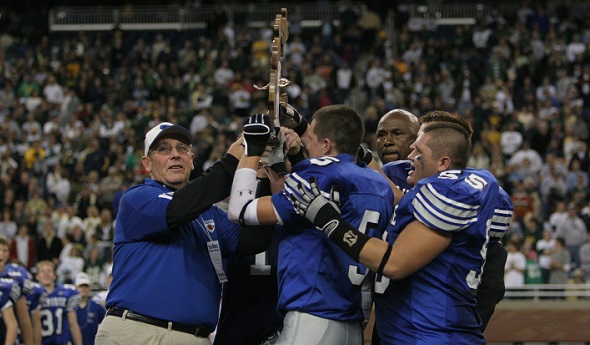
Jack Schugars led five Muskegon Oakridge teams to MHSAA football championship games during his 32 seasons running the program. He finished his high school coaching career in 2010 with a record of 262-78.
And of course, he impacted hundreds of lives in a community that, according to a former assistant, considers him a "saint."
Schugars was honored last week with the Duffy Daugherty Award for his outstanding achievements in high school football. Each spring, the Duffy Daugherty committee – made up of football supporters and media from the Lansing area – recognizes a high school coach along with a past or current college coach. The college award is among those recognized by the College Football Hall of Fame.
Among previous high school honorees present to congratulate Schugars during Thursday's banquet in East Lansing were Farmington Hills Harrison’s John Herrington, Birmingham Brother Rice’s Al Fracassa and former East Lansing coach Jeff Smith.
Schugars – now an assistant at Ferris State University – led his 1997, 2005 and 2008 teams to MHSAA titles, while his 1990 and 2003 teams finished MHSAA runners-up. He is a member of the Muskegon Sports Hall of Fame (class of 2009), the Michigan High School Coaches Association Hall of Fame (2008) and the Michigan High School Football Coaches Association Hall of Fame (1993). He received the MHSFCA’s highest honor, the Jim Crowley Award, in 2000.
The Schugars family is rooted in education. He also taught biology at the high school for 38 years, while his wife Julie taught English. Their daughter Amanda teaches in Battle Creek, and son Eric teaches and is the defensive coordinator at Traverse City Central.
Below are brief excerpts from the introduction of Schugars by his former football assistant and current Oakridge softball coach Joe Coletta, followed by Schugars' closing words of wisdom.
‘Faith, Family, Football’
(Coletta) “To Jack, those are not just words of hollow meaning. They are his compass.
 “Jack has won countless awards for his accomplishments on the football field. He absolutely refused to let anyone outwork him or his teams in preparation for a football game.
“But in my opinion, his strength as a football coach is his ability to take a kid that most people would give up on: a kid that some might label as no good, troublemaker, not worth the effort. He found a way to love the unlovable.
“He would give those kids direction; he would mentor them to be young men and young women and take them to where they could not possibly take themselves.
"When you can do that for a person, you let them see their worth as a human being and make a lasting impact so you can change the rest of their lives.
“That, to me, is what sets Jack apart from most coaches.”
What's most important
(Schugars) “The reason I'm on this Earth is to love the Lord your God with all my heart and soul and love your neighbors as yourself.
“So when I speak at clinics, when I talk to coaches, I tell them the greatest thing they can do for their team is to love their players.
“That is the greatest thing a coach can do. Love your players and be true role models each day.
“I could not ask for a better career than when ... a (former) player in the Navy Seal team calls me Coach. Lawyers, doctors, bankers, they call you Coach.
"Wow, that's a great word: Coach. That's what it's all about. Being a coach. Building relationships that will last a lifetime.
"I love the hundreds of players that are part of the Oakridge football family. And I hope I continue to build men out of boys, continue at the college level."
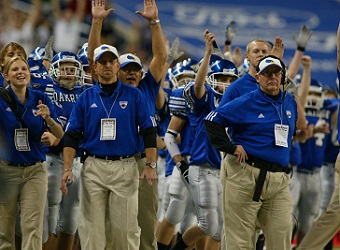
PHOTOS: (Top) Former Muskegon Oakridge football coach Jack Schugars holds up the 2005 Division 5 championship trophy with his players after their victory at Ford Field. (Middle) Schugars (right, with headset) monitors his team's play on the field against Jackson Lumen Christi.
Stevenson's Travels Following Lake Orion Success Include Space Force, Penn, NYC
By
Keith Dunlap
Special for MHSAA.com
July 17, 2025
It certainly isn’t hard for Marques Stevenson to pause and turn back the clock, even if sometimes it’s in the middle of the night.
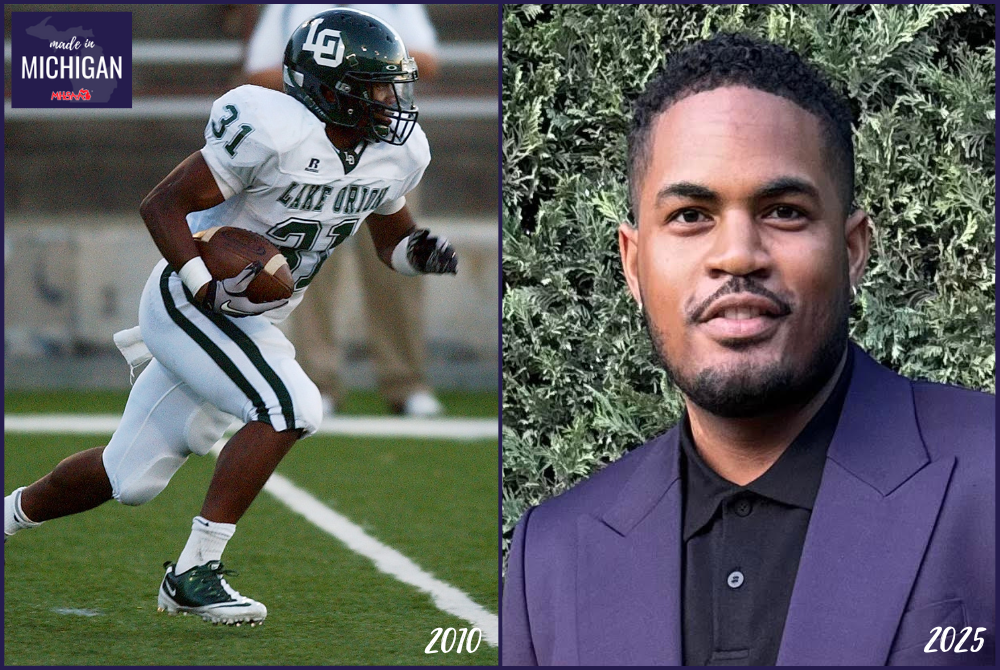
 Once a star running back at Lake Orion High School, Stevenson was arguably the MVP of what still stands as the only Dragons team to win an MHSAA Finals football championship.
Even though it will be 15 years this fall since that magical run in 2010, the memories remain as fresh as if they happened yesterday.
“I get the nostalgia, and I’ll cut on some highlights of that year,” he said. “I’ll tell my girlfriend at 3 in the morning, ‘Hey watch this, we were so good in high school.’ At least twice a year I’ll find myself cutting on the old game film or watching ‘MHSAA Rewind’ and watch the championship game over again.”
Nobody could blame Stevenson, given he capped off a sensational senior year by rushing for 186 yards and two touchdowns on 27 carries in Lake Orion’s 21-13 win over Plymouth in the Division 1 championship game.
Stevenson also rushed for 288 yards and four touchdowns in a District Final that year against Grand Blanc, and for 190 yards in a Semifinal win over Detroit Cass Tech.
Even more impressive is that late in that playoff run, opponents knew Lake Orion was going to ride its offensive line and Stevenson – and still couldn’t stop them.
Starting quarterback Sean Charette suffered a season-ending injury in their Regional Final, and while backup Cole Schaenzer definitely wasn’t a liability and did a good job filling in, it was no secret Lake Orion’s best route to scoring points was handing the ball to Stevenson.
“When (Charette) went down, it was a tough loss,” Stevenson said. “But we all felt like it was next man up and that we truly trusted each other.”
Stevenson finished the season with 1,966 rushing yards and 25 touchdowns, the former still a Lake Orion record.
"The season was special because going into that year, I don’t think any of us thought that was going to be the outcome,” said Stevenson, adding he vividly remembers the strong support given to the team by the Lake Orion community. “We all, day after day and week after week, started to believe in ourselves more. By the end, it came into fruition. It was a special run.”
 After graduating from Lake Orion, Stevenson went on to the Air Force Academy, studying and also playing football there until deciding not to play his senior year.
Following graduation, he served six years in the Air Force, conducting satellite command and control for the U.S. Space Force while stationed in Denver and Los Angeles.
Once he finished his service, Stevenson obtained a master’s degree from the University of Pennsylvania, and he now works as a strategy consultant in New York City.
“I don’t think any of that would have been possible without Lake Orion and that football experience,” Stevenson said. “That got the ball rolling for the journey I’ve been on now. I’ve been able to see the world, moved around a lot and had different experiences. Most of those experiences are attributed to the opportunity I got at Lake Orion.”
Stevenson is listed a few more times in the Lake Orion football record book, ranking third all-time in career yards (3,122) and touchdowns in a season (25).
“His senior year, with his work, his speed, his vision and his knowledge of our offense, it almost looked easy for him,” said current Lake Orion head coach and athletic director Chris Bell, who also was the head coach of the 2010 championship team. “His work and preparation made him one of the best we ever had. He was a 4.0 student, a high-character young man and just a lot of fun to coach and be around.”
Stevenson said he’ll come back into town a couple times every year, but there might be a special reason to do so this fall – a 15-year celebration of the championship season.
Due to the COVID-19 pandemic, there wasn’t a 10-year reunion in 2020.
“I would love to do a proper reunion of that team,” Stevenson said. “I should probably reach out to Coach Bell and Coach (John) Blackstock and those guys.”
If a reunion does happen, no doubt it will be more reason to get out the clips from that 2010 season again.
“That whole run and experience resonates with me,” Stevenson said. “And I don’t think that’s ever going to change.”
2025 Made In Michigan
July 15: 'Who Will Cheer for the Nimrods?' Peterson IV, Watersmeet Found Fans Worldwide - Report
July 10: Feeding 'Drive to Win,' Loy Norrix Grad Morgan Impresses with Strong USBC Showing - Report
July 9: After Blazing Multiple Volleyball Trails, Bastianelli Charting Next Career Path - Report
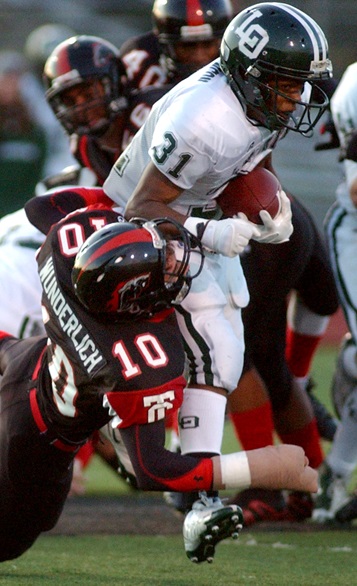
PHOTOS (Top) At left, Marques Stevenson carries the ball for Lake Orion during his senior season in 2010. At right, Stevenson today. (Middle) Stevenson takes on a Troy defender in 2008. (Action photos courtesy of the Oakland Press; headshot provided by Marques Stevenson.)