

Older, Wiser MCC Ranks with Elite Again
By
Tom Kendra
Special for MHSAA.com
October 21, 2020
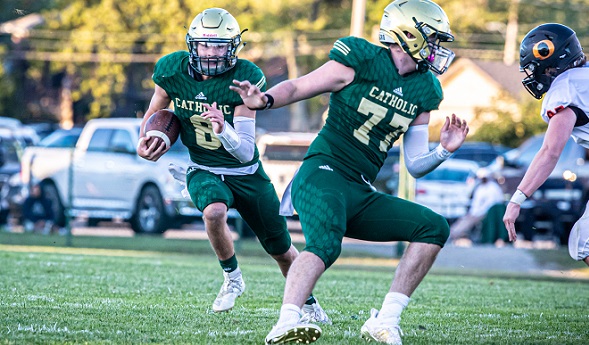
Max Price is right – Muskegon Catholic Central football is back.
 Not that the Crusaders ever went too far away. But after winning four consecutive Division 8 titles from 2013 to 2016, failing to make it out of Districts the past three seasons felt like a 100-year drought to Price and his teammates.
“I feel like this is the way we should be playing here at Muskegon Catholic,” said Price, the three-year starting senior quarterback who has his team at 5-0 and ranked No. 2 in the latest Associated Press Division 6 state poll.
“We were down, no doubt, but now we’re back up and ready for the playoffs.”
MCC has one more hurdle to clear to complete its first unbeaten regular season since 2016 when it hosts Holton at 4 p.m. Friday.
The Crusaders are doing it with defense, allowing a total of 18 points over five games. But even that low number is misleading, as the defense has only allowed one TD from scrimmage (a 79-yard run against Ludington), with the other points coming on an interception return and a kickoff return.
While the defense has been reminiscent of those MCC championship teams, one big change is that the Crusaders are now competing in Division 6 because of a cooperative agreement with nearby Muskegon Western Michigan Christian.
As a result, MCC appears on a collision course to host top-ranked Montague in a Division 6 District championship game next month – which would be a showdown between a pair of three-year starting quarterbacks in Price and Montague’s Drew Collins.
Ironically, MCC’s recent gridiron struggles can be traced back to its first-ever meeting with Montague during the 2017 regular-season finale. The Crusaders came into that game with a 27-game winning streak, but suffered a humbling 34-10 home loss. That game was followed by a lackluster 42-20 win over Decatur in the Pre-District, before a season-ending 26-15 loss at Mendon the following week.
The bad news continued that offseason, when three key sophomores transferred, leaving behind the youngest varsity team in MCC school history.
“We started 10 underclassmen and five freshmen in 2018,” said eighth-year MCC coach Steve Czerwon, whose team finished 3-6 that season. “There’s a lot of JV teams that don’t start five freshmen. I’m as proud of that team as any I’ve coached because of how they hung in there, and now we’re seeing the fruits of that this season.”
Price was thrust into the starting quarterback role as a sophomore and took a pounding behind a small and inexperienced offensive line. He played at less than full strength most of that season and missed the final three games when it was discovered that he had three fractured vertebrae in his spine.
“Looking back, I was scared back there and really didn’t understand the quarterback position,” said Price, who helped MCC flip its record to 6-3 last season. “I was new, and the game was so fast. I am very comfortable now, and that’s a huge thing.”
 Price (5-foot-11, 175 pounds) came out this fall flinging the ball around in the Crusaders’ opening win over Ludington, completing 10-of-13 passes for 212 yards and three touchdowns.
But for those worrying that the quintessential running football team has gone pass-happy, no worries. Since that game, MCC has settled into its running ways, with Price passing for just 235 yards and one touchdown over the past four games.
The Crusaders are back to pounding teams on the ground behind an offensive line that has grown bigger and more experienced under the direction of veteran line coaches Mike Ribecky, Joe Perri and Mike Hornak. Guard AJ Lock (6-1, 220) is still the lone senior starter on the interior line, with the other four being juniors – tackles Jaden Johnson (6-4, 235) and Alex Barnhill (6-0, 260), guard Jack Heminger (5-10, 210) and center Landon Patterson (6-0, 220).
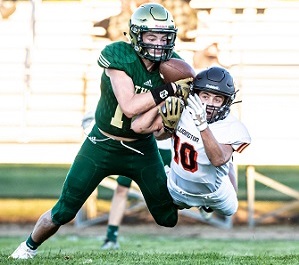
The real secret of this year’s team is a stable of talented and interchangeable backs, led by senior Tommy Kartes and junior Joe Waller. The other backs getting significant touches are all underclassmen – juniors Nick Powell, Dane Rutz and Eliot Riegler.
“We were still in the first quarter last week against Orchard View, and seven different kids had touched the football,” said Czerwon. “I don’t think this team has any superstar on it. Quite frankly, we have a lot of kids of equal ability – we have a lot of good, solid players.”
The first to touch the ball each play is Price, who then distributes the ball around.
Price is thankful to be playing at all, after the COVID lockdown wiped out his junior baseball season this spring and a team that many believed was poised to make a run at an MHSAA Finals championship.
He is also thankful to be healthy. Price likely appreciates his health more than most his age because of the health issues of his father, Paul, who was paralyzed in 2015 after a fall at their home.
“I was in middle school when that happened, and I wondered if I should even play football with all the risks,” said Price. “But I know he wants me to follow my passion and be out there. He is a motivation for me, and I love seeing him on the sidelines at our games.”
 Tom Kendra worked 23 years at The Muskegon Chronicle, including five as assistant sports editor and the final six as sports editor through 2011. E-mail him at [email protected] with story ideas for Muskegon, Oceana, Mason, Lake, Oceola, Mecosta and Newaygo counties.
PHOTOS: (Top) Muskegon Catholic Central senior quarterback Max Price runs behind the block of junior tackle Jaden Johnson during the Crusaders' 30-6 season-opening victory over visiting Ludington on Sept. 18. (Middle) MCC senior slot receiver Tommy Kartes hauls in this reception from Price while an Orioles defender works to break it up. (Photos by Tim Reilly.)
Generations of Jonesville Reunite to Say Good-Bye to Old Field, Await New
By
Doug Donnelly
Special for MHSAA.com
November 11, 2025
As the old saying, and more recent song lyric goes, "Every new beginning comes from some other beginning's end."
 A new era of Jonesville football will begin next fall when the Comets begin playing on a new field at a new sports complex on the high school campus.
It’s a new beginning. But, before that new era was launched, the Comets had one final game on its old football field this fall – a nearly 75-year-old relic that sits just outside Jonesville Middle School.
“I have a lot of memories of playing on that field,” said Comets football coach Frank Keller. “It’s been home to a lot of big games, good times.”
The final home game on the field was Week 8 against Vandercook Lake. Keller temporarily relinquished his play-calling duties when his former head coach – and recent Michigan High School Football Coaches Association Hall of Fame inductee – Greg Morrison came to the sidelines for a series after some convincing from his former player.
Morrison showed he hadn’t lost his touch. The third and final play he called – “tight end delay” – went for a touchdown.
“It was one of his favorite plays,” Keller said. “He called it, and we scored. It couldn’t have gone any better. He got to call the last touchdown on the old field.”
About a year ago, an anonymous donor gave a $4 million donation to the school to build a new track and football field, along with an accompanying concession stand and restrooms. The field is in a picturesque spot, tucked among trees.
 The donation came from a Jonesville family that has had four generations of athletes play sports for the Comets. Athletic director Jeff Turner said the family stepped forward when it became apparent it would be difficult for the district to pass a bond issue or a new tax to fund such a large-scale project.
"We are certainly grateful for them coming forward," Turner said. "We couldn't have done this without them. They wanted to help the school district and the community, and we are fortunate that we are able to build such a nice facility."
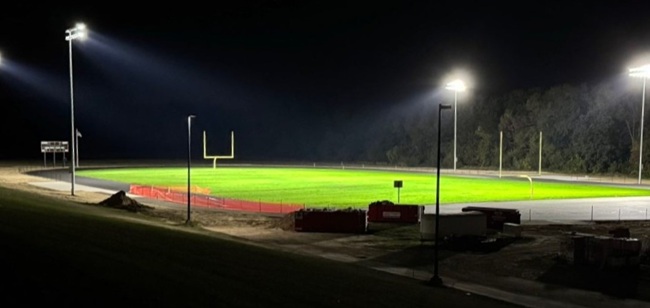
The track will be ready for events this spring. Sod was laid on the football field, inside the track, this fall and has been mowed a few times. New bleachers were constructed on both sides of the field recently, and the concession building is almost ready for business.
It’s a dramatic change for the district.
The current football field has been in use for decades and was home to league championship teams, playoff games and more great Jonesville memories.
“Growing up as a kid I always watched football games, there and I played there,” Keller said. “I have mixed feelings about it. It’s great to get a new facility, but sad to see the old one go.”
Morrison recalled a game during his coaching tenure when the opposing team hid in the nearby woods, and then just before kickoff came running onto the field.
Jonesville won by several touchdowns. Clearly the ploy didn’t exactly work out as intended.
“It was a great field to play,” Morrison said. “It was unique.”
These days, Jonesville is a Division 7 football school with an enrollment of 299 students. The Comets play in the Cascades Conference West and went 6-4 this season, falling in the first round of the playoffs.
 The football team has been in the playoffs four of the past seven seasons, went 9-0 during the regular season in 2019 and has 16 playoff appearances.
Keller graduated from Jonesville in 1999. He was on the Comets varsity for three seasons, from 1996-1998. Turner is a Jonesville graduate as well. He said several past players, cheerleaders and band members returned to the field for its final game, stirring a lot of memories.
“I don’t know how much of the game I got to watch that night,” Turner said. “It was great to catch up with a lot of people I may not have seen in quite a while. It was great.”
Turner said the athletic complex will be great for the district.
“It looks wonderful,” he said. “Our kids are excited about running track this spring and playing on the new field. Everyone is excited about it.”
As with any new facility, the complex is creating a buzz around athletics at Jonesville.
“We’re hoping we get more kids out just because they want to play on the new field, maybe even get new kids to the school,” Keller said. “We’re hoping it helps bring in more kids. Track looks awesome. The whole facility looks great.
“For us to get a new facility like that is unbelievable.”
 Doug Donnelly has served as a news and sports reporter at the Adrian Daily Telegram and the Monroe News for 30 years, including 10 years as city editor in Monroe. He's written a book on high school basketball in Monroe County and compiles record books for various schools in southeast Michigan. He is now publisher and editor of The Blissfield Advance, a weekly newspaper. E-mail him at [email protected] with story ideas for Jackson, Washtenaw, Hillsdale, Lenawee and Monroe counties.
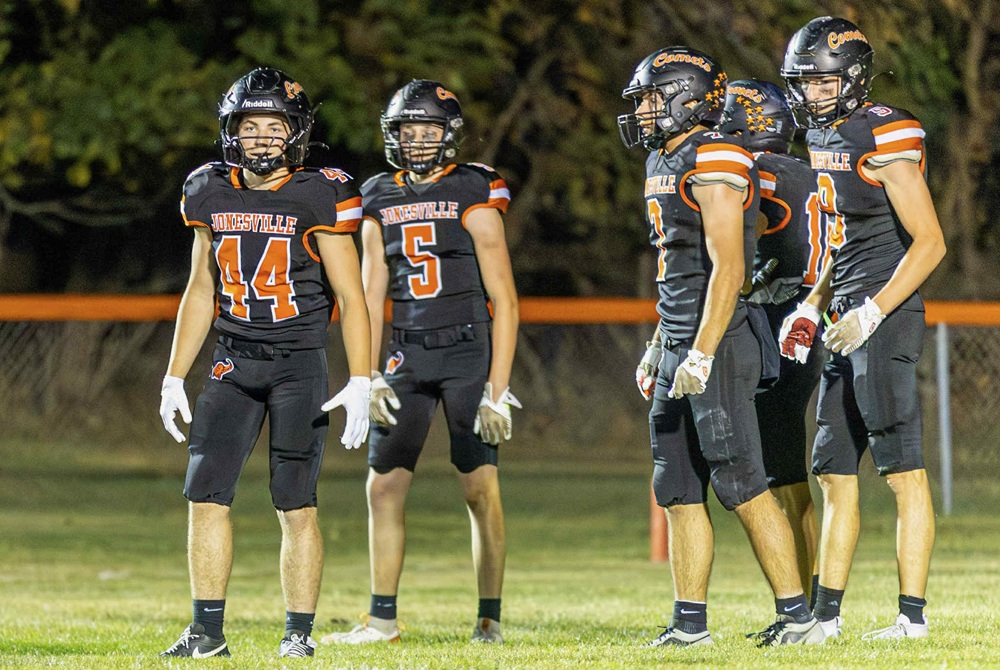
PHOTOS (Top) Jonesville players take the field for their final home game last month at their now former field. (Middle) Past Jonesville players line up with retired coach Greg Morrison during the final game. (Below) Jonesville’s new stadium sits under the lights and will be ready for the spring track & field season. (Photos courtesy of the Jonesville football program.)