


Our Place in the Sun
August 22, 2017
Today’s blog was written by MHSAA Website and Publications Coordinator Rob Kaminski
Millions of people across the country yesterday were mesmerized and fascinated by a once-in-a-lifetime show staged by the solar system: a total solar eclipse, which spanned the contiguous United States from Oregon to South Carolina.
The “Great American Eclipse” (because everything needs a title these days) was preceded by countless hours of coverage to prep enthusiasts on a variety of topics: the best places in which to view “totality;” the time frame in which the phenomenon would occur; the manner in which to view the orbs without damaging retinas; and, for the more scientifically inclined, detailed explanations as to the cause of the event.
It is somewhat ironic that this temporary traveling blackout began in the Pacific Northwest where people often yearn for even a glimpse of the sun over periods of time, and ended off the coast of South Carolina where residents have endured more than their share of weather disasters and a day of total sun would have been greatly preferred. At widespread locations in between, how many citizens beg for just a little more sunshine each day when the clock runs out on Daylight Saving Time?
The attraction to Monday’s event, of course, was its rarity. Its peculiarity. Its deviation from the norm. The last time a total solar eclipse could be seen anywhere in the United States was 1979, and the last time it went coast to coast was 99 years ago. That was the hook. It was darkness’s day in the sun.
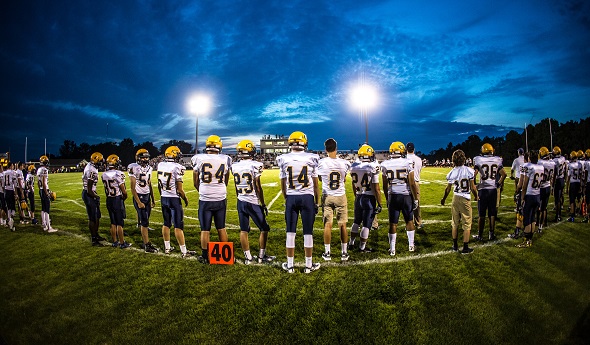
Another MHSAA football season kicks off around the state Friday just clear from the shadows of Monday’s historic, but fleeting, happening. The school sports spotlight shines brightest on fall Friday nights and has for decades, not only in Michigan, but also from shore to shore across the country. It is pep rallies and parades; pizza parlors and burger joints; neighborhood caravans and tailgates; perhaps even a Friday cross country meet or volleyball match, all leading up to the football game, for many years the only game in town.
Now, as college football continues its attempt to upset the natural balance and create its own eclipse, it is our hope that high school fans from state to state will consider this movement a fleeting attention grab. It is our hope that the people who have fueled our product over the course of time will turn their heads and focus on the brightest Friday night stars in their own back yards.
MHSAA Opposes Big Ten Friday Football
November 2, 2016
By Geoff Kimmerly
Second Half editor
The executive director of the Michigan High School Athletic Association said today that he is “disappointed and disheartened” by the Big Ten Conference announcement that it will play and televise football games on Friday nights beginning with the 2017 season.
Friday night football remains one of the strongest and longest-standing traditions in high school athletics, and the MHSAA has fought since the start of this century to keep Friday nights sacred against the overstepping of college football and the damage televised Big Ten games are now expected to cause to attendance and media coverage of the sport at the high school level.
MHSAA Executive Director John E. “Jack” Roberts was contacted by both Big Ten Conference commissioner Jim Delany and Michigan State University athletic director Mark Hollis before the decision was announced. Roberts said he is appreciative of Michigan State and University of Michigan’s low tolerance to be included in this venture – at most, both will host a Thursday or Friday night game during Labor Day weekend and play one Friday night away game during the remainder of a season – but remains frustrated that similar respect for high school football was not shown by the conference as a whole.
Michigan State has played Friday night games during Labor Day weekend the last six seasons, hosting five and playing at Western Michigan University in 2015. However, most Michigan high school games continue to be scheduled and played on the Thursday before Labor Day, relieving holiday travel conflicts in most communities. University of Michigan did play on the Thursday before Labor Day at University of Utah in 2015, but has not played on a Friday night of Labor Day weekend this decade. The Wolverines are one of five Big Ten schools without a Friday night game in 2017.
“We are saddened by this decision. We had hoped that the Big Ten Conference would stay above this. We think this cheapens the Big Ten brand,” Roberts said. “Fans won’t like this. Recruits won’t like this. And high school football coaches won’t like this.
“We are grateful that Michigan State University and the University of Michigan are trying to minimize the effects of this decision by the Big Ten. But overall, this is just the latest step by major college athletics in the pursuit of cash that is just crushing high school sports.”
The MHSAA has shown its opposition to the use of Friday nights for televised collegiate football games for more than 15 years, dating back to 2001 when the NCAA lifted its restrictions on Friday night telecasts, which at first led to the broadcasting of “mid-major conference” games on the same night traditionally reserved for high school athletes.
The MHSAA launched in 2001 its “Save Our Friday Nights” campaign to emphasize the role that Friday night high school athletic events play in communities and to rally MHSAA member schools to contact NCAA member school football coaches, athletic directors and conference commissioners to voice their concerns.
In addition to causing lower attendance at events going up against Big Ten football games, Roberts anticipates that Friday night college games also will leave high school football as a secondary priority in many media markets. More than 80 radio stations statewide cover high school games regularly, but many also carry Michigan State or University of Michigan football. High school football could lose significant time on local TV highlights shows and in print and online coverage as well, as resources are diverted to cover a college game – potentially quieting significantly the positive buzz that comes from the typical high school football Friday night.
“Everyone knows that football is struggling right now,” Roberts said. “It’s getting a lot of bad publicity. Participation is declining. And now this; there couldn’t be worse timing.”
PHOTO: Grand Ledge takes on Okemos under the Friday night lights this season. (Click to see more from HighSchoolSportsScene.com.)