


Parking, Entrance Protocols Announced For Ford Field
November 25, 2013
By Geoff Kimmerly
Second Half editor
To provide for the convenience and safety of spectators attending the Michigan High School Athletic Association Football Finals at Ford Field in Detroit, Nov. 29 and 30, attendees are being advised of a variety of items related to transportation and security – including new policies regulating types of bags that are allowed into the stadium.
In cooperation with Olympia Entertainment, more than 2,000 parking spaces will be available in close proximity to Ford Field and Comerica Park to the west, east and north of the ball parks. These parking lots will be clearly marked with Olympia Entertainment signs and will be charging $6. A map identifying the designated Olympia Entertainment lots can be found on the Football page of the MHSAA Website. (There also are a number of privately-operated parking facilities close to Ford Field, but their pricing may differ.)
Fans also are advised that tailgating, including the setting up and use of grilling equipment, and the consumption of alcohol, is prohibited by City of Detroit ordinances.
Gates A, B and G will be available for public entrance during the event. Ticket sales will begin near Gates A and G at 8 a.m. each day, and the building will open its doors to spectators at 9 a.m.
Tickets are priced at $10 and will allow a fan to see all four games in a single day. Spectators leaving the stadium will be required to purchase another ticket for re-entry. Children under the age of 2 will be admitted without charge for this event. There will not be a public Will Call window.
Upon arrival in the building, fans will find their designated seating areas on the South side of the field if their team is the designated home team for their contest and on the North side for the designated visiting team. Home teams this weekend are Clarkston, Muskegon, Zeeland West, Grand Rapids South Christian, Menominee, Ithaca, Ishpeming and Beal City. Brightly lit video boards above the seating areas will display the names of the participating teams each day, and fans should sit on the side of the stadium where they see their school’s name. For general fans, the entire lower bowl of Ford Field will be open for the event.
Security measures also will be in place to help assure spectator safety. Fans will be subject to a visual search, and Ford Field personnel reserve the right to request patrons open their coats, bags and other item-carrying vessels for visual inspection and deny entrance to individuals who do not cooperate. The NFL this season has enhanced its safety policy to further monitor what type of bags may be brought into stadiums. Those additions are noted in bold below.
Items which fans will be prohibited from bringing into the building include, but are not limited to, the following:
- Purses larger than a clutch bag, coolers, briefcases, backpacks, diaper bags, fanny packs, cinch bags, grocery & paper bags, duffle bags, luggage of any kind, computer bags and camera & binocular bags or cases. Visit www.nfl.com/allclear for additional details.
- Aerosol cans (hairspray, mace, pepper spray, etc.)
- Animals (except service animals to aid guests with disabilities)
- Balloons (air or helium)
- Balls (beach balls, footballs, etc.)
- Banners
- Cameras with lenses longer than five inches
- Decals, stickers, confetti or flitter
- Electronic equipment including laptop computers, large video recorders and video cameras, and tripods (hand-held video cameras are allowed)
- Fireworks
- Food, beverages or liquids (cans, bottles, boxes, flasks, etc.)
- Illegal substances
- Knives, pocket knives, box cutters, scissors, etc.
- Laser pointers
- Markers (permanent) and/or paint
- Noisemaking devices (bells, horns, kazoos, whistles, etc.)
- Objects that can be used as missiles or projectiles (sticks, bats, clubs, Frisbees, etc.)
- Seat cushions
- Strollers and infant car seats or carriers
- Umbrellas
- Weapons
The following items will be permitted after inspection:
- Bags that are clear plastic, vinyl or PVC and do not exceed 12 inches by 6 inches by 12 inches
- One-gallon clear plastic freezer bags (Ziploc bag or similar)
- Small clutch bags, approximately the size of a hand, with or without a handle or strap. For details, visit www.nfl.com/allclear. An exception will be made for medically necessary items after proper inspection at a gate designated for this purpose.
- Small radios (no larger than the size of a football and used with an earpiece).
- Small hand-held video cameras (but no tripods or extension cords).
- Binoculars (but no cases).
The complete list of prohibited items can be found on the Ford Field Website under Policies & Info. Prohibited items that are discovered during security inspections at stadium entrances must either be returned to the owner's vehicle or discarded. Items will not be held for later pickup.
Fans are reminded that all image taking (still and video) may be only for personal, non-commercial use.
The MHSAA is a private, not-for-profit corporation of voluntary membership by more than 1,500 public and private senior high schools and junior high/middle schools which exists to develop common rules for athletic eligibility and competition. No government funds or tax dollars support the MHSAA, which was the first such association nationally to not accept membership dues or tournament entry fees from schools. Member schools which enforce these rules are permitted to participate in MHSAA tournaments, which attract more than 1.4 million spectators each year.
Fresh Off Newfound Spring Swing, Tabron Remains Driver of Cass Tech Title Hopes
By
Keith Dunlap
Special for MHSAA.com
August 20, 2026
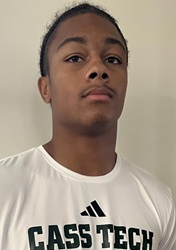
DETROIT — One of the country’s top football recruits in the Class of 2028, Detroit Cass Tech junior quarterback Donald Tabron pursued a newfound passion this spring even while zigzagging across the country on recruiting visits to prominent college football programs.
 When he wasn’t busy with school studies, recruiting trips or football training, Tabron happily was a member of Cass Tech’s boys golf team, building on a love for that sport he developed the previous spring as he was winding down his freshman year of high school.
Tabron said one of his football teammates who was also on the golf team introduced him to a golf simulator at the school, and the seed was planted.
“We got down and hit golf balls in the simulator,” Tabron said. “We did that the last few weeks of the school year. He was like, ‘You have a pretty decent swing. I’ll get you with our golf coach,’ So I got with Coach Mike (Schuchard). I love Coach Mike. He helped me out during that summer, giving me lessons once a week. I went to Five Iron Golf and those indoor simulators on Sundays and just suddenly was getting better. I got my first set of clubs.”
Tabron liked golf so much that he decided to not participate on the track & field team at Cass Tech, where he shined in the high jump as a freshman.
In fairness, his busy schedule of football recruiting trips also played a factor in not going out for track. But he made time for golf, finishing up by competing in his team’s Regional tournament in May.
There are physical characteristics of playing golf that Tabron said should help him in football, such as similar torso turning and strength needed to both swing a golf club and throw a football. But it’s the mental side of golf that he feels will make him a better quarterback.
“A lot of times in football you may take a bad hit or make a bad play, and in golf you may hit a bad shot,” Tabron said. “It’s how you rebound from that. As a quarterback, you have to be able to stay cool, calm and collected. You can’t get too over your head or too low. That’s the same for golf.”
 There haven’t been too many lows for Tabron during what already has been an accomplished high school football career – and he still has two years left.
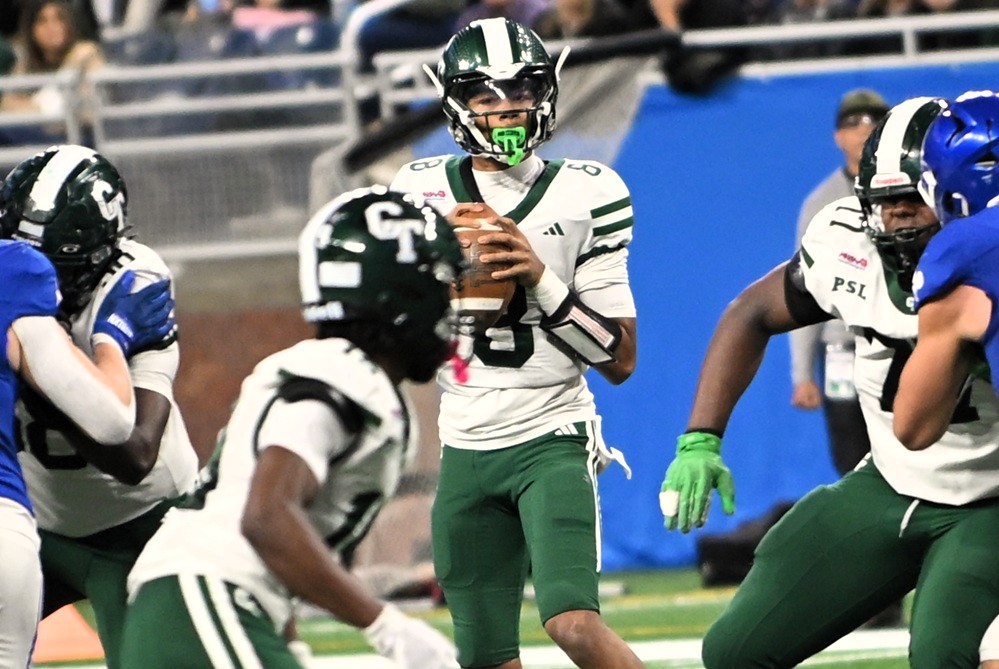
As a freshman two years ago, Tabron was the starter for Cass Tech’s team that won the Division 1 championship, and he helped lead the Technicians to an unbeaten record last year before a loss to Detroit Catholic Central in the title game.
This year as a junior, particularly with Mr. Football Award winner C.J. Sadler graduated, it is fully Tabron’s offense and his team.
“I’m going to be like the offensive coordinator on the field, but you can only work as good as the surrounding cast,” Tabron said. “That’s how it’s going to be for us. I’ll be like the coach and leader on the field, but I can’t do it without them.”
Tabron got his start in football much earlier in life than golf, as a toddler, mainly because his father, Donald Tabron Jr., played collegiately at Northwood.
A right-handed thrower, Tabron made an immediate impact once he got to high school, earning the starting quarterback job, and after initial lumps, guided Cass Tech to that Division 1 championship. Tabron finished 15 of 20 passing with three touchdowns that day at Ford Field, and from there college scouts started drooling.
The 6-foot-3 Tabron committed to Texas A&M on Saturday, and this spring was quite a whirlwind with recruiting trips across the country including to Oregon, USC, Texas A&M, LSU, Ohio State and many others.
Tabron didn’t measure how many miles he traveled, but he did become quite an expert on the quality of airports in various cities.
“My mom was like, ‘Not many kids can say how good or bad airports are at 17 years old,” Tabron said. “I’m definitely blessed and grateful for the opportunity to go to all these places.”
He likely won’t go on more recruiting visits now that he is committed. But if he does, one big request from Tabron will be to check out the university’s golf course.
“I actually talked about it with a few coaches because a lot of college coaches play golf,” he said. “(They say) ‘Next time you come down, get on the range here or get on the course where the golf team practices at.’ It’s definitely been a conversation.”
 Keith Dunlap has served in Detroit-area sports media for more than two decades, including as a sportswriter at the Oakland Press from 2001-16 primarily covering high school sports but also college and professional teams. His bylines also have appeared in USA Today, the Washington Post, the Detroit Free Press, the Houston Chronicle and the Boston Globe. He served as the administrator for the Oakland Activities Association’s website from 2017-2020. Contact him at [email protected] with story ideas for Oakland, Macomb and Wayne counties.
PHOTO (Top) Cass Tech quarterback Donald Tabron (8) drops back to pass during last season’s Division 1 Final, moments before throwing for a big gain that set up the team’s first touchdown.