


Parking, Entrance Protocols Announced For Ford Field
November 25, 2013
By Geoff Kimmerly
Second Half editor
To provide for the convenience and safety of spectators attending the Michigan High School Athletic Association Football Finals at Ford Field in Detroit, Nov. 29 and 30, attendees are being advised of a variety of items related to transportation and security – including new policies regulating types of bags that are allowed into the stadium.
In cooperation with Olympia Entertainment, more than 2,000 parking spaces will be available in close proximity to Ford Field and Comerica Park to the west, east and north of the ball parks. These parking lots will be clearly marked with Olympia Entertainment signs and will be charging $6. A map identifying the designated Olympia Entertainment lots can be found on the Football page of the MHSAA Website. (There also are a number of privately-operated parking facilities close to Ford Field, but their pricing may differ.)
Fans also are advised that tailgating, including the setting up and use of grilling equipment, and the consumption of alcohol, is prohibited by City of Detroit ordinances.
Gates A, B and G will be available for public entrance during the event. Ticket sales will begin near Gates A and G at 8 a.m. each day, and the building will open its doors to spectators at 9 a.m.
Tickets are priced at $10 and will allow a fan to see all four games in a single day. Spectators leaving the stadium will be required to purchase another ticket for re-entry. Children under the age of 2 will be admitted without charge for this event. There will not be a public Will Call window.
Upon arrival in the building, fans will find their designated seating areas on the South side of the field if their team is the designated home team for their contest and on the North side for the designated visiting team. Home teams this weekend are Clarkston, Muskegon, Zeeland West, Grand Rapids South Christian, Menominee, Ithaca, Ishpeming and Beal City. Brightly lit video boards above the seating areas will display the names of the participating teams each day, and fans should sit on the side of the stadium where they see their school’s name. For general fans, the entire lower bowl of Ford Field will be open for the event.
Security measures also will be in place to help assure spectator safety. Fans will be subject to a visual search, and Ford Field personnel reserve the right to request patrons open their coats, bags and other item-carrying vessels for visual inspection and deny entrance to individuals who do not cooperate. The NFL this season has enhanced its safety policy to further monitor what type of bags may be brought into stadiums. Those additions are noted in bold below.
Items which fans will be prohibited from bringing into the building include, but are not limited to, the following:
- Purses larger than a clutch bag, coolers, briefcases, backpacks, diaper bags, fanny packs, cinch bags, grocery & paper bags, duffle bags, luggage of any kind, computer bags and camera & binocular bags or cases. Visit www.nfl.com/allclear for additional details.
- Aerosol cans (hairspray, mace, pepper spray, etc.)
- Animals (except service animals to aid guests with disabilities)
- Balloons (air or helium)
- Balls (beach balls, footballs, etc.)
- Banners
- Cameras with lenses longer than five inches
- Decals, stickers, confetti or flitter
- Electronic equipment including laptop computers, large video recorders and video cameras, and tripods (hand-held video cameras are allowed)
- Fireworks
- Food, beverages or liquids (cans, bottles, boxes, flasks, etc.)
- Illegal substances
- Knives, pocket knives, box cutters, scissors, etc.
- Laser pointers
- Markers (permanent) and/or paint
- Noisemaking devices (bells, horns, kazoos, whistles, etc.)
- Objects that can be used as missiles or projectiles (sticks, bats, clubs, Frisbees, etc.)
- Seat cushions
- Strollers and infant car seats or carriers
- Umbrellas
- Weapons
The following items will be permitted after inspection:
- Bags that are clear plastic, vinyl or PVC and do not exceed 12 inches by 6 inches by 12 inches
- One-gallon clear plastic freezer bags (Ziploc bag or similar)
- Small clutch bags, approximately the size of a hand, with or without a handle or strap. For details, visit www.nfl.com/allclear. An exception will be made for medically necessary items after proper inspection at a gate designated for this purpose.
- Small radios (no larger than the size of a football and used with an earpiece).
- Small hand-held video cameras (but no tripods or extension cords).
- Binoculars (but no cases).
The complete list of prohibited items can be found on the Ford Field Website under Policies & Info. Prohibited items that are discovered during security inspections at stadium entrances must either be returned to the owner's vehicle or discarded. Items will not be held for later pickup.
Fans are reminded that all image taking (still and video) may be only for personal, non-commercial use.
The MHSAA is a private, not-for-profit corporation of voluntary membership by more than 1,500 public and private senior high schools and junior high/middle schools which exists to develop common rules for athletic eligibility and competition. No government funds or tax dollars support the MHSAA, which was the first such association nationally to not accept membership dues or tournament entry fees from schools. Member schools which enforce these rules are permitted to participate in MHSAA tournaments, which attract more than 1.4 million spectators each year.
1st & Goal: 2026 Week 4 Preview
By
Geoff Kimmerly
MHSAA.com senior editor
September 18, 2026
We’re just three weeks into the 2026 high school football season, and a great sign that Michigan teams are challenging themselves is that only 116 – or just under 20 percent – are still undefeated.

That total also is guaranteed to be reduced by 15 this weekend, and will likely fall well below the century mark with several high-powered matchups kicking off all over the state. Five of those games are among those featured below.
Games below are Friday unless noted. Tune in to the NFHS Network to watch the majority and follow the MHSAA Scores page for results as they’re submitted.
Bay & Thumb
Linden (3-0) at Holly (3-0)
Holly is 3-0 for the first time since 1984, and a 42-7 win over Pontiac Notre Dame Prep is notable even though the Fighting Irish are struggling early after finishing Division 5 runner-up last season. The Bronchos also haven’t defeated Linden since 2011 and fell last year 42-6. But a win would open up the Flint Metro League Stripes race significantly and provide a giant assist as Holly works to make the playoffs for the fourth time in five seasons.
Keep an eye on these FRIDAY North Branch (2-1) at Imlay City (3-0), Caro (3-0) at Millington (3-0), Montrose (2-1) at Chesaning (2-1), Shepherd (2-1) at Gladwin (2-1).
Greater Detroit
Clarkston (3-0) at Rochester Adams (2-1)
Even as Adams has reached Division 1 Semifinals the last two seasons, it hasn’t won the Oakland Activities Association Red since sharing the title with Clarkston and West Bloomfield in 2022. Clarkston won last year’s matchup on the way to the OAA Red championship. Both faced 2025 league champions to open this season, Adams falling to Romeo and Clarkston defeating South Lyon, and there’s always a chance this will be just the first of multiple meetings as they’ve seen each other in the playoffs as well two of the last four years.
Keep an eye on these FRIDAY Warren De La Salle Collegiate (2-1) at Detroit Catholic Central (3-0), Detroit Denby (2-1) at Detroit Cody (3-0), Romeo (3-0) at Macomb Dakota (2-1), Monroe Jefferson (3-0) at Riverview (3-0).
Mid-Michigan
McBain (2-1) at Beal City (3-0)
Beal City has only three Highland Conference losses since the start of 2019 – all to McBain, but with the most recent in 2024. The Aggies won last season’s meeting 42-7 and are coming off a major defeat last week of Springport plus have downed two more 2025 playoff teams in Ravenna and Manton. McBain’s only Highland loss since the start of 2024 came to Beal City, and the Ramblers’ defeat this season came to unbeaten Division 4 power Edwardsburg.
Keep an eye on these FRIDAY McBain (2-1) at Beal City (3-0), Traverse City Central (2-1) at Mount Pleasant (3-0), Birch Run (3-0) at New Lothrop (2-1), Brighton (2-1) at Hartland (2-1), Saginaw Michigan Lutheran Seminary (2-1) at Ithaca (3-0).
Northern Lower Peninsula
Grand Blanc (3-0) at Traverse City West (2-1)
Grand Blanc has dominated all four games of the recent series between these two, but there’s reason to believe this meeting might be closer. It may start with Grand Blanc having to travel much farther than usual – although the Bobcats also won at West in 2025. But the bigger positive for the Titans may not be 56 points put up in a win last week over Bay City Central but the 35 scored in a Week 1 loss to Howell. Grand Blanc has two straight shutouts but must be ready for another challenge on that side of the ball.
Keep an eye on these FRIDAY Kingsley (3-0) at Grayling (2-1), Midland Bullock Creek (2-1) at Ogemaw Heights (3-0), Johannesburg-Lewiston (2-1) at Frankfort (2-1), Traverse City St. Francis (1-2) at Maple City Glen Lake (2-1)
Southeast & Border
Tecumseh (3-0) at Chelsea (3-0)
Tecumseh has reached 40 points scored in all three of its games, which is more than it did either of the entire 2024 or 2025 seasons. A win over Chelsea would be a first since 2022, when Tecumseh put together a perfect regular season, and this is the team’s best start since that fall. Chelsea also has strung together an impressive first three weeks with the Bulldogs’ most recent win over Adrian a rematch of last year’s Southeastern Conference White title decider and the Week 1 victory over Harper Woods one that will be referenced all fall.
Keep an eye on these FRIDAY Jonesville (2-1) at Brooklyn Columbia Central (3-0), Saline (3-0) at Dexter (2-1), Adrian Madison (3-0) at Hudson (3-0), Ann Arbor Father Gabriel Richard (3-0) at Jackson Lumen Christi (3-0), Hanover-Horton (2-1) at Napoleon (3-0).
Southwest Corridor
Edwardsburg (3-0) at Paw Paw (3-0)
Paw Paw has won this Wolverine Conference rivalry game three straight seasons but also finished runner-up in the league to Niles the last three years. The Red Wolves downed Niles 42-14 last week, making them potential frontrunners in the conference unless Edwardsburg spoils that plan. Paw Paw has been impressive giving only 28 points total against teams that went a combined 21-10 a year ago. But the Eddies are ripping through yards again like during their best years, topping 50 points twice already after not doing so once all of last season.
Keep an eye on these FRIDAY Berrien Springs (3-0) at Buchanan (3-0), Battle Creek Harper Creek (3-0) at Marshall (3-0), Kalamazoo Central (2-1) at Portage Central (2-1), Constantine (2-1) at Schoolcraft (3-0), Quincy (3-0) at Union City (3-0).
Upper Peninsula
Calumet (3-0) at Menominee (3-0)
This game sets up identically as last season’s matchup, won by Menominee 25-15 on the way to claiming the Western Peninsula Athletic Conference Copper title. The Maroons have won their games by 54, 30 and 50 points so far, but Calumet should bring that average down especially after giving up only 24 points over its first three victories. A win over Menominee would be the Copper Kings’ first since the 2021 District Semifinals.
Keep an eye on these FRIDAY Negaunee (2-1) at Kingsford (3-0), Iron Mountain (1-2) at L’Anse (2-1), Petoskey (2-1) at Escanaba (1-2). SATURDAY Cadillac (2-1) at Marquette (1-2).
West Michigan
Ludington (2-1) at Fremont (3-0)
Fremont is staring down a potential first winning season since 2013 and after earning a combined three victories over the last two. They avenged last year’s 56-0 loss to Whitehall with a 32-19 win in Week 2 and with 24 more points will equal their scoring output for all of last year. Enter Ludington, which won the 2025 matchup 49-0 and the West Michigan Conference Lakes title during a perfect regular season. The Orioles graduated a significant senior class in the spring and opened with a loss to Coopersville, but have bounced back with a pair of close wins.
Keep an eye on these FRIDAY Grand Rapids West Catholic (2-1) at Ada Forest Hills Eastern (3-0), Grand Rapids South Christian (2-1) at Hudsonville Unity Christian (2-1), Middleville Thornapple Kellogg (3-0) at Holland Christian (2-1), East Kentwood (3-0) at Grand Haven (2-1).
8-Player
Mio (3-0) at Mendon (3-0)
Mio has strung together two straight playoff seasons and charged into this one impressively, already avenging one of its two 2025 losses by downing Hillman 30-16 in Week 2. The Thunderbolts now have the opportunity to test themselves against one of the annual elite, as Mendon is a combined 20-3 over the last two years and averaging 51 points per game during this early going despite replacing the leading scorer in MHSAA 8-player history.
Keep an eye on these FRIDAY Climax-Scotts (3-0) at Colon (3-0), Ishpeming (2-1) at Crystal Falls Forest Park (3-0), Pickford (3-0) at St. Ignace (3-0). SATURDAY Norway (3-0) at Lake Linden-Hubbell (3-0).
MHSAA.com's weekly “1st & Goal” previews and reviews are powered by MI Student Aid, a division within the Department of Lifelong Education, Advancement, and Potential (MiLEAP). MI Student Aid encourages students to pursue postsecondary education by providing access to student financial resources and information. MI Student Aid administers the state’s scholarship and grant programs that help make college Accessible, Affordable and Attainable for you. Click to connect with MI Student Aid and find more information on Facebook and Twitter @mistudentaid.
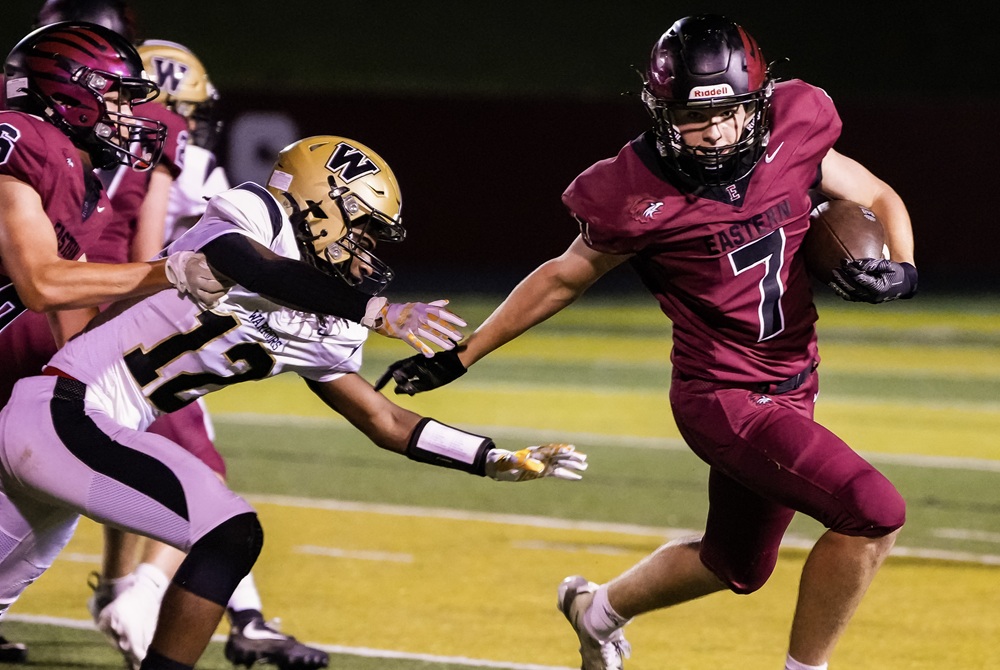
PHOTO An Ada Forest Hills Eastern ball carrier attempts to hold off a Flint Elite defender during FHE’s Week 3 win. (Photo by Michigan Sports Photo.)