

Pellston Writing Unforgettable Story
November 1, 2019
By Chris Dobrowolski
Special for Second Half
PELLSTON — It’s a story that could easily derive from Hollywood.
 Only, this script is being written in Pellston.
Leading up to the 2019 season, the narrative for the Pellston football team has been mostly a tale of woe.
Zero playoff appearances.
Twenty-three years without a winning season.
A .260 winning percentage since 1950.
This year, however, the plot has turned into a feel-good story as the Hornets have put together a season that’s only been dreamed about over the years, posting an 8-1 record and earning their first postseason berth.
“To go 8-1, it was great,” said Pellston head coach Jack Carter, a 1987 graduate of the school. “I knew we had some really good players, some great seniors. Strong leadership on that end. It all kind of came together for us, at least through the regular season. I don’t know if it’s being a miracle worker as much as we’re at the right place at the right time.”
Pellston quarterback Glenn Bonter is one of those seniors. Bonter moved to town two years ago from Grand Haven and immediately found his niche within the confines of the weight room. The other players who were there made him feel welcome, and they quickly became friends. They also filled him in on the school’s history in football.
“(I heard) that it was a struggle,” said Bonter. “That they hadn’t had a whole lot of success. That was something where we looked at it and all of us wanted it to change. Looking around in the weight room, I saw how much hard work and dedication kids were really putting into it. Pretty much the whole entire team would go to weight room in the summer. We would all go out to the field and just pass and do some running. I think it was a whole team thing. We were like, ‘You know what? We want to win, and we’re going to do it.’ We just kind of put our foot down and went for it.”
Carter is in just his third year leading the Hornets, though he is well-versed in how difficult it has been for the school to win on the football field having off-and-on been a part of the program in one capacity or another since 2001. He’s seen players and coaches come and go, working to get things heading in the right direction but often finding that to be an insurmountable hurdle.
 “If you look at it strictly from wins and losses, it wouldn’t tell the complete story because we have not been that great,” said Carter. “But we’ve had, every single year, guys that went out there and worked so hard. Played with as much heart and emotion as you could expect. For me, I think that was the template, or the groundwork for us to build off.”
Pellston also laid some of the foundation for this season during last year’s 4-5 campaign. What might seem like a rebuilding year for some was a breakthrough for the Hornets. It was the most wins they had recorded in six years. Three of those wins came in succession, too — the first time the program had strung together consecutive victories since it opened the 2012 season with four straight victories.
That propelled the Hornets into the offseason with a ton of hunger. The team’s four seniors — Bonter, running back/defensive back Lakota Worthington, and linemen Evan Cameron and Joey Rizzardi — spearheaded the team’s participation in summer training. When the full squad met for the first time in August, it came in with good fitness, strength, talent and desire.
“We made sure to make the weight room a thing,” said Worthington. “We made sure to come in during the offseason and put in the work and made sure we worked on our routes.”
It didn’t take long for Pellston to reap the benefits of its hard work as it started the year with six wins in a row — the longest winning streak in school history. Among those victories were dramatic triumphs over Posen (42-38) and Au Gres-Sims (32-30) where the Hornets overcame halftime deficits of 16 and 18 points, respectively, to remain undefeated.
“Normally you just don’t come back from those type of deficits,” said Carter. “This group of guys, they just keep fighting. They keep believing, and they keep their heads up. Their positive outlook and attitude is first rate.”
“For us to rally back and win those games, it was unbelievable,” said Bonter.
Three games into his junior season, Bonter switched from running back to quarterback. He’s been dynamic in running the Hornets’ spread offense, accounting for 16 touchdowns rushing and 13 through the air. Junior David Jamroz, like Bonter, has rushed for more than 1,000 yards. Worthington joins them in a backfield that features a great deal of speed. He also provides electricity in the return game.
“(He’s a) special returner,” Carter said of Worthington, a four-year varsity player. “He’s been that sparkplug and that catalyst that we’ve been needing for quite a while. In 8-man football a lot of times teams choose not to really kick to guys who are like that. It seems like every time a ball did go to him, he made the most of it. If he didn’t get a touchdown out of it, he certainly flipped the field for us and gave us great starting position on offense.”
The Hornets have averaged 46 points per game. The only time they’ve been held under 30 points was a 38-14 loss to Hillman in the seventh week, a game where injuries hampered Pellston’s chances.
“I think we just had an off night,” said Bonter. “They’re a really good football team. A lot of respect to Hillman. They should go far; but yeah, that was a tough loss.”
 “We learned that sometimes only going in with 11 players can get you in trouble,” said Carter. “We did get hit with some injuries that night. Secondly, Hillman was the first team that really came out and really played good, sound, hard-hitting football, especially on the defensive side. They have a history of being able to make the playoffs, and they’ve had success in football. They showed why they’re at where they’re at.”
The Hornets were able to rebound and finished the regular season with a pair of convincing wins over St. Helen Charlton Heston and Central Lake.
If the current football playoff system was in place in 1995, Pellston wouldn’t have had to wait until this season to gain its first postseason bid. That year the Hornets went 8-1 but did not qualify because they ultimately didn’t have enough playoff points.
Twenty-four years later Pellston finally buzzed its way into the postseason. It opens the MHSAA 8-player Division 1 tournament with a Pre-Regional on Friday against Gaylord St. Mary.
“I’m so ready. I’m ready today,” said Worthington. “I just want to go out there and show everybody what we can do. I know Gaylord (St. Mary) is pretty good, but I’m ready to get them.”
The Snowbirds come into the game with a 4-5 record, but four of their first six wins were forfeited for using an ineligible player.
“St. Mary is coming in with a really, really good football team,” said Carter. “I look at them as an 8-1 football team, and we have to look at them that way.”
As magical as this season has been for the Hornets, they feel like there is still more of the story to be told and are looking to add a few more chapters in the coming weeks as the playoff scenario unfolds.
“Hopefully we have a good Hollywood ending with it and keep it going into the playoffs,” said Carter.
 Chris Dobrowolski has covered northern Lower Peninsula sports since 1999 at the Ogemaw County Herald, Alpena News, Traverse City Record-Eagle and currently as sports editor at the Antrim Kalkaska Review since 2016. He can be reached at [email protected] with story ideas for Manistee, Wexford, Missaukee, Roscommon, Ogemaw, Iosco, Alcona, Oscoda, Crawford, Kalkaska, Grand Traverse, Benzie, Leelanau, Antrim, Otsego, Montmorency, Alpena, Presque Isle, Cheboygan, Charlevoix and Emmet counties.
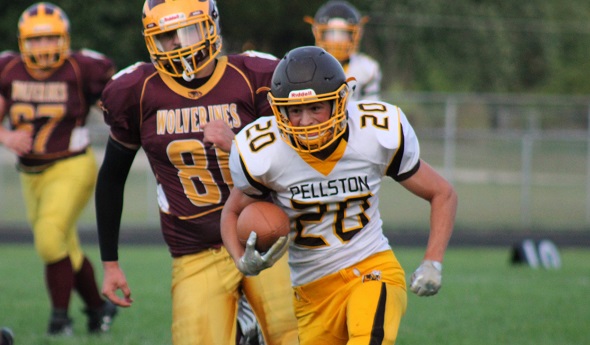
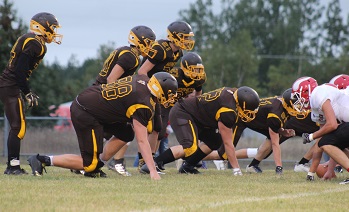
PHOTOS: (Top) Pellston’s David Jamroz (20) races through the Au Gres-Sims defense during a Week 3 win. (Middle) The Hornets stack the line during a Week 2 victory over Posen. (Photos courtesy of the Pellston athletic department.)
Thank Roosevelt for Football Weekends
December 20, 2013
By Rob Kaminski
MHSAA benchmarks editor
The next time you find yourself immersed in a tense crosstown football rivalry on a Friday night followed by a Saturday pilgrimage to the nearest college campus and a Sunday afternoon with a remote and your favorite snacks and beverages, take a moment to consider what the weekend would be like if it weren’t for Teddy Roosevelt.
The man who became our 26th President shortly after the turn of the 20th Century following the assassination of William McKinley in 1901 was a football fan like you. Maybe more so.
Today’s game of football has reached a critical crossroads. Player size and speed have increased across the board. Savage use of equipment as weapons rather than protective gear has been glorified on television networks and social media. Leaders of the game at all levels have recognized the need for change, employing new rules and widespread educational efforts to aid in preserving the sport.
History, as they say, is repeating itself.
In an ironic twist, it was Roosevelt who saved the then-brutally violent game of football from itself more than 100 years ago. Yes, the same “Rough and Ready Teddy” who led the charge up San Juan Hill during the Spanish-American War and often sparred in the boxing ring while in office from 1901-09 opined that football was becoming so gruesome that he delivered an ultimatum: clean up the game or it would be outlawed.
The Chicago Tribune reported that in 1904 alone, there were 18 football deaths and 159 serious injuries, mostly among prep school players. Football deaths suffered by younger players were reported on a nearly weekly basis, as outraged citizens called on colleges and high schools to banish football outright.
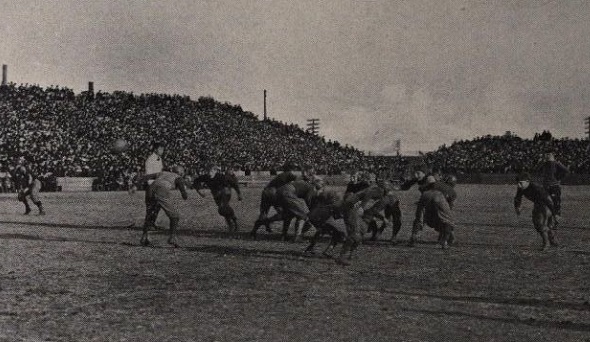
In stepped Roosevelt, who called head coaches and representatives from Harvard, Yale and Princeton – college powers at the time – to the White House in 1905 urging them to eliminate excessive violence and set an example of fair play for the rest of the country. When the casualties actually rose by one during the ensuing season, Roosevelt reacted with greater resolve and convened leading football authorities for the purpose of authoring drastic rules changes. What emerged was an intercollegiate conference which was the predecessor of the NCAA.
Among the most effective changes for the 1906 season were the legalization of the forward pass, the elimination of mass formations, and the creation of a neutral zone. Football fatalities fell to 11 in each of the next two seasons, and severe injuries fell drastically.
Thanks to the introduction of protective equipment and ever-evolving rules changes, football during the 100-plus years to follow has become an exponentially safer game. Yet, the game’s leaders always will need to adjust and react to scrutiny that comes with the territory.
So, as the game once again undergoes rules modifications in the name of safety, give a tip of the cap to President Roosevelt while you enjoy college bowl season and the NFL playoffs and begin to think ahead to the first high school practice of 2014.