

Performance: Morrice's Hunter Nowak
November 15, 2018
 Hunter Nowak
Morrice senior - Football
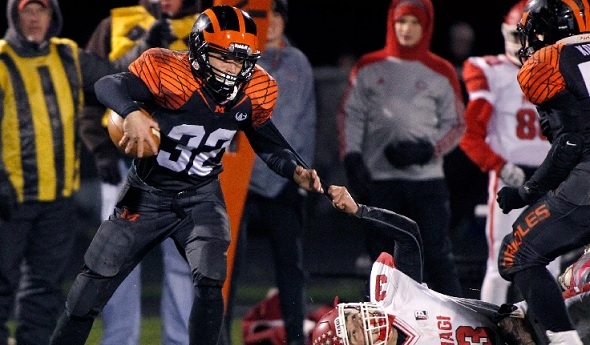
Morrice’s third-year varsity quarterback continued the play Friday that has helped his team to the best season in program history. Nowak ran 28 times for 158 yards and three touchdowns to lead the Orioles to a 40-8 win over Colon in an 8-Player Division 1 Semifinal, earning the senior signal-caller the Michigan Army National Guard “Performance of the Week.”
Nowak has run 204 times for 1,922 yards (9.4 yards per carry) and 33 touchdowns this season, and completed 24 of 49 passes for 529 yards and eight more scores. His 232 points rank third all-time since MHSAA-sponsored 8-player football was added a decade ago. He took over the QB spot in 2016, and Morrice went 4-5, but the Orioles improved to 9-2 last season and this fall finished the regular season 9-0 for the first time in the program’s 11 or 8-player history. Last week’s Semifinal was the team’s second ever and first since 1996, and this Saturday’s championship game against Pickford at Northern Michigan University’s Superior Dome will be the Orioles’ first trip to the MHSAA Finals in this sport. Along the way, Morrice avenged last season’s playoff loss to North Central Thumb League Red rival Deckerville – which went on to finish 2017 Division 1 runner-up – and handed Wyoming Tri-unity Christian its only defeat this fall in the Regional Final two weeks ago.
 Nowak plays only football at Morrice, but does also play on a high school-level rugby club team based in Howell. He carries a 4.0 grade-point average while dually enrolled at Lansing Community College, and hopes to study aviation after high school with aspirations of becoming a commercial airline pilot.
Performance Point: “The defense played great. They played shutout. The defense really won us the game, I think,” Nowak said of the Semifinal win over Colon. “We were able to put up 40 points, but that was a great offense they had. … It’s the first time we ever went to a state final for this, and we’re just really excited about it. We’ve been playing football since third grade, and we’ve always had successful seasons. We always thought that especially our senior year, we always thought, man, we really need to do really good that year. For it to happen, I think it’s great, because we’ve been working hard all year (and) ever since we started playing varsity. We’re thankful to the town for showing up at the games. Everyone comes out. It’s a big deal.”
That’s when we knew: “Our sophomore year, we didn’t do too great. We got four wins as sophomores; we could’ve done better. Last year we were OK – we lost to Deckerville in the second round (38-0). … Our first game (this season), we beat Deckerville (34-14). I think that was big. We went there, we won by 20 points, and that’s when we realized we’re a good team this year – we really have a shot to go far. We had lost the second round of playoffs the year before by a lot there. So to have our first game, since playing there, be right there again, and to be able to win – it put behind all the doubt that we had last year.”
 Taking this on together: “I think it’s the combination of a lot of us have been playing since third grade together. And there’s not a whole lot of us, so that bond has just grown through the years. And I think we’re just really good at football, and the whole speed thing really helps too. … I think it’s just knowing what someone else is going to do. If I’m running the ball, I can get a sense of where my lead blockers are going to go, what they’re going to do. We can try to get a sense of what other people are going to do. We can communicate easier. If something happens, we can fix it real quick, because we know how to talk to each other.”
It’s a speed thing: “I think 11-man was more about who’s going to be bigger on the line and then trying to work around that. (Eight-player) is not so much who is bigger on the line, it’s who can get off the line quicker and find the hole faster. We’re not the biggest team, but we’re a very fast team. That definitely helps us out.”
Revved and rallying: “When you’re done with the game and you’re walking back to the stands, there’s a lot of people I’ve never met before. But they’re all congratulating us, and they seem really excited about it. They’re there. They don’t know us personally, but they’re excited for the football team and they want to tell us, ‘Good job.’ There’s a lot of people talking about coming up (for the Final).”
- Geoff Kimmerly, Second Half editor
Every week during the 2018-19 school year, Second Half and the Michigan Army National Guard will recognize a “Performance of the Week" from among the MHSAA's 750 member high schools.
The Michigan Army National Guard provides trained and ready forces in support of the National Military Strategy, and responds as needed to state, local, and regional emergencies to ensure peace, order, and public safety. The Guard adds value to our communities through continuous interaction. National Guard soldiers are part of the local community. Guardsmen typically train one weekend per month and two weeks in the summer. This training maintains readiness when needed, be it either to defend our nation's freedom or protect lives and property of Michigan citizens during a local natural disaster.
Past 2018-19 honorees
November 8: Jon Dougherty, Detroit Country Day soccer - Read
November 1: Jordan Stump, Camden-Frontier volleyball - Read
October 25: Danielle Staskowski, Pontiac Notre Dame Prep golf - Read
October 18: Adam Bruce, Gladstone cross country - Read
October 11: Ericka VanderLende, Rockford cross country - Read
October 4: Kobe Clark, Schoolcraft football - Read
September 27: Jonathan Kliewer, Grand Rapids Forest Hills Northern soccer - Read
September 20: Kiera Lasky, Bronson volleyball - Read
September 13: Judy Rector, Hanover-Horton cross country - Read
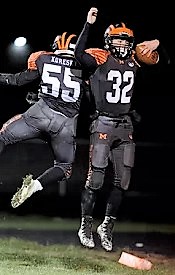
PHOTOS: (Top) Morrice quarterback Hunter Nowak (32) pulls away from a Colon defender during last week’s Semifinal win over the Magi. (Middle) Nowak and teammate Sam Koresky celebrate one of his touchdowns. (Photos courtesy of the Lansing State Journal.)
Portage Northern Coach Nurturing New Roots After Arriving from Crosstown Rival
By
Pam Shebest
Special for MHSAA.com
October 19, 2021
PORTAGE — When Kurt Twichell was hired as Portage Northern’s head football coach last May, he had some serious closet cleaning to do.
 As an assistant coach at crosstown rival Portage Central, his wardrobe was filled with blue and gold.
“I had to clean out probably 80 percent of my closet,” Twichell said, laughing. “Being a phys. ed. guy, I had quite a bit of blue and gold PC stuff.
“That all went into a big old bag, and I actually donated it back to them. I had a lot of work to do from a wardrobe perspective, no doubt about that.”
Twichell is nearing the conclusion of his first season as a head coach, with Portage Northern 2-6 this fall heading into its season finale Friday against Kalamazoo Central.
He had spent the previous seven seasons at Portage Central, finishing his tenure with the Mustangs last fall as their defensive coordinator. Across town at that time, Pete Schermerhorn was completing his 27th and final season leading the Huskies’ football program – and after some thought, Twichell applied to be his replacement and was named Northern’s next coach this spring.
Twichell made sure to wear orange when he met with his new team for the first time.
If he had worn any hint of blue, “We wouldn’t have let him in,” said senior and two-way player Xavier Thomas with a big grin.
Twichell said he understood why players were apprehensive.
 “I think naturally, with teenagers, it was like what the heck is going on?” he said. “We hired a guy from Portage Central. This is crazy.”
Twichell said he worked very hard to establish a rapport with the players.
“You’re trying to build trust within your program,” he said. “As soon as I accepted this job, I’m diving full on in, orange, brown and white as a Huskie.”
Thomas said players did not know what to expect.
“The initial feeling, we were a little nervous as far as what his path for us was going to be. Having come from that school, would he hold a grudge against us or not?” he recalled.
“After meeting him and sitting down and having a conversation with him, we understood that he was fully on the path of Portage Northern Huskies. He fully supports all of our sports programs, not just football. He’s just a great guy that we need in our community.”
Climbing the ladder
Twichell said his love of football started at Haslett High School in “an up-and-coming program” under head coach Charlie Otlewski and defensive coordinator Rob Porritt, adding “Those are my guys.”
After a football injury at Hope College derailed his playing career, Twichell transferred to Michigan State as a “regular student” and started working with Otlewski and Haslett’s football team.
“I spent a couple years there doing it for fun,” Twichell said. “I ended up loving it so much.”
He scrapped plans for med school and earned a teaching degree.
Taking his first job at White Pigeon, “I was just a young guy looking for any job I could get.”
 Two years later he contacted Enders, who happened to have a job available. Twichell spent the next seven years at Central, working his way up to defensive coordinator.
When he heard about the opening at Northern, which included a teaching position, he was not sure about applying.
“I was very, very rooted with Central and really enjoyed the staff and the opportunity they gave me to work my way up to d-coordinator,” he said. “When this job came up, I actually sat down and thought about it for more than three seconds. Being a head coach is a goal of mine.”
Twichell’s wife, Kate, coaches the Portage schools’ co-op girls lacrosse team and he said the family, including 3-year-old twins, are happy living in the community.
Ironically, shortly after accepting the Northern coaching job, his wife left Hackett Catholic Prep to teach Spanish and English at Portage Central.
That makes for some interesting family dynamics, especially during the rivalry game.
“I try to push the (twins) one way; Kate doesn’t necessarily try to push them either way but we still hear the ‘M’ (Mustangs) word after “Go” from the kids,” Kurt said. “They’ll say every now and then, Go Mustangs or Go Huskies. Kate just cheers for ‘no injuries,’ the way she puts it.”
No longer just Xs and Os
“The biggest change is how much of your role has almost nothing to do with football from an Xs and Os perspective or from an actual coaching kids perspective,” Twichell said.
“It’s community relations, youth involvement, financial management, recruiting.”
He said it is like the iceberg analogy.
“People just see Friday nights and results, but below the surface is all these components that go into building a good program,” he said. “Coach Shermerhorn left a pretty good foundation in terms of that iceberg, but I definitely want to put my own spin on things.”
During the day, Twichell is in the weight room, teaching a full day of power lifting.
The academic classes are open to all students, and Twichell hopes to resurrect the school’s power lifting team.
Chris Riker, Northern’s athletic director, said when hiring a coach, it is not where he coached but if he was a good fit for the program.
“We had some outstanding candidates and Kurt had a good plan on developing culture, developing not just the football player but the whole athlete, the whole person,” Riker said. “Academics were important. Getting involved in your community is important, and being a role model for the younger kids is important as well as being a good football player, good person.”
Riker said the team is very involved with the community.
“He’s done some things with our kids and Rocket Football to establish that connection with the youth program,” he said.
He added that Twichell and Enders collaborated on Camp Ability in July.
“It’s a camp for special needs kids who want to be involved with football,” Riker said. “It’s pretty cool to get out there and see kids who aren’t involved in football be that excited and be next to our football players. Kids had big smiles on their faces, just to be able to try on the shoulder pads and football jerseys.”
The children also ran drills, tossed footballs and ran for touchdowns, helped by players from both teams.
Not just another game
The Huskies are still settling into a new system (although a highlight was a Week 4 win over Division 3 No. 10 Stevensville Lakeshore). But Twichell has surrounded himself with solid support, carrying over several assistants from Schermerhorn’s staff.
 “Those guys have been phenomenal,” Twichell said. “Just about every coach who wanted to come back did.”
As the defensive coordinator at Portage Central, Twichell was familiar with Tom Laskarides, Schermerhorn’s defensive coordinator.
“People probably wondered what that was going to look like, but I have nothing but admiration and respect for Tom,” Twichell said. “We also brought back Mike McGuire who was on staff here probably 10 years ago. He’s a quarterbacks, offensive guy and a former head coach himself. That’s been huge to have these guys.”
Twichell said the team lost several outstanding players to graduation the last three years.
“When you go through losing groups like that, there’s going to be a transition there, regardless of a new coach,” he said. “We have a very young team, an inexperienced team.”
One game on Twichell’s radar this fall was the battle of the Portages, a game Northern lost, 33-17, two weeks ago.
“I’m not sure there’s a playbook out there that anybody’s ever written,” he said. “Not just competing against players that you had physically coached and had invested so much in their lives, but you know their families, their career aspirations, especially that senior class.”
Twichell said the “coach speak” was that it was just another game.
But the emotions surfaced during the postgame handshakes.
“Lots of hugs and some emotions. It was a good feeling from a human standpoint, but obviously we’re disappointed the game didn’t go the way we wanted it to,” he said.
Thomas said his coach warned the players that the game would generate more than the usual hype.
“He let us know there would be a lot of attention brought on us from the media, being (Central head coach Mick) Enders vs. Twichell,” Thomas said.
“But with his preparation, we were pretty dialed into the game. Hopefully we can take the things we learned from that game and assess them moving forward so the things that happened in that game won’t happen again.”
 Pam Shebest served as a sportswriter at the Kalamazoo Gazette from 1985-2009 after 11 years part-time with the Gazette while teaching French and English at White Pigeon High School. She can be reached at [email protected] with story ideas for Calhoun, Kalamazoo and Van Buren counties.
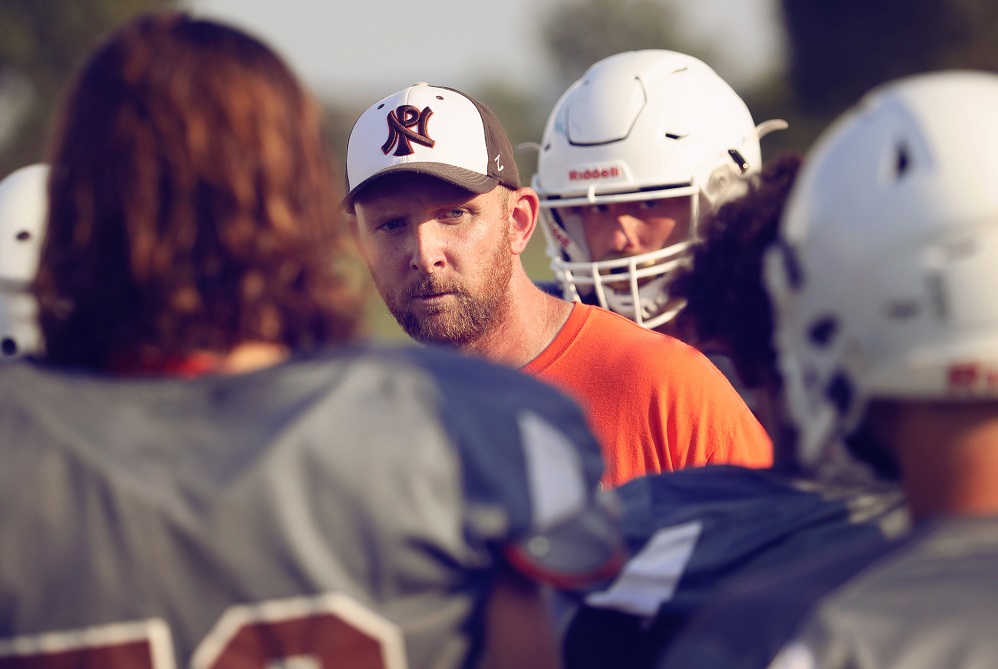
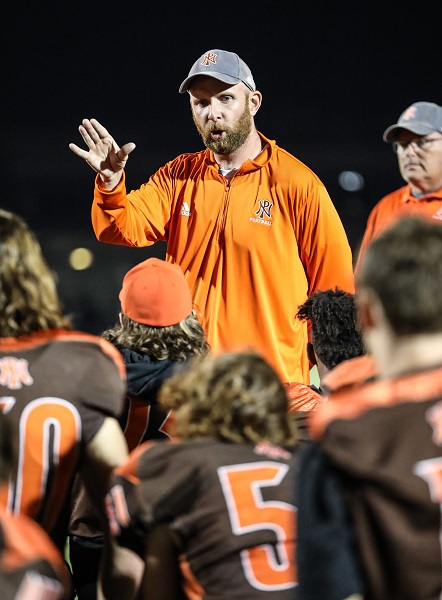
PHOTOS (Top) First-year Portage Northern varsity football coach Kurt Twichell talks with his team this season. (2) Portage Northern senior Xavier Thomas, top, and athletic director Chris Riker. (3) Twichell, left, works with his players during a practice this fall. (4) Twichell addresses the Huskies after a game. (Action photos by Jason Altwies; head shots by Pam Shebest.)