

Physical & Powerful, Beal City Rumbles to 1st Finals Title Since 2009
By
Brad Emons
Special for MHSAA.com
November 29, 2024
DETROIT – No stranger to an MHSAA Finals appearances, Beal City put an exclamation point on its 2024 season by upending Riverview Gabriel Richard, 43-14, for the Division 8 title Friday at Ford Field.
The Aggies (12-2), using a highly-effective ground attack, secured their third championship in 10 tries matching the feats of their 2009 (D8) and 1994 (Class D) title teams.
Beal City racked up 315 yards on the ground led by senior Drew Block, who finished with 112 yards on 20 carries and two touchdowns. Owen McKenny chipped in with 12 carries for 88 yards and a TD, while Garrison Zuker contributed seven for 64.
“Our offensive line was just outstanding today,” Block said. “We really couldn’t do anything without them. They’re the heart-and-soul of our team. They continually got us chunks and chunks of yards. We were going to let them just do their job and march down the field. We’ve got a lot of great talent on this team. Each guy has his own specific thing ... just a bunch of dogs, really.”
Beal City’s Brad Gross, in his 10th season as head coach, has been part of the program for nearly 23 years. He was a player on that ’94 team and was the offensive coordinator in 2009.
“They all mean a lot,” Gross said. “To be the head coach and get your first one ... it’s just awesome. I’m a Beal guy; when I’m done coaching, it will be at Beal.”
Gabriel Richard quarterback Nick Sobush was 9 of 18 passing for 120 yards and a TD for the Pioneers (11-2). He also added 51 yards rushing on 12 carries with a score.
 Gabriel Richard, making its inaugural Finals appearance, scored first taking its opening possession 72 yards in just three plays. The drive was capped by Sobush’s 53-yard TD toss down the sideline to Derek Lesko followed by Joey Calhoun’s 2-point conversion run to make it 8-0 just 1:19 into the game.
Beal City answered on its first offensive possession to make it 8-all after Drake Gatrell returned the ensuing kickoff to the 50. Six plays later Block scored on a two-yard run and McKenny added the 2-pointer after the Pioneers jumped offsides on the extra point attempt with 7:48 to go in the first.
With 4:39 remaining in the opening quarter, the Pioneers went for it on 4th-and-4 at their own 49 only to turn the ball over as Block intercepted a pass on his own 13. That led to a nine-play, 77-yard TD drive for the Aggies capped by Block’s five-yard TD run followed by Kyle Martin’s PAT to give Beal City a 15-8 advantage with 39 seconds remaining in the first.
On its next possession Gabriel Richard, going for it on 4th-and-9 from the Beal City 40, came up empty on an incomplete pass, which led to the Aggies increasing their lead to 22-8. Quarterback Cuyler Smith connected with McKenny, who made a leaping grab just over the goal line for an eight-yard TD catch on 4th-and-2 with 2:30 to play in the first half.
“The ball was thrown perfectly, I just came back and grabbed it,” McKenney said. “I was snag. It was 4th-and-2 and changed the momentum of the game. It was a real tone setter.”
Gabriel Richard did thwart another Beal City scoring threat just before the first half ended when Lesko intercepted a pass at his own 4 with just four seconds remaining.
Beal City outgained the Pioneers 195-158 in total offense over the first two quarters.
McKenny returned the opening kickoff of the second half 44 yards, and the Aggies’ star running back scored just six plays later on three-yard TD run to increase Beal’s lead to 29-8 with 8:30 to go in the third quarter.
Gabriel Richard answered with a 16-play, 76-yard drive that chewed up 7 minutes and 37 seconds and finished on a one-yard keeper by Sobush, but the Pioneers were unable to convert the 2-pointer and trailed 29-14 with 47 seconds to play in the third.
The Pioneers then tried an onside kick that was recovered by Zuker at the 50. With a short field to play with, Beal City put the game away on flanker Austin Small’s 29-yard TD run with 9:14 to go.
Neil Finnerty also got into the scoring act with a five-yard TD run to give the Aggies a 29-point cushion with only 2:21 left.
 “Today they caught us at the right time,” Gabriel Richard first-year coach Mark Shea said. “We went through a gauntlet of teams. We were really beat up coming into this. Honestly, we had three or four guys that we didn’t think would be able to play, but they came out and played. Taking absolutely nothing away from Beal City. They played a great game, but we were beat up and you could see it. We lacked some of the explosiveness that we generally have. And when we don’t have the balance in our attack, it puts us in a bad situation. But as far as effort goes, they gave me everything they could do.”
“Joey (Calhoun) got a little banged up first drive on defense; that’s an all-state kid,” Sobush added. “And (Beal City) kind of just took our passing game away. I made a bad throw that kind of changed the momentum of the game.”
Beal City had opened this postseason with a 47-0 win over Frankfort, but then had to get past Glen Lake (21-14), Iron Mountain (14-7) and Fowler (17-16).
“It was nice to get this one,” Gross said. “I wouldn’t say easier, but the word I’m looking for is that it wasn’t as stressful. These guys have done everything we asked them to do.”
Six weeks ago, and just prior to the playoffs, Gross said the Aggies “had to play physical football with bad intentions.
“These guys took it to heart,” the Beal City coach said. “We just got more physical.”
Gross said the beauty of this newly-crowned Aggies championship team was the cohesiveness between the seniors, juniors, sophomores and even their freshmen.
“And these guys treat those guys like they’re just like any other player,” he said. “That’s what makes our team special, because we’re more of a team. I think our model all year was, ‘Teams win championships, individuals win awards,’ so we kind of stuck by that and that’s what got us here. It means a lot to me, but it’s all about these guys and that’s the most important thing.”
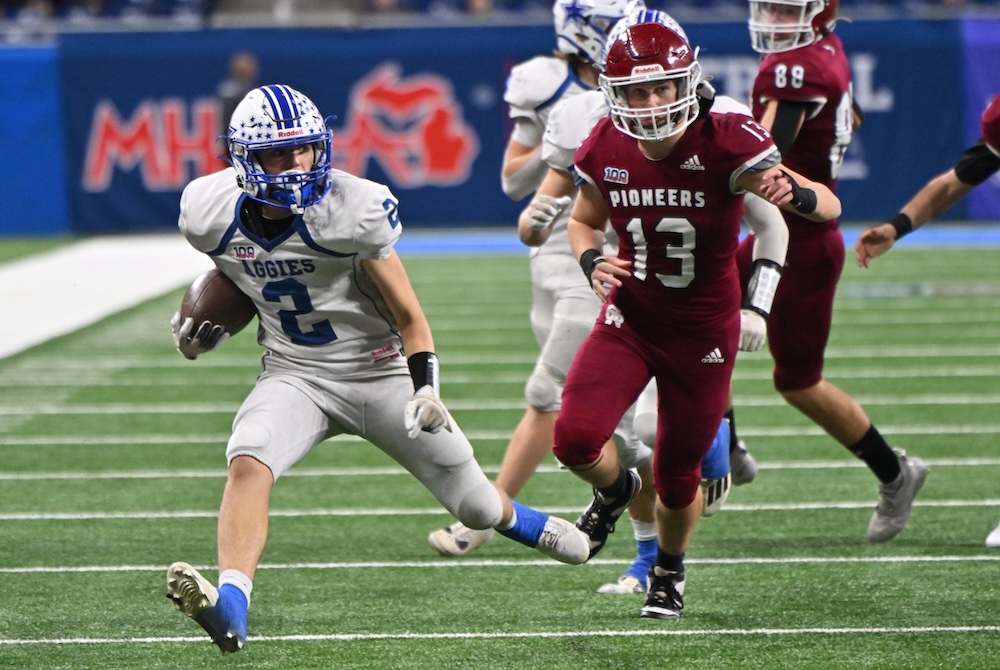
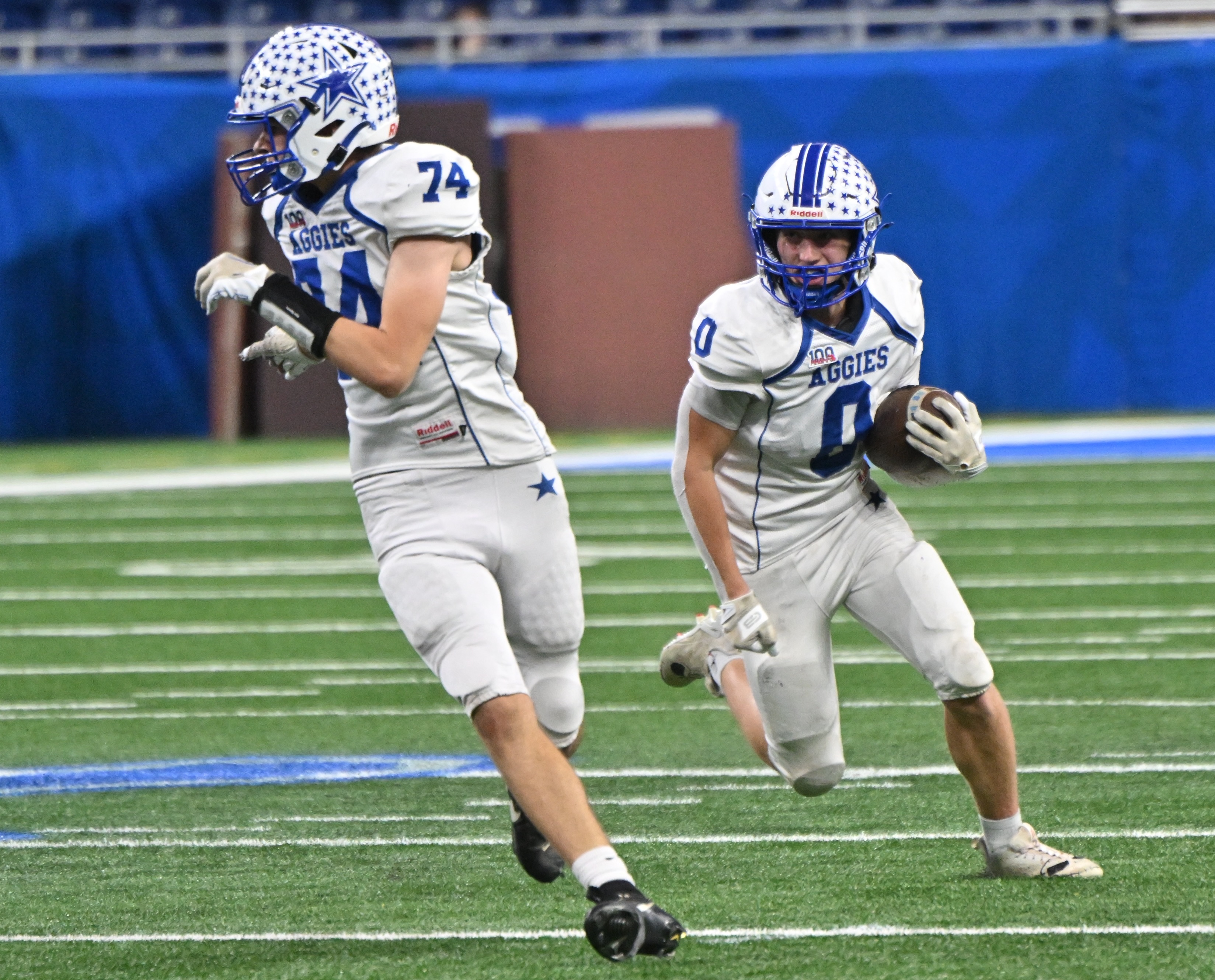
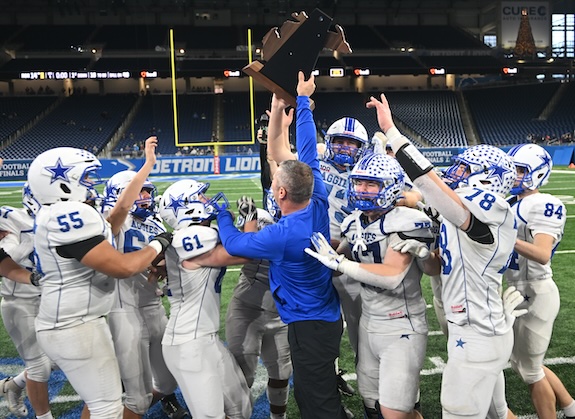
PHOTOS (Top) Beal City’s Austin Small (2) looks to cut back Friday as Gabriel Richard’s Aidan Valatka (13) pursues him. (Middle) Beal’s Drew Block follows the block of Jace Faber. (Below) Aggies coach Brad Antcliff raises the Division 8 championship trophy as his players celebrate. (Photos by Hockey Weekly Action Photos.)
Performance of the Week: Hudsonville's Brady Van Laecke
October 10, 2025
 Brady Van Laecke ♦ Hudsonville
Senior ♦ Football
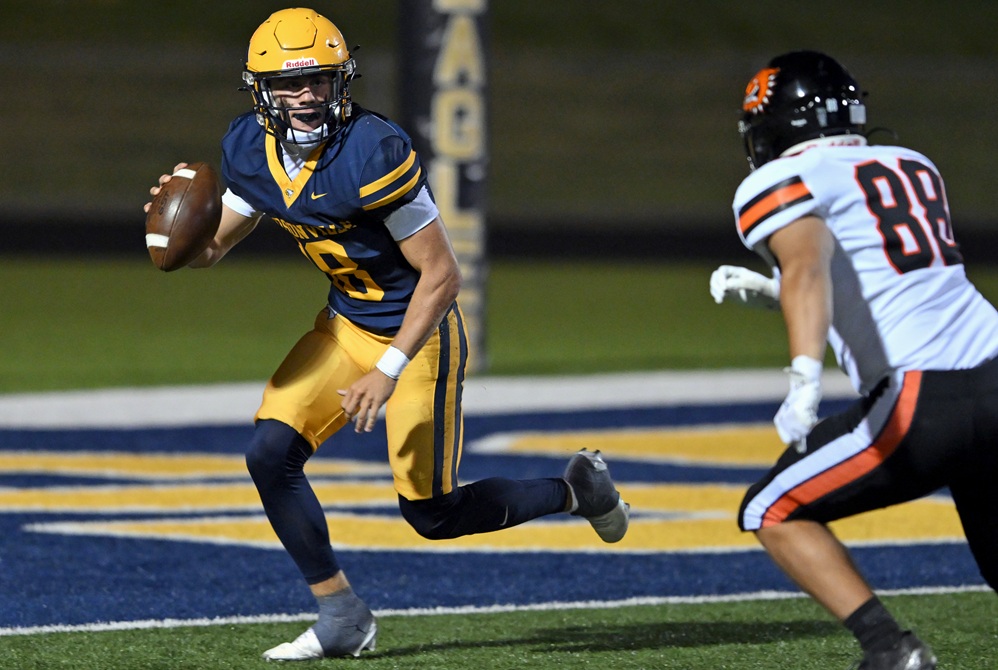
Hudsonville's quarterback produced one of most notable performances in the state during Week 6, completing 11 of 13 passes for 239 yards and two touchdowns and running 17 times for 85 yards and two more scores as the Eagles held off rival Rockford 35-28 to improve to 6-0 and move into first place alone in the Ottawa-Kent Conference Red.
Van Laecke saw time during last season's Division 1 championship game loss to Detroit Cass Tech at Ford Field, throwing three passes, running five times and punting twice. He also is a sprinter on the track & field team and was part of Hudsonville's O-K Red championship 400 relay in the spring. His final scoring pass against Rockford, to teammate Lawsyn Weber, received national attention as Weber leapt over a defender and pulled down the pass in the back of the end zone.
@mhsaasports 🏈POW: Brady Van Laecke #hudsonville #football #highschoolsports #performanceoftheweek #MHSAA ♬ Bright and fun upbeat pops, Kids, Animals, Pets, Fun, Cute, Happy, Playful, Upbeat(1465232) - SAKUMAMATATA
@mhsaasports 🏈POW: Brady Van Laecke #funfacts #tiktalk #performanceoftheweek #highschoolsports #MHSAA ♬ Girly and cute synth pop - SAKUMAMATATA
Follow the MHSAA on TikTok.
MHSAA.com's "Performance of the Week" features are powered by MI Student Aid, a division within the Department of Lifelong Education, Advancement, and Potential (MiLEAP). MI Student Aid encourages students to pursue postsecondary education by providing access to student financial resources and information. MI Student Aid administers the state’s 529 college savings programs (MET/MESP), as well as scholarship and grant programs that help make college Accessible, Affordable and Attainable for you. Connect with MI Student Aid at www.michigan.gov/mistudentaid and find more information on Facebook and Twitter @mistudentaid.
Previous 2025-26 honorees
Oct. 2: Sarah Giroux, Flat Rock volleyball - Report
Sept. 25: Sam Schumacher, Portage Central tennis - Report
Sept. 18: Kaylee Mitzel, Saline field hockey - Report
Sept. 11: Natasza Dudek, Ann Arbor Pioneer cross country - Report
Sept. 4: Kate Posey, Big Rapids golf - Report
(Photos courtesy of the Hudsonville football program.)