

Playmakers Make Way for GRCC Repeat
By
Paul Costanzo
Special for MHSAA.com
January 23, 2021
DETROIT – Frankenmuth came into Saturday’s Division 5 Football Final with staggering defensive numbers.
The Eagles had held opponents to 6.8 points and 27 yards rushing per game, and 1.1 yards per carry. Just three opponents had scored in double digits, and Frankenmuth had won each of those games comfortably.
Grand Rapids Catholic Central was well aware of those numbers – so much so that coach Todd Kolster recited them off the top of his head after the game. But the Cougars were also aware of the playmakers they had on offense, and the opportunities they would have to make plays.
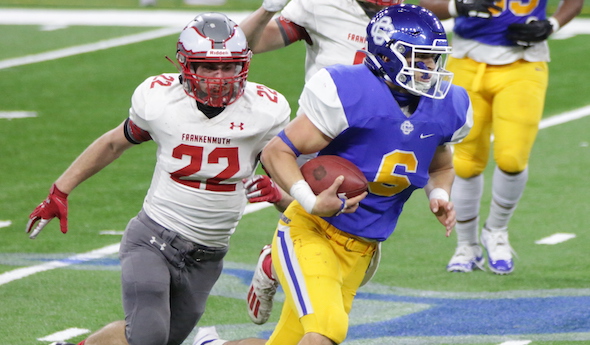
Behind a six-touchdown performance from junior quarterback Joey Silveri, Catholic Central did just that, claiming a 48-21 victory against the Eagles at Ford Field. It’s the second-straight title for the Cougars, and fourth in five years. The previous three came in Division 4.
“They are a great defense; they don’t give up a lot of rush yards,” Silveri said. “We knew going into this game that we were going to have to win our matchups one on one to make some big plays, and I was very confident in our guys.”
It was the second-straight year that Silveri accounted for six touchdowns in the Finals, as he did the same against Detroit Country Day in 2019. On Saturday, he threw for three touchdowns and ran for three more. He finished the night with 172 yards on 9 of 15 passing, and 104 yards on the ground.
“I love playing in big games,” Silveri said. “It’s what you play for; it’s a lot of fun. All the preparation we did through this week, it all paid off. When you play a defense that’s basically man-on-man coverage, they bring a lot of pressure, it leaves a lot of chances for big plays, and we took advantage of that tonight.”
Silveri and the Cougars (11-0) wasted little time spreading the field and putting their athletes in space to keep Frankenmuth’s aggressive defense off balance. He hit senior running back Nick Hollern for a 30-yard pass on the first play from scrimmage, and each of the first two drives ended with touchdown passes to the Cougars’ Division I-bound receivers – an 11-yard pass to junior tight end Nolan Ziegler (Notre Dame) and a 13-yard pass to senior receiver Jace Williams (Miami of Ohio).
 The Cougars built a 28-7 lead by the half and went up 35-7 early in the third quarter.
“I thought our guys really came out aggressive, and that was the big thing for us,” Kolster said. “We knew they were a heck of a football team, they’re very physical, they play hard, so we had to be able to match that intensity and get some matchups early. We were able to do that, and we were able to continue to go.”
The hill was too high to climb for Frankenmuth (11-1), which was making its first Finals appearance. The Eagles have been a near-constant playoff presence, making it in each of the past 10 years and qualifying for seven Semifinals since 1987. This year’s group was able to take a big step, even if it wasn’t the final one.
“Today, leaving town was amazing,” Frankenmuth coach Phil Martin said. “Our community rallied around this team. It was a sendoff like no other. I want to say it was probably close to 14 miles long with people lined up showing support for this team. The community was outstanding. They stepped up and supported us for this state championship with contributions for buses and meals. It’s just been awesome.”
While Frankenmuth finally broke through this season, Grand Rapids Catholic Central has entered elite territory, with five titles since 2010 and its recent dominant stretch. With key players like Silveri and Ziegler coming back, it might not be over – although Silveri wasn’t quite ready to think beyond Saturday’s accomplishment.
“I’m just trying to enjoy tonight – enjoy the win,” he said. “We’ll worry about next season when we get there, and hopefully we’ll win another one.”
Ziegler had a pair of touchdown catches on the night, adding a 35-yarder early in the second quarter. Silveri’s rushing touchdowns came on runs of two, one and 12 yards. Hollern, who had 192 yards rushing, added a one-yard touchdown. Ziegler and Dan Mikolay each had seven tackles to lead the Catholic Central defense.
Daniel Barger, Davin Reif and Konnor Roche had touchdown runs of four, seven and four yards, respectively, for the Eagles. Cole Lindow led the team with 99 yards rushing, while Reif had 85. Ben Reinert led the Frankenmuth defense with 12 tackles, while Dalton DeBeau had eight.
Barger’s touchdown was set up by an Ashton Benkert fumble recovery, with the ball sprung loose by Ethan Jacobs. That made the score 14-7 late in the first quarter, but Catholic Central scored the game’s next 21 points to pull away.
“I can’t ask any more of our kids; they came out and fought hard,” Martin said. “We got a little behind early. Field position kind of put us in a bind, and we didn’t convert a couple first downs early, and they were able to take advantage of that field position. We made a couple pretty good adjustments at half, but it just wasn’t enough.”
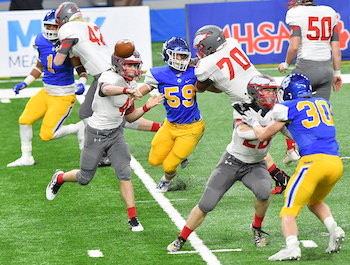
PHOTOS: (Top) Grand Rapids Catholic Central’s Joey Silveri (6) makes a move upfield as Michael Carter gives chase. (Middle) Frankenmuth quarterback Davin Reif (4) unloads a pass as GRCC’s Ryan Beggs (59) works to break free of Zach Adkins’ block. (Click for more from Hockey Weekly Action Photos.)
1st & Goal: 2026 Week 4 Review
By
Geoff Kimmerly
MHSAA.com senior editor
September 21, 2026
There's always a week during high school football season when league championship races begin to become clearer.

Week 4 seems a little early for that most years. But several conference title scenarios may have begun to unfold with the results of this weekend's games.
Of course we have several more weeks to go; we haven't reached midseason yet. But read on for more on how many matchups from Week 4 may end up being the deciding ones when this regular season is complete.
Bay & Thumb
HEADLINER Imlay City 17, North Branch 14 Imlay City sits atop the Blue Water Area Conference with Almont and Macomb Lutheran North, which are all 3-0 in league play. The Spartans (4-0) won only three games total last season and a combined 11 since their last four-win season in 2020. Click for more from the Flint Journal.
Watch list Saginaw Valley Lutheran 31, Saginaw Nouvel Catholic Central 28 The Chargers (4-0) have gone from a winless 2021 and a one-victory 2022 to a perfect regular season a year ago and an equally impressive start this fall.
On the move Linden 49, Holly 35 The Week 7 matchup between Linden and Fenton is lining up as the potential Flint Metro League Stripes decider as the Eagles (4-0) sent Holly (3-1) a game back of the leaders. Croswell-Lexington 20, Richmond 14 The Pioneers (1-3) opened against teams that are a combined 11-1 but started making their move by avenging last season’s 18-point loss to Richmond (0-4), which has three defeats by seven points or fewer. Saginaw Swan Valley 15, Whitehall 14 A late safety kept Swan Valley (4-0) undefeated and among the highest-ranking teams in Division 5 playoff points as we approach midseason.
Greater Detroit
HEADLINER Romeo 36, Macomb Dakota 26 This matchup – and a similar result – ended up deciding the Macomb Area Conference Red title in Romeo’s favor last season, and the Bulldogs (4-0) are hoping for a similar bump as they’ll carry the momentum into this week’s matchup with league co-leader Grosse Pointe South. Dakota (2-2) took an early 14-0 lead before Romeo rallied the lockdown defense that has otherwise given up only 17 points this season. Click for more from the Macomb Daily.
Watch list Detroit Denby 12, Detroit Cody 6 Two games into the league schedule, Denby (3-1) is the only team undefeated in Detroit Public School League Gold play as it pursues a fourth-straight title. Circle the Week 7 home game against Detroit Central as the big one.
On the move Dearborn Fordson 24, Dearborn 17 The Tractors (3-1) bounced back from a Week 3 loss to Belleville to down the rival Pioneers and have now seen all four of their games this season decided by seven points or fewer. Redford Thurston 47, Redford Union 6 These two had shared the Western Wayne Athletic Conference championship a year ago, and Thurston took a big step toward making it a one-team title this fall, with the Week 6 matchup against Garden City a potential showdown. Clarkston 45, Rochester Adams 0 The Wolves (4-0) are riding a two-game shutout streak and opened the Oakland Activities Association Red schedule in a big way, but Adams (2-2) also lost to Clarkston last season and still went on to reach the Division 1 Semifinals.
Mid-Michigan
HEADLINER Leslie 34, Michigan Center 32 Leslie (3-1) sits atop the Cascades Conference North thanks to the game-winning touchdown pass with nine seconds to play. A 36-32 loss to Michigan Center (2-2) in Week 5 last season stopped the Blackhawks’ season-opening winning streak, and they went 1-5 the rest of the way, but this time Leslie will look to extend their early-season success against winless Grass Lake this week before a big Week 6 matchup against Manchester. Click for more from WLNS.
Watch list Saranac 21, Laingsburg 0 The Red Hawks are 4-0 for the first time since 2011 and haven’t allowed a point since Week 2 – and only 20 total this fall. Against Fowler this week, Saranac will have its first chance to avenge a 2025 defeat.
On the move Beal City 35, McBain 16 If recent history holds, this could end up deciding the Highland Conference title for the Aggies (4-0), although Evart has re-entered the conversation and hosts Beal City in Week 7. Hartland 36, Brighton 21 The Eagles (3-1) defeated Brighton for the first time since 2015 to become Howell’s primary challenger in the Kensington Lakes Activities Association Gold; they face off in two weeks. Okemos 35, Lansing Everett 20 The Wolves bounced back from a Week 3 loss to Grand Ledge to get to 3-1, that third victory marking the team’s most since 2018 and after winning a combined five games over the last seven seasons. Okemos’ next three opponents are a combined 3-9.
Northern Lower Peninsula
HEADLINER Traverse City St. Francis 39, Maple City Glen Lake 20 The Gladiators’ first-half schedule has been one of the state’s toughest, and the second half may not get much easier – which made this victory especially important, even as the team is stacking up playoff bonus points for taking on such tough competition. Glen Lake (2-2) should continue to contend in the Northern Michigan Football Conference, while St. Francis (2-2) has Pontiac Notre Dame Prep and Grand Rapids West Catholic among others over the next five weeks. Click for more from the Traverse City Record-Eagle.
Watch list Petoskey 34, Escanaba 0 The Big North Conference is looking more unpredictable by the week, and the Northmen (3-1) find themselves tied with Marquette atop the early standings after finishing fourth a year ago.
On the move Frankfort 44, Johannesburg-Lewiston 16 Six of nine teams in the NMFC are 2-2 are better, including both of these, and matchups like this likely will help determine who qualifies for the playoffs. Harbor Springs 34, Tawas 6 The Rams (3-1) are another of those NMFC teams in the early playoff hunt as they pursue a first postseason appearance this decade. Ogemaw Heights 35, Midland Bullock Creek 0 The Falcons (4-0) built on a steady start defensively this season with their first shutout and did the work on offense as well after Bullock Creek (2-2) entered coming off two shutout wins.
Southeast & Border
HEADLINER Adrian Madison 21, Hudson 12 Madison trailed 12-7 at halftime but came back to defeat last season’s Division 8 runner-up Tigers for the first time. The pair has been in the Lenawee County Athletic Association together the last three seasons and Hudson (3-1) had scored at least 50 points in all three of those LCAA meetings including during a 56-7 win over the Trojans (4-0) a year ago. Click for more from the Adrian Daily Telegram.
Watch list Monroe Jefferson 36, Riverview 24 These two are among five teams at 2-1 in the Huron League race with the midpoint coming up this week, and Jefferson (4-0 overall) leads with Monroe St. Mary Catholic Central at 3-0 in Huron play. Riverview (3-1) shared last year’s league title with both and will be hoping for a few slip-ups.
On the move Chelsea 63, Tecumseh 6 The Bulldogs (4-0) stand alone atop the Southeastern Conference White standings after their highest-scoring performance yet while also holding down a Tecumseh offense that reached 40 points every game of a 3-0 start. Jackson Lumen Christi 40, Ann Arbor Father Gabriel Richard 10 Every win is important in the Catholic High School League AA this season and especially as Lumen Christi (4-0) works to keep pace with Dearborn Divine Child. Brooklyn Columba Central 31, Jonesville 14 Jonesville had won all three meetings since these two joined the same Cascades Conference division in 2023, and the timing couldn’t have been better this time for Columbia Central which will take some added energy into this week’s key matchup at Hanover-Horton.
Southwest Corridor
HEADLINER Marshall 28, Battle Creek Harper Creek 26 A dramatic fourth quarter that included a long Marshall scoring drive and 2-point conversion stop put the Redhawks (4-0) at the top of the Interstate 8 Athletic Conference standings and ended a run of three straight losses to the Beavers (3-1) – who have won the last two league titles. Click for more from the Battle Creek Enquirer.
Watch list Constantine 41, Schoolcraft 21 Just as we were anticipating a Week 6 Schoolcraft/Kalamazoo United matchup for first in the Southwestern Athletic Conference, the Falcons swooped in and changed things up, with United now alone in first place and Constantine and Schoolcraft both just a game behind at 3-1.
On the move Berrien Springs 30, Buchanan 20 The Shamrocks (4-0) no doubt were waiting for this Lakeland Athletic Conference rematch after losing last season to the Bucks and ending up as part of a three-team title share. Edwardsburg 21, Paw Paw 14 The Eddies (4-0) broke a three-game losing skid against Paw Paw (3-1) and in doing so whittled the leaders in the Wolverine Conference down to only themselves and Vicksburg, their Week 8 opponent. Union City 22, Quincy 18 The Chargers (4-0) are undefeated through the first half of their Big 8 Conference schedule after claiming their closest league win since 2022 and handing Quincy (3-1) its first defeat.
Upper Peninsula
HEADLINER Menominee 22, Calumet 8 The Maroons (4-0) have run their winning streak to 18, but with this victory their second-closest during the last two regular seasons – ranking just behind the 10-point victory over the Copper Kings from a year ago. The victory kept Menominee atop the Division 7 playoff-point rankings and sent Calumet (3-1) from No. 4 to No. 14 in Division 6. Click for more from the Marinette/Menominee Eagle Herald.
Watch list Marquette 33, Cadillac 27 After opening this season with a pair of losses to Upper Peninsula rivals, Marquette has added a pair of victories to begin Big North Conference play after finishing third in the league a year ago.
On the move Kingsford 21, Negaunee 16 This one always seems to have league title implications, and the Flivvers (4-0) kept themselves among the undefeated in the Western Peninsula Athletic Conference Copper. Iron Mountain 42, L’Anse 22 After a pair of one-score losses heading into this matchup, Iron Mountain (2-2) ran its winning streak over L’Anse (2-2) to six, although they meet again Week 7. Ishpeming Westwood 38, Houghton 26 The Patriots (1-3) got on the board after opening this fall with losses to three teams that are currently a combined 11-1.
West Michigan
HEADLINER Grand Rapids South Christian 34, Hudsonville Unity Christian 33 Unity led 14-0 early and by as many as 20 before Austin Burgess scored the go-ahead touchdown on fourth down with 1:34 to play and Brody Shilts iced the win for South Christian (3-1) with an interception in the end zone. Unity (2-2) had won their last two meetings by 28 and 29 points. Click for more from WOOD TV.
1-800-CALL-SAM PLAY OF THE WEEK NOMINEE
ONE LAST CHANCE… DENIED. ❌
Brody Shilts picks off Unity Christian’s final end-zone attempt to slam the door and seal the win for South Christian! 🔒🏈
Powered by @CallSam pic.twitter.com/acTvBzzbhA— STATE CHAMPS! Michigan (@statechampsmich) September 20, 2026
Watch list Hamilton 28, Spring Lake 7 The schedule won’t get easier for the Hawkeyes (3-1), but they’ve already improved substantially on last year’s 2-7 finish, especially considering their first three opponents are a combined 11-5.
On the move Big Rapids 27, Reed City 7 This matchup decided the last two Central State Activities Association Red championships, and the Cardinals (2-2) have an important edge again as they prepare to play current co-leader Remus Chippewa Hills this week. Grand Rapids West Catholic 42, Ada Forest Hills Eastern 34 West Catholic (3-1) delivered Forest Hills Eastern’s first defeat in the matchup that might end up deciding the Ottawa-Kent Conference White title. Middleville Thornapple Kellogg 26, Holland Christian 7 TK also has some major opponents ahead, but sits 4-0 for the first time since 2018 and delivered Hamilton’s lone loss and Hastings’ first this season.
8-Player
HEADLINER Colon 32, Climax-Scotts 8 Colon coach Robbie Hattan previously led the Magi to the Division 1 championship in 2019 and has the team rumbling again in his return as it downed a Climax-Scotts team that had averaged 31 points per game during its 3-0 start and won last year’s meeting 77-33. Colon has another big one this week against undefeated Mendon. Click for more from WTHD.
Watch list Dansville 38, Morrice 25 The Aggies (4-0) are playing their first season of 8-player after winning one game total over their last three 11-player seasons. The switch suits them, as they’ve claimed all of their games this fall by at least 12 points.
On the move Ishpeming 38, Crystal Falls Forest Park 22 It’s a good time to say Ishpeming is all the way back from last season’s uncharacteristic down year as the Hematites (3-1) are now the only contender to defeat traditional powers Forest Park (3-1) and Powers North Central this season. Mendon 50, Mio 34 The Hornets (4-0) won this matchup of unbeatens by giving up their season high but also topping 45 points for the fourth straight week. Lake Linden-Hubbell 60, Norway 32 The Lakes already had a win over Ishpeming and this was another massive achievement as Norway’s only defeat over the last two years was during last season’s Division 1 Semifinals.
MHSAA.com's weekly “1st & Goal” previews and reviews are powered by MI Student Aid, a division within the Department of Lifelong Education, Advancement, and Potential (MiLEAP). MI Student Aid encourages students to pursue postsecondary education by providing access to student financial resources and information. MI Student Aid administers the state’s scholarship and grant programs that help make college Accessible, Affordable and Attainable for you. Click to connect with MI Student Aid and find more information on Facebook and Twitter @mistudentaid.
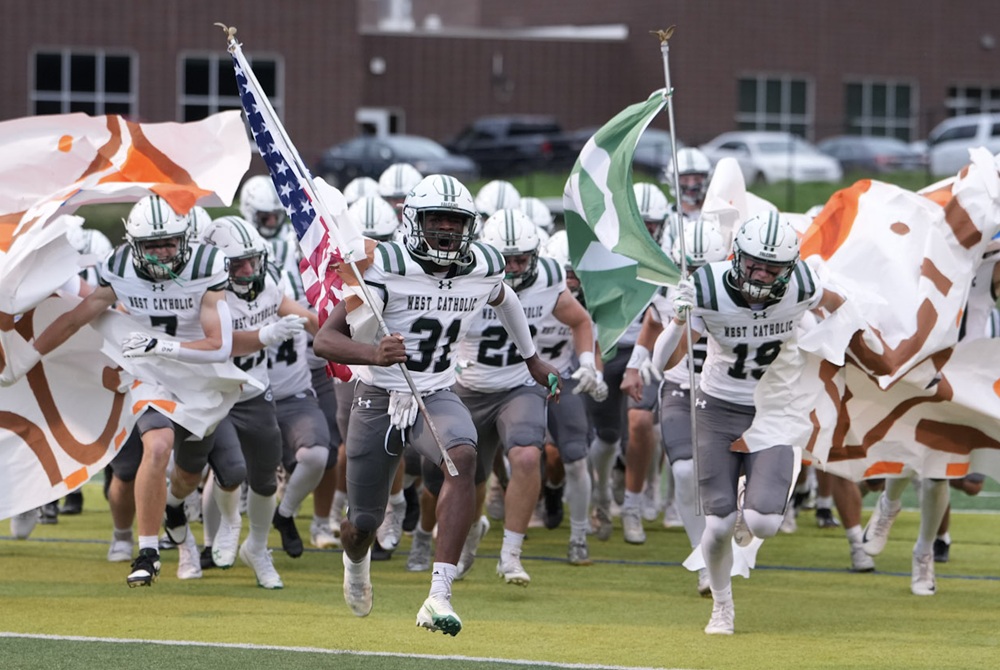
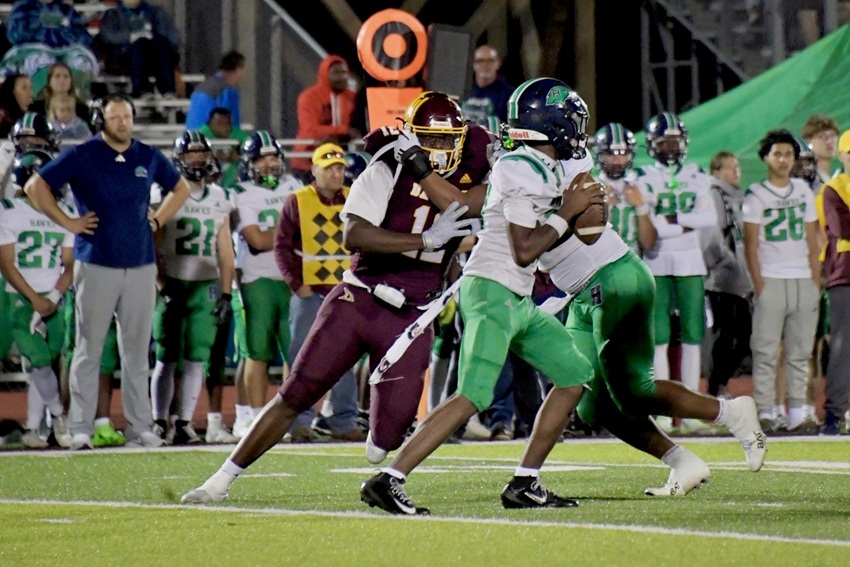
PHOTOS (Top) Grand Rapids West Catholic takes the field prior to last week's win over Forest Hills Eastern. (Middle) A Davison pass rusher pursues the Saginaw Heritage quarterback Friday. (Below) Marquette's Winston Leonard keeps the ball as Cadillac's Westin Hamp pursues and eventually tackles him. (West Catholic photo by Michigan Sports Photo. Davison/Heritage photo by Terry Lyons. Marquette/Cadillac photo by Cara Kamps.)