

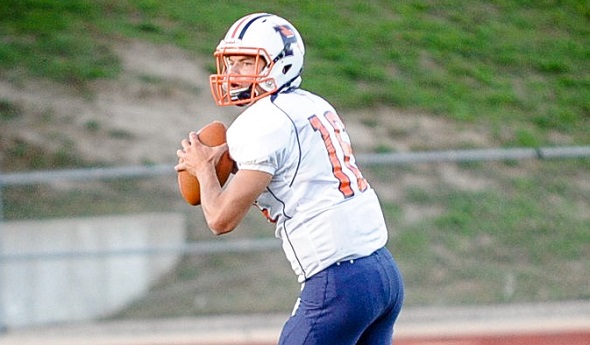
Playmaking Sargent Powers Chargers
November 25, 2015
By Bill Khan
Special for Second Half
FLINT — Most high school football coaches aren't comfortable having their quarterbacks, no matter how athletic they are, perform double duty by playing defense.
 The risk of injury or excessive fatigue is simply too great.
Flint Powers Catholic's Bob Buckel is no different than the majority of his peers.
"I'll be honest, I don't feel comfortable having him on the field all the time," Buckel said of senior quarterback Noah Sargent.
And, yet, having Sargent play defensive back when he isn't running the offense is one of the reasons why Powers (11-2) will play Zeeland West (13-0) for the MHSAA Division 4 championship at 7:30 p.m. Friday at Ford Field.
Sargent's team-high third interception of the season played a major role in Powers' 21-14 come-from-behind victory over Detroit Country Day in the Semifinals last Saturday in a snowstorm at West Bloomfield
He had already ignited a comeback from a 14-0 halftime deficit by tossing a 38-yard touchdown pass to Peyton Beauchamp. Sargent's one-handed interception later in the third quarter at the Country Day 20-yard line set up a 20-yard touchdown run by Reese Morgan.
Showing off one more aspect of his skill set, Sargent scored the winning touchdown on a 2-yard run with 26 seconds left in the game, putting Powers in the MHSAA championship game for the third time in school history. The 2005 team won the Division 4 championship, while the 2011 squad won the Division 5 title.
Putting an exclamation point on his performance, Sargent knocked down Country Day's final desperation pass as time expired.
"Noah understands we don't want him to get killed on defense," Buckel said. "We really try to put him on the best receiver and keep him out of harm's way. I heard someone earlier in the year say, 'When you get to the playoffs, you've got to save him.' I said, 'When you get to the playoffs, you have to play every play like it's your last play.' You throw him out there and hope for the best; the best happened last Saturday."
Sargent has 19 tackles, ranking ninth on the team. He is part of a defense that has allowed only 21 points in four playoff games and posted a school-record six shutouts.
"Coach really only plays me as a cover guy," Sargent said. "He doesn't like to throw me down (near the line). He uses me in coverage on third-and-long situations and passing downs."
As a quarterback, Sargent has displayed the kind of dual-threat capability that was integral to Powers' last MHSAA championship four years ago. Garrett Pougnet ran for 159 yards and two touchdowns and threw for 258 yards and four touchdowns in Powers' 56-26 rout of Lansing Catholic in the 2011 title game.
Sargent is Powers' leading rusher, in addition to its leading passer. He's run 134 times for 1,026 yards and 15 touchdowns, including an 83-yard scramble on third down for a touchdown in the playoff opener at Goodrich. He's 104 for 181 for 1,563 yards, 18 touchdowns and only four interceptions. Five of those touchdown passes came in a 41-0 victory over Goodrich, as he had a hand in all six touchdowns.
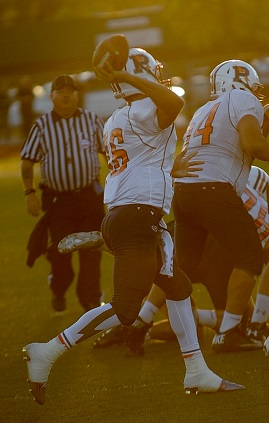 "We knew Sargent was the show," Goodrich coach Tom Alward said. "They've got good receivers, but Sargent's the one that makes them go."
Sargent is the son of Mike Sargent, an all-state linebacker at Powers in 1983 and a tight end on Michigan State's 1988 Rose Bowl championship team. Both of Sargent's parents went to Powers, and Noah attends his parents' alma mater with his sister, Nikole, who was the MHSAA Lower Peninsula Division 2 shot put champion as a junior last spring.
"He's a good leader," said senior tight end Nick Thompson, Powers' leading receiver with 27 catches for 448 yards and seven touchdowns. "He's humble. He's not selfish. He has the aspects of a good leader. You can see it on the field, obviously, and at practice. We trust him."
Sargent isn't the only Charger with a rich Powers pedigree.
Running back Reese Morgan and receiver Matt Wiskur had brothers on the 2011 championship team. Brooks Morgan was a starting receiver, while Ethan Wiskur was a starting defensive back who had an interception in the 2011 title game.
Watching in the stands as middle school students, the younger Morgan and Wiskur brothers had all the incentive they needed heading into high school.
"That's my main motivation," said Wiskur, who has 23 catches for 383 yards and five touchdowns. "They're the strongest team I've ever seen. They had great leaders. They were 5-4 going into the playoffs. They knew they were going to win states the whole time. They were confident in themselves, and they lived up to that."
A similarity between the 2011 and 2015 teams is their slow starts. Powers was on the brink of playoff elimination after six games, starting out 2-4 in Buckel's first season at the helm. This year's team lost its opener, 27-11, to a Flushing team that went 3-5 the rest of the way. The Chargers were 3-2 before winning their last eight games.
"I remember they didn't have a very good start, but they had a lot of heart and they made a big run in the playoffs and kind of shocked everyone," said Morgan, who has run 146 times for 987 yards and 10 touchdowns while catching 27 passes for 317 yards and two scores.
"The talent on that team was incredible. We have the same chance they did of winning."
When Powers steps foot onto the turf at Ford Field on Friday, the current team will play under the watchful eye of youngsters who hope to one day have the same experience.
"Any high schooler wants to leave a legacy when they leave," Sargent said. "Our whole team is trying to make a mark on Powers history."
 Bill Khan served as a sportswriter at The Flint Journal from 1981-2011 and currently contributes to the State Champs! Sports Network. He can be reached at [email protected] with story ideas for Genesee, Lapeer, St. Clair, Sanilac, Huron, Tuscola, Saginaw, Bay, Arenac, Midland and Gladwin counties.
PHOTOS: (Top) Powers Catholic quarterback Noah Sargent drops back to pass against Midland Dow this season. (Middle) Sargent unloads a throw during the 35-30 loss, but has led the Chargers to an 11-2 record this fall. (Click for more from HighSchoolSportsScene.com.)

Parking, Entrance Protocols Announced for 2025 11-Player Football Finals
By
Geoff Kimmerly
MHSAA.com senior editor
November 24, 2025
To provide for the convenience and safety of spectators attending the Michigan High School Athletic Association 11-Player Football Finals on Nov. 28 and 30 at Ford Field in Detroit, attendees are being advised of a variety of items related to transportation and security – including policies regarding parking, seating and types of bags allowed into the stadium.
Parking will be available in Ford Field facilities and lots to the east and north of the stadium and costs $8. A map identifying the designated Ford Field lots (4, 5 and 6) and parking deck can be found on the Football page under “2025 Road to the Finals.” (There also are a number of privately-operated parking facilities close to Ford Field, but their pricing may differ.)
Fans also are advised that the consumption of alcohol is prohibited in Ford Field parking facilities and lots, and smoking – including use of electronic cigarettes and vaporizers – is prohibited inside the stadium. Tailgating, including the setting up and use of grilling equipment, also is not allowed.
Tickets are priced at $20 and allow a fan to see all four games in a single day. Tickets are available for purchase at the door (cash or credit accepted), or online from Ford Field via Ticketmaster – links to order tickets both days also are on the MHSAA Website football page. Spectators leaving the stadium will be required to purchase another ticket for re-entry. Babes in arms will be admitted without charge for this event.
Spectators may enter Ford Field at Gates A, D & G. Upon arrival in the building, fans will find their designated seating areas on the South side of the field if their team is the designated home team for their contest and on the North side for the designated visiting team. Home teams this weekend are Detroit Catholic Central, Dexter, DeWitt, Hudsonville Unity Christian, Pontiac Notre Dame Prep, Jackson Lumen Christi, Menominee and Hudson. Brightly-lit video boards above the seating areas will display the names of the participating teams each day, and fans should sit on the side of the stadium where they see their school’s name. For general fans, the entire lower bowl of Ford Field will be open for the event.
Security measures also will be in place to help assure spectator safety. Fans will be subject to metal detector screening, and Ford Field personnel reserve the right to request patrons open their coats, bags and other item-carrying vessels for visual inspection and deny entrance to individuals who do not cooperate. Spectators should remove cell phones, cameras, keys and other large metal objects before passing through the metal detectors.
Items which fans will be prohibited from bringing into the building include, but are not limited to, the following:
* Purses larger than a clutch bag, coolers, briefcases, backpacks, book bags, diaper bags, fanny packs, cinch bags, grocery & paper bags; duffle bags, computer bags or luggage of any kind.
* Aerosol cans (hairspray, mace, pepper spray, etc.)
* Animals (except service animals to aid guests with disabilities)
* Balloons (air or helium)
* Balls (beach balls, footballs, etc.)
* Banners or large flags
* Cameras with lenses longer than five inches or any detachable lens. Selfie Sticks also are prohibited.
* Chairs including folding chairs or stools
* Decals, stickers, confetti or glitter
* Drones and/or remote-controlled aircraft
* Electronic equipment including laptop computers, video recorders (hand-held video cameras are allowed), tripods and wearable video cameras including Go Pros.
* Fireworks
* Flashlights
* Food, beverages – including water – or liquids (cans, bottles, boxes, flasks, etc.)
* Illegal substances
* Knives, pocketknives, box cutters, scissors, etc.
* Laser pointers
* Marijuana including medically prescribed electronic accessories or paraphernalia associated with marijuana or illegal narcotics use.
* Markers (permanent) and/or paint
* Noisemaking devices (bells, horns, kazoos, whistles, etc.)
* Objects that can be used as missiles or projectiles (sticks, poles, bats, clubs, Frisbees, etc.)
* Strollers and infant car seats or carriers
* Umbrellas (large size)
* Weapons
* Wrapped gifts
The following items may be permitted after inspection:
* Bags that are clear plastic, vinyl or PVC and do not exceed 12 inches by 6 inches by 12 inches, or a one-gallon clear plastic freezer bag (Ziploc or similar). An exception will be made for medically necessary items after proper inspection at the Gate.
* Infant items in a clear bag (bottles and formula) only if accompanied by a child
* Binoculars and binoculars cases not exceeding 4½ inches by 6½ inches may be brought in via one of the clear plastic bag options.
* Cameras (lenses may not measure longer than five inches or be detachable, and no tripods or extension cords)
* Small radios (no larger than the size of a football and used with an earpiece)
* Small, compact umbrellas (must be placed securely under seat)
* Posters and signs without poles or sticks, or larger than what one person can hold.
* Tablets (iPads, Kindles, etc.)
* Seat cushions not exceeding 15 inches by 15 inches. Seat cushions also must not contain arm rests, zippers, pockets, flaps or metal backs.
The complete list of prohibited items can be found on the Detroit Lions Website. Prohibited items that are discovered during security inspections at stadium entrances must be returned to the owner's vehicle or discarded. Items will not be held for later pickup.
Fans are reminded that all image taking (still and video) may be only for personal, non-commercial use.