

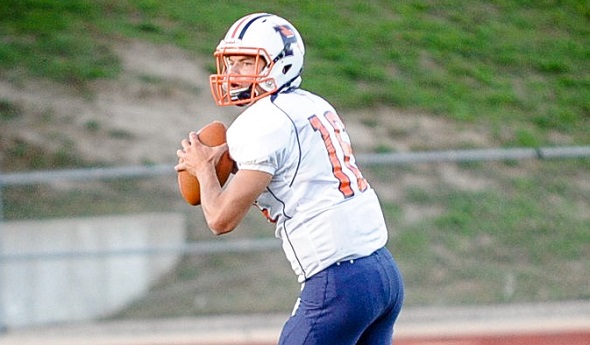
Playmaking Sargent Powers Chargers
November 25, 2015
By Bill Khan
Special for Second Half
FLINT — Most high school football coaches aren't comfortable having their quarterbacks, no matter how athletic they are, perform double duty by playing defense.
 The risk of injury or excessive fatigue is simply too great.
Flint Powers Catholic's Bob Buckel is no different than the majority of his peers.
"I'll be honest, I don't feel comfortable having him on the field all the time," Buckel said of senior quarterback Noah Sargent.
And, yet, having Sargent play defensive back when he isn't running the offense is one of the reasons why Powers (11-2) will play Zeeland West (13-0) for the MHSAA Division 4 championship at 7:30 p.m. Friday at Ford Field.
Sargent's team-high third interception of the season played a major role in Powers' 21-14 come-from-behind victory over Detroit Country Day in the Semifinals last Saturday in a snowstorm at West Bloomfield
He had already ignited a comeback from a 14-0 halftime deficit by tossing a 38-yard touchdown pass to Peyton Beauchamp. Sargent's one-handed interception later in the third quarter at the Country Day 20-yard line set up a 20-yard touchdown run by Reese Morgan.
Showing off one more aspect of his skill set, Sargent scored the winning touchdown on a 2-yard run with 26 seconds left in the game, putting Powers in the MHSAA championship game for the third time in school history. The 2005 team won the Division 4 championship, while the 2011 squad won the Division 5 title.
Putting an exclamation point on his performance, Sargent knocked down Country Day's final desperation pass as time expired.
"Noah understands we don't want him to get killed on defense," Buckel said. "We really try to put him on the best receiver and keep him out of harm's way. I heard someone earlier in the year say, 'When you get to the playoffs, you've got to save him.' I said, 'When you get to the playoffs, you have to play every play like it's your last play.' You throw him out there and hope for the best; the best happened last Saturday."
Sargent has 19 tackles, ranking ninth on the team. He is part of a defense that has allowed only 21 points in four playoff games and posted a school-record six shutouts.
"Coach really only plays me as a cover guy," Sargent said. "He doesn't like to throw me down (near the line). He uses me in coverage on third-and-long situations and passing downs."
As a quarterback, Sargent has displayed the kind of dual-threat capability that was integral to Powers' last MHSAA championship four years ago. Garrett Pougnet ran for 159 yards and two touchdowns and threw for 258 yards and four touchdowns in Powers' 56-26 rout of Lansing Catholic in the 2011 title game.
Sargent is Powers' leading rusher, in addition to its leading passer. He's run 134 times for 1,026 yards and 15 touchdowns, including an 83-yard scramble on third down for a touchdown in the playoff opener at Goodrich. He's 104 for 181 for 1,563 yards, 18 touchdowns and only four interceptions. Five of those touchdown passes came in a 41-0 victory over Goodrich, as he had a hand in all six touchdowns.
 "We knew Sargent was the show," Goodrich coach Tom Alward said. "They've got good receivers, but Sargent's the one that makes them go."
Sargent is the son of Mike Sargent, an all-state linebacker at Powers in 1983 and a tight end on Michigan State's 1988 Rose Bowl championship team. Both of Sargent's parents went to Powers, and Noah attends his parents' alma mater with his sister, Nikole, who was the MHSAA Lower Peninsula Division 2 shot put champion as a junior last spring.
"He's a good leader," said senior tight end Nick Thompson, Powers' leading receiver with 27 catches for 448 yards and seven touchdowns. "He's humble. He's not selfish. He has the aspects of a good leader. You can see it on the field, obviously, and at practice. We trust him."
Sargent isn't the only Charger with a rich Powers pedigree.
Running back Reese Morgan and receiver Matt Wiskur had brothers on the 2011 championship team. Brooks Morgan was a starting receiver, while Ethan Wiskur was a starting defensive back who had an interception in the 2011 title game.
Watching in the stands as middle school students, the younger Morgan and Wiskur brothers had all the incentive they needed heading into high school.
"That's my main motivation," said Wiskur, who has 23 catches for 383 yards and five touchdowns. "They're the strongest team I've ever seen. They had great leaders. They were 5-4 going into the playoffs. They knew they were going to win states the whole time. They were confident in themselves, and they lived up to that."
A similarity between the 2011 and 2015 teams is their slow starts. Powers was on the brink of playoff elimination after six games, starting out 2-4 in Buckel's first season at the helm. This year's team lost its opener, 27-11, to a Flushing team that went 3-5 the rest of the way. The Chargers were 3-2 before winning their last eight games.
"I remember they didn't have a very good start, but they had a lot of heart and they made a big run in the playoffs and kind of shocked everyone," said Morgan, who has run 146 times for 987 yards and 10 touchdowns while catching 27 passes for 317 yards and two scores.
"The talent on that team was incredible. We have the same chance they did of winning."
When Powers steps foot onto the turf at Ford Field on Friday, the current team will play under the watchful eye of youngsters who hope to one day have the same experience.
"Any high schooler wants to leave a legacy when they leave," Sargent said. "Our whole team is trying to make a mark on Powers history."
 Bill Khan served as a sportswriter at The Flint Journal from 1981-2011 and currently contributes to the State Champs! Sports Network. He can be reached at [email protected] with story ideas for Genesee, Lapeer, St. Clair, Sanilac, Huron, Tuscola, Saginaw, Bay, Arenac, Midland and Gladwin counties.
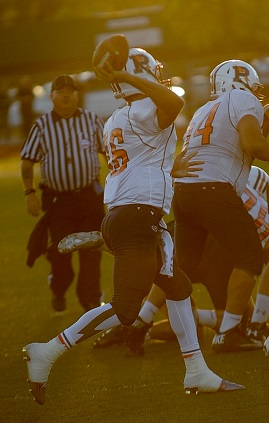
PHOTOS: (Top) Powers Catholic quarterback Noah Sargent drops back to pass against Midland Dow this season. (Middle) Sargent unloads a throw during the 35-30 loss, but has led the Chargers to an 11-2 record this fall. (Click for more from HighSchoolSportsScene.com.)
Drive for Detroit: Week 7 Preview
October 5, 2017
By Geoff Kimmerly
Second Half editor
Week 7 has a couple of contrasting meanings in the grand scheme of Michigan high school football.
 On one hand, we're drawing to a close of the regular season. On the other, we're just reaching the midpoint of the 14-week drive that carries us through the MHSAA Finals.
So here's where we sit. Fifty-one 11-player teams have qualified for the 11-player Playoffs. Another 94 are on the verge, needing one more victory. League titles will be decided all over Michigan again this weekend, and pairs of the best in all of the Upper Peninsula face off in both 11 and 8-player games.
Keep an eye on the statewide scene by following the MHSAA Score Center for scores as they come in tonight and Saturday, and check out MHSAA.tv for six live broadcasts – click here for the schedule. Drive for Detroit is powered by MI Student Aid.
Sidenote: With a win tonight against Oak Park (5-1) by his Hawks (4-2), Farmington Hills Harrison coach John Herrington would tie retired Birmingham Brother Rice coach Al Fracassa for the MHSAA record with 430 wins. Stay tuned.
Bay & Thumb
Frankenmuth (6-0) at Millington (6-0), Friday
This is the game, again, in the Tri-Valley Conference East as Frankenmuth has won 22 straight in the league dating to a loss to Millington in 2014. That season was the first of what is now four straight that these two have entered their annual meeting both undefeated. Coincidentally this time, both have scored 246 points this year, with Millington giving up 112 and Frankenmuth 102. And it gets closer still: In a projected Division 5 playoff field, Frankenmuth is third in playoff point average, with Millington next trailing by a mere 1.600. It’s fair to say a league title and possible home District Final are on the line.
Others that caught my eye: FRIDAY Flushing (5-1) at Fenton (6-0), Lapeer (5-1) at Davison (5-1), Ortonville Brandon (4-2) at Linden (5-1), Elkton-Pigeon-Bay Port Laker (5-1) at Unionville-Sebewaing (4-2).
Greater Detroit
Detroit Central (5-1) at Detroit Martin Luther King (5-1), Friday
Detroit Central is much smaller than even a decade ago when it had more than 1,000 students; the Trail Blazers played in the Division 6 playoffs last season. But they’ve got a chance to take a share of the Detroit Public School League Black division title from King, which has three times as many students these days and is the two-time reigning Division 2 champion. Both have talented offenses, but defense may reign; King has given up six points total over four league games, Central just 25. King is coming off a 27-6 win over previously-undefeated Denby, which handed Central its lone loss, 12-6, in Week 3.
Others that caught my eye: FRIDAY Ann Arbor Gabriel Richard (6-0) at Dearborn Divine Child (5-1), Warren Fitzgerald (5-1) at Madison Heights Madison (6-0), Clarkston Everest Collegiate (5-1) at Waterford Our Lady (4-1), Clarkston (5-1) at Rochester Adams (5-1).
Mid-Michigan
DeWitt (5-1) at Haslett (5-1), Friday
For the first time in a decade, one of this region’s most heated rivalries is relevant again, as the Capital Area Activities Conference Red title is on the line. That’s hardly all. Six of these teams’ first 11 meetings this century were decided by seven or fewer points; only two of the last 10 have been that close, and DeWitt has won 16 straight. But Haslett is 5-1 for the first time since 2007 and already has one more win than all of last season, and DeWitt moves to the CAAC Blue next fall – making this the most significant regular-season meeting these two might enjoy against each other for a while.
Others that caught my eye: FRIDAY Wyoming Godwin Heights (5-1) at Belding (5-1), Lansing Sexton (4-2) at Holt (3-3), Lake Fenton (5-1) at Corunna (3-3), Carrollton (5-1) at Alma (6-0).
Northern Lower Peninsula
Johannesburg-Lewiston (4-2) at Gaylord St. Mary (6-0), Friday
Despite a couple of nonleague losses, Johannesburg-Lewiston has bounced back nicely from last season’s 4-5 finish, which was its first below .500 since 2007. Although Harbor Springs could figure into the mix – both the Cardinals and St. Mary face the Rams over the final two weeks of the regular season – tonight’s matchup could go a long way in deciding the Northern Michigan Football Conference Legacy champ. St. Mary is enjoying that opportunity after starting 2016 5-0 and finishing it 1-4. But that one win was over Johannesburg-Lewiston and by 28 points, perhaps a bit of a confidence builder with these two now the main contenders.
Others that caught my eye: FRIDAY Elk Rapids (5-1) at Grayling (4-2), Beal City (4-2) at McBain (5-1), Hillman (3-3) at Oscoda (4-2), Cheboygan (3-3) at Traverse City St. Francis (6-0).
Southeast & Border
Hudson (6-0) at Ida (5-1), Friday
The Tigers are looking to run through the Lenawee County Athletic Association schedule undefeated for the fifth time in nine seasons, but 2015 league champion Ida is standing in the way after both teams also shared last season’s title – Ida fell to Hudson by a point (and Hudson fell to Hillsdale). After a pair of impressive nonleague wins, the Tigers have won every LCAA game so far by at least 22. The Bluestreaks took an eight-point loss to Brooklyn Columbia Central two weeks ago and surely won’t mind sharing the title again as a result of handing Hudson its first defeat tonight.
Others that caught my eye: FRIDAY Ann Arbor Pioneer (3-3) at Saline (5-1), Athens (5-1) at Pittsford (5-1), Parma Western (4-2) at Jackson Lumen Christi (5-1), Grass Lake (4-2) at Addison (5-1).
Southwest Corridor
Edwardsburg (6-0) at Three Rivers (5-1), Friday
Edwardsburg’s 34-game Wolverine B Conference winning streak just keeps growing, but a few challengers are lined up. Three Rivers fell to the Eddies 38-0 just a year ago, but already has avenged its other 2016 league loss this season, flipping a 29-point defeat to Plainwell into a 20-point win on opening night. Granted, the Wildcats followed that with a 14-point loss to Dowagiac, which fell to the Eddies by eight two weeks later in giving them their first significant league challenge in two years. But if nothing else, this should be closer than a year ago – and Vicksburg (5-1) will be waiting for Edwardsburg in Week 8.
Others that caught my eye: FRIDAY Coldwater (4-2) at Battle Creek Harper Creek (6-0), Schoolcraft (5-1) at Coloma (4-2), Cassopolis (6-0) at Hartford (5-1), Decatur (4-2) at Mendon (6-0).
Upper Peninsula
Gladstone (6-0) at Escanaba (5-1), Friday
It’s an interesting coincidence that the season these two are considered arguably the best teams in the Upper Peninsula is also the first time they aren’t in the same league since the mid-1980s, but that hardly lessens the significance of this matchup. The Eskymos are laying claim to the top spot after doubling up annual top U.P. team Menominee last week. Gladstone is staring down its best season since at least 2008 – and it can only get better with this opportunity against its old Great Northern Conference foe.
Others that caught my eye: FIRDAY Newberry (3-2) at Norway (6-0), Calumet (3-3) at L'Anse (4-2), Charlevoix (2-4) at Munising (3-3), Bark River-Harris (3-3) at Bessemer Gogebic (2-4).
West Michigan
Rockford (4-2) at Holland West Ottawa (5-1)
Pick a league, any league, on the west side and it seems like there is a game that will determine a league champion either this week or eventually. These are the best from the elite Ottawa-Kent Conference Red; Rockford is 3-0 in the league and West Ottawa is 4-0. The Panthers especially have to be thinking historically; they haven’t beaten the Rams since 2002. But West Ottawa also has more wins this fall than the last two seasons combined and has yet to give up more than seven points in a league game – an impressive enough feat to make this look like a much closer matchup than last year’s 51-14 Rockford win.
Others that caught my eye: FRIDAY Lowell (4-2) at Grand Rapids Forest Hills Central (6-0), Comstock Park (4-2) at Grand Rapids Catholic Central (6-0), Wyoming Kelloggsville (6-0) at Grand Rapids NorthPointe Christian (5-1), Muskegon Oakridge (5-1) at Montague (6-0).
8-Player
Stephenson (6-0) at Rapid River (6-0)
Similar to Powers North Central and Crystal Falls Forest Park in 2016, these two have an argument that they are the best in all of 8-player football even as relative neighbors. But only one (most likely) will finish as champion of the Western Eight Conference – although at this point, both could have a chance to finish as MHSAA champions as they project to play in different playoff divisions. Stephenson has two straight wins over the Rockets and hasn’t allowed an opponent closer than 24 points this season. Rapid River certainly has more experience in close games – with three wins by eight or fewer – and that could pay off.
Others that caught my eye: FRIDAY Engadine (4-2) at Cedarville (6-0), Marion (5-1) at Manistee Catholic Central (2-3), Kingston (4-2) at Morrice (6-0), Pickford (6-0) at Onaway (3-3).
Second Half’s weekly “Drive for Detroit” previews are powered by MI Student Aid, a part of the Student Financial Services Bureau located within the Michigan Department of Treasury. MI Student Aid encourages students to pursue postsecondary education by providing access to student financial resources and information, including various student financial assistance programs to help make college more affordable for Michigan students. MI Student Aid administers the state’s 529 savings programs (MET/MESP) and eight additional aid programs within its Student Scholarships and Grants division. Click for more information and connect with MI Student Aid on Facebook and Twitter @mistudentaid.
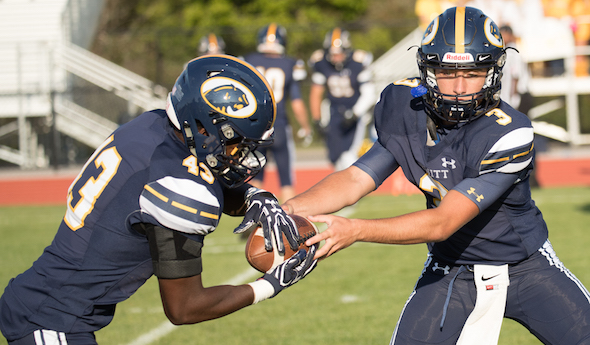
PHOTO: DeWitt, here against Grand Ledge in Week 2, will try to win its 17th straight over rival Haslett. (Click for more from HighSchoolSportsScene.com.)