

Portland Makes Right Moves for March
November 29, 2012
By Geoff Kimmerly
Second Half editor
Dylan Carroll and Adam Goodman knew the request was coming long before coach John Novara asked them to make a big change for their senior seasons on the Portland football team.
The writing was on the scale, so to say. At 6-foot-5 and 230 pounds, Carroll was among the three most sizable players on the Raiders’ roster this fall. And Goodman, at a solid 6-0, 200, wasn't far behind.
Still, it’s fair to assume not a lot of players want to trade in the opportunity to carry the ball for a jersey in the 50s. But Novara had no choice but to ask; he needed two new guards, and the best fits were tight end Carroll and the fullback, Goodman.
“At first, it was block, block, block. But after that, you get to pancake guys when you pull. Especially in this offense, guard is one of the best positions that we run,” Goodman said. “At first, it wasn't so exciting. But after that, it’s the best position. I would've played it all four years if I’d had the chance.”
Their one season on the line helped the Raiders produce unprecedented results.
Portland gets a Second Half High 5 this week after finishing a 13-1 season with its first trip to the MHSAA Finals – and first championship, thanks to a 12-9 win over Grand Rapids West Catholic.
The Raiders won in the same way they've made the playoffs every season over the last decade – with a mix of physical play up front, tough running and stout defense. That style often has been made possible by big bodies up front – a standout or two like alum and recently-graduated Eastern Michigan University 300-pounder Bridger Buche have been more the usual than occasional for Portland of late.
Not this season. For the Raiders to win again like they always have, it took the sacrifices of a couple smaller but just as tough seniors to be the catalysts.
“I think that was one of the keys to our success, offensively,” Novara said. “They graciously moved there. Without them moving to guards, I don’t know that we could've done this.”
Portland scored 500 points this season, likely its most ever (Michigan-football.com records date back to 1950). No other Raiders team had scored even 400.
Carroll and Goodman also were two of only three Portland players who pulled double duty, with Carroll also a starting defensive end and Goodman a starting linebacker. They helped key a defense that gave up just 13 points per game.
That defense gave up more than 14 points only once during the regular season – in a 41-32 loss to 2011 Division 5 runner-up Lansing Catholic. It gave up more than 20 twice in the playoffs, but hung on when it counted in a 45-28 win over reigning champion Flint Powers Catholic in the Regional Final and then the next week in a 28-23 nail-biter against Ann Arbor Gabriel Richard.
Portland scored all of its points of the MHSAA Final during the game's first 15 minutes. But the defense came up with three interceptions and two turnovers on downs, plus blocked a field goal attempt. The Raiders ended West Catholic’s final drive with a fourth-down stop on their 12-yard-line.
“The defense had been there all season, and we were just happy to make that one last play to win a state championship,” Goodman said.
And if he and Carroll’s moves to the offensive line hadn't been worth it completely before, they certainly became so that afternoon. As Carroll said after, he and most of his teammates are three-sport athletes who grew up together in their small town midway between Lansing and Grand Rapids. A position change hardly qualified as a sacrifice for an opportunity like this.
“I wasn't going to go out without a state championship this year. Our seniors deserved it,” Carroll said.
“We kept our mouths shut. We did whatever was best for the team, and we still worked as hard as we could this summer. It was well worth it.”
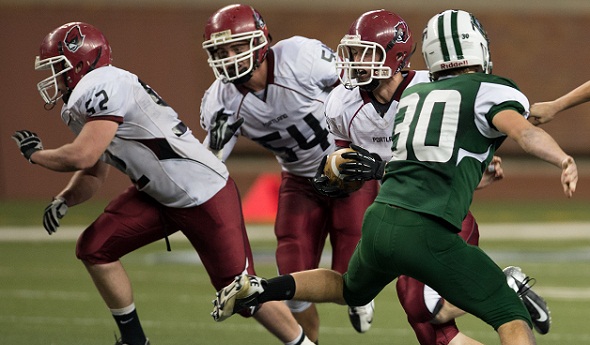
PHOTO: Portland linemen Adam Goodman (52) and Dylan Carroll (54) lead the way for teammate Auston Brandt during Saturday's Division 5 Final at Ford Field. (Click for more from Terry McNamara Photography.)

Football Scheduling
December 23, 2014
The major complaint about the MHSAA Football Playoffs is not that too few teams qualify or too many, or that a five-week playoff is too long or should become six weeks, or that some worthy teams miss out while some less worthy teams get in. No; most people find a five-week, 11-player tournament after a nine-game regular season is the best that our late start to fall classes and our early start to winter weather will allow us in Michigan.
Many people appreciate being able to complete our 14-week season in the warmth of Ford Field on the Friday and Saturday of Thanksgiving weekend. Most people think that nearly 45 percent of 11-player schools is a sufficient tournament field. Many people like the excitement that the six-win threshold creates for teams that had been eliminated earlier from league championships.
The most serious and legitimate complaint about the season-ending playoffs is the stress it has placed on conferences and the struggles many schools have in building nine-game regular-season schedules. Some critics want to mess with the Football Playoffs because of the mess they believe it makes for regular-season schedulers.
Having the MHSAA provide every school a nine-game regular season schedule of the most nearby teams of the most nearly equal enrollments would shift scheduling headaches from the local level to the MHSAA.
I’m not suggesting that this solution to local problems doesn’t create new, large headaches for the MHSAA. But in fact, that is the tradition of school sports: when an issue is large enough in scope and common enough among member schools, the state high school association is asked to be the problem-solver. That’s how we got transfer rules, defined sports seasons and competitive cheer tournaments, for example. Just about every policy and procedure and program of the MHSAA arises from a common local problem looking for a statewide solution.
The 2014 Update Meeting Opinion Poll indicates that 70 percent of responding administrators do not favor the solution of the MHSAA making all schools’ regular-season varsity football schedules. Maybe the question should be narrowed to having the MHSAA complete member schools’ non-conference scheduling.
Meanwhile, we will keep watching as high school associations in other states move to statewide scheduling. For if scheduling is the problem, then scheduling itself needs to be the focus of the solution.