

Portland Makes Right Moves for March
November 29, 2012
By Geoff Kimmerly
Second Half editor
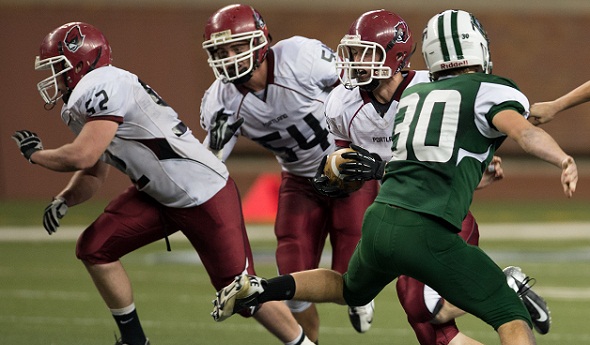
Dylan Carroll and Adam Goodman knew the request was coming long before coach John Novara asked them to make a big change for their senior seasons on the Portland football team.
The writing was on the scale, so to say. At 6-foot-5 and 230 pounds, Carroll was among the three most sizable players on the Raiders’ roster this fall. And Goodman, at a solid 6-0, 200, wasn't far behind.
Still, it’s fair to assume not a lot of players want to trade in the opportunity to carry the ball for a jersey in the 50s. But Novara had no choice but to ask; he needed two new guards, and the best fits were tight end Carroll and the fullback, Goodman.
“At first, it was block, block, block. But after that, you get to pancake guys when you pull. Especially in this offense, guard is one of the best positions that we run,” Goodman said. “At first, it wasn't so exciting. But after that, it’s the best position. I would've played it all four years if I’d had the chance.”
Their one season on the line helped the Raiders produce unprecedented results.
Portland gets a Second Half High 5 this week after finishing a 13-1 season with its first trip to the MHSAA Finals – and first championship, thanks to a 12-9 win over Grand Rapids West Catholic.
The Raiders won in the same way they've made the playoffs every season over the last decade – with a mix of physical play up front, tough running and stout defense. That style often has been made possible by big bodies up front – a standout or two like alum and recently-graduated Eastern Michigan University 300-pounder Bridger Buche have been more the usual than occasional for Portland of late.
Not this season. For the Raiders to win again like they always have, it took the sacrifices of a couple smaller but just as tough seniors to be the catalysts.
“I think that was one of the keys to our success, offensively,” Novara said. “They graciously moved there. Without them moving to guards, I don’t know that we could've done this.”
Portland scored 500 points this season, likely its most ever (Michigan-football.com records date back to 1950). No other Raiders team had scored even 400.
Carroll and Goodman also were two of only three Portland players who pulled double duty, with Carroll also a starting defensive end and Goodman a starting linebacker. They helped key a defense that gave up just 13 points per game.
That defense gave up more than 14 points only once during the regular season – in a 41-32 loss to 2011 Division 5 runner-up Lansing Catholic. It gave up more than 20 twice in the playoffs, but hung on when it counted in a 45-28 win over reigning champion Flint Powers Catholic in the Regional Final and then the next week in a 28-23 nail-biter against Ann Arbor Gabriel Richard.
Portland scored all of its points of the MHSAA Final during the game's first 15 minutes. But the defense came up with three interceptions and two turnovers on downs, plus blocked a field goal attempt. The Raiders ended West Catholic’s final drive with a fourth-down stop on their 12-yard-line.
“The defense had been there all season, and we were just happy to make that one last play to win a state championship,” Goodman said.
And if he and Carroll’s moves to the offensive line hadn't been worth it completely before, they certainly became so that afternoon. As Carroll said after, he and most of his teammates are three-sport athletes who grew up together in their small town midway between Lansing and Grand Rapids. A position change hardly qualified as a sacrifice for an opportunity like this.
“I wasn't going to go out without a state championship this year. Our seniors deserved it,” Carroll said.
“We kept our mouths shut. We did whatever was best for the team, and we still worked as hard as we could this summer. It was well worth it.”
PHOTO: Portland linemen Adam Goodman (52) and Dylan Carroll (54) lead the way for teammate Auston Brandt during Saturday's Division 5 Final at Ford Field. (Click for more from Terry McNamara Photography.)
Thank Roosevelt for Football Weekends
December 20, 2013
By Rob Kaminski
MHSAA benchmarks editor
The next time you find yourself immersed in a tense crosstown football rivalry on a Friday night followed by a Saturday pilgrimage to the nearest college campus and a Sunday afternoon with a remote and your favorite snacks and beverages, take a moment to consider what the weekend would be like if it weren’t for Teddy Roosevelt.
The man who became our 26th President shortly after the turn of the 20th Century following the assassination of William McKinley in 1901 was a football fan like you. Maybe more so.
Today’s game of football has reached a critical crossroads. Player size and speed have increased across the board. Savage use of equipment as weapons rather than protective gear has been glorified on television networks and social media. Leaders of the game at all levels have recognized the need for change, employing new rules and widespread educational efforts to aid in preserving the sport.
History, as they say, is repeating itself.
In an ironic twist, it was Roosevelt who saved the then-brutally violent game of football from itself more than 100 years ago. Yes, the same “Rough and Ready Teddy” who led the charge up San Juan Hill during the Spanish-American War and often sparred in the boxing ring while in office from 1901-09 opined that football was becoming so gruesome that he delivered an ultimatum: clean up the game or it would be outlawed.
The Chicago Tribune reported that in 1904 alone, there were 18 football deaths and 159 serious injuries, mostly among prep school players. Football deaths suffered by younger players were reported on a nearly weekly basis, as outraged citizens called on colleges and high schools to banish football outright.
In stepped Roosevelt, who called head coaches and representatives from Harvard, Yale and Princeton – college powers at the time – to the White House in 1905 urging them to eliminate excessive violence and set an example of fair play for the rest of the country. When the casualties actually rose by one during the ensuing season, Roosevelt reacted with greater resolve and convened leading football authorities for the purpose of authoring drastic rules changes. What emerged was an intercollegiate conference which was the predecessor of the NCAA.
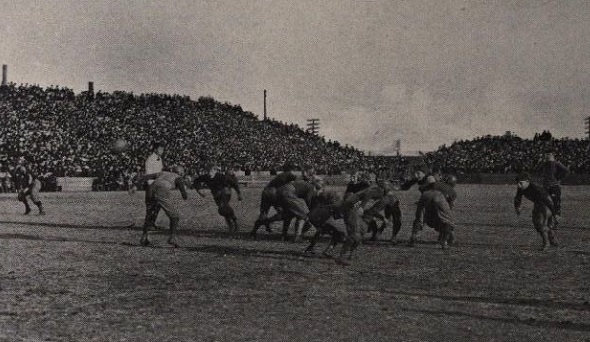
Among the most effective changes for the 1906 season were the legalization of the forward pass, the elimination of mass formations, and the creation of a neutral zone. Football fatalities fell to 11 in each of the next two seasons, and severe injuries fell drastically.
Thanks to the introduction of protective equipment and ever-evolving rules changes, football during the 100-plus years to follow has become an exponentially safer game. Yet, the game’s leaders always will need to adjust and react to scrutiny that comes with the territory.
So, as the game once again undergoes rules modifications in the name of safety, give a tip of the cap to President Roosevelt while you enjoy college bowl season and the NFL playoffs and begin to think ahead to the first high school practice of 2014.