

Prepare to Compare: Clarkston Wins D1
November 29, 2014
By Bill Khan
Special for Second Half
DETROIT — Nolan Eriksen dislikes two things: Losing and comparisons to his older brother, Ian.
He's never had to experience a loss since being promoted to Clarkston's varsity football team before last year's MHSAA playoffs, so that's never been an issue.
But comparisons between the Eriksen brothers are plentiful — and valid.
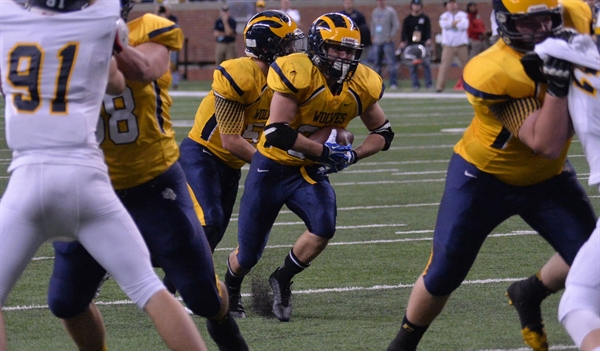
Nolan, a junior running back, ran 28 times for 172 yards and three touchdowns as the Wolves repeated as MHSAA Division 1 champions with a 33-25 victory over first-time finalist Saline on Saturday at Ford Field.
A year ago, Ian Eriksen ran 32 times for 237 yards and three touchdowns against Detroit Catholic Central, leading Clarkston to its first title.
So, you'd think that Nolan would've leaned upon his brother's advice now that he was the starting running back in the championship game.
Nope.
"I was just trying to do what I do," Nolan said. "People always try to compare us and stuff, but I just try to play my game and do the best I can for my team. No advice. ... Every now and then we'll talk about it a little bit, but mainly we try to keep it pretty separate. We just do our own thing."
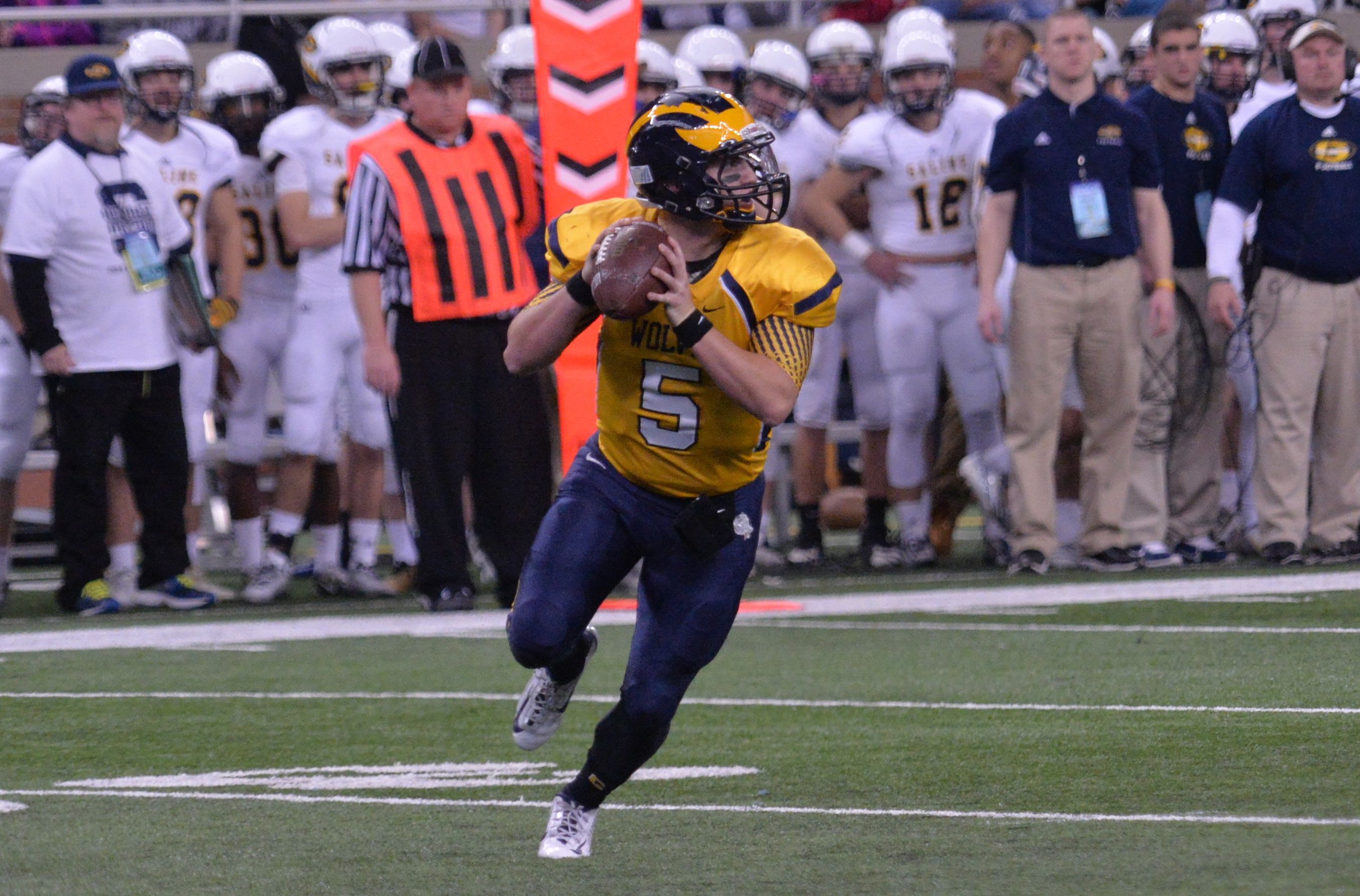
Senior quarterback D.J. Zezula has no problem comparing the brothers. He's got a unique perspective, having handed the ball to each during his three-year career as Clarkston's starter.
"Noah doesn't want to be compared, but they're twins in my eyes," said Zezula, who ran 17 times for 120 yards and a 70-yard touchdown. "They're both hard-hitting football players. Mr. (Mark) Eriksen coached me when I was younger; he's the same way. They're awesome kids. They want what's best for the team. I love both of them. I love Mr. Eriksen. They're great guys. He coached me my first two years of football that I ever played."
 While Ian Eriksen was the workhorse for Clarkston's first championship team, Nolan watched from the sidelines, as is typical for junior varsity players who are promoted after the regular season. He said he "got a couple plays" during the 2013 playoff run, but never saw action at Ford Field.
Just being part of the atmosphere last year was beneficial once he stepped onto the field Saturday, Eriksen said.
"We've been here before," he said. "We weren't too shocked looking around. We knew what the deal was. We knew what it felt like to be here. We knew what was riding on it. It was just the experience. It was incredible being able to look up there and see your whole town there and getting it done."
Eriksen had a solid first half, running 12 times for 61 yards and a touchdown, but he was a key reason why Clarkston took over in the second half after trailing 10-7 at halftime. Eriksen ran 16 times for 111 yards and two scores in the second half, as Clarkston scored touchdowns on four of its first five possessions after halftime.
"These guys have taught me something," Clarkston coach Kurt Richardson said. "The old Kurt Richardson would've blown up at half with two turnovers and stuff. We just said, 'Hey, we're fine. We're down three. We didn't play very well. We're getting the ball, so everything's fine.' I learned it from these guys."
Poise comes more naturally when a team has won 27 straight games — now the longest active streak in Michigan following Finals losses this weekend by Ithaca (69) and Ishpeming (33).
The Wolves needed only four plays after the second-half kickoff to take the lead for good on a 52-yard pass from Zezula to Merrick Canada with 10:09 left in the third quarter. A bobbled snap prevented an extra-point kick, leaving Clarkston up by a 13-10 score.
Clarkston's only three-and-out of the second half came on the next series, but the Wolves followed with three straight touchdown drives. A 2-yard run by Eriksen made it 20-10 with 47 seconds left in the third quarter before Zezula kept it and ran 70 yards for a touchdown with 8:17 remaining in the game, expanding the lead to 27-10.
Just before that touchdown, Saline missed a chance to make it a one-possession game. The Hornets had first-and-goal at the 8-yard line, but settled for a 24-yard field goal attempt that was wide left.
Saline also missed a field goal on the first series of the game, as linebacker Cole Chewins blocked the kick. Chewins, who has committed to Miami (Ohio) as a tight end, also batted down three passes.
"With the deflections and stuff, that was just playing the game," Chewins said. "I was able to make plays and just play football."
Saline coach Joe Palka tried to run plays away from Chewins, who had his blocked kick and two of his knockdowns early in the game.
"We had to adjust and go to the other side, just because he can cover so much ground and he's got such good range," Palka said.
Saline cut the deficit to 27-17 when quarterback Josh Jackson scored on a 1-yard run with 5:15 remaining.
Clarkston (14-0) recovered the onside kick, then marched 50 yards in eight plays, the final 22 yards coming on a touchdown run by Eriksen with 1:57 on the clock. The extra point failed, keeping it a two-possession game at 33-17.
That loomed as a potential issue when it took Saline only four plays to reach the end zone on a 2-yard run by Kevin Gross with 1:09 to go. Cameron Cole caught a 2-point pass from Jackson to make it an eight-point game.
Clarkston's Shane Holler recovered the onside kick, allowing the Wolves to clinch the title with two kneel-downs.
Jackson, a junior, was 20-for-31 for 237 yards while running 17 times for 82 yards and a touchdown to lead Saline, which won a school-record 12 games (to finish 12-2) and advanced beyond the Regional Final for the first time.
"It's an amazing thing for Saline football," Jackson said. "It's the best team ever in Saline. That we got to play on this stage was an amazing opportunity. Going into next year, that will just give us fire to come back here and try to win it."
Even though his career ended Saturday after starting at quarterback for teams that went 37-2 over three seasons, Zezula is mindful of what these back-to-back championships will mean for the future of the Clarkston program. The Wolves lost in Semifinals three times in 16 playoff appearances under Richardson before breaking through last year.
"Last year was kind of like breaking the mold, breaking this dark cloud over Clarkston that we could never win, could never get there," Zezula said. "This year was about building a legacy, a tradition here at Clarkston. ...
"It hits home when the little kids, the seventh-graders at our youth camps, wear my jersey and wear No. 5. That's where it really hits home, just to pave the way for the younger kids and start a legacy, start a tradition here that winning is what's got to happen at Clarkston."
PHOTOS: (Top) Clarkston's Nolan Eriksen takes a handoff as his lineman work to open a gap near the goalline Saturday. (Middle) Quarterback D.J. Zezula looks for a receiver while those on the Saline sideline look on. (Click for action photos and team photos from Hockey Weekly Action Photos.)
VIDEO HIGHLIGHTS:
GROSS GETS SALINE STARTED - Saline started the scoring in the second quarter against Clarkston with Kevin Gross running it in from 27 yards out.
OH CANADA! CLARKSTON GOES ON TOP - Clarkston took the lead to stay in the Division 1 championship game when D.J. Zezula hit a wide open Merrick Canada on a 52-yard pass.
Watch the entire game and order DVDs by Clicking Here.
St. Patrick Immediately Sets Tone On Way to Claiming 1st Title Since 1992
By
Jason Juno
Special for MHSAA.com
November 22, 2025
MARQUETTE — Portland St. Patrick has been no stranger to the MHSAA Finals since moving to 8-player football, but the Shamrocks had come up short of a title in three appearances since 2017.
They were back in the Division 2 championship game Saturday, and again facing a team from the Upper Peninsula, just like the other three times. But this time, St. Patrick made it clear from the opening kick it had no intention of going back below the Mackinac Bridge without the championship trophy.
The Shamrocks rode the momentum from a fast start and blanked Felch North Dickinson 53-0 at the Superior Dome.
“It means a lot,” St. Patrick senior back Brady Leonard said with the trophy in his hand. “Having a couple classes before us come here and not be able to finish the job, it was not just for our team, but it was for everyone that came and wasn’t able to finish it.”
Aiden Fandel set the tone when he took the opening kick to the Nordics’ 3-yard line. Jerryd Scheurer ran three yards on the first play from scrimmage, and Leonard ran in the conversion for an 8-0 lead just 20 seconds into the game.
 “It was huge, just to flip the field position right away was a big deal,” St. Patrick coach Patrick Russman said.
The Shamrocks scored two more times during the first quarter, taking advantage of excellent field position.
St. Patrick’s Tyler Thelen blocked a punt to set up its next score. The Shamrocks took over at the North Dickinson 9, and Charlie Thelen caught a four-yard pass from Scheurer on the second play of the drive for a 14-0 lead.
The Nordics went for it on fourth-and-1 at their own 29 on the ensuing possession, but they were stuffed for no gain, giving St. Patrick the ball not far from the red zone.
Leonard ran eight yards for the touchdown and a 20-0 lead with 5:34 still left in the first quarter.
What a start.
"It was very important," Leonard said. "We knew if we came off hot, we knew that we'd be able to punch them in the mouth and we'd get off to the start that we normally have.”
The Shamrocks scored two more times in the first half, both on runs by Hudson King, who led with 120 yards on 10 carries. His 30-yarder came just seven seconds into the second quarter, and his 21-yard rush gave them a 33-0 lead that held until halftime.
The Nordics drove into St. Patrick territory twice in the period. The first stalled at the 44 when the game was still within reach at 26-0. The second got all the way to the 24, but incomplete passes on third and fourth downs gave St. Patrick the ball back with four seconds on the first-half clock.
North Dickinson just couldn’t overcome that start, or the talent level of the Shamrocks.
“We’ve been punched in the mouth before, but they’re way better,” Nordics coach Mike Christian said. “They were just so much better than us today. They’re bigger, faster, stronger. We just couldn’t get anything going.”
 The second half proved to be more of the same. St. Patrick reached the end zone three more times, on short runs by Caleb Pline and two players listed as linemen, Logan Krieger and Nick Pung.
St. Patrick finished a perfect 13-0, and went unbeaten even with a tough schedule. Russman said the Shamrocks started off with tough Mid-State Activities Conference foes Merrill and Morrice. They ended the regular season with a win over eventual Division 1 runner-up Blanchard Montabella. Their playoff run included wins over Mendon, ranked No. 1 in the final media poll of the season, and last year’s Division 1 champion, Deckerville.
“We didn’t have any time to not be ready this year,” Russman said. “We’ve had a pretty good run of some very quality football teams throughout the stretch of the year. They didn’t give us any rest, so the kids did a good job of getting ready each week. Sometimes you slip, and these guys didn’t slip.”
He credited the team’s chemistry for the special season. The practices were superb all year. And they of course had some really good players.
“Our line has been working hard and they just continued to grind it out today, and our backs finished plays on the offensive end,” Russman said. “We’ve been trying to get a faster and faster defense each week, and I think they’ve really done that and accepted that challenge.”
St. Patrick’s last Finals win came when it was playing 11-player football in 1992, in Class D. North Dickinson was seeking its first championship but had to settle for its second runner-up finish (11-player, Class D, 1998).
The Nordics’ 17-game winning streak came to an end. They finished at 12-1 this year after winning their final five games last season.
North Dickinson canceled its varsity season in 2023, announcing at the time that it would play a JV schedule with only four upperclassmen on the roster. Two years later, the Nordics made it to the final game.
“My seniors would have been sophomores then,” Christian said. “I didn’t want to throw them into that right away. This is kind of what we were aiming for when we did that.”
It all worked out. Missing the playoffs last year proved to be a good motivator as well.
“They really put the extra work in,” he said. “They’re such great kids, and they worked their tails off all summer and I’m just so proud of them.”
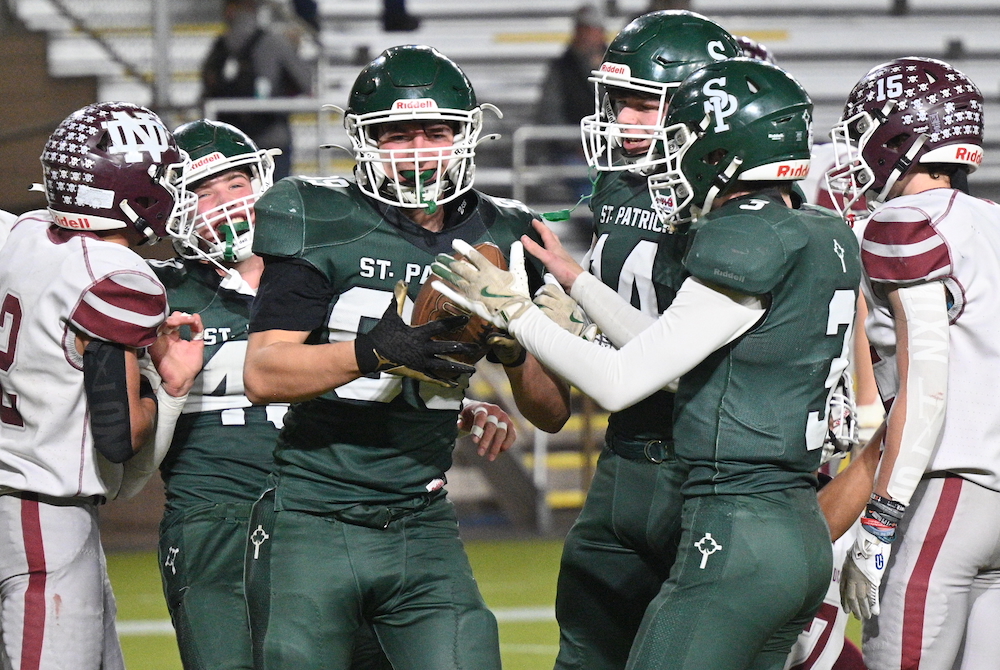
PHOTOS (Top) Portland St. Patrick players celebrate a touchdown Saturday at Superior Dome. (Middle) North Dickinson quarterback Brady Jungwirth (15) works to pull away from a tackler. (Below) The Shamrocks’ Charlie Thelen (12) goes high to pull in a pass. (Click for more from Cara Kamps.)