

Prepare to Compare: Clarkston Wins D1
November 29, 2014
By Bill Khan
Special for Second Half
DETROIT — Nolan Eriksen dislikes two things: Losing and comparisons to his older brother, Ian.
He's never had to experience a loss since being promoted to Clarkston's varsity football team before last year's MHSAA playoffs, so that's never been an issue.
But comparisons between the Eriksen brothers are plentiful — and valid.
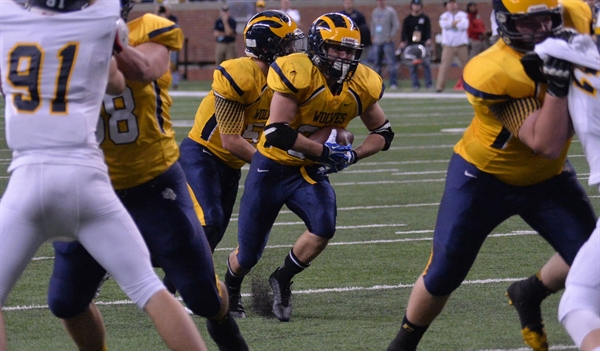
Nolan, a junior running back, ran 28 times for 172 yards and three touchdowns as the Wolves repeated as MHSAA Division 1 champions with a 33-25 victory over first-time finalist Saline on Saturday at Ford Field.
A year ago, Ian Eriksen ran 32 times for 237 yards and three touchdowns against Detroit Catholic Central, leading Clarkston to its first title.
So, you'd think that Nolan would've leaned upon his brother's advice now that he was the starting running back in the championship game.
Nope.
"I was just trying to do what I do," Nolan said. "People always try to compare us and stuff, but I just try to play my game and do the best I can for my team. No advice. ... Every now and then we'll talk about it a little bit, but mainly we try to keep it pretty separate. We just do our own thing."
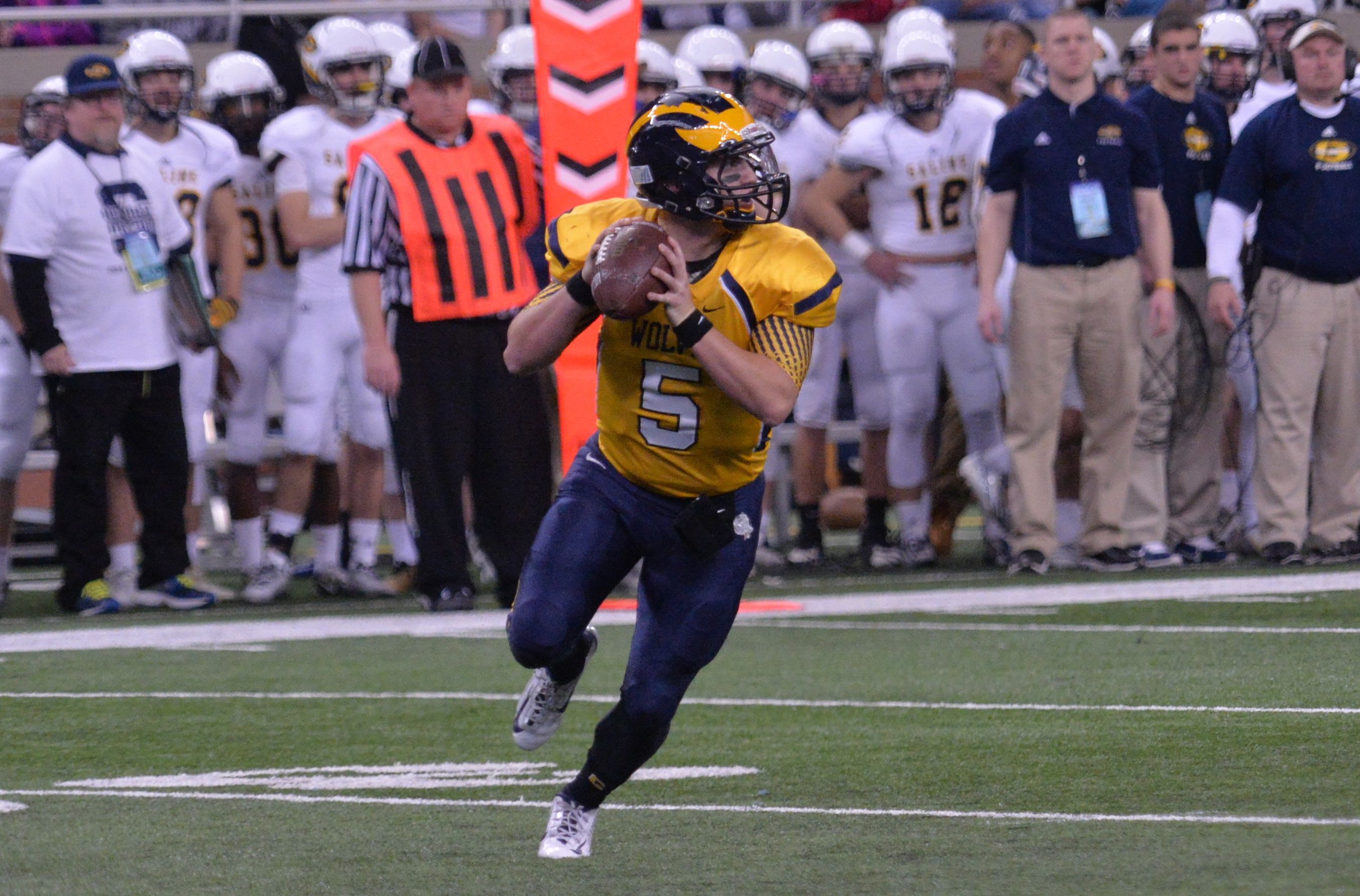
Senior quarterback D.J. Zezula has no problem comparing the brothers. He's got a unique perspective, having handed the ball to each during his three-year career as Clarkston's starter.
"Noah doesn't want to be compared, but they're twins in my eyes," said Zezula, who ran 17 times for 120 yards and a 70-yard touchdown. "They're both hard-hitting football players. Mr. (Mark) Eriksen coached me when I was younger; he's the same way. They're awesome kids. They want what's best for the team. I love both of them. I love Mr. Eriksen. They're great guys. He coached me my first two years of football that I ever played."
 While Ian Eriksen was the workhorse for Clarkston's first championship team, Nolan watched from the sidelines, as is typical for junior varsity players who are promoted after the regular season. He said he "got a couple plays" during the 2013 playoff run, but never saw action at Ford Field.
Just being part of the atmosphere last year was beneficial once he stepped onto the field Saturday, Eriksen said.
"We've been here before," he said. "We weren't too shocked looking around. We knew what the deal was. We knew what it felt like to be here. We knew what was riding on it. It was just the experience. It was incredible being able to look up there and see your whole town there and getting it done."
Eriksen had a solid first half, running 12 times for 61 yards and a touchdown, but he was a key reason why Clarkston took over in the second half after trailing 10-7 at halftime. Eriksen ran 16 times for 111 yards and two scores in the second half, as Clarkston scored touchdowns on four of its first five possessions after halftime.
"These guys have taught me something," Clarkston coach Kurt Richardson said. "The old Kurt Richardson would've blown up at half with two turnovers and stuff. We just said, 'Hey, we're fine. We're down three. We didn't play very well. We're getting the ball, so everything's fine.' I learned it from these guys."
Poise comes more naturally when a team has won 27 straight games — now the longest active streak in Michigan following Finals losses this weekend by Ithaca (69) and Ishpeming (33).
The Wolves needed only four plays after the second-half kickoff to take the lead for good on a 52-yard pass from Zezula to Merrick Canada with 10:09 left in the third quarter. A bobbled snap prevented an extra-point kick, leaving Clarkston up by a 13-10 score.
Clarkston's only three-and-out of the second half came on the next series, but the Wolves followed with three straight touchdown drives. A 2-yard run by Eriksen made it 20-10 with 47 seconds left in the third quarter before Zezula kept it and ran 70 yards for a touchdown with 8:17 remaining in the game, expanding the lead to 27-10.
Just before that touchdown, Saline missed a chance to make it a one-possession game. The Hornets had first-and-goal at the 8-yard line, but settled for a 24-yard field goal attempt that was wide left.
Saline also missed a field goal on the first series of the game, as linebacker Cole Chewins blocked the kick. Chewins, who has committed to Miami (Ohio) as a tight end, also batted down three passes.
"With the deflections and stuff, that was just playing the game," Chewins said. "I was able to make plays and just play football."
Saline coach Joe Palka tried to run plays away from Chewins, who had his blocked kick and two of his knockdowns early in the game.
"We had to adjust and go to the other side, just because he can cover so much ground and he's got such good range," Palka said.
Saline cut the deficit to 27-17 when quarterback Josh Jackson scored on a 1-yard run with 5:15 remaining.
Clarkston (14-0) recovered the onside kick, then marched 50 yards in eight plays, the final 22 yards coming on a touchdown run by Eriksen with 1:57 on the clock. The extra point failed, keeping it a two-possession game at 33-17.
That loomed as a potential issue when it took Saline only four plays to reach the end zone on a 2-yard run by Kevin Gross with 1:09 to go. Cameron Cole caught a 2-point pass from Jackson to make it an eight-point game.
Clarkston's Shane Holler recovered the onside kick, allowing the Wolves to clinch the title with two kneel-downs.
Jackson, a junior, was 20-for-31 for 237 yards while running 17 times for 82 yards and a touchdown to lead Saline, which won a school-record 12 games (to finish 12-2) and advanced beyond the Regional Final for the first time.
"It's an amazing thing for Saline football," Jackson said. "It's the best team ever in Saline. That we got to play on this stage was an amazing opportunity. Going into next year, that will just give us fire to come back here and try to win it."
Even though his career ended Saturday after starting at quarterback for teams that went 37-2 over three seasons, Zezula is mindful of what these back-to-back championships will mean for the future of the Clarkston program. The Wolves lost in Semifinals three times in 16 playoff appearances under Richardson before breaking through last year.
"Last year was kind of like breaking the mold, breaking this dark cloud over Clarkston that we could never win, could never get there," Zezula said. "This year was about building a legacy, a tradition here at Clarkston. ...
"It hits home when the little kids, the seventh-graders at our youth camps, wear my jersey and wear No. 5. That's where it really hits home, just to pave the way for the younger kids and start a legacy, start a tradition here that winning is what's got to happen at Clarkston."
PHOTOS: (Top) Clarkston's Nolan Eriksen takes a handoff as his lineman work to open a gap near the goalline Saturday. (Middle) Quarterback D.J. Zezula looks for a receiver while those on the Saline sideline look on. (Click for action photos and team photos from Hockey Weekly Action Photos.)
VIDEO HIGHLIGHTS:
GROSS GETS SALINE STARTED - Saline started the scoring in the second quarter against Clarkston with Kevin Gross running it in from 27 yards out.
OH CANADA! CLARKSTON GOES ON TOP - Clarkston took the lead to stay in the Division 1 championship game when D.J. Zezula hit a wide open Merrick Canada on a 52-yard pass.
Watch the entire game and order DVDs by Clicking Here.
After Reaching Historic Heights, Niles Eager to Continue Climb Under Shaw
By
Scott Hassinger
Special for MHSAA.com
September 9, 2025
NILES – Scot Shaw admits he was just looking to have a little fun when he accepted Matt Brawley's offer five years ago to become the new football coach at Niles.
 But anyone aware of his past success knew it wouldn't take long for Shaw – a member of the Michigan High School Football Coaches Association's Hall of Fame – to affect change in the culture of the Niles program.
Shaw, a former head coach at Elkhart Memorial, Ind., from 2015-2019, returned to the sidelines after sitting out 2020 during COVID-19.
Prior to Shaw's arrival, Niles hadn't had a winning season since 2014. Following six consecutive sub-.500 finishes, Niles compiled a 5-4 mark in Shaw's first season as several underclassmen played key roles and set the Vikings up for future success.
Not counting the shortened 200 season – when all schools were playoff eligible – Niles secured its first postseason berth since 2003 and went 6-5 in Shaw's second season, losing 24-17 in a Division 4 District Final to Edwardsburg. The Vikings improved to 10-2 in 2023, losing a heartbreaking 21-14 Regional decision to Portland but winning the first of now two straight Wolverine Conference titles.
Their hard work came to further fruition last fall as they finished 12-2 and secured league, District and Regional tiles, the latter by avenging the 2023 loss to Portland 37-34. Niles then doubled up perennial state power Grand Rapids South Christian 62-30 in a Semifinal at Armstrong Field in Three Rivers before falling to Goodrich a week later in the Division 4 championship game at Ford Field, 35-6.
Shaw is 35-13 at Niles with a career win-loss record of 246-120.
"When I got here, I was coming off a one-year retirement. I just wanted to have some fun and run a different offense. My son Kyle is an assistant coach at Mishawaka (Ind.), and they run the flexbone," Shaw said. "Coming in … I don't think the expectations were that high, so as a coaching staff you think about what you can do to improve things. So at least in my past experience, we've always been pretty good and have had high expectations. We changed the culture here at Niles by asking our players to come to practice, do the best they can every day and be more physical than the people we play. So far those three principles have worked out well and put this program where it is now."
Shaw used the 2024 home playoff win over Portland to describe how everything has come full circle.
"In that game we were ahead of Portland, then gave the lead up and we could've given up. But we came back and scored in the last few seconds to win in the Regional Finals,” Shaw said. “Having a belief that you can win despite all odds is a huge thing now and instilled in our kids. They don't doubt themselves or each other any longer.”
Niles outscored opponents 535-160 in 2024, posting six shutouts. The Vikings averaged 38.2 points per game while allowing just 11.4 per contest.
Freshman quarterback Will Turnbull now controls the Vikings' flexbone attack following the graduation of Talen Bennett. So far, Turnbull has met the challenge by completing 10-of-27 passes for 117 yards and one TD with three interceptions. He's also run for a pair of TDs.
 "The quarterbacks we've had so far at Niles have been very intelligent, smart and very good at reading opposing defenses. Will is an excellent athlete who throws the ball well and is a little water bug when he runs it. He's been able to pick up our offense pretty quickly," Shaw said.
Niles also graduated 1,000-yard rusher Sam Rucker, but sophomore Brandon Walsh has stepped up at that spot with 63 carries for 303 yards and four TDs. Anderson also handles some of the rushing load, along with Elijah Norris, who had 23 touches for 120 yards during a 16-0 Week 2 win over Stevensville Lakeshore – Niles’ first victory on Lakeshore’s home field.
Junior wideout Max Rucker, along with senior tight end Brenden Olsen, are two other key ingredients on both sides of the ball for Niles.
Olsen (6-foot-7, 180 pounds) is also a standout basketball and baseball player for Niles who recently received a Division I baseball scholarship off from the University of Houston.
"It’s been a wonderful experience playing football with several cool guys and a great coaching staff. They key is just showing up every day ready to work and getting better,” Olsen said. "Our state finals loss just showed that we need to dig deeper and prepare better for teams like that down the road.
“Building good chemistry with the new guys has been easy because we have so many returners. My goals are to be more of a leader and be more involved in plays this season."
Senior all-staters Chase Brawley (6-1, 280) and Brandon Hamilton (5-11, 245) both return on the Vikings' offensive line. Knee injuries to both Hamilton and senior Trenton Scott (6-2, 280) kept them on the sidelines during the Vikings' push through the end of the 2024 regular season and playoffs. Evan Williams (5-10, 200) is another key part of the Vikings' blocking group, and junior kicker Ben Bruckner is another returning offensive weapon.
"Getting to state last year really motivated us to prepare well for this season,” Brawley said. “The experience I gained playing varsity these last three years has been invaluable. Our team motto this season is 'All In,' so we just have to remain focused to attain our goals."
Perhaps no one was more motivated to get back on the field than Hamilton, who was sidelined with that injury after Week 6.
"Last year I learned it takes all 11 guys to win a football game. Coaching from the sidelines really taught me a great deal,” Hamilton said. “I'm playing right guard and outside linebacker. We have four out of our five offensive linemen back, so we are experienced. Defensively we can fly to the ball, and we have some dudes who can really hit. That's exciting.”
Cheney, Jayelin Vawter, RJ Fielder, Bryce Zache, Malachi Burris, Rucker and Bradley Wolverton are among the team's top tacklers so far.
"It takes everyone on the team to make a big difference. The main thing we have to remember is it’s a new year,” Cheney said. “Last year's achievements don't matter, but it prepared us well for any success we have this time around."
Cheney, a senior, anchors the Niles' defense after earning all-state honors as a junior. Freshman Vaughn Ausmus also has seen time at linebacker. Other returning starters on the Vikings' defensive front include Fielder, Burris and Bryce Young.
Niles' defensive secondary will be anchored by Olsen, Rucker and Anderson.
"We have a lot of good kids coming back defensively, and the kids who are stepping up to fill in different spots realize what their responsibilities are and they have become part of our rotation," Shaw said.
Many successful stops
Shaw is a 1975 graduate of Mishawaka, where he played basketball for legendary coach Marvin Wood. Shaw also lettered in football and received the prestigious Phil Askew Mental Health Award his sophomore year at the 1973 Indiana state football finals. He then attended and played football at Butler University, earning all-Pioneer Football Conference honors in 1978 and 1979 and serving as senior captain.
From 1979-1986, Shaw taught social studies and physical education at Concord High School (Ind.) serving as an assistant coach in football, wrestling and baseball. He served as Three Rivers' varsity football coach from 1986-2004, leading that team to the MHSAA Playoffs 15 times and the Division 4 title in 2003. Shaw also served as the Wildcats' head boys track & field coach, leading them to 2000 and 2002 MITCA team championships.
 Shaw then served as Grandville's head football coach from 2005-2010, leading the Bulldogs to two Ottawa-Kent Conference Red titles and two playoff appearances. He was an assistant coach at Hope College for three seasons, then served a one-year stint in 2014 as the head coach at Wayne High School in Fort Wayne, Ind., where the Generals went 9-2, won the Summitt Conference and made it to the third round of the state playoffs.
He moved on to coach four seasons at Elkhart Memorial before the school consolidated with Elkhart Central. After the one-year coaching hiatus in 2020, he took over at Niles.
Brawley, who was hired as the school's athletic director just three days before Shaw, remembers football participation nearly doubling after Shaw and his staff took over.
"Basically, Scot had only a month to put together his coaching staff and prepare the kids that first season. I accompanied the coaching staff to a three-day coaches clinic down south at Harding University. Scot is very detailed, and I remember he filled several notebooks with notes on running the Flexbone offense," Brawley recalled.
"Scot relates very well to his players and has a special knack for being able to motivate them with positive words, and he understands that kids have more going on in their life besides football. We couldn't ask for a better situation. Scot does a great job of mentoring his coaches, getting kids into the weight room. It’s truly amazing what Scot and his coaching staff have been able to do here at Niles in such a short time."
Shaw has been successful in building Niles' program in much the same manner that he developed Three Rivers into a perennial conference and state power.
"It's my sincere belief that kids want to be successful, be good and to win,” Shaw said. “It’s not enough to want to do it, but they must be taught how to do so. You are off to a great start if you have that belief that you can win, do the things that are required of you to win and then carry that out with a tremendous work ethic. The next step is to develop that talent, and it’s easier if you have the right attitude. I've been very fortunate to be able to mold attitude, a strong work ethic and a team-first attitude in building this program.”
Shaw's current group of players closely resemble some of the teams he had years ago at Three Rivers. This year’s Niles team features big, strong, physical and athletic athletes with quickness who succeed because of an extraordinary work ethic.
Niles' school enrollment increase pushed the Vikings into Division 3 this fall. They quickly have proved they belong with victories over St. Joseph (28-18) and Lakeshore (16-0). Niles could very well see either one of them again come playoff time.
"Bumping up to D3 is going to be another challenge, but it also means we're going to see some different teams in the playoffs. The community is going to expect the same type of results,” Shaw said. “As a team, we have to be able to carry on that tradition with the same type of attitude and commitment to excellence that we preach every day. You have to do that in each step along the way, and if you're lucky enough to make the playoffs then you have to be able to do whatever you can to earn yourself another Monday.”
Shaw's coaching staff includes Kyle Mikel, Dan Brawley, Dave Landon, Austin Weber, Lonnie Jones, Thane Typer, Zach Fillwock, Joel Brawley, Scott Swanson, Shane Brown and Chase Andres.
 "I’m really happy with our coaching staff. They are very dedicated and they work hard during the offseason in the weight room, attending clinics, and they are very knowledgeable at the positions they coach,” Shaw said. “When we got here, we had a hard time getting coaches because of previous results. But now we have a loyalty to the guys who have helped build this while we were going through the growing pains. I had been there before at the Finals, and last year it was fun to gauge the excitement our other coaches felt.”
Honoring a community icon
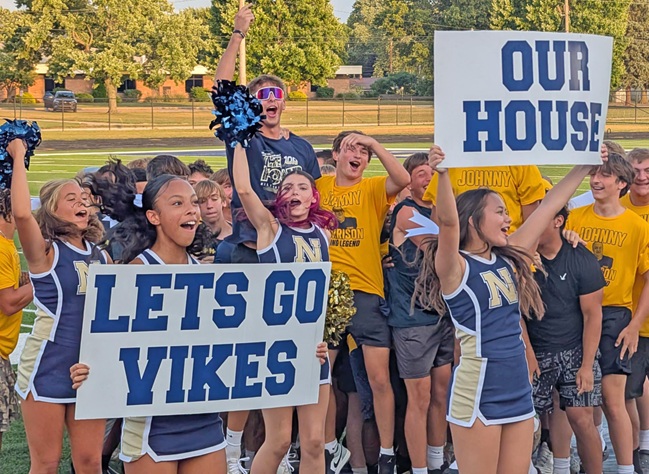
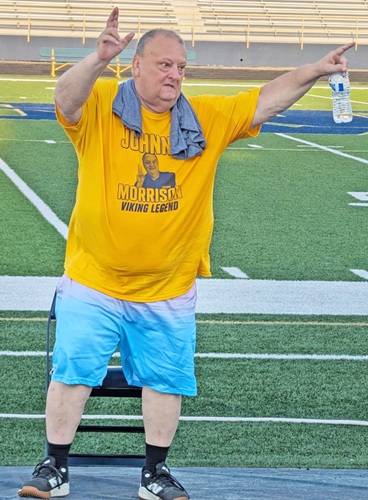
Niles held its annual community-wide pep rally Sunday, Aug. 17 where all 2025 Vikings fall sports teams were introduced and long-time Niles' No. 1 fan Johnny Morrison was honored for his years of support of the athletic program. Hundreds of people attending the event wore Gold T-shirts with the words "Johnny Morrison Vikings' Legend" across the front.
"Johnny is one of the most outstanding human beings I've ever been around in my life. When you see him, he always is eager to talk about our coaching staff or our athletes. He has the biggest heart in the world," Brawley said.
Morrison, who has Down syndrome, has served as manager on the sidelines for the Vikings' football, basketball and baseball teams since 1986.
 Scott Hassinger is a contributing sportswriter for Leader Publications and previously served as the sports editor for the Three Rivers Commercial-News from 1994-2022. He can be reached at [email protected] with story ideas for Berrien, Cass, St. Joseph and Branch counties.
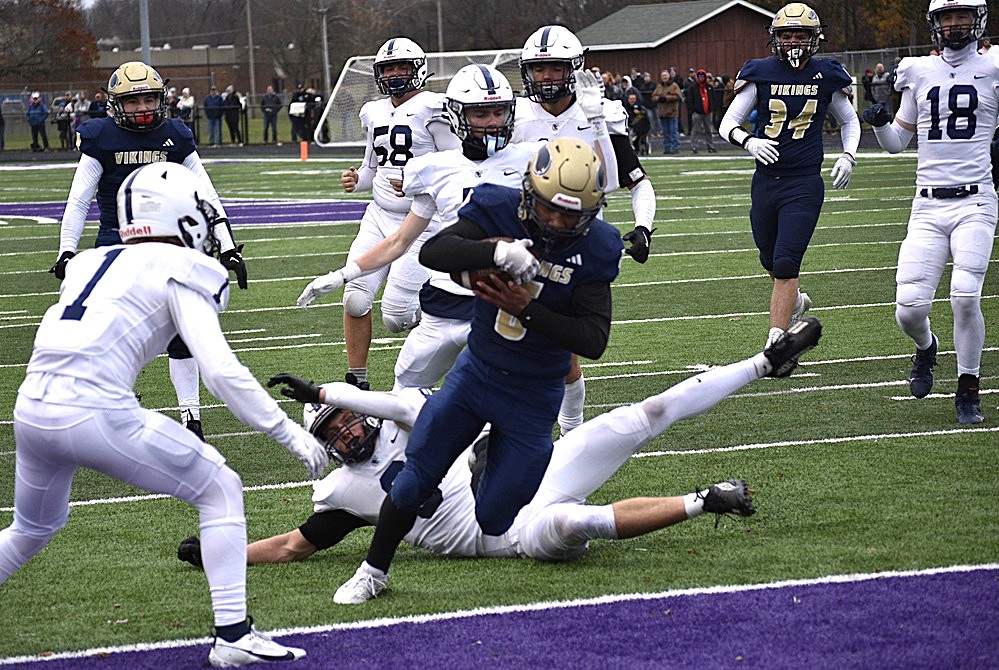
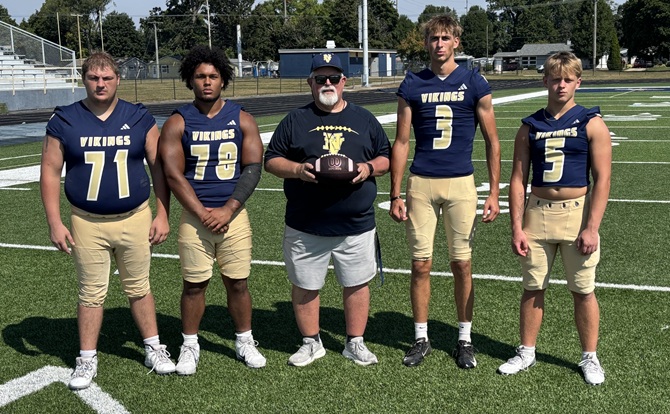
PHOTOS (Top) Niles senior tailback Alex Anderson scores a touchdown during last season's 62-30 Semifinal win over Grand Rapids South Christian at Armstrong Field in Three Rivers. (2) Fifth-year Niles head coach Scot Shaw, third from left, is pictured with seniors Chase Brawley (71), Brandon Hamilton (78), Brenden Olsen (3) and Ward Cheney (5). (3) Members of the Niles cheerleading squad and student body get the crowd pumped up and showing their school spirit at a community-wide pep rally on Aug. 17. (4) The Niles athletic department and sports boosters held the pep rally to introduce the 2025 fall sports teams and honor longtime Niles' No. 1 fan Johnny Morrison. (Action photos by Scott Hassinger. Pep rally photos by Max Harden/Leader Publications.)