

Program Builder Boyd Honored by Our Lady
October 12, 2016
By Keith Dunlap
Special for Second Half
WATERFORD – Mike Boyd always had a grand vision how his last home game as head coach at Waterford Our Lady of the Lakes would play out.
 As it got into the later stages of a nearly 50-year tenure as football coach, athletic director and so much more at the school, Boyd had one specific idea for how he wanted to go out.
“I always said that the last game I coached before I retired, I was going to play it here under the lights,” said Boyd, referring to the field at the school that doesn’t have permanent lights. “I didn’t get a chance.”
Boyd did not, since in April 2013 he decided to retire as football coach from WOLL after a 46 year-career in order to move full-time to Sarasota, Florida.
However, last Friday proved to be the next best thing for Boyd and the Our Lady of the Lakes community.
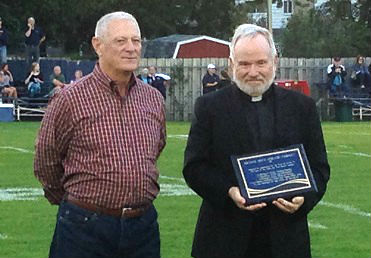
In a ceremony that was more than three years in the making after he made his retirement official, Boyd was brought back for the honor of having the entire athletic complex at Our Lady of the Lakes named after him.
To top it all off, the ceremony took place under portable lights in what doubled as the first night game ever at the school.
The game was against Royal Oak Shrine, which is not only the biggest rival for Our Lady of the Lakes, but coached by Boyd’s longtime best friend in coaching, John Goddard.
All anyone needs to do is look at MHSAA record book for evidence that it was a no-brainer for Our Lady of the Lakes to name the athletic complex after Boyd, one of the state’s all-time greatest prep athletic figures.
As football coach, Boyd won 357 games in his 46 years, which currently is good for fourth place on the all-time wins list for coaches in that sport.
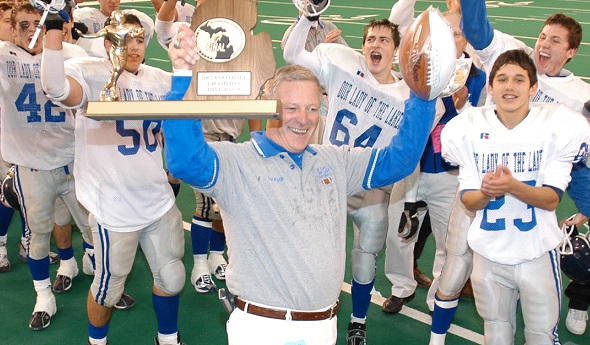
He led the Lakers to three appearances in MHSAA football championship games, with the zenith of his coaching career on the gridiron coming in 2002 when his Our Lady of the Lakes team won its only Finals title in school history with a 13-10 overtime win over Gaylord St. Mary in Division 8.
Facing a 4th-and-goal from the 1-yard line that day, Boyd didn’t hesitate in sending his offense out to go for the win on a do-or-die running play, and the decision paid off when running back Murray Percival broke the goal line to give Boyd his long-awaited title.
The jubilation was apparent on Boyd with how high he jumped over and over again in celebration following the handshake line.
While that was the only time Boyd celebrated an MHSAA championship in football, he did so plenty of times on the softball diamond.
Boyd led Our Lady of the Lakes to what remains a team state-record eight MHSAA championships in softball, going a perfect 8-for-8 in title game appearances and finishing with 703 career wins before retiring from that sport in 2007.
During his tenure, Boyd also coached two games for the hockey team, track & field and started the baseball program by coaching it for its first year of existence.
When not on a playing surface, Boyd was a principal, bus driver, the athletic director and overall face of not only what has become one of the state’s best small-school athletic programs, but the school as a whole.
One of Boyd’s big contributions was creating the home football field at Our Lady of the Lakes behind its school in stunningly quick fashion after some unexpected news.
Our Lady of the Lakes used to play home games at other high schools or middle schools in Waterford, but that changed suddenly in 2001 before a scheduled home game against Royal Oak Shrine.
“They got a new school board one year,” Boyd said. “We used to pay like $250 a game. They came back and said ‘We want $1,200 a game.’ The Dads club got together and put (the press box) up on one week and got the field ready.”
Indeed, in a matter of days a three-story press box was built (fully furnished later in the season) and space for a football field was created (the right side of it through the infield of the baseball diamond) to allow Our Lady of the Lakes to play games on its campus.
 It was fitting that the first home game in 2001 was against Shrine and that the ceremony last week was against Shrine, given his nearly 50-year friendship with Goddard.
The two had a nice chat on Shrine’s bench before the game last Friday, and one can only imagine the stories that were re-hashed.
In fact, when Boyd announced his retirement in 2013, he said how much he would miss playing against “that old turkey” in Goddard.
No doubt, Goddard misses competing against Boyd just as much.
“One year he had a kid that got hurt during practice during that week and he shows up at our place for a game, and after kickoff he comes out and starts running a single-wing,” Goddard said. “I go, ‘What the heck is this offense he is running?’ We beat them, but it took us half a game to figure what he was doing. He made it up on Saturday and we played on Sunday. He was a great coach.”
Boyd still follows the Our Lady of the Lakes program from Florida, watching film online and communicating regularly with current Our Lady of the Lakes head coach Josh Sawicki, a player on that 2002 title team – although Boyd was quick to point out he wants no part in decision-making with the Lakes team. “He’s his own coach,” Boyd said of Sawicki.
Boyd also returns to Michigan every August to help out with preseason practices for Lake Orion, which is coached by his son-in-law, Chris Bell, and he visits Sawicki at his preseason practices while in the area.
Before the game last Friday, Sawicki spoke about how little the topic of the ceremony came up with Boyd during conversations in the days leading up to the game.
“He was talking to me Wednesday or Thursday night, and there was not one question about (the ceremony),” Sawicki said. “It was all about the game plan. ‘What have you got? What have they got? What will you do if they do this? Watch out for Goddard because he likes to do this and likes to do that.’ Still to this day, that was all he was talking about.”
Sawicki said doing things without fanfare is who “Coach” has always been, and it’s a legacy that will be carried on in name now that the athletic complex is named after Boyd.
More importantly, it will also be carried on in spirit.
“He built that brand,” Sawicki said. “It’s the responsibility of the coaches and the players to continue that brand on. That is what we are focused on doing.”
PHOTOS: (Top) Our Lady of the Lakes football coach Mike Boyd hoists the Division 8 championship trophy in 2002 after his team defeated Gaylord St. Mary at the Pontiac Silverdome. (Middle) Boyd (left) receives a plaque from Rev. Lawrence Delonnay, Our Lady’s pastor, on Friday to recognize the naming of the school’s athletic complex in Boyd’s honor.
MHSAA Vault: Shooks a Legend as Freshman Coach
By
Geoff Kimmerly
MHSAA.com senior editor
September 4, 2026
The following originally appeared in the Lansing State Journal on Oct. 28, 2004, and was reprinted by the MHSAA that winter.
Wayne Shooks retired from coaching entirely in 2008 and died Tuesday at the age of 84.
Wayne Shooks tried the varsity football thing once. Some time during the late 1980s, longtime DeWitt coach Gail Thornton asked Shooks to be his offensive coordinator.
“I didn't sleep a night. My wife, after three weeks, said, ‘You're going back to freshmen,’” Shooks remembered.
And those three weeks were in the month of June.
But Shooks' wife must have been on to something. Because few, if any, freshman football coaches have accomplished what Shooks finished with one last win last fall.
He ended his 16th and final season as freshman coach with a 135-2-1 record.
Amazing.
“You can't lose a game for him, or you'll feel bad,” DeWitt senior Mat Brynick recalled from his days as a freshman. “Coach never says it, but it's what everyone expects.
“He taught us how to win.”
 Guys like Shooks, 62, usually go unappreciated.
They get the kids fresh to high school, fresh to high school sports, and still learning things like not spiking the ball after a touchdown.
But few freshman football coaches are as legendary as Shooks is in DeWitt. They are so unappreciated that it's impossible to find out if anyone has accomplished what he's done.
Shook is not big on numbers. Never has been during his 41 years teaching in the district, or more than 20 coaching everything from football to basketball to wrestling to tennis. Oh, and track since 1980.
He also coached 8th-grade football for a few years, junior varsity for one season and was a varsity assistant. But he'll be remembered for what he did with the freshmen.
The losses came in 1993 to Mason during a terrible wind storm, and in 2002 to Greenville. That same year, the Panthers tied Haslett, meaning it was the only year during his tenure that DeWitt wasn't sure if it finished first in its league, since league titles aren't handed out at the freshmen level.
“The kids felt bad. They did their best,” Shooks remembered.
But the losses, however few, were more of a relief for Shooks than a letdown.
Don't take that to mean Shooks doesn't like to win.
Sure, he embraced the role of teacher as much as any freshman coach. But as DeWitt varsity coach Rob Zimmerman said, “If he was a 5th-grade coach, he'd be the most competitive 5th-grade coach you've ever seen.”
“I never pointed (our record) out, it was not our goal,” Shooks said. “Our goal was to win the next week. Although the kids knew it. They just assumed we were going to go 9-0, I guess.”
Guess so.
Shooks had more easily-attainable goals:
- Have fun
- Learn fundamentals
- Emphasize the logical stuff, like the importance of bringing equipment to school every day
“He does a really good job teaching expectations about being young men and being great students,” Zimmerman said. “It's gigantic.”
And it kept kids coming back to junior varsity and varsity. You could hear the fun coming out in Brynick's voice.
He was remembering his freshman football experience, remembering his time with perhaps Michigan's most successful coach at that level.
“I remember a few games, we'd find one play that works, and we ran it to death, pounding it and pounding it,” Brynick recalled. “He loves running the same play over and over. If you can do that, march 80 yards down the field, you're doing something right. No one could stop us.”
That was not all Brynick remembered, or didn't.
Shooks almost never yelled. If he did, it meant a kid messed something up over and over and over again.
He has a doctorate in zoology. Education is obviously a big deal. He loves to win, but he loves to teach. And he's hesitant to go looking for any attention for what he's done.
All made him a perfect freshmen football coach.
“Sometimes I don't think people understand about coaches. You think college level, they are coaches first, that's their job, but not at the high school level,” Shooks said.
“It's not what I've done, it's what they've done. I've always believed the focus should be on the kids. My job is a teacher. I coach because I love to coach.”
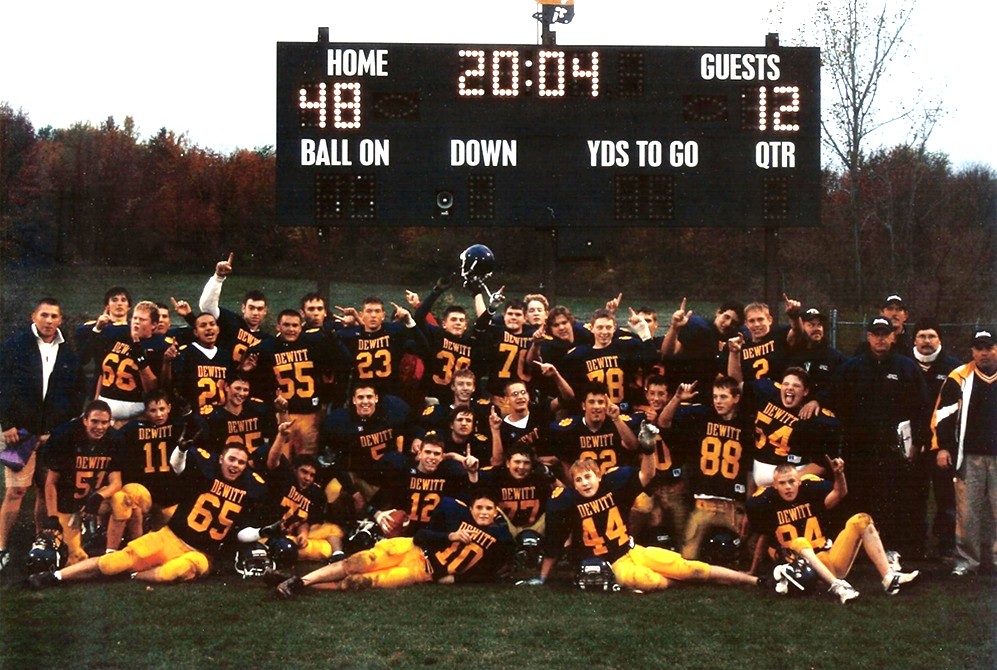
PHOTO DeWitt freshman coach Wayne Shooks, fourth from right, stands for a photo with this final football team in 2004. (Photos courtesy of the DeWitt football program.)