

Prout Powers Pinckney with Inspiration
September 12, 2019
By Tim Robinson
Special for Second Half
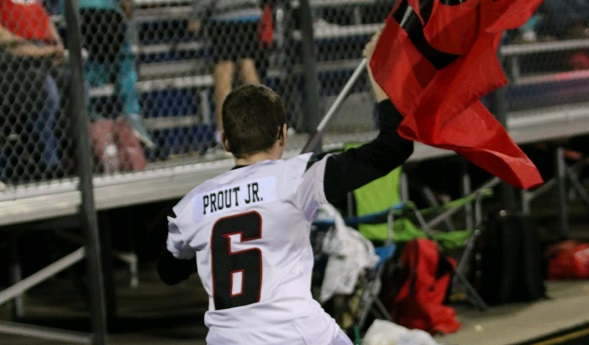
Larry Prout, Jr., who wears Pinckney football jersey number 6, stands 4-foot-8 and 85 pounds.
 Or slightly less than one pound for each of the 105 surgeries he’s had in his young life.
He can’t play football — his body is much too fragile, despite a strong desire to play the game — but he makes his mark with the Pirates as an inspiration.
And the Pirates put a spark into a young man who has spent a large portion of his life in hospitals.
“Everyone gets pumped when he’s around,” Pirates senior quarterback Joe Bona says. “How could you not? Larry’s a great kid, an awesome, awesome character, and what he’s gone through should push us, because it’s way harder than what we’ve ever done. I think it pushes and makes us work harder.”
Larry is the sixth of six children of Kathy and Larry Prout Sr., who have made countless trips to emergency rooms when a medical emergency has cropped up in young Larry’s life.
At one point, their living room was a hospital room for Larry, complete with bed and medical equipment as the Prout family rallied around him.
He was born with no skin covering the lower half of his torso, leaving his internal organs exposed.
He spent most of the first 18 months of his life in the hospital, and didn’t breathe on his own until he was 3 years old.
“His first word was ‘lucky,’” Kathy Prout said in a 2016 interview. “It was the craziest word. It’s like a three-legged dog named Lucky, you know? That was his first word, and we would die laughing.”
He was included as much as he could be in his siblings’ hijinks, although he spent much of his time at C.S. Mott Children’s Hospital in Ann Arbor. But Larry Jr. became well-known among Wolverines fans during the 2016 season for the inspiration he was providing to the U-M football team, with Bleacher Report referring to him as the “heartbeat of Michigan football” in a 2017 report.
 He’s making that level of impact on his favorite high school team now as well.
"Being part of Pinckney and Michigan means a lot," Larry Jr. said. "It’s been really fun, seeing the players and coaches; it’s the same as at Michigan. I love going to the games and sitting on the sidelines before kickoff, and seeing my players and my friends, my best friends, and seeing Coach Jim (Harbaugh) and Coach Rod (Beaton).
Larry is home-schooled because his body isn’t strong enough to allow him to attend school on a regular basis. He takes electives at Pinckney, including photography, and loves being at school, although his parents had to set some limits.
“We found out that every time we dropped him off at school, he would go out and find Rod (Beaton, Pinckney’s football coach),” Kathy said.
“We told him, once a week,” Larry Sr. said. “Rod’s got work to do.”
That may be, but Beaton returns Larry Jr.’s admiration.
“It goes without saying that he’s truly an inspiration,” Beaton says. “I’ve never met a young person with a more positive attitude than Larry. He really does bring it every single day, every time he’s here.”
Larry also has carried the flag during Pinckney's "No Quarter," the pause between the third and fourth quarters where a student picks up a black or red flag, depending on how the Pirates are faring, and runs back and forth in front of the bleachers to rev the Pirates crowd for the fourth quarter.
He practiced at home before carrying the flag in both of Pinckney's games so far this season.
His peers return the love, too.
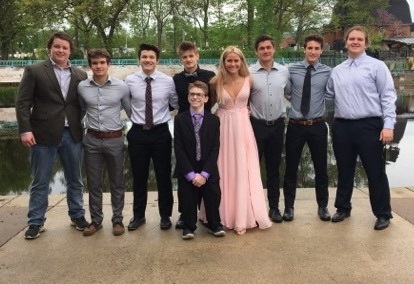
Last spring, Larry Jr. planned to attend Pinckney’s prom, but had to miss it due to a hospitalization.
When Larry Jr. got out of the hospital, a classmate, Alex Williams, put on her prom dress and with some fellow students put on a prom for Larry.
“We have some outstanding kids here,” Beaton said, “and it goes to speak to what we have in this community. Our kids come from such great households, with parents who raise these kids the right way. They understand what Larry’s situation is, and it uplifts us all, every time he’s out here.”
The same, the Prouts say, goes for Larry.
“I remember I loved school,” Kathy said. “I loved it when my older kids were in school. You get the pencils and the pictures and the new clothes. With Larry, I have anxiety and stress because he wants to fit in and make friends and take six classes when he can only do two or three.”
Including Larry Jr. in activities like the prom and football means a lot to all of the Prouts.
“We have a lot of gratitude, and we don’t know how to show it enough,” Kathy said, ‘We want to show our gratitude to Rod and all of the players because they’ve made Larry feel important, such a part of this Pinckney football team. It’s something we’ll never forget, something Larry will never forget.”
 Larry Jr. was a part of the Michigan football team for three seasons, and among his close friends is reserve Buck West, a former Pinckney standout who often is seen at the Prout house watching game shows with Larry Jr.
“I love watching Family Feud and Steve Harvey,” Larry Jr. said. “(The Pirates) are like my brothers, just like Michigan was.”
Larry Jr. got connected to the Michigan team through an organization called Team Impact, which connects youths with life-threatening or chronic illnesses to college football teams.
Dan Kraft, the son of New England Patriots owner Robert Kraft, invited the Prouts to Ford Field when the Patriots played a preseason game there last month and got them passes to be on the field during pregame.
“As I was hanging out, the camera was filming me and they said Team Impact had a surprise for me,” Larry Jr. said. “And the craziest thing is, I see Tom Brady coming up and giving me a fist-bump and a high five. I shook his hand and told him I loved seeing him play. He pointed to my (Michigan) hat and told me to make sure to beat the Buckeyes this season. I told him I would make sure to do that.”
After Brady left, Larry Jr. jumped for joy, no mean feat for a young man who uses a wheelchair for anything but short walks.
“When he gets excited, he jumps,” Kathy said. “He can clear eight inches, which is pretty awesome, because they said he would never walk.”
At Pinckney practice, Larry Jr. hands out encouragement and banters with players who are, in many cases, a foot taller than him.
While he basks in the glow of being part of a team, he contributes to the Pirates something they might not have learned otherwise.
“The lesson I take is that it’s not as bad as what it’s going to be,” senior running back Sal Patierno said. “What we go through, you just think of what he’s gone through, and it makes you want to go harder. Just keep fighting. I know he’s fought harder than any of us.”
“It makes you think,” Bona said. “It makes you work harder.”
“He uplifts us all, every time he’s out here,” Beaton said.
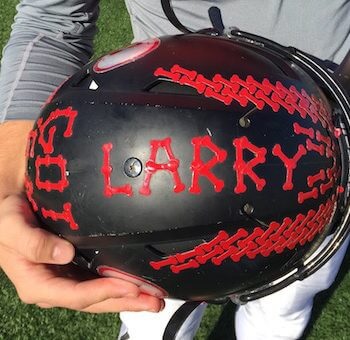
PHOTOS: (Top) Larry Prout Jr. carries the Pinckney "No Quarter" flag in front of the crowd during the Pirates’ Week 2 game at Chelsea. (Middle) Then-senior Pirates quarterback Jack Wurzer spelled out Prout’s name on his helmet in 2017 from bones the players receive for outstanding efforts. (Below) Prout’s friends put on a prom for him after Prout, in purple shirt and tie, missed the school’s event this spring while hospitalized. (Photos courtesy of the Prout family and Tim Robinson.)
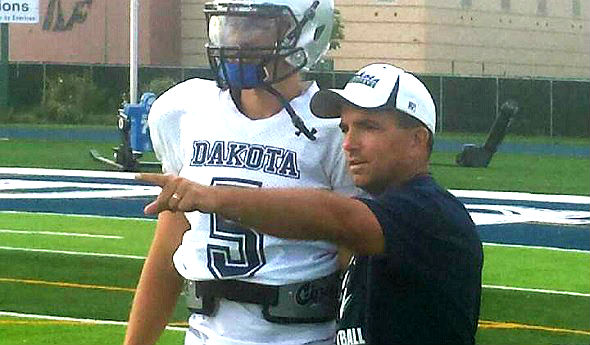
Longtime Assistant Set to Lead Dakota
By
Tom Markowski
Special for Second Half
August 17, 2016
MACOMB TOWNSHIP – Greg Baur was content to continue coaching in the background, much like a supporting actor in a movie.
 Baur, 46, had been an assistant football coach for 26 years at four different schools, most recently at Macomb Dakota. For 21 seasons he was a defensive coordinator, including the last 12 for the Cougars.
And he was good at it. In 2001, under then-head coach Mike Carr, Bauer was instrumental in guiding Clinton Township Chippewa Valley to its only MHSAA title, in Division 2. Chippewa Valley held Jenison to 139 yards in its 26-13 victory in the Final. In 2006 and 2007, Baur was with head coach Mike Giannone when Dakota won its two MHSAA Division 1 titles. That gives him the distinction of being the only Macomb County coach to play a big part in three MHSAA championships.
Last January, Giannone left Dakota to take the head coaching position at Warren DeLaSalle. The move took Baur by surprise – but it also started the wheels turning in his head.
Just once had Baur sought to be a head coach. When Carr left Chippewa Valley after the 2004 season, Baur applied to take over. When he didn’t get the job, Giannone quickly hired him at Dakota.
With Giannone gone, Baur made another bid at a head coaching gig. This time, he got it.
“I don’t remember the date,” Baur said. “I just remember it was a snow day. They called me and told me I had it. The first thing I did was make sure the staff would stay, and they did. Next I met with the players, and the kids were really excited about it.”
At most programs, going from a coordinator position to take over as head coach is akin to jumping into a pool after sitting an hour with just your feet in. Baur said it isn’t like that for him.
 Sure there’s more paper work, and yes, the fundraising becomes more of his responsibility. But as far as the workload, it’s not as daunting for Baur as it might be for others. Baur has always been a workaholic.
“I’ve always worked extra hard,” he said. “I told my wife, this will amp things up. It’s 24/7. The good thing is the kids have grown up a bit. And it’s not work for me. It’s fun. I’m really excited to get things going. When you wait 25 years you look at what you can tweak here and there. Offensively, I’ll tweak it a little. Defense is the same. I’m still running it. I can’t see myself not coaching (the defense).”
In a sense, Baur has already experienced success. He convinced Carr to come out of retirement and serve as his offensive coordinator.
It’s come full circle.
There are a number of reasons why Baur hadn’t looked elsewhere for a head coaching job. He and his wife, Renee, live in the area, and their three children attend schools in the Chippewa Valley school district, of which Dakota is a part. Their eldest child, Jason, played football at Dakota and graduated this spring. He’s now attending Wayne State University and helping out with Dakota’s freshmen team.
Professionally, there isn’t a program in Macomb County that can match Dakota. It is the only school in the county with more than one MHSAA title, and the Cougars are consistently one of the state’s top teams. They’ve made the playoffs 15 consecutive seasons, and just once since 2003 have they failed to win a playoff game. Last season Dakota lost to Detroit Cass Tech, 16-10, in a Regional Final.
Given that, there’s a certain amount of pressure that comes with being the head coach of such a program. It’s similar to the pressure that’s on coaches like Ralph Munger at Rockford and Kurt Richardson at Clarkston. Those in the community not only expect them to win every year, but expect their teams to be a factor in the playoffs every year. A first-round loss is not only disappointing – it can also raise a few eyebrows.
Baur’s attitude? Bring it on.
“To me, it’s not pressure,” he said. “I love to compete. If all goes well, great. If not, then we move on. I might not be the smartest coach around, but no one is going to outwork me.”
During this time of year, time is scarce. Double sessions start at 9 a.m. and end at 3 p.m. There’s time for dinner, then its film sessions followed by an hour or two of quality time with his children.
“That hasn’t changed,” he said. “That was always the schedule. But now there’s paperwork, putting out fires.
“I love this. There isn’t a part of the job I don’t like. There’s no complaining. You get an opportunity, you make the best of it. I know there’ll be tougher times.
“Being a head coach, it never really crossed my mind. (Giannone) is relatively young. I thought he’d retire (as a head coach) here. It wasn’t something I was campaigning for.”
Baur owes much of his success and where he’s at to those who mentored him. A graduate of Sterling Heights Stevenson, he played and coached under one of Macomb County’s legendary coaches, Rick Bye. After four years, Baur went to Romeo and coached under Greg Ganfield. Ganfield was gave Baur his first shot as a coordinator. Four years later, Baur went to Chippewa Valley.
Carr showed Baur how to run a program, not just coach. He lectured him on how to deal with parents and their concerns. A bit overwhelming then, Baur has gained the experience where such responsibilities are more easily managed.
“(Giannone) wasn’t that much different,” Baur said. “Heck, he coached under Carr, too. But (Giannone) took the program to another level.”
As good as Dakota has been recently, expectations are even higher this season. The senior and junior classes did not lose a game on the freshman or junior varsity levels. Many outside the program, including Utica Eisenhower coach Chris Smith, have said this senior class at Dakota is one of the best they’ve seen.
Baur said one of his biggest tasks is to make sure this group doesn’t become complacent.
“I’m a players’ coach,” he said. “When it got real hot recently, I dialed back. They don’t even call me Coach. It’s like, hey Baur.”
Baur is just like one of the guys – except this time he’s playing the leading role.
 Tom Markowski is a columnist and directs website coverage for the State Champs! Sports Network. He previously covered primarily high school sports for the The Detroit News from 1984-2014, focusing on the Detroit area and contributing to statewide coverage of football and basketball. Contact him at [email protected] with story ideas for Oakland, Macomb and Wayne counties.
PHOTO: Greg Baur (right), the new head coach at Macomb Dakota, directs one of his players. (Photo by Tom Markowski.)