

Ratings, Polls & Birth of State's 'Top Ten'
September 30, 2020
By Ron Pesch
Special for Second Half
By December, with the annual announcement of Michigan’s All-State football team, the intense pressure of the 1951 season had disappeared for two of the state’s finest high school coaches.
The football season had started with an exceptional honor for Muskegon’s Harry Potter, one of the mentors.
“Six leading Michigan school-boy coaches, representing separate geographical areas of the state, again will write daily stories for Free Press readers heralding the outstanding All State candidates from week to week,” noted prep sportswriter Hal Schram.
Potter worked with Joe Rosbeck of Hamtramck, Bob Waldorf from Battle Creek Central, Willard Anderson of Stambaugh, Herb Korf of Saginaw High School and Hiram Becker of Cadillac High on the board.
“At the close of the 1951 campaign these six veterans in Michigan’s prep coaching ranks will be brought to Detroit by the Free Press to select Michigan’s official All-State team.” It was the third straight season the Detroit paper had done such.
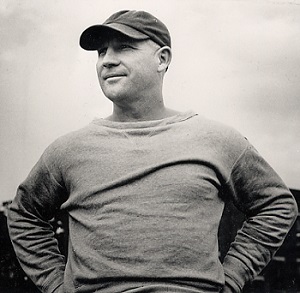
Potter had joined the Muskegon staff as reserve coach in 1927, serving as an assistant to head varsity coach C. Leo Redmond. In 1947, when the successful Redmond resigned to take a position as a principal within the district, Potter took charge of the varsity.
Ted Sowle could relate to the pressure no doubt felt by Potter. Schram, the Free Press’ high school sports editor, had really started his full-court press on prep coverage in 1949. For a nickel daily, readers could keep tabs on the state’s top teams and players. The head coach at Grand Rapids Catholic Central had been honored in 1950 to occupy one of those half-dozen cherished seats on the Free Press All-State board. Sowle (who had also replaced a successful and cherished coach in Edward Killoran at Catholic) joined a panel that featured well over 100 years of coaching experience, including future University of Nebraska coaching legend Bob Devaney, then guiding Alpena High School, and Howard Auer, who had led Flint Central since 1939. Bill Kelly, Saginaw Arthur Hill’s mentor, with 19 seasons, and Oscar E. ‘Okie’ Johnson of Muskegon Heights – Michigan’s Dean of Coaches with 24 campaigns under his belt – were among the six that sat on Schram’s first All-State board.
 All of the state’s high school gridiron coaches could assist the panel representatives by mail weekly, with material for their columns. “Postcards, addressed to their Board representative, are in the hands of all state schoolboy coaches for the ‘feeding’ process,” stated Schram explaining the procedure to readers. At season’s end, having received ballots from those coaches, game officials and sports reporters, the board named the Free Press’ All-State squad.
During the 1951 season, the six board members penned 42 by-lined stories for the paper. Potter’s updates appeared on Fridays in the Free Press.
On Friday, November 30th, five of the six All-State Board members gathered at Detroit’s Hotel Shelby, then spent seven hours on Saturday compiling, correlating, then distilling down “recommendations of more than 400 other Michigan coaches… which climaxed a season long search.” Herb Korf of Saginaw, “confined to his bed with the flu” had been unable to attend. His choices and material, however, had been sent to Detroit to be weighed with the others.”
Because of the method of involvement, Schram referred to the Detroit Free Press All-State squad as “Michigan’s OFFICIAL All-State” team. Released on Wednesday, December 5th after masterful pomp and circumstance by the advertising staff of the Detroit paper over the weeks previous, the 1951 team, like several before it, featured the names of nearly 400 prep players. The first, second and third teams each included 11 names that came from, but were not limited to, schools with the largest enrollment, labeled Class A in Michigan. An additional 22 players, 11 each from Class B and Class C enrollment-sized schools, were also accorded top honors. Finally, more than 300 other players were recognized on the extensive honorable mention list by the paper.
As challenging and rewarding as the work had been to Potter, it was not what had brought the majority of stress to the coach during the 1951 season.
Rivals
Located 40 miles apart, the cities of Muskegon and Grand Rapids had been longtime rivals, economically and athletically, since the turn of the century. The Big Reds had faced Catholic Central on the gridiron off and on since 1918. The teams had met to uncap the season in both 1949 and 1950. The Cougars had won both games, but Muskegon still led the 10-game series between the schools with seven wins against three defeats. With the end of their home-and-home contract, they would not play each other in 1951. Grand Rapids Press sportswriter Lendy Davis wrote the Big Reds were dodging Catholic, expected to be a strong squad.
So, it was a bit of a surprise when Potter and Sowle, rivals on the gridiron, united over issue with another aspect of the newspaper industry’s battle for readers – the weekly rating of high school football teams to identify a state champion.
Almost from the day football became a sport in Michigan, the battle for supremacy – local, state or national – has been part of the game. Claims on Michigan’s state prep title date back to at least 1894. Today, the Michigan High School Athletic Association awards 10 gridiron championship trophies – eight across Divisions in 11-player football and two across Divisions in 8-player football – via a structured playoff. However, the MHSAA’s first postseason football tournament didn’t arrive until 1975. That season, the Association awarded championships in four enrollment groupings – Class A, B, C and D.
Postseason basketball tournaments sponsored by the Association and its predecessors had produced annual champions in Michigan dating back to at least 1918. State Track and Field meets had named champions even before that time. But in football, operating without a postseason since its start before the turn of the 20th century, naming champions was left in the hands of the media and the schools prior to 1975. Without structured head-to-head competition to sort the results of the state’s nine-game season, titles were based on observation, opinion, guesswork or proclamation. Hence the term ‘mythical’ is applied to state titles proclaimed prior to 1975 in the Great Lakes State.
Rankings and the evolution of the 'Top Ten'
Initiated by a suggestion from Charles Sumner ‘Cy’ Sherman, a Lincoln, Nebraska sportswriter, The Associated Press (AP) launched college football’s Top Ten weekly rankings in 1936 with a national poll of a hundred sportswriters. In 1943, in the final weeks of the season, Watson Spoelstra of the AP in Michigan used late-season lists to relay the win-loss marks of the state’s undefeated and once defeated high school football teams with the largest enrollment numbers. Those lists were sorted, first by victories, then by points scored. (‘Waddy’ Spoelstra would later become a sportswriter for the Detroit News, a correspondent for The Sporting News and the founder of the Baseball Chapel, an international ministry responsible for the appointment of team chapel leaders, recognized by Major League Baseball.)
The Detroit Free Press writer Truman Stacey can be credited with the creation of Michigan’s weekly poll, starting with his arrival in Detroit in 1944. He brought the idea with him from his previous job as a sportswriter in Oklahoma. In 1943 at the Daily Oklahoman, published in Oklahoma City, Stacey’s byline regularly appeared with the ranking of the Sooner State’s “Top Ten” high school football teams. The concept, at least in Oklahoma, was initiated by his predecessor, sports editor Arthur Edson, in 1941. (Edson started at the Oklahoman in 1936, and later would become a longtime newsman for the Washington D.C. bureau of The Associated Press, and political writer for U.S. News and World Report).
In Michigan, Stacey’s “ratings proved so popular that both news services and other newspapers picked them up later,” wrote Schram at the dawn of the MHSAA Playoffs in 1975. “After all, a good thing is a good thing, even if someone else thinks of it first.”
Within weeks, Stacey quickly proved the impact and popularity of the polls with fans. His first top-ranked team was Jackson High School: “By reason of three decisive victories over strong foes, Jackson stands at the top of the list as the State’s finest football team.”
In Week 6, Jackson squared off with Muskegon, the state’s second-ranked team according to the rankings. In his weekly Tuesday column, Stacey relayed the result to readers in dramatic fashion:
“Jackson’s fancy Vikings, for five straight weeks the kingpins of high school football in Michigan, fell from their pinnacle this week as the list of the state’s top ten teams underwent its most drastic revision.
“Muskegon, by virtue of the completeness of its 19-0 victory over the former leaders, fell heir to Jackson’s scepter as the state’s schoolboy ruler.
“The two leaders clashed for the top in a game that created so much excitement in Muskegon Friday night the school officials were forced to close the gates of the stadium 15 minutes before the kickoff, after 10,000 fans had jammed their way inside.”
Blueprint for the future
The theatrics and playfulness that inspires chroniclers of the weekly polls today was present in 1944.
Muskegon stayed at the top of Stacey’s list as the year rolled on, with Grand Rapids South and Saginaw nipping at its heels.
With two games left to play in the season, Stacey’s column in the Friday paper leading up to Week 8’s games focused on a call he had received from Federal Judge Frank Picard. A Saginaw High and University of Michigan alum and devout Trojans football fan, Picard was questioning the writer’s smarts as the season headed for a conclusion.
“Fierce blue sparks darted from the telephone when I listened to him speaking in what, for want of a better description, I shall call his six-gun voice,” Stacey wrote.
 “’I see you haven’t yet learned that crime does not pay, Stacey,’ he said. ‘You still have Muskegon up there in first place ahead of Saginaw, which is a mere third in your rankings …’”
Emphasizing that he felt the Trojans had played a stronger schedule, Picard asked, “By just what process of reasoning do you consider Muskegon a better team than Saginaw?’
…’Well, your honor, I just used my own judgement, and ---‘
“’I’d send a man to jail for less! You are a menace to American jurisprudence.”
Picard must have been annoyed when Stacey’s Week 8 poll arrived, showing Saginaw had slipped past Grand Rapids South for second place, but still trailed the Big Reds for the top spot. He must have been overjoyed when Stacey finally saw the light.
“The 1944 race to decide Michigan’s mythical state high school grid champion blazed to the tape in a photo finish. … It was one of the ironic quirks of the schedules that the three powers did not meet – a circumstance which caused many fans and coaches to bemoan the lack of a method of deciding a champion similar to that employed during the basketball season.
“By reason of a 13-6 decision over Arthur Hill in their final start on Thanksgiving Day, the Trojans of Coach Carl Nordberg won a narrow decision over Muskegon and South for the top spot among the state’s elect.
“The victory gave the Trojans their first perfect season since 1907, when another mythical state champion was produced.”
Incidentally, the quarterback of that 1907 Saginaw team was Frank Picard. A tie in a season-ending game with, ironically, Muskegon that year had allowed Saginaw to proclaim itself “mythical” state champion.
A good thing – or is it?
In late September 1945, Stacey announced he had accepted a position as public relations director for the University of Detroit. During his stay at the university, he earned his bachelor and master’s degrees.
Hal Schram, previously a prep writer for the Lansing State Journal, stepped into Stacey’s role on the Free Press sports staff. Over his 42-year career, he would expand and enhance what Stacey started and ultimately define the role of a beloved prep writer.
In 1945, Muskegon Heights unseated top-ranked Muskegon in the final week of the season to earn the Free Press title. The Big Reds, riding a 16-game win streak before the loss, had been Schram’s top-ranked team for the previous three weeks. The Tigers laid claim to the crown with a 7 to 6 triumph played out before 13,500 fans. Two Class B schools made Schram’s final top 10. (In the coming years, the top 10 lists would eventually expand to separate and rank all four enrollment classes in Michigan.)
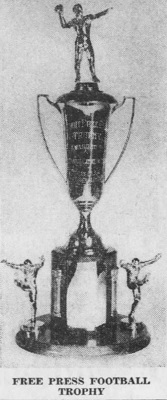
In 1946, Lansing Sexton slipped past undefeated Muskegon Heights in the Week 9 poll for the Free Press championship. With the 1947 season, Schram and the Free Press publicized use of a statistical championship system to rank the state’s Class A teams and announced plans to award a 30-inch high trophy to symbolize the achievement of ending the season as the top-ranked football team. (A limited number of copies, describing the system, were available to those interested by sending a self-addressed stamped envelope to Schram at the Free Press). Flint Central emerged as titleholders with Port Huron finishing second. Despite running its consecutive win streak to 27, Muskegon Heights ended the season fifth in the Free Press final standings.
The Associated Press chose to jump into the fray of ranking teams in 1947 with a poll of Class A schools by the state’s sportswriters. George Maskin, prep writer at the Detroit Times, opted to rank teams too. They both named Flint Central as tops in the state, with Muskegon Heights ending the year in second. Port Huron landed in third place in the AP poll and fourth in the Times rankings.
While the Free Press and Times awarded the state’s No. 1 ranking to Grand Rapids Union in 1948, the AP did not rank squads, opting instead for a season-ending compilation of undefeated teams, supplied by “Dick Kishpaugh, Kalamazoo statistician and newsman.” When announcing its All-State squads in December, the AP did note that Union was “generally considered the No. 1 team in the state.”
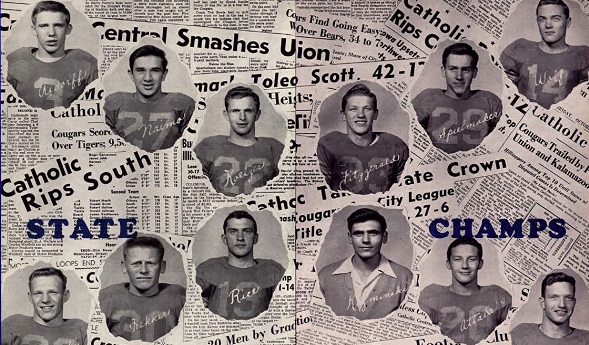
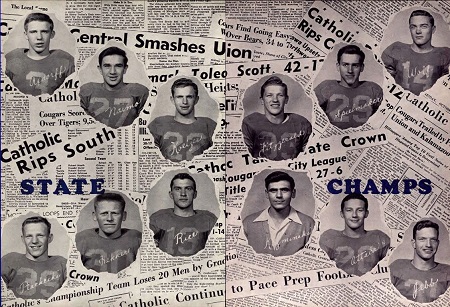
Grand Rapids showcased its second-straight Free Press trophy as the Cougars of Catholic Central, led by Coach Sowle, grabbed the 1949 crown. The Cougars downed Muskegon, Muskegon Heights, Toledo Scott and Grand Rapids Union to start the season, never relinquishing their hold on the No. 1 spot in Schram’s Top Ten. The Times concurred.
In 1950, United Press International (UPI) entered the ratings game. At season’s end, the Free Press, the Times and UPI all awarded the mythical crown to Flint Northern. The Associated Press remained on the sidelines. However, when naming Northern’s backfield trio of Duncan MacDonald, Ellis Duckett and Leroy Bolden to its annual Class A All-State squad, the AP did indicate that the three backs were “the big reason why Flint Northern smashed its way to nine straight wins this season to make it a standout for honors as the state championship eleven.”
Madness
The Free Press, Detroit Times, Grand Rapids Press, AP, and UPI all took to rating statewide teams in 1951. According to Schram, a total of 69 Class A and B teams, “whose schedule sends their teams against at least three Class A opponents” were eligible for the Free Press trophy, now in its fifth year of presentation.
Sowle’s Grand Rapids Catholic Central Cougars immediately grabbed control of the top spot in the rankings. With the exception of the Free Press ratings, Muskegon quickly emerged as the second-ranked team in the polls.
With two weeks remaining on schedules, Muskegon and Catholic were tied for the top spot in the Associated Press poll. The Big Reds overtook Catholic Central for the top spot in the AP Top Ten in Week 8, following a 33-0 win over Southwestern Conference rival Kalamazoo Central. (AP sports editor for Michigan, Harry Stapler, had made a surprise visit to the press box at Muskegon to check out the action). That victory was also enough for the Big Reds to slip by Owosso for second place in the Free Press rankings. Earlier in the year, Birmingham (now Birmingham Seaholm), a Class B school playing a slate composed of primarily Class A competition, had a lock on No. 2 in Schram’s statistical championship system.
In their season-ending contest, hosted at Houseman Field in Grand Rapids, the Cougars squared off with twice-beaten Detroit Catholic Central. Muskegon would face crosstown rival Muskegon Heights in its finale. Catholic and Muskegon had met only one like opponent on the year – Holland. The Cougars downed the Dutchmen, 32-12 in Week 4. Muskegon overpowered Holland 48-0 in Week 5.
Ted Olewinski and Roman Zobro, a pair of breakaway backs, powered the GRCC attack. Led by senior quarterback Earl Morrall, who later played 21 seasons in the NFL, the Big Reds had scored 290 points on the year – tops in the state entering the game. According to Schram, both teams were favored by two touchdowns.
Only hours after their contests, both Coach Sowle and Coach Potter publicly criticized the football polls as putting too much pressure on teams and players and creating overemphasis on high school football.
Who won?
Both teams emerged victorious. The Free Press, United Press International and the Grand Rapids Press each named Grand Rapids Catholic as state champion. The Associated Press poll selected Muskegon in a tight vote of sportswriters.
“Man for man, perhaps, the Cougars might boast an edge on Muskegon,” said George Maskin of the Detroit Times. “But Muskegon’s ace quarterback, Earl Morrall … certainly balanced the books.” The teams finished the season as co-champions according to Maskin’s Times rankings.
“For the first time in my career – with a winning club – I was booed from the stands this season when I substituted at a point where we could have continued to score,” said Sowle, speaking out at a Knights of Columbus dinner honoring the Catholic Central team the day after the Cougars’ season-ending victory over the Shamrocks.
“My first string, gunning for state honors, begged me to keep them in the game … in order to win a decisive victory and enhance the state championship possibilities. They wanted to demonstrate their scoring potential for reasons created by the rating system.”
“When we piled up that big score Saturday night, we were battling the polls, and not Detroit.”
 “Coach Ted Sowle of the G.R.C.C. kept his regulars in action until only 30 seconds remained in the game,” wrote Maskin, who made the trip to Grand Rapids for the game. “They had a hand in all eight Cougar scores.”
The Cougars defeated DCC 51-0 before a crowd of 6,100.
Heavy snow had been removed from the stands of Hackley Stadium by students and from the field by city plows in Muskegon in preparation for the Saturday game with the Heights. With temperatures in the 40s, the Big Reds downed the Tigers, 26-6, in front of 11,000 fans.
Potter said that during the season, “he had been open to criticism because he removed his regulars in several games and did not ‘pile it on’ to the last touchdown.”
“It has been like trying to hold in thoroughbred horses. The boys themselves feel the poll rivalry keenly and want to go all out.”
The comments received statewide coverage.
“Such blasts have been heard consistently in the college ranks this season,” stated a United Press article.
Schram fights back
Schram came out swinging at the criticism.
“In Michigan there are two generally-accepted state-wide high school rating systems,” stated the Detroit writer. “One is a ‘popularity poll’ in which voters are influenced, to some extent, by the size of scores. The other, conducted by the Free Press for seven seasons, award points for winning and tieing games. It takes into account the quality of opposition – but does not give a bonus for increasing the point spread.”
Potter emphasized to the Free Press he was against all ratings of high school teams. Sowle backtracked a bit in conversation with Schram, stating “his critical remarks were not directed at the Free Press system,” and agreed with the writer that the paper’s system was “the ‘fairest possible approach.’”
“We feel that this feature creates interest,” continued the journalist. “We think it’s a lot of harmless fun. Rating systems have been used in many states for the past 10 years and have proved very popular with readers, coaches and players alike. In the absence of an official high school playoff toward state championships, such as (those) in Texas, Oklahoma and other states, the Free Press believes a rating system is the best possible way for fans, players and coaches to evaluate teams.”
Schram concluded with a final statement.
“The Free Press system operates in such a fashion that it is free from any such charges. The Free Press will continue to rate high school teams in football and basketball.”
Battle Raged
“Proponents of the polls claimed they increased interest in high school athletics, raised the standard of play, brought in funds at the gate that helped support minor sports and were demanded by readers,” noted the AP as it weighed the issue. The AP also observed that others felt polls were a detriment to sportsmanship, created unnecessary rivalry between schools, encouraged teams to run up scores and curbed substitutions even though the game was in hand. Some felt that the polls encouraged betting.
Charles E. Forsythe, state director for the MHSAA, was asked for comment.
“We can’t do anything to stop the rating systems of course. We wouldn’t think of attempting to. But the association may decide whether or not to make a statement on its stand,” he said.
At the end of November, the MHSAA’s Representative Council unanimously did adopt a motion denouncing such polls. A spokesman for the Council said the only issue at stake in the voice vote was: “’Do the polls do any good?’ He said the discussion was brief, as no one spoke in favor of the polls.”
In June of 1952, the managing editors of Associated Press-affiliated newspapers responded. In a 12-11 decision, they voted to discontinue the weekly polls. The Free Press and Times, UPI and other organizations pushed on unabated.
Schram reminded readers that point spreads were not a factor in the Free Press system. The Associated Press returned to running Kishpaugh’s lists of undefeated squads. After three years away, they returned to posting weekly gridiron polls in the fall of 1955. There appears to have been little if any objection.
Since then, as sure as the leaves start to fall come football season, Michigan’s media outlets hype the coming prep season and rank the state’s prep teams.
 Ron Pesch has taken an active role in researching the history of MHSAA events since 1985 and began writing for MHSAA Finals programs in 1986, adding additional features and "flashbacks" in 1992. He inherited the title of MHSAA historian from the late Dick Kishpaugh following the 1993-94 school year, and resides in Muskegon. Contact him at [email protected] with ideas for historical articles.
PHOTOS: (Top/4) Grand Rapids Catholic Central was celebrated as the 1949 "mythical state champion." (2) Muskegon football coach Harry Potter. (3) GRCC received the Detroit Free Press trophy as the top team in 1951. (4) GRCC coach Ted Sowle. (Photos gathered by Ron Pesch.)
Memorable Wakefield Run Won't Be Forgotten
October 2, 2019
By Ron Pesch
Special for Second Half
When it comes to football, Russ Maki wears his heart on his sleeve. A 1971 graduate of Wakefield High School, he’s on a mission.
As a 7-year-old, he fell in love with the sport and, in particular, with a team.
“My Dad brought me to every (Wakefield) game,” he recalled. “We lived four blocks from the football field, and I watched every morning and afternoon practice.”
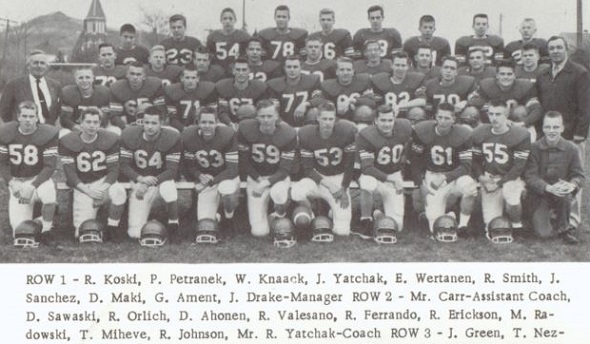
Maki’s memories are of the 1960 Cardinals, and he’s on a quest to honor the team.
Football began in 1920 at Wakefield. Interrupted briefly for a national crisis, it returned to the gridiron stronger than ever – but then, until recently, disappeared from the landscape of this Upper Peninsula town. Like in other cities across the nation, shrinking enrollments have impacted the sport.
“(That 1960) team just kicked everybody's butt,” added Maki. “The players on this team were my heroes then and still are to this day. Hardly anybody in town knows they were State Champs.”
Football state championships in Michigan are decided on the playing field via a tournament these days. But that wasn’t the case when Maki was a kid.
Hence, his challenge. He would like the school district to honor the team with recognition such as a pennant to hang in the gym. So he needs proof.
Big Iron
The City of Wakefield proudly notes that it is located in the heart of Big Snow country. Indeed, nearby are three of the finest ski hills in the Midwest. Located in the center of town is Sunday Lake. Porcupine Mountains State Park and Lake Superior are a little north. It is beautiful country.
 But it wasn’t snow, scenic waterways or quality of life that initially attracted folks to the Gogebic Range area of Michigan. Rather, it was the discovery of iron ore in 1881. The find inspired a mad rush to capitalize, and that led to the founding of the village of Wakefield in 1887. The city was incorporated in 1919.
Hop on highway US-2, head west, and around 10 minutes later, you’ll be in Wisconsin. Stay on US-2, jog a bit to the north, and in two hours you’ll find yourself in Duluth, Minnesota. A trip from Wakefield to Fargo, ND, is six and a half hours. For comparison, a visit to Detroit, with traffic cooperating, would require a commitment of at least nine hours.
So it’s completely understandable that, from the beginning, Hurley High School – located a mere 13 miles away in the Badger State – became a rival.
“The Wakefield high school football team will meet Hurley on the local grounds Saturday afternoon,” announced the Ironwood Daily Globe on October 20, 1920. According to Coach (Fred) Hackett, who has charge of the team, the boys are light and newly organized and have only a fair chance of winning the game with Hurley.”
Indeed, it was a mismatch, with Hurley trouncing the “green but willing youngsters” from Wakefield, 46-6.
“In the two weeks that the Wakefield team has been out in uniform, Coach Hackett had little time to even drill some of the youngsters in ordinary tactics of the game, much less develop a strong team.”
The schools met again in 1921 with similar result, but continued to play each other sporadically in the coming years. A field goal by Pat O’Brien with eight seconds left to play in the 1929 contest gave Wakefield a 23-20 victory over its natural rival, sealing the school’s first ever unbeaten (but once tied) season.
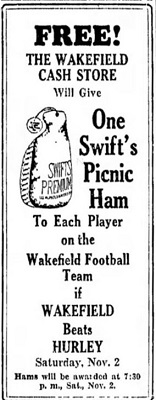
“A local grocery store offered a free ham to each player on the team if they beat Hurley in that season-ending game,” said Maki, laughing. “Can you imagine that?”
They became league rivals when both teams, along with Bessemer and Ironwood from Michigan and Ashland from Wisconsin, became charter members of the Michigan-Wisconsin Conference in 1937.
Hopes for a different moniker, “for brevity’s sake,” were tossed around by the press at the time. The ‘Big Five’ was pitched by the Iron Mountain News. The Ironwood Daily Globe suggested ‘Michwico’, a juxtaposition of the words Michigan, Wisconsin and Conference. Another thought was the ‘WHABI’, a combination or first letters from each member town.
Instead, as time wore on, the league simply became known as the “M-W.”
Alumnus comes home
Wakefield discontinued football for two years – some say three – due to World War II. The team returned in the fall of 1945. Ansel Anderson, a graduate of league rival Ashland and Stout Institute in Menomonie, Wis. – where he took part in basketball, track and captained the football team – guided the athletic squads at Wakefield for two seasons.
In 1947, the school hired one of its own.
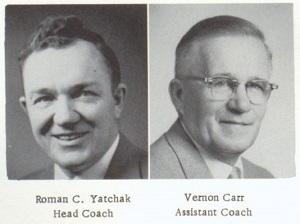 Roman Charles Yatchak had starred in both football and basketball at Wakefield, earning all-U.P. honors in the early 1930s, then lettered in football, basketball and baseball at Iowa State Teachers College. He coached prep ball in Iowa, then at Highland Park in metro Detroit before returning to Wakefield. A year earlier, the Cardinals became members of the newly formed Western Upper Peninsula Football Conference, comprised of Class ‘C’ schools from Houghton, Hancock, L’Anse, Ontonagon, Lake Linden and Crystal Falls. The 1947 season would be the first during which each member played one game against all the other members.
“The squad has responded magnificently to his tutoring,” wrote the News near the end of Yatchak’s first gridiron season at the helm. Wakefield had posted a 5-2 mark heading into the season-ending contest with Bessemer, now a nonleague game. The Cardinals had faced the Speedboys on 17 occasions with minimal luck, winning only four contests since 1924 when the teams first met.
Bessemer again came out on top, 13-0. Still, the season featured a third-place finish in conference play and was deemed a success. Ten juniors were expected back for the 1948 season.
The Cardinals, under Yatchak and assistant Vern Carr, won the Western Upper Peninsula Conference title in the fall of 1948 and posted a 7-1 mark overall. The loss was 6-0 to Ironwood, an old M-W conference rival, in the season opener and was played on the road. At season’s end, eight Cardinals earned all-conference honors, with center Ed Kuivinen receiving first-team all-U.P. accolades and Bob Novack appearing on the second team honor roll.
It was Wakefield’s best mark since 1929. Yatchak’s squad finished the 1949 season with another league title and a 7-1 mark. Again, the loss was to Ironwood.
Good times
After a nine-year absence, in 1951 Wakefield and Hurley renewed their cross-border rivalry. It would continue uninterrupted until 1993.
The game was played beneath the lights at the new home of the Hurley Midgets before a crowd of 2,000.
“The Cards opened the season with a thriller but a heart-breaker,” wrote the sports editor of the school’s yearbook, The Echo.
Both teams opened scoring in the first quarter. Trailing 7-6, Wakefield grabbed a single point advantage with a safety secured late in the third by downing a Hurley back behind his own goal line. The 8-7 lead held until late in the fourth, when Hurley halfback Louis Grandelis “tossed a perfect pass to end Tony Cornolo,” who rumbled to the Wakefield 6-yard line. The play covered 51 yards. Fullback Bob Johnson plowed over his left tackle on the ensuing play for the touchdown with just over a minute to play. Johnson then “drove through center to tally the extra point” and a 14-8 victory.
 The Cardinals romped over the Midgets 27-0 in 1952 on their way to their first 8-0 season. There were only three undefeated U.P. teams that year, and the Floyd Barber Trophy – symbolic of gridiron supremacy above the straits – was awarded by the U.P. Sportswriters Association to Menominee, which finished 7-0 and had won its last 15 games.
Wakefield fell to Hurley, 14-0, in 1953 and 38-14 in 1954. A 32-13 victory by the Cards in 1955 cemented the annual battle as a highlight of the schedule.
Attendance issues and stellar success
“Wakefield football teams seem to be a drawing card in every football stadium except their own,” wrote the Wakefield News in mid-September 1954. “The local populace has never really supported football as other range towns have. … This fact is surprising, especially since local teams have been extremely successful.”
In an attempt to improve local support, in 1957, Hurley and Wakefield again became conference rivals when the Cards returned to the Michigan-Wisconsin league from the Western Upper Peninsula Football Conference.
“The recommendation of the change of conferences was made by Coach Roman Yatchak to draw a larger attendance at football games,” stated the Globe. Contests with foes from the Western U.P. Conference, all 50 to 110 miles in distance from Wakefield, simply didn’t capture the attention of local fans. With the change, league contests would be no more than 50 miles away – the longest when they needed to travel to Ashland.
The Cardinals finished 3-1 in the M-W Conference in 1957 and 6-2 overall that first year. In the fall of 1958, Wakefield ran the table, ending the year with the M-W crown and a flawless 8-0 record on the season, the best in school history. Wakefield outscored its opponents 234-26.
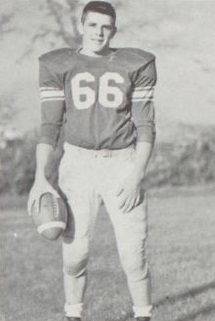
Yatchak’s team had included 13 returning lettermen including four regulars. Dick Koski, winner of 12 varsity letters at Wakefield, was much of the reason for the success. At season’s end, he was named to the Detroit Free Press’ Class C all-state team backfield. He netted 943 yards from scrimmage and finished as the third-highest scorer in the U.P. with 106 points. Teammate Jerry Bugni earned honorable mention recognition.
(Koski would go on to star at Northern Michigan College, then coach high school ball, guiding Ontonagon for three seasons and then Negaunee for 31 more. He retired following the 1999 season with a 211-113-1 record).
Despite the perfect mark, Wakefield finished the season ranked No. 7 in Class C-D by United Press International in its 1958 season-ending prep ratings. Charlevoix was the leading vote getter in the classification according to UPI’s panel of 21 top high school coaches. The Barber Trophy again went to Menominee. Wakefield, which finished second in the voting, was one of five undefeated U.P. teams that year.
A loss in the final 60 seconds of play, again to Ironwood, was the single flaw on the Cardinals’ 1959 slate. The team ended the year ranked 10th in the final UPI Class C-D rankings.
State Champs
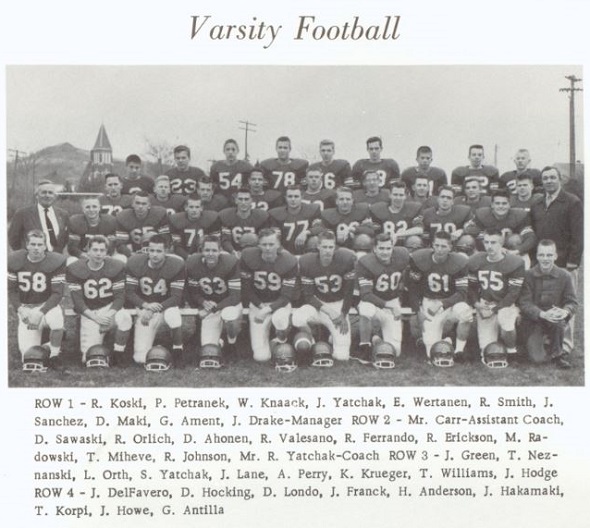
Maki’s favorite, the 1960 squad, included 12 seniors. Ontonagon, winner of one game in 1959, dropped from the schedule, leaving Wakefield with only seven games as the season opened. About a dozen schools in Michigan and Wisconsin had been contacted in an effort to secure an opponent for the early October date. Despite Yatchak’s best efforts, he couldn’t find a replacement.
A Friday night blockbuster kicked off the season. At Longyear Field in Ironwood, a crowd of 3,000 lined the grounds on a warm, humid night for the rematch between the ’59 Michigan-Wisconsin Conference co-champs. Tied at 7-7 at the end of the first quarter, Wakefield opened a 21-7 lead as the teams headed to the locker room for halftime. Ironwood took the opening kick of the second half 11 yards to its 28, and then mounted a 10-play, 72-yard drive for a touchdown. A low kick kept the margin at eight. 21-13.
“Shortly after that the Red Devils were unable to capitalize on two golden opportunities to score following the recovery of Wakefield fumbles,” stated the Globe in its coverage the following day.
Ironwood snagged the first bobble on the Cardinals’ 32-yard line, but Wakefield held firm, allowing only seven yards on four plays: “Ironwood lost a certain touchdown when an end dropped a pass just a few steps from the goal line.”
The Red Devils grabbed the second fumble at the Wakefield 13, but the Cardinals’ unrelenting defense drove Ironwood back to the 17-yard line. An attempted field goal on fourth down sailed beneath the crossbar. From there, “neither team made a serious threat.”
For Wakefield, there were really no other major threats for the remainder of the season.
The Cards topped a strong Houghton 11 on a beautiful sunny Saturday by a score of 20-7 before a home crowd of 1,000. Again, an inopportune fumble by the hosts at their own 21 was snuffed out in four downs by the staunch Wakefield defense.
Next came conference victories over Bessemer, 40-0, Ashland, 20-6, and Hurley, 46-6. The win at Hurley was highlighted by a 50-yard interception return by Bob Orlich and an 81-yard kickoff return for a touchdown by Dewey Maki that opened the second half. Dave O’Leary, Hurley’s signal caller, picked up a Wakefield fumble and streaked 90 yards for the Midgets’ only points in the contest.
With the wins, the Cardinals secured the M-W championship and jumped from third place to first place in UPI’s weekly ratings, replacing Imlay City as the state’s top team in the Class C-D listings.
Despite continued efforts, no opponent could be found for the open date. When the team returned to action in mid-October, it squared off against Iron River. A 61-yard touchdown run by Tom Miheve on the second play of the game opened the scoring. Bob Erickson’s 31-yard TD dash followed. Then Dewey Maki “streaked 58 yards up the middle” in tallying the Redbirds’ third score. Miheve capped the scoring in the fourth quarter, whizzing 57-yards for his second TD as Wakefield grabbed a 27-0 road win before 2,500 at Nelson Field.
“Roman had the same personality traits as Coach Vince Lombardi of the Green Bay Packers. They were clones of one another,” said Russ Maki, describing the coach based on observation and conversations with former players in the years to come. “Yatchak was such a perfectionist. He’d have the players run a play, say an end sweep, over and over, six, seven times, maybe more, until it was perfect.”
The coach yelled and instructed and blew his whistle at afternoon practices audible to residents of the surrounding neighborhood.
“Mothers quickly learned to recognize signs to when practice was wrapping up, and the players were headed for the showers. It was time to cook the roast beef,” added Maki. “Their sons would be home in an hour.”
The season-ending contest with Calumet was a track meet, with the Cardinals steamrolling the Copper Kings 61-7 at Agassiz Field in Calumet on Friday, October 21.
According to the Globe:
 “Shifty Tom Miheve registered three markers, Bob Erickson, power-driving fullback added three more, followed by Dewey Maki, Bob Koski and Tom Neznanski each with a TD apiece. Bob Orlich added three extra points and Miheve, Erickson, Bob Smith and Pete Petramek each posted one.”
Still topping the UPI rankings after the game, now all Wakefield could do was wait for the rest of the state to finish the schedule.
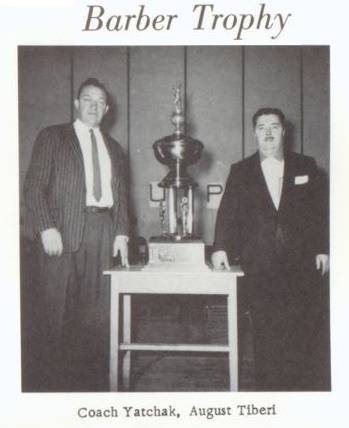
On Saturday, November 5, the Upper Peninsula Sportswriters Association gathered in Iron Mountain and awarded the Barber Trophy to Wakefield. The trophy was presented to Coach Yatchak and captain Bob Erickson at a special assembly at the high school on Monday.
The Cardinals had ranked No. 35 in Hal Schram’s Top 50 teams in the state, regardless of size, published in November in the Detroit Free Press. It was an impressive accomplishment for the little U.P. squad, especially when one considered 675 schools in Michigan sported prep football teams.
It would take until after Thanksgiving weekend – more than a month – before the UPI coaches panel would announce its final poll.
Word finally appeared in print in the SHORTS IN SPORTS column in the December 1 edition of the Wakefield News, which was published weekly.
“Congratulations this week go to: Wakefield Cardinal football team for being named top Class ‘C’ team in Michigan by United Press International.”
The city with a population of 3,231 celebrated its first (and only) mythical state football championship.
The annual Fourth of July parade included a red flatbed truck, adorned with an ornamental goal post and a large banner that read “State Class C Champs.” Four players, dressed in their uniforms, stood on the bed, carrying footballs.
Yatchak’s 1961 team extended the win streak to 14 games (and 25 wins in 26 dating back to 1957) with victories in its first two games before falling to Bessemer in a heartbreaker, 13-7. It would be the only loss of Wakefield’s seven-game season.
Following the 1961-62 school year, Yatchak departed Wakefield to help develop the athletic program at newly-opened Lansing Waverly High School. His Cardinals teams had posted 90 wins and two ties over his 15 years in charge, against only 25 losses.
Changing landscape
The coming years saw plenty of regular-season success, but no team would match the accomplishment of the 1960 squad. Mythical state titles, where state championships were determined by press polls and media input, were replaced in 1975 by MHSAA championships decided by postseason play.
“The Sunday Lake mine closed in 1961. They employed 225 guys. It was a big deal,” recalled Maki. Between the mine’s first shipment in 1885 and closing, Sunday Lake had raised an estimated 17 million tons of ore. Between 1960 and 1970, Wakefield’s population plunged by nearly 15 percent to 2,757. “A lot of people left for mining work elsewhere in Michigan, Wisconsin, Minnesota, Arizona.”
Maki himself made honorable mention all-state in 1970 as a senior when the Cards went 6-2 with losses to Hancock and Hurley.
“Dick Koski had a brother who was the same age as me. He was as good as Dick, maybe better. The Koski family left. There’s no doubt in my mind that we would have won some basketball state titles, maybe another Barber Trophy if they stayed. You just don’t know.”
The Gogebic area did see its fortunes improve, but the reprieve wouldn’t last.
“White Pine, a little town about 35 miles northeast of Wakefield, had a small copper mine. Digging deeper they found new veins of copper. All of sudden, they (needed workers). I remember five charter busses would line up near the football field each morning to take people to work there. That was happening all around the area.”
“Of the more than 3,000 workers at White Pine Copper Mine, less than 1,000 live here,” noted the Ironwood Daily Globe in September 1971. “Many workers commute great distances – some up to 90 miles each day.”
 However, uncertainty and layoffs began in 1975 and 1976. Employment dropped in half or more. In 1995, the mine shut down completely.
Wakefield’s 1991 football team was the first to qualify for the MHSAA postseason and won its opening-round contest with Central Lake before falling to Lake Linden-Hubbell in Class DD. The 1998 and 2000 teams also qualified.
Dropping student enrollment was impacting athletic programs at schools across upper and lower Michigan, including at Wakefield. Between 1985 and 2003, enrollment had fallen from 225 to 100. Following the 2003-04 school year, Wakefield consolidated with Marenisco, a district located 15 miles southeast. Still, for a variety of reasons, enrollment continued to drop. In 2009, Wakefield-Marenisco entered a co-op with Bessemer for football, and that fall, the Gogebic Miners were formed. Past rivals became teammates.
The rivalry with Hurley had been resurrected in 2000 and continued through the 2017 season. That school year, Ironwood joined the co-op, supplied the football schedule and its home field for the games.
In 2018, games were played at Bessemer. With enrollment now determined by combined school totals, the Wisconsin schools on the Gogebic schedule were replaced with games against Negaunee, Ishpeming Westwood and Iron Mountain, each with similar-sized enrollments.
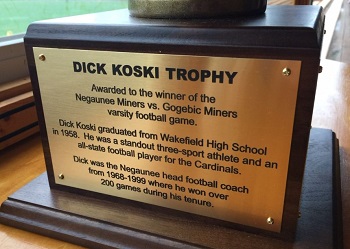
The Dick Koski Trophy, a new entry in the state’s collection of rivalry hardware, also was created in 2018. Awarded annually to the winner of the Negaunee-Gogebic game, it celebrates Koski’s connection to Wakefield and Negaunee.
This season, home contests are staged at Ironwood. In 2020, the games are scheduled to move to Wakefield.
Celebration
Maki hopes a lesson in history may help inspire future kids, so he’s been doing his homework.
“They have banners honoring conference champions,” he said.
If all goes as hoped, a new banner could be unfurled in time to celebrate the 60th anniversary of the 1960 championship.
“I am scheduled to speak at the next Wakefield school board meeting in late October to try to get this team some recognition such as a pennant to hang in the gym,” added Maki, also noting a desire for a public dedication, perhaps during Wakefield’s annual Independence Day celebration. “A lot of people come back to watch the fireworks.”
Now, wouldn’t that be a blast!
Ron Pesch has taken an active role in researching the history of MHSAA events since 1985 and began writing for MHSAA Finals programs in 1986, adding additional features and "flashbacks" in 1992. He inherited the title of MHSAA historian from the late Dick Kishpaugh following the 1993-94 school year, and resides in Muskegon. Contact him at [email protected] with ideas for historical articles.
PHOTOS: (Top & 5) The 1960 Wakefield team is celebrated in the school’s yearbook for the 1960-61 school year. (2) An Ironwood Daily Globe advertisement announced a local store would guarantee a ham to every Wakefield player for a win over Hurley in 1929. (3) Roman Yatchak and Vernon Carr led Wakefield to its greatest football glories. (4) Dick Koski starred on the field for Wakefield before becoming a legendary coach. (6) Wakefield earned the Barber Trophy as the Upper Peninsula’s best team of 1960. (7) The Dick Koski Trophy is awarded annually to the winner of the Negaunee/Gogebic football game. (Photos gathered by Ron Pesch.)