

'Refuse to Lose' Divine Child Set Tone for Teams to Come with 1st Class B Title
By
Brad Emons
Special for MHSAA.com
November 15, 2024
There was no more conjecture, no newspaper or Associated Press polls to determine the state football champions.
The champion was no longer decided on paper, but out on the field as the MHSAA launched its first playoff tournament in 1975.
Only 16 total teams over four classes were invited to the dance.
And a school with an already a rich football heritage in Dearborn Divine Child proved it on the field with a 21-0 win over Saginaw MacArthur in the Class B title game before 4,000 fans at Central Michigan University’s Perry Shorts Stadium in Mount Pleasant.
In the Semifinals, MacArthur had outlasted Flint Ainsworth, 44-38, as senior halfback Mark Neiderquill rushed for 285 yards and four touchdowns, while Divine Child ousted Sturgis, 20-3.
In the frigid championship final on Nov. 22, the Falcons’ defense held MacArthur’s high-octane offense to seven first downs and 74 yards rushing. They caused three turnovers, with two fumble recoveries and an interception leading to all three of their TDs.
“I thought we could move the ball, but MacArthur was tough,” DC coach Bob LaPointe told the Detroit Free Press.
In the second quarter, Pat Doyle returned an interception 28 yards for a TD, and Mike Surmacz added the PAT for a 7-0 Divine Child advantage.
 “That first interception really got us rolling,” LaPointe said. “Doyle can run the 40 in 4.9 and speed is what made that touchdown. But he got good blocking, too.”
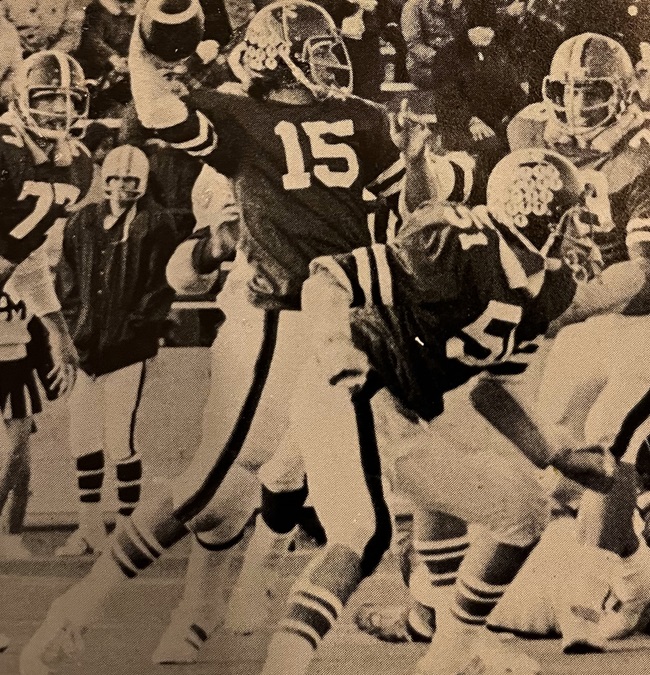
Two minutes later, Mike Wiacek gave DC another scoring opportunity when he recovered a MacArthur fumble at the Generals’ 24. Nine plays later, senior quarterback Dan Faletti swept right end and scored on a three-yard bootleg for a 14-0 lead.
“The big thing is that they had a good running back that we had to make sure we kept under control,” said Faletti, who went on to play at Eastern Michigan University before a neck injury prematurely ended his career as a sophomore. “We pretty much got the lead, and Bob was conservative. I just remember scoring that touchdown, and my picture made the paper the next day.”
Neither team could move the ball in the third quarter. There were no first downs.
All-stater Mike Svihra then picked up a fumbled lateral in the fourth quarter and ran 10 yards for the game’s final TD.
“It was not a lot of offense; it was a bitter, cold day,” said Faletti, who went on to work for the Department of Defense for 20 years and Ford Motor Co. before recently retiring. “Bob LaPointe ran a conservative offense. We did ball-control, we didn’t put tons of points on the board ... we didn’t fumble the ball. We didn’t throw interceptions.”
The game, ironically, was played on AstroTurf, not on real grass.
“Everyone makes a bit deal of it, but there really isn’t that much difference,” LaPointe added afterwards. “The only thing I regretted about this game was that I could dress only 44 of my 56 players under the rules. It was tough (to) tell the other 12 they couldn’t suit up.”
An 18-12 loss to Madison Heights Bishop Foley during the final regular-season game, spoiling what would have been an undefeated season in 1974, had left the Falcons distraught – but even more galvanized as they made preparations for the 1975 campaign.
The Falcons also changed their offense in 1975, switching to a triple-option attack that LaPointe got from Notre Dame. The offense proved to be good enough for a 9-0 regular season and an MHSAA playoff berth.
“We were an underdog the whole thing, the whole time, we were the underdog in every big game we played in, but we didn’t allow people to beat us,” said Wes Wishart, who coached the linebackers and offensive line that season before taking over the head coaching reins for the Falcons from 1978-95. “We refused to lose, and that was the motto. From ’74 on those group of kids said, ‘We refuse to lose.’ You use that phrase as a coach all the time, but this group of kids lived it. They were the ones that invented it. When things got tight, ‘refuse, refuse, refuse.’ We’re not backing off from anybody. Great group of young men, great players.”
 During the regular season, DC earned victories over highly-touted Flint Powers Catholic (20-14), previously unbeaten Southgate Aquinas (26-12) and Allen Park Cabrini (12-8).
That set up a Catholic League Prep Bowl showdown in the final game of the regular season against highly-touted 8-0 Birmingham Brother Rice, which was ranked No. 1 in the final regular-season AP Class A poll.
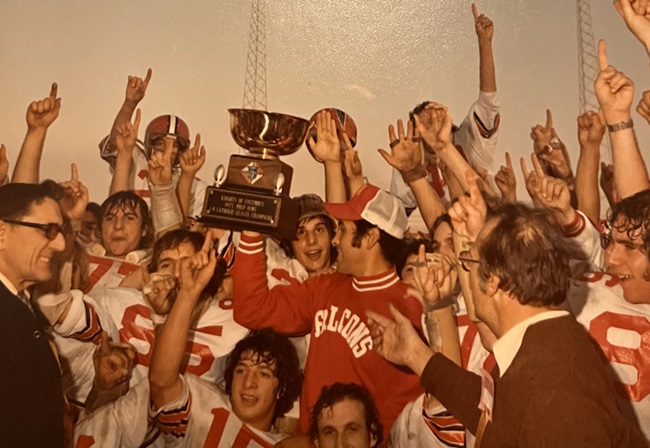
Although the Falcons were a decided underdog, the AA division champs upended Rice, 7-0, before a packed crowd at Eastern Michigan University’s Rynearson Stadium to snap the Warriors’ 22-game winning streak thanks to Jim Kempinski’s fumble return for a seven-yard touchdown as he snagged the ball in mid-air and never broke stride while crossing into the end zone.
“We played our butts off,” Faletti said. “It was a dog-eat-dog game.”
It was DC’s 11th Catholic League title, but more importantly put the Falcons into the first MHSAA Playoffs against Sturgis in a Semifinal match at C.W. Post Field in Battle Creek.
“I remember everything was brand new; nobody knew what they were doing,” said Wishart, who guided the Falcons to the 1985 Class A crown as their head coach. “Coach LaPointe on Monday had to get the school to get our hotel rooms in Battle Creek.”
Steve Toepper booted a 27-yard field goal for Sturgis to open the scoring, but DC responded with 20 unanswered points.
In the final quarter, DC’s Rick Rogowski scored on a seven-yard run with 9:23 left (after Steve Savini recovered a fumble caused by Joe Wiercioch) followed by a 10-yard TD run by Faletti with only six minutes to go (after Svihra recovered a fumble).
That sent the Falcons into the Final at CMU, where their defense suffocated MacArthur (9-2).
“We kind of ran a special outside zone. We had to quickly change (how) we would defend that. We shut them down,” said Wishart, who spent 50 years in CYO and high school coaching before retiring to live in New York. “There was no doubt, we were more physical than they were. We were blue collar kids. Typical Divine Child kids, hard-working, never give up.
“We believed desperately in defending Divine Child at all costs because we were a smaller school, so we had an attitude that still lingers there today that we all cultivated. We were going to be a physical squad.”
Meanwhile, what made the Falcons special and unique that title season was their “one for all and all for one” attitude.
“Everybody was the same,” Faletti said. “When we went between the lines, we were all equal. As captain, I got to be command as quarterback in the huddle. But off the field we were all equal. We played like 22 seniors. We were ready for this game.”
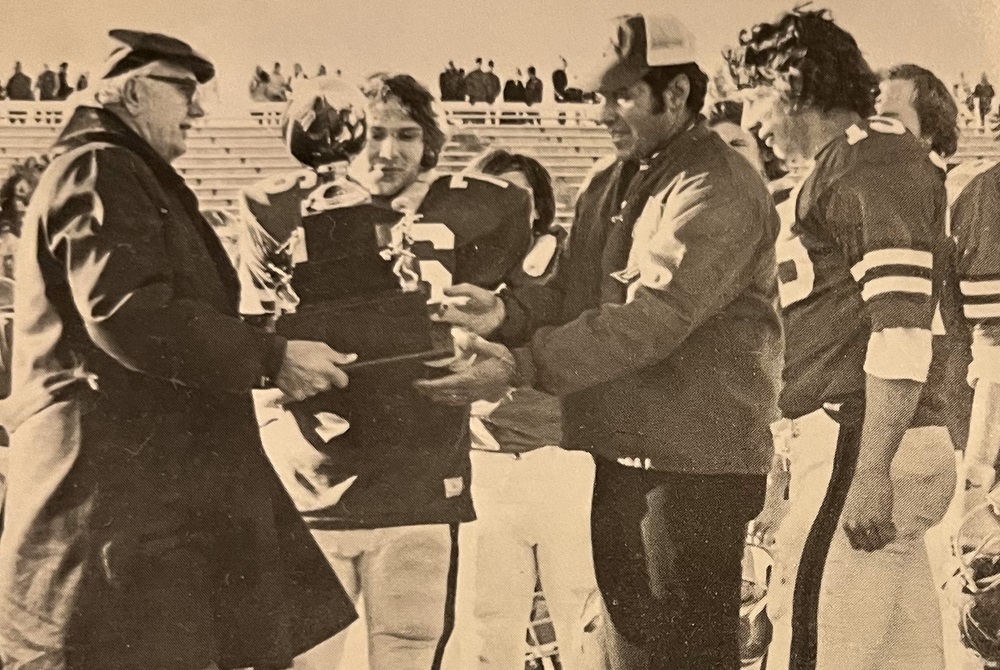
PHOTOS (Top) Dearborn Divine Child coaches and players receive the Class B championship trophy after winning the inaugural title game in 1975. (Middle) Falcons quarterback Dan Faletti throws a pass during the Final. (Below) Divine Child players and coaches raise their Prep Bowl trophy in celebration. (Championship game photos courtesy of Dearborn Divine Child yearbook. Prep Bowl photo provided by Dan Faletti.)
Notre Dame Prep Seniors Leave Legacy in Leading Irish to Historic Heights
By
Keith Dunlap
Special for MHSAA.com
December 11, 2025
DETROIT – Understandably, Pontiac Notre Dame Prep head football coach Pat Fox couldn’t even get the words out before getting choked up.
 At the start of the postgame press conference following his team’s 42-14 loss to Grand Rapids West Catholic in the Division 5 championship game Nov. 30, Fox tried to introduce several members of a historic senior class.
Then, the reality set in that he wouldn’t get to coach them again.
“I love my kids, and it’s hard to say goodbye,” Fox said while fighting back tears.
With a Division 5 championship last year and a runner-up finish this fall, Notre Dame Prep has likely established itself as a perennial contender with such a great foundation laid during Fox’s 12 years at the helm.
But to Fox’s point, it certainly will be hard for future players at the school to top the standards set by this year’s senior class.
Notre Dame Prep had never advanced to an MHSAA Final before the last two years and wasn’t a program known for sustained playoff runs.
“They were (32-5) as a group,” Fox said, referring to the team’s combined record the last three years.
What made it even harder for Fox was that he has known those seniors since they were starting kindergarten at the school.
Fox recited a story about how quarterback Sam Stowe, who threw for more than 5,000 yards combined over the last two seasons, took something from his sister during a holiday concert at the school when they were young kids, and Stowe’s sister tried tackling him to get it back.
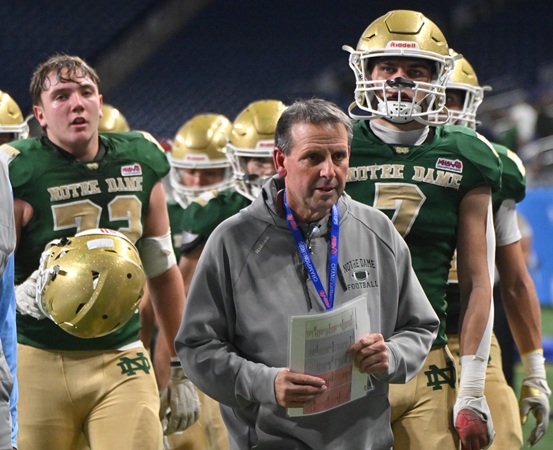 Standouts such as linebacker Brody Sink, who has signed with Miami (Ohio), wideout Drake Roa, running back Ben Liparoto, and linemen Henry Ewles and Jack Williams also have been in the building with Fox for seemingly their whole lives and last year helped deliver Fox and the school their first Finals championship.
“I’ve known all of them since they were little boys,” Fox said.
Sink said if there was a turning point where the seniors knew they could help take the program to heights never before attained, it came when they were sophomores.
“My sophomore season, we had a great team, a great quarterback and great players,” Sink said. “We ended up losing to a really good Corunna team (in a District Final). But I didn’t hang my head. I knew we’d come back next year. We had a great (senior) class coming back last year and knew it would be something special for the next two seasons. We stayed the course, and it was a very special last two years.”
After going 9-1 two years ago, Notre Dame Prep went 12-1 last fall and 11-3 this season.
Through it all, the group became heroes to younger kids in the school, who regularly came up to them in the halls to say congratulations or just chat.
“It’s pretty cool,” Stowe said. “I used to be that kid too, looking up to all the Notre Dame Prep quarterbacks. To be that guy, you have to appreciate it and I’m totally humbled to be in the spot where I’m at today.”
Fox did say that before the senior class arrived at the varsity level, the program was “knocking on the door for a while” of becoming a state power, citing a close loss in Districts to eventual Division 4 champion Detroit Country Day in 2020 as one example.
Ultimately, it was this senior class that busted through that door, and now Fox hopes those younger players will take the torch and keep the program among the best in the state.
“You would hope they do,” Fox said. “But every year is different and every challenge is great. We have great kids.”
 Keith Dunlap has served in Detroit-area sports media for more than two decades, including as a sportswriter at the Oakland Press from 2001-16 primarily covering high school sports but also college and professional teams. His bylines also have appeared in USA Today, the Washington Post, the Detroit Free Press, the Houston Chronicle and the Boston Globe. He served as the administrator for the Oakland Activities Association’s website from 2017-2020. Contact him at [email protected] with story ideas for Oakland, Macomb and Wayne counties.
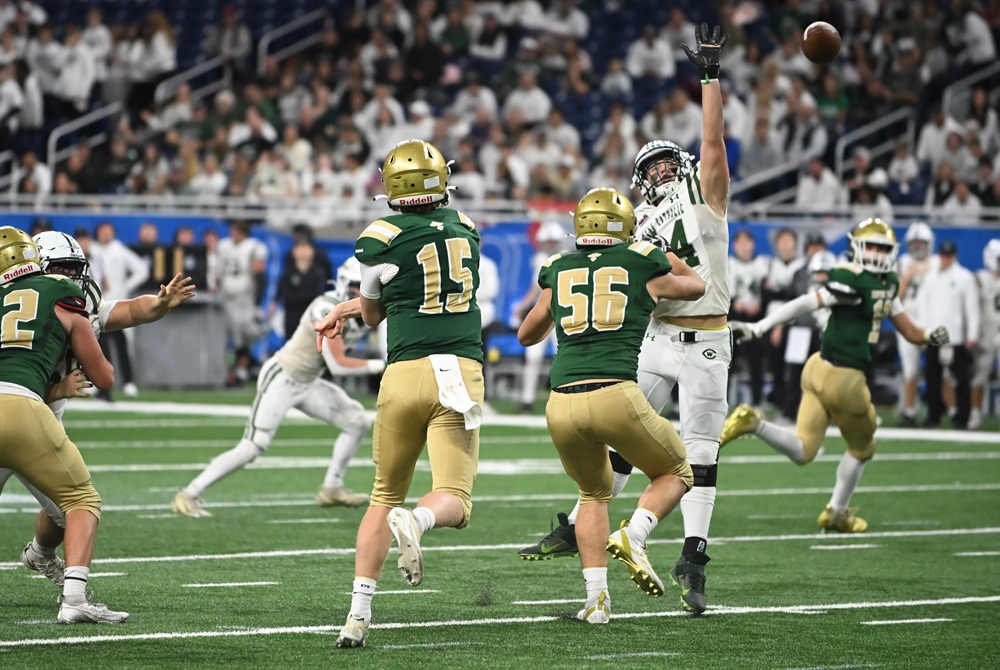
PHOTOS (Top) Pontiac Notre Dame Prep quarterback Sam Stowe (15) throws a pass during the Division 5 Final while protected by lineman Adrian Fernandez (56). (Middle) Fighting Irish coach Pat Fox leads his team – including Henry Ewles (72) and Brody Sink (7) – off the field.