

Repeat-Minded North Central Rolling with Playoffs Approaching
By
John Vrancic
Special for MHSAA.com
October 22, 2021
POWERS — Eighteen and counting.
 That’s the number at which North Central’s football winning streak stands after taking a forfeit victory from Gogebic last weekend.
The reigning 8-player Division 2 champion, however, has bigger fish to fry.
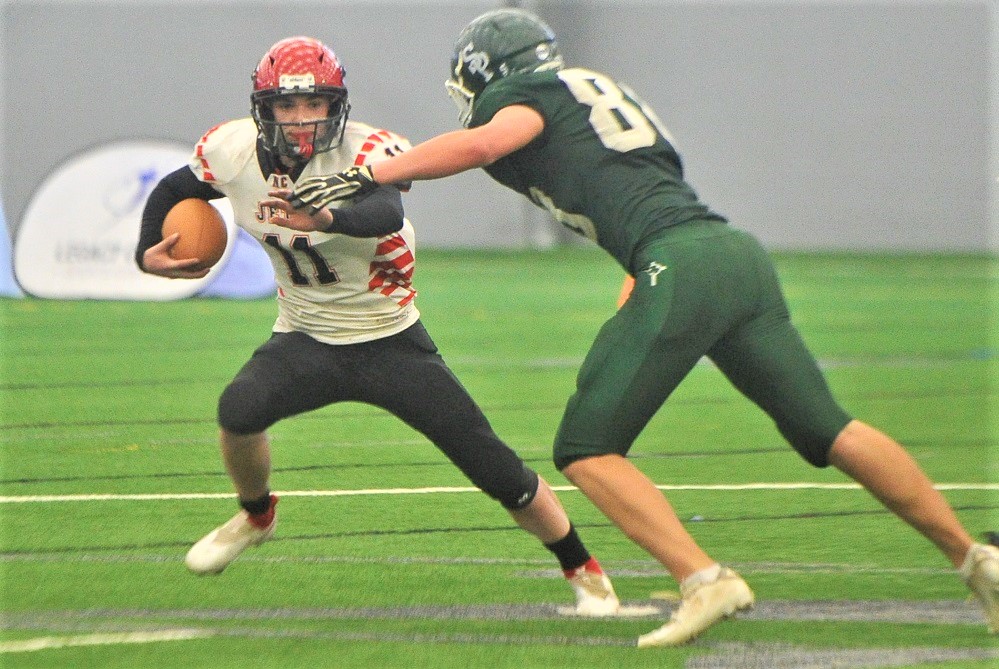
“The winning streak is something you don’t focus on,” said junior quarterback Luke Gorzinski, who pulled his hamstring in a 71-6 rout of Ontonagon on Oct. 8 but has returned. “First we have Forest Park, then we have the playoffs. It feels great to be back on the field. It feels like I’m part of the team again.”
The Jets naturally hope to retain their title, but know they must first turn their attention to tonight’s regular-season finale at Crystal Falls Forest Park.
North Central (8-0) finished 10-0 last season after defeating Portland St. Patrick 70-48 in Division 2 Final on Jan. 16.
“We try to look at it as if we hadn’t won a state championship yet,” said senior lineman Lane Nehring. “We don’t want to get too comfortable. We still have Forest Park. We’re not close in distance, but we have a rivalry going. Both of us have good teams.”
What has been the key to North Central’s success on the field?
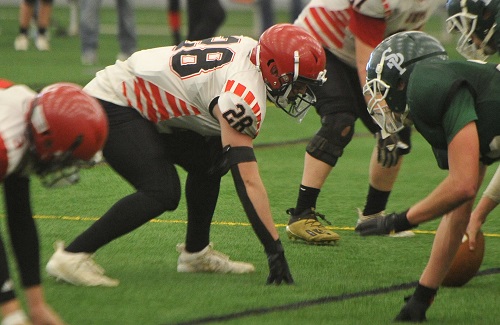 “I think it’s our D line play,” said Nehring. “We work together and communicate. Ontonagon’s hook-and-ladder play caught us off guard. They scored on that play, which was bit of a wake-up call for us. Everybody looks at you to be a contender. We definitely have pressure on us to win another one.”
Off the field, coach Leo Gorzinski believes offseason work also has been key to the Jets’ success.
“The kids are invested,” he said. “They bought into the system and know what’s expected of them here at North Central. The interest in our program is there. The kids stay up, which makes it a little easier to keep them focused.
“We have a few people dinged up. We’re very fortunate to have a lot of depth. We have a couple people down who are key players.”
North Central is averaging 63 points per game, and its defense has allowed just 13 points this season. The Jets held Stephenson to minus-seven yards of total offense in a season-opening 46-0 win.
“You feel on top of the world right away,” said Luke Gorzinski. “You also have to be ready to play right away. It’s a good way to open the season, but any team can beat any other team on any given day or night. Stephenson has a good team. You can’t take any team for granted.”
No team is exempt from adversity, and the Jets will verify that.
They lost senior Alex Naser for the season Oct. 8 due to a hairline fracture below his right kneecap.
“I couldn’t have asked for a better year,” he said. “I’m going to stay on the sidelines and help as much as I can. I’ll be giving the guys a few pointers. It’s a little disappointing to not be able to play, but it’s all part of football.”
The Jets are taking this as a reminder of the importance of depth.
“Other guys have been involved in our offense,” said Coach Gorzinski. “They know what they need to do. We may not be as explosive as we were before, but we should still have an efficient offense.”
 John Vrancic has covered high school sports in the Upper Peninsula since joining the Escanaba Daily Press staff in 1985. He is known most prominently across the peninsula for his extensive coverage of cross country and track & field that frequently appears in newspapers from the Wisconsin border to Lake Huron. He received the James Trethewey Award for Distinguished Service in 2015 from the Upper Peninsula Sportswriters and Sportscasters Association.
PHOTOS (Top) Luke Gorzinski (11) eludes a Portland St. Patrick defender during last season’s Division 2 championship win at Legacy Center in Brighton. (Middle) Wyatt Raab (28), another star of last season’s Final, is again a standout for the Jets.

Drive for Detroit: Finals in Review
November 27, 2012
Champions representing five regions of our state. The fifth to win three-straight MHSAA titles. Two more repeat champions, and three teams that hoisted trophies for the first time. Plus four games decided by a touchdown or less, including a Final won on an overtime field goal.
The 2012 MHSAA 11-Player Football Finals gave us just about everything this weekend at Ford Field.
Second Half covered all eight games, with links to each below followed by some of the most notable record performances and a handful of stories we’ll remember long after the helmets and pads are put away.
Finals in Review
D1 – Detroit Cass Tech 36, Detroit Catholic Central 21 – This was closer than the 2011 championship game matchup between the teams. But it played out similarly because the Technicians were simply too speedy and broke off a number of big plays. Cass Tech quarterback Jayru Campbell added another touchdown pass to the five he threw in the 2011 Final. Click to read more.
 D2 – Birmingham Brother Rice 35, Muskegon 28 – There weren't many firsts left to accomplish in coach Al Fracassa’s 44 seasons leading Brother Rice, but the Warriors accomplished another with their first back-to-back titles under the state’s winningest football coach. The wrinkle that ended up deciding the game was a cross-field lateral on a kick return that turned into a touchdown with 2:13 left to play. Click to read more.
D3 – Grand Rapids Christian 40, Orchard Lake St. Mary’s 37 (OT) – Record-setting performances by St. Mary’s running backs and Eagles receiver Drake Harris capped the weekend and sent this thriller to overtime. See more on those below. Joel Shipper kicked a 28-yard field goal with four seconds left in regulation to send the game to the extra period, and after St. Mary’s didn't score in overtime he nailed a 27-yarder for the win. Click to read more.
D4 – Grand Rapids South Christian 40, Detroit Country 7 – With back-up quarterback Derek Woltjer moving over to fill in for injured standout Jon Wassink, the Sailors opened up the run game a bit more after being mostly a passing offense this fall. Woltjer responded by leading his team to its first title since 2002. Click to read more.
D5 – Portland 12, Grand Rapids West Catholic 9 – After defeating reigning champion Flint Powers Catholic along the way, the Raiders beat the 2010 champion too thanks to a defense that held on long enough after the offense scored twice early. The Raiders had played in one of the first Semifinals, in 1975, but had never played in a championship game. Click to read more.
D6 – Ithaca 37, Constantine 27 – In a repeat of last season’s Final, Ithaca again beat Constantine for the championship. The Yellowjackets extended their win streak to 42 including the last three titles, and this time did so with a back-up quarterback in Logan Hessbrook after all-stater Travis Smith went out with an injury on the team’s first possession. Click to read more.
D7 – Ishpeming 20, Detroit Loyola 14 – This qualified as the biggest upset of the weekend, as Loyola came into the game undefeated and ranked No. 1. But the Hematites, despite a sizable size disadvantage, never let that be a deciding factor in going on to win their first MHSAA title since 1979. Click to read more.
D8 – Harbor Beach 35, Beal City 10 – Despite losing its top player for the season on opening night, Harbor Beach marched on to its first MHSAA championship. The Pirates set the tone quickly with two touchdown passes of at least 50 yards in the first quarter. Click to read more.
Records report
A total of 24 entries – 16 for individuals and eight for team accomplishments – have been added from the weekend’s games to the MHSAA record book Finals section. Below are some of those that ranked highest on the lists. Click to check out the entire Finals record book.
 Scoring at will: Well, not quite. But in the Division 3 Final, Orchard Lake St. Mary’s and Grand Rapids Christian combined for a Finals record 1,033 yards, with St. Mary’s setting the single-team Finals mark of 579 total yards and tying the most first downs with 29. Most came on the second-most rush attempts in a championship game, 65, for 459 yards on the ground. Parker McInnis ran for the fourth-highest total by one player, 269. Grand Rapids Christian had the fourth-most passing yards, 307 by quarterback Alex VanDeVusse. Drake Harris broke the championship game record for receiving yards by 39 with and incredible 243, and his kicker Schipper tied the record for most field goals with two.
Go long: Teams threw the third and fourth-longest passes in MHSAA Finals history, both for scores. In the Division 1 Final, Campbell hit Jourdan Lewis for an 89-yard touchdown pass that was the third-longest for a few hours. That afternoon, in the Division 5 Final, Portland's Tanner Allison connected with Auston Brandt for a 94-yard scoring strike. Brandt finished with the fifth-most receiving yards for a Final, 178.
In the long run: Cass Tech’s Kenton Gibbs tallied the third-longest fumble return, 58 yards, for a touchdown against Detroit Catholic Central. Birmingham Brother Rice’s Jason Alessi had the fourth-longest kickoff return, 91 yards, after taking a cross-field lateral and returning it for a score against Muskegon.
Stories behind the scores
The streak: Ithaca became just the fifth team to win at least three straight MHSAA championships, a streak that began with the Yellowjackets’ first Finals appearance in 2010. Farmington Hills Harrison (1997-2001) and East Grand Rapids (2006-10) are tied for the longest title streaks at five seasons.
The repeats: Both Detroit Cass Tech in Division 1 and Birmingham Brother Rice in Division 2 won titles for the second straight year. The Technicians made their first final in 2011, while the Warriors now have won eight championships.
The first-timers: Harbor Beach in Division 8, Portland in Division 5 and Grand Rapids Christian in Division 3 all won their first championships – Portland and Christian in their first Finals appearances. Harbor Beach had played in one other championship game, in 1991.
 No stopping Drake: Although final season stats are being confirmed, it’s fair to say Grand Rapids Christian receiver Drake Harris completed the finest receiving season in MHSAA history. His eight catches for 243 yards and a touchdown in the Division 3 title game put his season totals at 91 catches for 2,015 yards and 25 scores. The yardage is the most in MHSAA history for one season by 119 and would rank 12th nationally for one season (his yards per game rank fourth and yards per catch sixth on the NFHS lists). Harris, who has committed to Michigan State, also ranks fourth for catches in one season and second for touchdown catches on the MHSAA lists.
The replacements: South Christian's Woltjer and Ithaca's Hessbrook probably aren't the names most had associated with their schools. But the back-up quarterbacks – who also started at other positions – moved over to run the show and led their teams to championships. Woltjer, usually a starting flanker and cornerback, ran for 136 yards and two touchdowns and completed all seven of his pass attempts for 88 yards and two more scores – while also making four tackles and intercepting a pass. Hessbrook, also a starting defensive back, ran for 113 yards and two scores and threw for 104 yards and two more TDs and also made four tackles.
Coach’s last stand (?): It was tough to tell from Brother Rice coach Al Fracassa’s remarks after his team’s Division 2 title win if he would return in 2013. But the 80-year old legend would leave with an MHSAA record for wins and a career record of 416-117-7.
Dedication fulfilled: There has been much sadness in the Ishpeming football program over the last two years, with the death of coach Jeff Olson’s son and former Hematites quarterback Daniel Olson, the death of current quarterback Alex Briones’ older brother and former player Derrick and the death also of youth player Christopher Croley in October. Those memories surely weighed on the players’ hearts and minds as they upset top-ranked Detroit Loyola in the Division 7 Final to give the Upper Peninsula its first champion since 2007.
Go to MHSAA.tv for replays of all eight 11-Player Finals and the 8-Player Final at Greenville High.
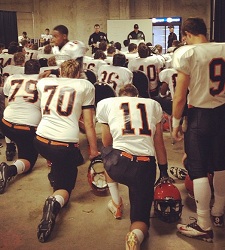
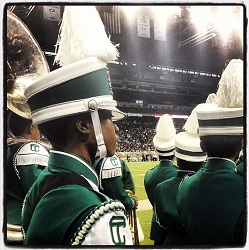
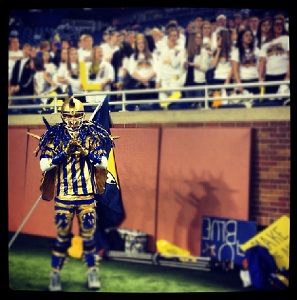
PHOTOS: (Top) Eight champions celebrated MHSAA titles over Friday and Saturday at Ford Field. (Click to see more from Terry McNamara Photography). (Middle top) Brother Rice players listen to their coaches during halftime of the Division 2 Final. (Middle) A Cass Tech band member prepares to take the field during the Division 1 Final. (Middle below) An Ithaca fan roots on his team in a costume made of Duck Tape, (Click to see more like the middle photos on the MHSAA Instagram page.)