

In Return to Finals, Edwardsburg Reigns
By
Tom Markowski
Special for Second Half
November 23, 2018
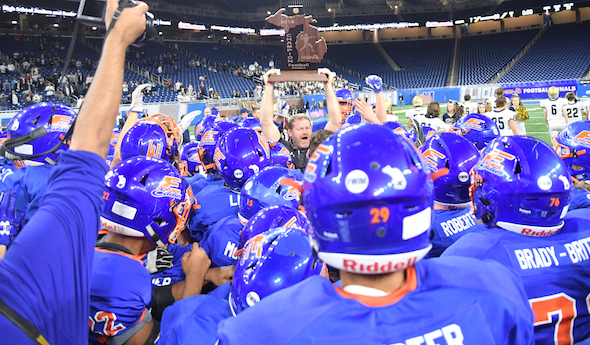
DETROIT – Edwardsburg finished the deal on Friday, erasing much of the disappointment the final game of last season produced.
Although the Eddies’ offense was slow to jell, they controlled the clock and Chelsea’s multi-faceted attack to capture their first MHSAA Finals championship in any boys sport with a 28-7 victory in the Division 4 title game at Ford Field.
Edwardsburg has one other MHSAA title to its credit – the girls volleyball team won Class C in 1977.
“This is a huge moment for the program,” Edwardsburg coach Kevin Bartz said. “Last year was more of a surprise. Beating a good River Rouge team, we were just happy to be here. They were more focused this year and not getting involved with all of the hoopla.”
Edwardsburg defeated River Rouge, 32-21, in a Semifinal last season and then lost to Grand Rapids Catholic Central, 42-31, in the Final. Last week, the Eddies avenged that defeat, downing GRCC 46-44 in overtime in their Semifinal matchup.
The Eddies (14-0) entered this championship game averaging 48.5 points per contest this fall and had scored 196 during the playoffs. But Chelsea (10-4) was up to the task early, and its defense gave the team a chance at winning would have been its first football championship as well.
But an underrated unit is Edwardsburg’s defense. The Eddies have five shutouts to their credit this season, and their defense kept this game close until the offense got untracked.
“You hear a lot about our offense,” Bartz said, “but it was our defense that won the game.”
Mistakes, a missed field goal attempt and a failed fourth down try kept the scoring to a minimum in the first half.
Chelsea stopped an Edwardsburg try for a first down on 4th-and-1 at the Eddies’ 34, but the Bulldogs couldn’t take advantage of the fine field position as Bryce Blue intercepted a Chelsea pass in the end zone.
That turnover set up Edwardsburg’s lone touchdown of the first half, as Caden Goggins scored from five yards out. Isaiah Mitchell’s conversion run gave the Eddies an 8-0 lead with 1:53 left in the first quarter.
Chelsea came back on the next possession and scored on a four-yard touchdown pass from Quinn Starkey to Hunter Neff, who made a one-handed catch in the left corner to complete the play. Starkey was 3-of-3 passing for 50 yards on the 64-yard drive.
 The teams exchanged turnovers in the middle of the second quarter, and Chelsea couldn’t capitalize on a good scoring opportunity late. The Bulldogs drove from their 40 to the Edwardsburg 3, but a three-yard loss and an incomplete pass produced a bit of a dilemma for Chelsea coach Josh Lucas. He decided to go for the short field goal from the 6, but it missed to the right with 20 seconds left. Edwardsburg clung to an 8-7 lead at the break.
There were just two possessions in the third quarter, and only Edwardsburg made good on its opportunity.
The Eddies took the second half kickoff and drove 83 yards in 12 plays. Mac Gaideski, on his only carry of the drive, scored on a five-yard run. Quarterback Tre Harvey’s conversion run gave Edwardsburg a 16-7 lead with 6:39 left.
Chelsea used up the rest of the quarter, but its drive stalled at the Edwardsburg 32, and third and fourth down passes were incomplete.
Edwardsburg’s first drive of the fourth quarter didn’t produce any points, but it was just what Bartz wanted. His team burned 6:31 off the clock and pinned the Bulldogs on their 15.
Chelsea did not make a first down on its next drive, and the Eddies put the game away as Harvey ran five yards around right end for a touchdown and a 22-7 lead with 3:10 left.
“I came back with a vengeance this year,” Harvey said. “I wanted it. (Chelsea) came out strong in the beginning. They’re a good team. We preach playing strong in the third and fourth quarters. We definitely wear teams down.”
Edwardsburg rushed for 382 yards on 50 carries. The Eddies did not complete a pass in two attempts, but that’s not unusual for a T-formation team that prefers physicality at the line of scrimmage over big pass plays.
“The running backs deserve the credit,” Harvey said. “They’re the ones carrying out the fakes.
“We came in here not so much in awe as last year. I might have stared at the ceiling here too much a year ago.”
Goggins led Edwardsburg with 125 yards on 15 carries, and Chase Segar had 119 yards on 14 attempts.
For Chelsea, Starkey was 16-of-27 passing for 178 yards and one touchdown. The Bulldogs were held to 69 rushing yards.
“All of the credit goes to the line,” Sager said. “They made the holes. We had a mindset after last year. We weren’t used to the atmosphere then. I think now people will know where Edwardsburg is (located). We’re making them pay attention.”
Edwardsburg is located in the southwest part of the state, by the way.
PHOTOS: (Top) Edwardsburg celebrated earning its first MHSAA Finals championship in any boys sport Saturday at Ford Field. (Middle) Eddies linebacker Drew Bidwell brings down a Chelsea ball carrier.
As Football Launches Again, Reeths-Puffer Fueled for Fresh Start
By
Geoff Kimmerly
MHSAA.com senior editor
August 9, 2021
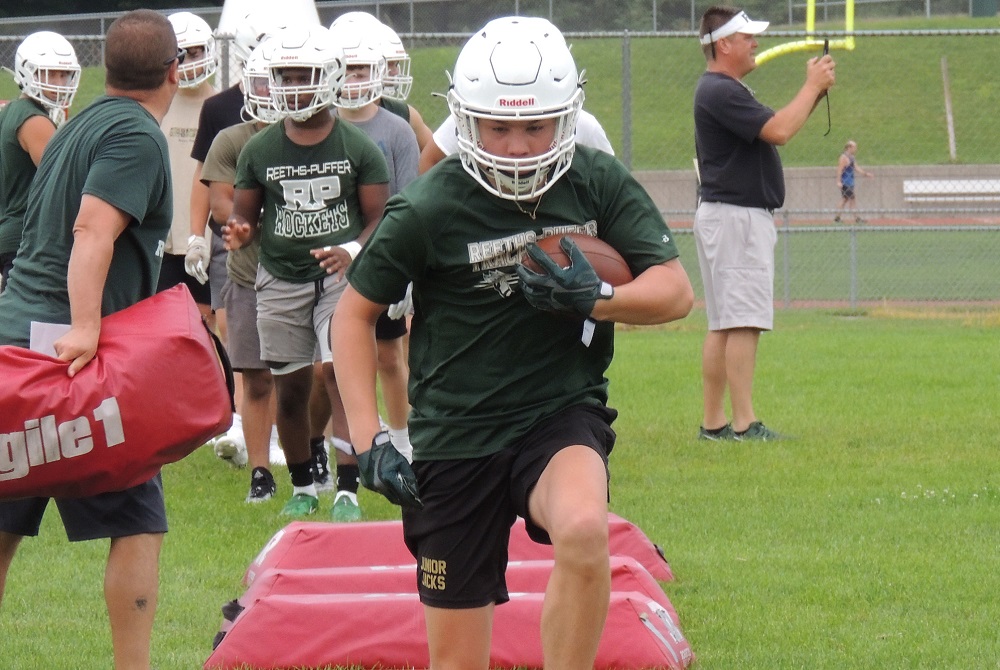
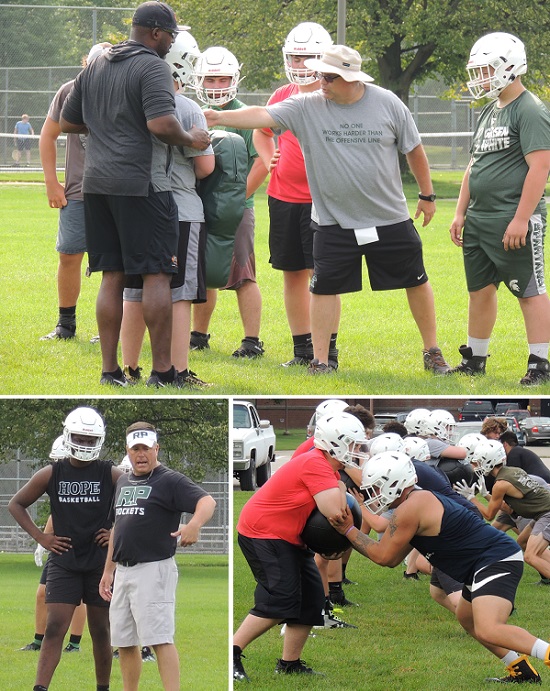
MUSKEGON – A Reeths-Puffer running back tripped and plowed into the Kit Kat-shaped bags he was supposed to be hurdling Monday, and his teammates laughed. The offensive line coach wore a shirt, like line coaches always do, that read “No One Works Harder Than The Offensive Line.” The sun came out about halfway through, but the breeze kept the weather just right, and after a hands-in, all-together “R-P!” someone shouted, “I’ve missed that!”
The setting was as typical as could be for the first day of football practice at any high school across Michigan over the last many years … except for 2020.
Remember a year ago? When COVID-19 precautions meant little to no contact for the most contact-filled sport? When locker rooms were closed and footballs were wiped down after every snap? And the possibility of the season ending at any moment hung in the air?
“I was telling the team (last year) we could play our first game and the rest of the season could get canceled, so you don’t know,” Rockets senior lineman Marco Fields recalled. “The seniors only got to play half their season, and some got hurt.
“Now that we know we have a full senior season ahead of us, for us seniors, all we can do now is stay focused.”
 Indeed, although there’s little debate that COVID-19 is still lingering, just about everything Monday at Reeths-Puffer felt differently from the first day of football practice a year ago. And although varsity head coach Matt Bird thought he might have an answer to what remained the same from 2020 … he really didn’t.
“The same is … (searching for his thought)
“… that you are … (pause)
“Kids … (trailed off)
“Actually, I don’t feel that anything is the same,” he admitted. “Other than we have a football, and we have some things involved from that standpoint.”
Monday marked a fresh start for high school football across Michigan, after last season included multiple COVID-related delays before finishing up in late January – which followed also an abbreviated regular season during which the conversation was forced at times into much more serious topics than the highlights on the field.
But every first day of practice means starting anew. And when it comes to fresh starts, Reeths-Puffer is a great place to begin Fall 2021.
Start with Bird, something of a master when it comes to building from a clean slate.
Way back in 2000, he was an offensive assistant when Grand Ledge won the Division 1 championship, the only Division 1 title that’s been won by a Lansing-area team. Six years later, he took over the Comets program and debuted with back-to-back 3-6 seasons (which predictably didn’t go over too well) before rattling off 10 winning seasons over the next 12 including a Semifinals trip in 2015. That eventually led to a rarely-seen career move after the 2018 season – leaving an established power for a new challenge, as Bird took the Reeths-Puffer job and took on a program that was coming off a second-straight 5-4 finish but accomplished with just under 30 players on the roster.
Bird led his first Rockets team to another 5-4 finish in 2019 … and then 2020 hit. Reeths-Puffer finished 2-5, but all things considered there were plenty of positives to take away.
When practice started, Bird was just finishing up recovery from COVID-19. And despite the unpredictability the season promised, the varsity still managed to grow to 53 players.
“As a coach you have to acknowledge it,” Bird said Monday, recalling 2020. “But the thing that is frustrating to me is you want to acknowledge it, but when you look at it everything was done so differently; it didn’t even feel like a season. At times you’d get started, then kicked back, then started and kicked back. We couldn’t do team dinners, we couldn’t do a lot of the bonding things we do as a group, and that hurt us.”
Monday was the beginning of another fresh start for the Rockets. Set aside that the great majority of COVID restrictions are off – the program is still emphasizing a number of hygiene and health-related concepts to help players avoid illness – and the football-related details provide plenty of excitement.
 On one hand, Reeths-Puffer still plays in the Ottawa-Kent Conference Green – which includes the winningest program in MHSAA history in Muskegon High, back-to-back Division 2 champion Mona Shores and powerful neighbors Zeeland West and East. Grand Rapids Union, Holland and Wyoming all provide some intriguing possibilities as well heading into the new season.
But Bird’s varsity roster looks to push past 50 again, with 20 seniors including four returning senior starters on both sides of the ball. Fields is a Division I-caliber college line prospect, and the sophomore class is shaping up to be special with 6-foot-7 Travis Ambrose of particular note.
“I know every coach says their sport is the best team sport, but there’s something about football where you’ve got 11 guys out there and everybody can contribute,” Bird said. “The 6-5 kid to the 5-7 kid, and you can find a way to make that come together. I’ve always been a big fan, where it’s ‘Tell me that we can’t do something, and let me prove that (we can).’ … We compete using our strengths rather than focusing on some of the things that we don’t have.”
And there are lessons learned last season which, despite its wildness, should pay off. For example, last year teams were forced to focus more on technique with contact cut down substantially, and then rely on technology to cut down on face-to-face conversation. On Monday, Bird was recording his quarterbacks’ footwork with a tablet so he could share the video later over Google Meet, the new norm in communication but something Bird considers a valuable teaching tool brought on by the last 18 months.
The players, for their part, could allow themselves to feel a little lighter than a year ago. Fields and his teammates got to have more fun this time. And they were able talk about the expectations and aspirations that always make the first day a special one.
“I’ve heard people are expecting a normal Reeths-Puffer, and some say ‘Rocket failure again,’ which is just us going 2-5 or whatever they’re trying to say,” Fields said. “But I think we’re going to take this thing all the way.”
“This is normalcy, to an extent,” was Bird’s take on the day. “And it’s just really nice.”
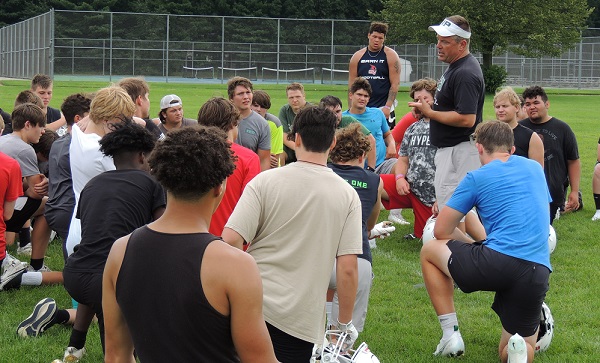
PHOTOS: (Top) Reeths-Puffer running backs hurdle a series of bags during a busy first practice Monday. (Middle) Clockwise from top: Assistant coaches Jari Brown (left) and Jeff Uganski work with the linemen; senior Marco Fields (front, blue sleeveless shirt) is among those working on his form; varsity coach Matt Bird works with one of his quarterbacks and their receivers. (Below) Bird gathers with his team at the end of their first practice of the season. (Photos by Geoff Kimmerly.)