

Rice Sends Out 'Coach' on Winning Note
November 29, 2013
By Bill Khan
Special to Second Half
DETROIT — What do you get the football coach who has everything?
How about a perfect 14-0 season?
Better yet, how about a third straight MHSAA championship as a nice going-away present?
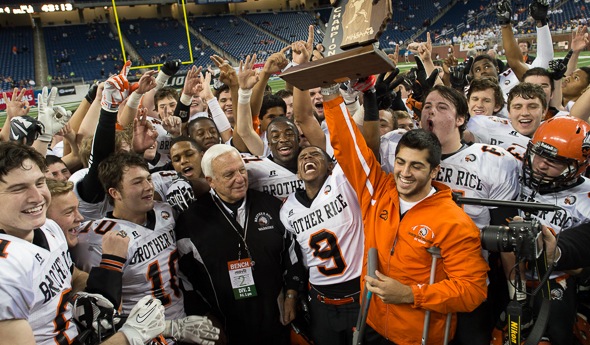
Al Fracassa had accomplished just about everything during his legendary 45-year career at Birmingham Brother Rice, but his final three teams embraced the school's tradition and elevated it to an even higher level.
Brother Rice won its ninth MHSAA title — all under Fracassa — with a 38-21 victory in a rematch against Muskegon in the Division 2 championship game on Friday at Ford Field.
Before this current run, Brother Rice hadn't won back-to-back MHSAA championships. The school record for victories was set by the 2000 team, which went 13-1. The school's last undefeated team was in 1983. The Warriors' 23-game winning streak is one short of the school record set from 1976-78.
"I wish I was young enough to coach some more," said Fracassa, 81. "When you love something so much, it's very difficult to leave. I'm going to still love football; it's done a lot for me."
Fracassa finished his career with a 430-117-7 record, ranking first in Michigan history and sixth nationally in victories. That included eight seasons at Royal Oak Shrine before he was hired as Rice's head coach in 1969.
"I'm glad I made it," Fracassa said. "Now I can rest easy. I'll probably be very sad for awhile, and hopefully I'll be strong enough mentally to handle this."
 Friday's game was such a special occasion that even his wife, Phyllis, was in the stands.
"My wife never comes to games," Fracassa said. "She used to come, but she'd be so nervous that she'd beat everybody up next to her. Today, she came with my daughter, who flew in from Omaha. It was nice for her to see us play and have a great victory. I can't wait to see her."
Whoever takes over at Brother Rice has an excellent chance of extending the Warriors' championship and winning streaks.
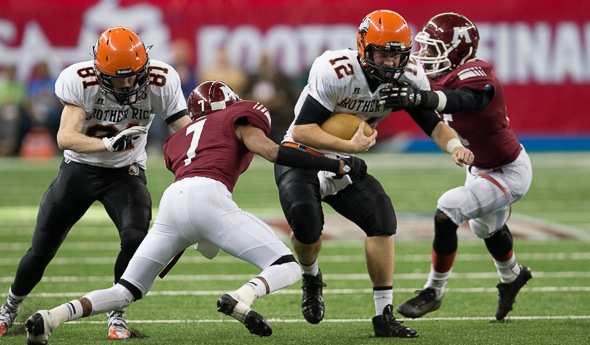
Brother Rice will return junior quarterback Alex Malzone, who has been outstanding in two MHSAA Finals appearances. Malzone completed his first nine passes against Muskegon, finishing 20 for 24 for 263 yards and four touchdowns. In two title games, he is 28 for 34 for 430 yards, six touchdowns and no interceptions. Malzone was in a rotation last year with Cheyne Lacanaria.
Malzone also ran 17 yards as the holder on a fake field goal attempt with 4:33 left in the game.
"For him to go out with what we've done is an overall great feeling," Malzone said. "It's going to be different without him on the field every practice. He's the best coach I've ever had. I'm going to miss him a lot."
Corey Lacanaria caught 10 passes for 125 yards and a touchdown, while Grant Perry had five catches for 91 yards and two touchdowns.
The teams picked up where they left off in their wild finish in 2012, when a 91-yard kickoff return by Jason Alessi off a lateral gave Brother Rice a 35-28 victory.
Last year, they combined for 42 points during the final 13 minutes and 58 seconds after staging a defensive battle most of the way. On Friday, they scored on the first four possessions of the game, creating a 14-14 deadlock with 1:09 left in the first quarter. Going back to last year, that added up to 70 combined points in only 24:49 of playing time.
Malzone started out 9 for 9 for 125 yards and two touchdowns, hitting Damaris Woods with a 16-yard touchdown pass on the first series of the game and Perry on a one-handed 34-yard grab with 4:24 left in the first quarter.
Muskegon responded to each of those scores with touchdown runs by quarterback Deshaun Thrower, whose 6-yard run capped the Big Reds' first drive and whose 16-yarder tied the game at 14-14 on the next possession.
Perry's second touchdown catch, an 18-yard play with 1:07 left in the first half, gave Brother Rice a 21-14 halftime lead.
The key to the game was that Brother Rice shut down Muskegon's ground game after halftime. Thrower ran 12 times for 117 yards and two touchdowns in the first half, leading a rushing attack that piled up 216 yards on 21 carries. In the second half, Thrower was held to minus-18 yards on 10 carries. As a team, the Big Reds had minus-9 yards on 13 carries in the second half.
Muskegon didn't have the ball beyond its 36-yard line in the second half until 3:30 left in the game when Thrower hit Justin Foster with an 86-yard touchdown pass. But by then Brother Rice had extended its lead to 38-14 on a 21-yard touchdown pass from Malzone to Lacanaria and Malzone's 17-yard touchdown run on the fake field goal.
"They changed defenses in the second half," Thrower said. "A couple of missed opportunities set us back. We couldn't get in a rhythm again."
Muskegon has five MHSAA titles, but has been denied a sixth by Brother Rice two years in a row. The Big Reds last won the championship in 2008.
"I'm going to go back and evaluate what we're doing wrong in the championship game," Muskegon coach Shane Fairfield said. "It's my responsibility and my duty to put these kids in the right position and give them a better chance to win a state championship. It must be something I'm doing. These kids played a heck of a game. They fought through a lot. They're tough as nails. They played 28 games for our fans the last two years. There's going to be a winner and a loser. Unfortunately, the last two years we fell on the other end of it."
While Fairfield works on bringing a title back to the state's all-time winningest program, Fracassa will be a spectator while Brother Rice goes for a fourth consecutive MHSAA title in 2014.
"It's hit me the whole season when I'd go home every night," Fracassa said. "I couldn't believe it's going to be my last year. I try not to think about it. Football kept me busy, but it's here. It's time for someone else to take over. I'd like to mention my coaching staff. ... They did an outstanding job coaching my boys. I hate to take all the credit. They coached and did most of the coaching. I did most of the yelling."
PHOTOS: (Top) Brother Rice coach Al Fracassa celebrates one more MHSAA championship with his team Friday. (Middle) Warriors quarterback Alex Malzone tries to break away from Muskegon's Terry Copeland (5) and Jordan Waire (7). (Click to see more from Terry McNamara Photography.)
Zeeland West Rumbles to Another Title
November 27, 2015
By Bill Khan
Special for Second Half
DETROIT — The Zeeland West offensive machine was in good hands the last three seasons with Casey Brinks directing the attack.
 The Dux’ senior quarterback brought two teams to Ford Field during his varsity career, and ended it Friday night helping hoist a second MHSAA championship trophy.
West scored its first of five touchdowns with 35 seconds left in the first quarter and didn't let up from there, pounding its way to a 40-14 victory over Flint Powers Catholic for a fourth championship in 10 years.
"That one (in 2013) was really fun, but this one to me is a lot better, just being a senior and it's my last year," Brinks said. "To end my football career playing on a state championship team in Ford Field is amazing."
Brinks was the starting quarterback as a sophomore when West won its last title, throwing for one touchdown and running for another in a 34-27 victory over DeWitt in the Division 3 championship game. He also led West to the Semifinal round a year ago.
Brinks was one of three Dux who played in the 2013 championship game, the others being running back Dakota Geurink and lineman Zach VanValkenburg. Geurink ran 14 times for 71 yards and a touchdown Friday. VanValkenburg had two sacks among three tackles for losses.
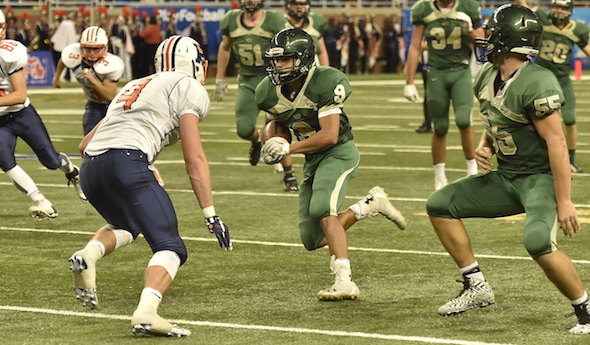
With his team facing fourth-and five near the end of the first quarter, fullback Darius Perisee scored on an 8-yard run for the opening touchdown and then added a 2-point conversion run. He was the top gainer for West's powerful T offense, finishing this season with 1,982 yards and 30 touchdowns rushing.
Brinks doesn't pass often but he was highly effective when he did. He finished 4 for 4 for 103 yards, with three straight completions on the team’s third possession. Tyler Thompson capped that drive with a 5-yard touchdown run, then added a 2-point run to make it 16-0 with 4:03 left in the second quarter.
Powers (11-3) drove to the West 18 late in the first half, only to be denied on the final play before halftime when Brinks picked off a pass in the end zone. He also had an interception in the third quarter, playing defense for only the second time this season.
"I played defense last week for the first time," said Brinks, who ran five times for 45 yards and a touchdown. "Otherwise, I didn't play defense. It was nice to play. Mostly in the playoffs, we've been playing running teams. We've played two passing teams the past two weeks."
 West came into the game running the ball 94 percent of the time and averaging 8.6 yards per carry. Even though Powers knew what was coming, the Chargers were unable to stop the Dux’ power-running attack.
Powers did get a huge stop when Reese Morgan caught Brinks for no gain on fourth-and-three from the Chargers' 5-yard line on the first series of the game, but West went on to score on its next five drives before running out the final 3:55 on its final possession.
"It's just a very deceiving offense they run," Morgan said. "It's hard to know who has the ball."
The Chargers nearly turned the momentum from that first defensive stop into a scoring drive of their own, marching down to West's 14-yard line on their first possession. On fourth-and-one, however, quarterback Noah Sargent came up inches short of a first down with 4:53 left in the first quarter.
"That was tough, but you can't say we lost the game on one play," said Sargent, who ran 17 times for 89 yards and a touchdown while going 12 for 19 for 158 yards, a touchdown and three interceptions through the air. "You've got to play the whole game."
Powers got on the board on the first possession of the second half, scoring on a 15-yard run by Sargent, but a 2-point run by Morgan was stopped by Riley Brinks. With West cashing in on all five of its 2-point conversion tries, the Chargers couldn't afford to miss theirs.
West (14-0) responded with a 13-play, 80-yard march that ended on a 4-yard run by Geurink with 3:14 to go in the third quarter. Following Casey Brinks' second interception, West built its lead to 32-6 on a 2-yard run by Thompson with 10:36 to go in the game.
Luke Brcic caught a 35-yard touchdown pass from Sargent and threw a 2-point conversion to Morgan with 7:28 remaining, getting Powers within 32-14, but Aaron Sleeman recovered the onside kick for the Dux.
Four plays later, West capped the scoring on a 39-yard run by Casey Brinks and Perisee's third 2-point run with 5:13 remaining.
Geurink picked off a pass with 3:55 remaining, and West was able to run out the rest of the clock and celebrate another championship.
"We've won four," West coach John Shillito said. "They're all different, but this one might have been the most complete on both sides of the ball. It's maybe not the deepest team, because we were playing a lot of guys two ways. I looked out there and we looked a little tired at times, because it's warm in here. It's maybe not the deepest (team), but the guys on the field were probably the best we've had."
West was able to score 40 points against a Powers team that had a school-record six shutouts, allowing only 21 points over its first four playoff games.
"I really just figured we had to score every time we had the ball, because no one has really stopped them all year," Powers coach Bob Buckel said. "Playing them, you start doing things you're uncomfortable doing, because you don't want to turn the ball over to them."
Thompson ran 16 times for 117 yards and two touchdowns to lead a West ground attack that had 318 yards and five touchdowns on 55 carries.
Matt Wiskur caught five passes for 70 yards, while Morgan ran 13 times for 61 yards for Powers. Both of them had brothers on the Chargers' 2011 Division 5 championship team.
The MHSAA Football Finals are sponsored by the Michigan National Guard.
PHOTOS: (Top) Darius Perisee breaks free for yardage in leading the Zeeland West rushing attack Friday. (Middle) The Dux hoist a championship trophy for the second time in three seasons.