

Rodammer Stacks 44 Years, 451 Games Tracking Frankenmuth's Football Numbers
By
Steve Vedder
Special for MHSAA.com
September 20, 2024
While Al Rodammer's abbreviated scouting career may have lasted all of one night, it didn't take him long to figure out how he'd spend Friday evenings for the next 44 years.
Rodammer remembers being asked by former Eagles football coach Ralph Munger to drive to Bullock Creek to scout an upcoming playoff opponent. But Rodammer and fellow scout Jeff Reinbold wound up getting lost en route and missed most of the first quarter.
The mix-up didn't sit well with Munger, who "reassigned" Rodammer to a different task: keeping stats for the program.
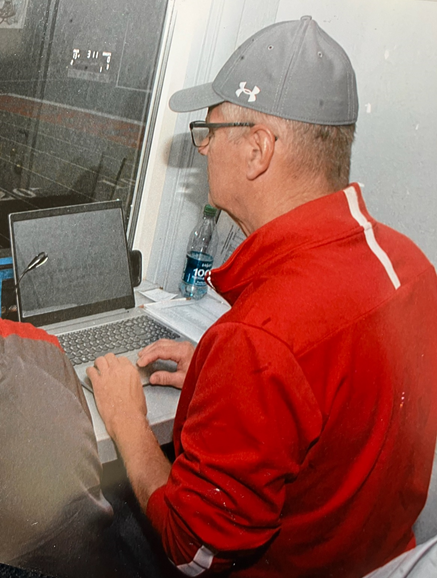
Instead of fretting about the switch, Rodammer, a former baseball and basketball player at Frankenmuth, embraced the move. Four and a half decades later, Rodammer has kept track of virtually every football stat you can imagine for 451 Eagles games. Starting in 1981, Rodammer has dragged, at first, his trusty pencil and paper, and now laptop to hundreds of cramped press boxes, unsteady roof tops, chilly sidelines or whatever dinky corner space may have been available.
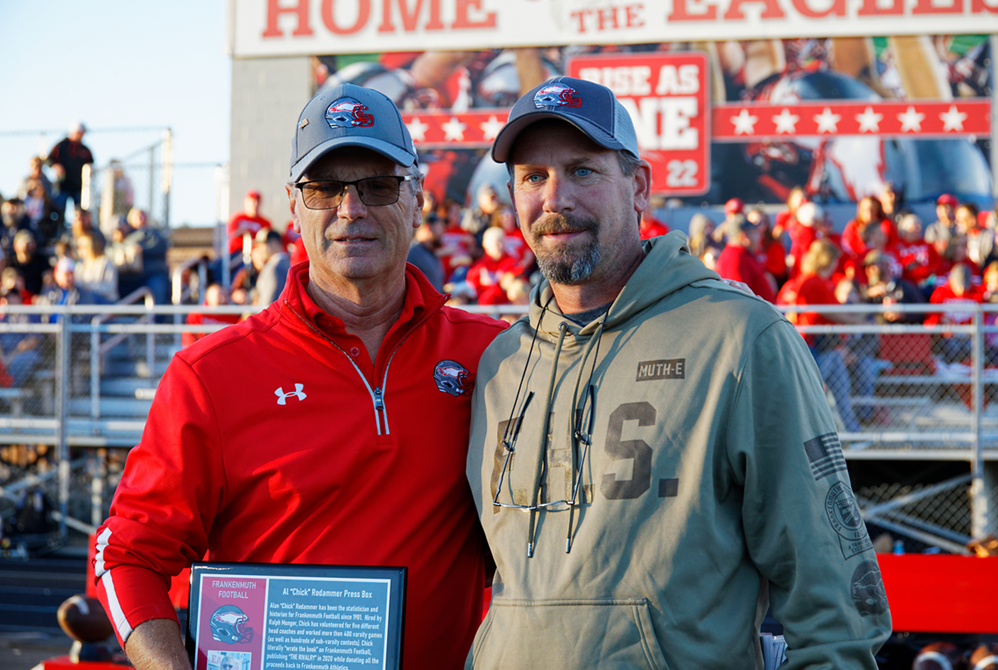
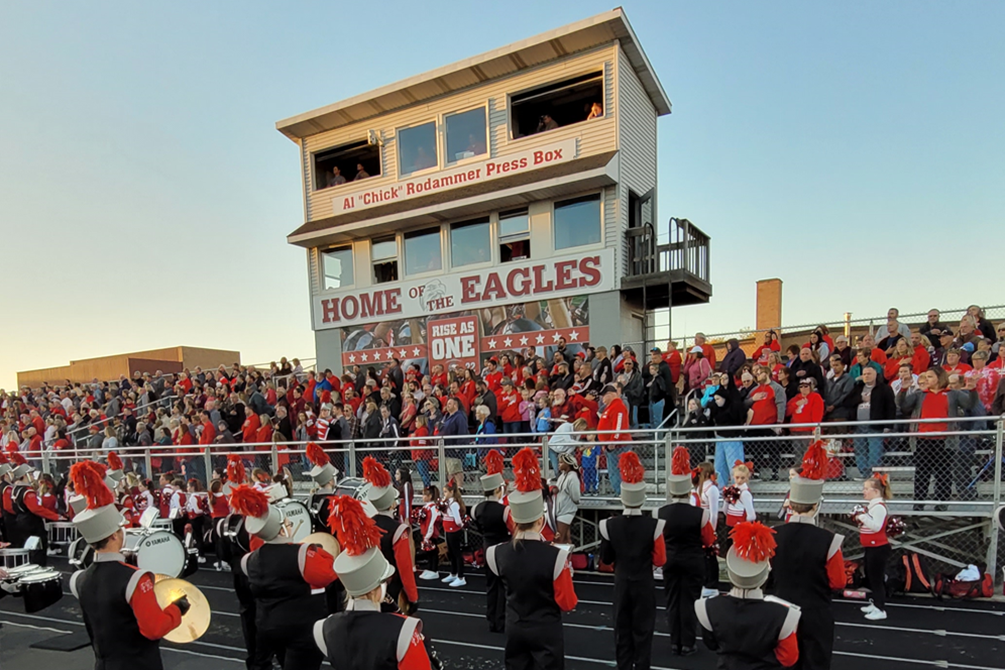
Many people may believe that totaling rushing yards or deciphering passing percentages is a thankless task. The 70-year-old Rodammer, who had the Frankenmuth press box named after him in 2022, prefers to think of his work as a labor of love.
Acting as a bridge between past and present Eagles teams and staying in touch with a community which loves its Friday Night Lights is his way of honoring a highly-successful football program.
 "It's a commitment, but it's also a labor of love," he said. "When they named the press box after me, I thought, "Gosh, I don't know if I deserve this.' I don't do it for the recognition. But when the alumni come back, and to see what the work means to them, that's what I get out of it."
Rodammer's connection with the program far exceeds keeping track of how many passes are attempted or how many yards the Eagles' defense surrenders. He's written two books about the program, including an 82-page history of the Frankenmuth-Millington rivalry. While his initial connection may have been as a failed scout, he's recognized as the program's official historian and leading goodwill ambassador as he's constantly stopped on the street and asked what the Eagles’ chances are for the upcoming season.
One of Rodammer's passions is organizing reunions of past teams, a couple of which included his two sons who played football at Frankenmuth.
When you consider all of Rodammer's contributions to the program, Frankenmuth coach Phil Martin said keeping stats is just a small part of his overall contribution to the program. The data turned in to coaches helps them plot offensive and defensive strategies. But Rodammer's work in writing game stories for community media, digging into archives for long-sought but pertinent information and communicating with past teams is his true value.
"But more than statistics, he's cared for the program for 40-plus years," Martin said. "He's helped tradition and the community in understanding what we have in 69 years of Frankenmuth football."
Rodammer, whose statistics career has covered a half-dozen athletic directors and five head coaches, takes particular pride in not just assembling the typical Friday night numbers, but in putting the long history of Eagles football into perspective. His boundless research of Frankenmuth football has taken him from local libraries to Detroit-area facilities which may contain older stories on the team. He uses that information to ensure the accuracy of his records.
"We've been successful in a lot of athletics like soccer or basketball, but Frankenmuth is a football town," said Rodammer, who added tabulating junior varsity statistics to his resume in 2002. "There's something about football that brings out the community. There are always a lot of older people in the stands who get into it.
"Athletics has a definite impact on the community, no doubt about it."
 Rodammer has missed only four games over his 44 seasons, 28 of which he has been joined by spotter Frank Bender. Two were for weddings, there was one funeral and once the fastpitch softball team he played for was in Minot, N.D., for a tournament. Rodammer is a member of the American Softball Association Hall of Fame.
He admits to being a "numbers guy," who developed programs for the Vassar Building Center before retiring 13 years ago, and he also kept statistics for his softball team for 20 years. Rodammer has his own definition of what numbers mean to him.
"I was only an average student, but there is something about stats," he said. "Yeah, I'm probably a little geekish about numbers."
Making the job easier – if not more fun – has been the wild success of the Frankenmuth program. The Eagles have won 62 consecutive conference games, including 12 league titles. Frankenmuth has been to two MHSAA Finals at Ford Field over the last four seasons. The Eagles have had 14 consecutive winning seasons, been to the playoffs 13 straight years and 29 times since 1987. The team is off to a 3-0 start this season and last week became the 14th program in state history to reach 500 victories.
Such success has left Rodammer with more than a few memories. For instance, he lists the team's 1987 playoff upset of Cheboygan as his personal favorite moment. Cheboygan was unbeaten, but the unraked Eagles prevailed 28-21. He also mentions a 28-20 win over powerhouse Ithaca in 2016 that interrupted a stunning string of Yellowjackets successes during an 118-5 run that included four MHSAA Finals titles and two more runner-up finishes between 2009-17. Another memory is Frankenmuth playing in its first championship game at a near-empty Ford Field due to COVID restrictions in January 2021.
Rodammer is hard-pressed to answer what he'd do with his Friday nights if he wasn't toiling away in a press box at a Frankenmuth football game. Maybe he'd work closer with his church, travel to see other local teams play or check off a couple stops toward his ultimate goal – to visit every Big 10 school for a game.
For the moment, at least, skipping a Friday night perched on a rickety chair tucked into the corner of a cramped press box isn't in the plan.
"I have a passion, but I don't do it for recognition," he said of connecting with the Eagles program "I want to keep a commitment from past teams to the present. That's what motivates me.
"I love summers, but every year I can't wait for the fall."
PHOTOS (Top) Al Rodammer, left and Eagles coach Phil Martin take a photo on the night the facility was named for its longtime stat person during the 2022 season. (Middle) The Al "Chick" Rodammer Press Box stands tall before the start of a Frankenmuth game this season. (Below) Rodammer does his work in the corner of the press box. (Top two photos by Chip DeGrace; below photo courtesy of Al Rodammer.)
Cisco Recalled for Jefferson Greatness, Care for Kids & Staff Over Half-Century as Coach
By
Doug Donnelly
Special for MHSAA.com
October 1, 2026
Marc Cisco was a gruff old football coach who was intimidating and set in his ways.
 Not really.
In fact, to those who knew him, Cisco was more like a teddy bear who had passions for good football, watching student-athletes play the game right and spending time with his close circle of friends.
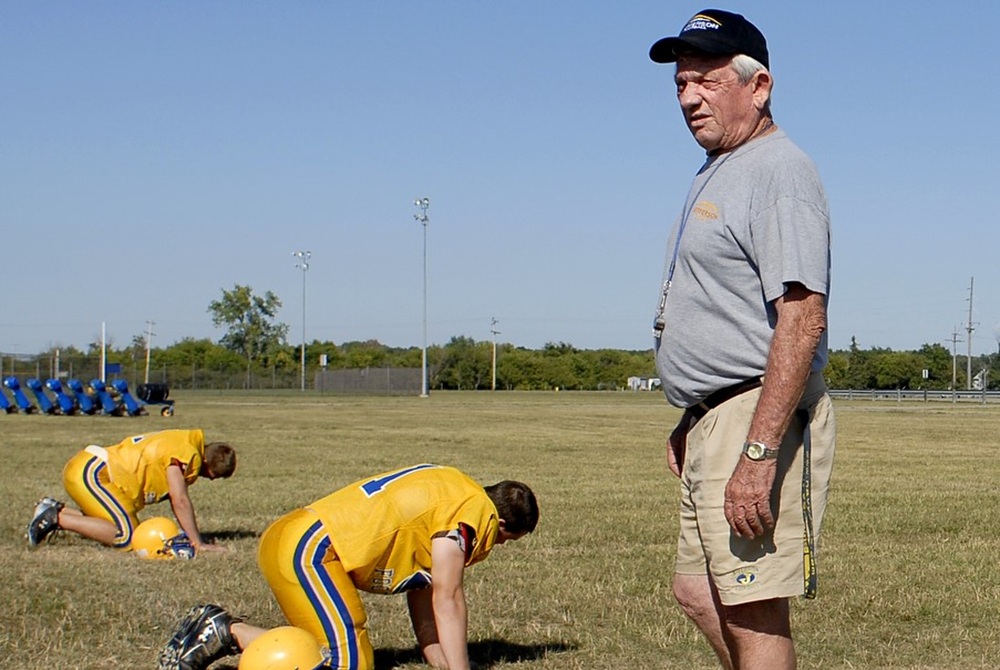
Cisco died Sept. 24 in Grand Rapids at the age of 90, leaving a legacy on high school football in southeast Michigan. He was best known for coaching the Monroe Jefferson varsity football team for a remarkable 47 years. His teams won 241 games, including the 1994 Class B championship in the Pontiac Silverdome.
“It appeared he was this mean old guy. He might yell at you, but he would be the first one to pat you on the back and tell you good job,” said one of his former players, Jeff Potter. “He really cared about his kids and nurtured his players. He was mostly a big teddy bear.”
Cisco made a career in education as a teacher and coach. In addition to coaching the Jefferson football team for 47 years, he coached track & field for almost as many seasons.
His son, Zeke, played for his father and was the Jefferson quarterback. Later, Zeke was a walk-on at the University of Nebraska. When Zeke was away at college and would come home for a visit each May, he would volunteer to work at the Jefferson Invitational track meet because that’s where he would find his dad.
“He was just a coach,” Zeke said. “My childhood was all about sports. If I wanted to see him in the fall, I had to go to practice. If I want to hang around with him in the winter, he kept score at basketball games, so I would go to the basketball games. He kept the scoreboard during wrestling meets. I usually would sit under his legs, underneath the scorers’ table. I would hit him in the legs a lot because he would get bored and forget to add the score on.
“He was nestled in the fabric of the high school in every way, shape or form.”
Niles Kruger, sports editor at The Monroe News, said when Zeke was at Nebraska, Marc Cisco was usually one of the first coaches every Friday to call in his stats and scores because he would be jumping in a car to drive to watch his son play.
“He was one of my favorite postgame interviews because he was always the same, win or lose,” Kruger said. “He was quite a character and pretty good at cussing. He would always say afterwards, ‘Clean that up for me.’”
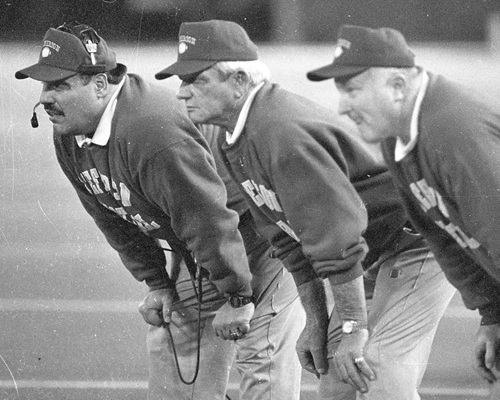
Cisco had a tremendous relationship with his assistant coaches. Several members of the Jefferson coaching staff were there for at least 40 of Cisco’s 47 years.
“His vacations, his fun things to do, were always with other coaches, their wives and their families,” Zeke Cisco said. “They would get together for card nights. They would go to Toledo Raceway (harness racing) Park. Pretty much every coach’s driveway, roof and deck were all built by the other coaches on the staff. They took care of each other.”
Cisco’s legacy includes an extended coaching tree filled with former players. Zeke has built a very successful program at Byron Center. Jason Gendron is the Gibraltar Carlson coach and in the middle of a tremendous run with the Marauders. Potter has coached at Ida for a decade and made that program a playoff regular.
“He was a big part of why I became a coach,” Potter said. “He was like a second family. My dad coached with him for 40 years. He was my Godfather. Our offense now is pretty much the same offense we ran in high school.”
Cisco had spent time in Florida after retiring but made his home in Reading near the Michigan-Indiana border the last few years.
“He would drive up to our games on Fridays,” Zeke said. “He would be in the parking lot at 3 o’clock.”
Marc had health issues over the last year, suffering from a stroke and congestive heart failure. He took a turn for the worse a little more than a week ago. He and his wife Donna, also a former coach at Jefferson, were together for more than 56 years. She survives.
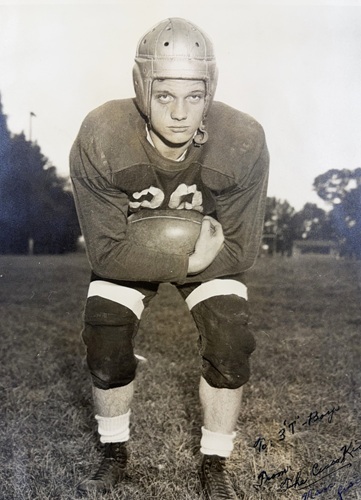
Marc Cisco was a legend long before he started blowing the coaching whistle. Growing up in Morenci, he earned 16 varsity letters – four each in football, basketball, baseball and track – before graduating in 1954. The Bulldogs football team won 44 straight games during his career, and he made The Associated Press all-state team three times.
Larry Tuttle, the winningest baseball coach in Michigan high school history, was a student at Morenci when Cisco was a player.
“I never missed one of his games because my mom and dad would go to all of them,” he said. “Later on, we became good friends. He was such a great football player.”
Cisco played football at Michigan State University under head coach Duffy Daugherty and later at the University of Toledo.
He got his teaching start at Britton Macon High School in Lenawee County, before moving closer to the banks of Lake Erie and Jefferson in 1961.
It was 1963 when Cisco first coached Jefferson, leading the varsity to a 4-3 season – the first of three straight winning campaigns. The tide turned in 1966 when Jefferson went 0-6. The team won seven games over the next three seasons before Cisco stepped down.
He regained the job in 1973 and stayed until 2012. He was the Bears’ varsity coach 41 years in all. From the time his 1983 team went 9-0 until the mid-2000s, Jefferson was a model of consistency, producing winner after winner. The 1993 team went 10-1, the 1994 team 12-1, and the 1999 team 11-2. It was the 1994 Bears that won the Class B title.
Zeke Cisco said when his father retired, it was rather unceremonious. There was no big announcement or celebration, although the school had much earlier renamed the football and track stadium after him.
“He just sort of stepped away,” he said. “He would come up here and watch his grandsons play.”
Marc Cisco never took himself or his wins too seriously.
“You know, I used to always give him hell,” Zeke said. “I'd call him and go, oh, ‘It's the winningest coach Monroe County.’ He goes, ‘I'm also the losingest coach in Monroe County.’”
 Doug Donnelly has served as a news and sports reporter at the Adrian Daily Telegram and the Monroe News for 30 years, including 10 years as city editor in Monroe. He's written a book on high school basketball in Monroe County and compiles record books for various schools in southeast Michigan. He is now publisher and editor of The Blissfield Advance, a weekly newspaper. E-mail him at [email protected] with story ideas for Jackson, Washtenaw, Hillsdale, Lenawee and Monroe counties.
PHOTOS (Top) Marc Cisco coaches his Monroe Jefferson football team. (Middle) From left, John Castiglione, Cisco and Dave Potter monitor the action at the Silverdome during their team’s 1994 Class B Final. (Below) Cisco, while starring at Morenci. (Jefferson photos courtesy of the Monroe News. Morenci photo courtesy of Larry Tuttle.)