

Romeo Raises 1st Champion's Trophy
November 28, 2015
By Bill Khan
Special for Second Half
DETROIT — With a championship on the line and the margin for error too thin, Paul Hurley couldn't have been faulted if he started looking elsewhere to throw the football.
 But Romeo's senior quarterback never lost faith in tight end Mitch Heimbuch, not even after the Western Michigan University recruit dropped two passes while wide open.
"Mitch probably has the best hands on the team, so it was really bizarre for us to see him drop two passes today," Hurley said. "It was never in my head when I was throwing to him. I knew if I was throwing to him, he was catching it."
Heimbuch was sure-handed when it mattered the most, catching three passes for 46 yards on the game-clinching drive, as Romeo beat Detroit Cass Tech, 41-27, in the MHSAA Division 1 championship game Saturday at Ford Field. Heimbuch even grabbed the 2-point pass following Brad Tanner's 16-yard touchdown run with 1:29 remaining in the game.
"Everyone still believed in me. Everyone was still coming up to me telling me to just get over it, forget about it," Heimbuch said. "I just knew I had to make a play if it came back to me. I forget my drops. You can't think too much on them or else they'll kill you."
Romeo scored six touchdowns, blocked a punt and recovered an onside kick to start the second half, but one of the key plays in the Bulldogs' first championship victory was a 12-yard catch by Heimbuch on second-and-13 on the second play of the final drive. That set up a manageable third-and-one and got the drive rolling. He also had catches of 12 and 22 yards on an 11-play, 75-yard march that consumed 5:45 from the clock, leaving Cass Tech little time to produce a miracle comeback similar to Detroit Martin Luther King's in the Division 2 Final on Friday.
Just when it looked like Romeo (13-1) would simply run out the clock, Tanner broke free from 16 yards out for his third touchdown of the game. He finished with a game-high 130 yards on 13 carries.
The drive began after a 36-yard touchdown pass from Aaron Jackson to Donovan People-Jones got Cass Tech within 33-27 with 7:15 remaining.
"I knew I just had to run hard on the play and good things would happen," Tanner said. "On that last drive, the whole time I knew if we just killed the clock, we'd be victorious."
Even before his three key catches on the final drive, Heimbuch made a major contribution to the victory on defense.
He blitzed Jackson and got a sack to force a fumble, which was recovered by Romeo's Austen Malczewski at the Cass Tech 40 with 10:36 left in the second quarter. Four plays later, Tanner's second touchdown run from 31 yards out gave the Bulldogs a 19-7 lead.
"We changed the call at the last second to a two-linebacker blitz," Heimbuch said. "It just opened up. The D-linemen took away their guard and center. I shot the gap. He just lost the ball; he panicked, I think."
Romeo scored on its first three possessions before Heimbuch's first drop on third-and-seven ended the fourth drive. The Bulldogs took that 19-7 lead into halftime.
Taking a page out of Sean Payton's book from the New Orleans Saints' Super Bowl victory in the 2009 season, Romeo's coaches called for an onside kick to start the second half. Kicker Zach Nies recovered his own kick at the Cass Tech 48-yard line. Six plays later, Domenico Bongiorno bulled his way 10 yards up the middle for a touchdown, extending Romeo's lead to 26-14 with 9:49 left in the third quarter.
"They have unbelievable return guys, so we were not supposed to kick it to them at all," Romeo co-coach Curt Rienas said. "We actually thought there was a 70-percent chance we would recover it. When you look at only a 15-yard difference in field position, we thought that was a good gamble on our part."
Recovering onside kicks was a priority in practice all week for Cass Tech (11-3) after it failed to cover three in its Semifinal victory over Canton.
 "That really ticked me off the most, out of anything that happened today," Cass Tech coach Thomas Wilcher said. "As far as trick plays or big plays, that one hurt the most, because we taught the kids what to do. We talked about it, met about it; they just froze. We lost three onside kicks, so that was the most important thing going into the game, just making sure we got all the short kicks."
Special teams had another huge impact when John Verellen blocked a punt and Anthony Quas returned the loose ball 18 yards to the Cass Tech 20. Hurley scrambled for a 20-yard touchdown on the next play, putting Romeo ahead 33-14 with 7:00 left in the third quarter.
One day after Detroit Public School League rival King rallied from 18 points down to win the Division 2 title, Cass Tech provided the host city some hope for another miracle comeback.
Jackson threw a 17-yard touchdown pass to Demetric Vance with 2:14 left in the third quarter, following a Khalid Jordan interception, and a 36-yarder to People-Jones with 7:15 remaining to make it a six-point game.
It was only the second start for Jackson, a sophomore who took over in the Semifinal game when junior starter Rodney Hall was injured. Jackson finished 19 for 27 for 194 yards and two touchdowns Saturday.
"These two starts have really been a big confidence booster for me," Jackson said. "I have a great offense, a great defense. I really love my teammates. These great athletes right here did this; I played a really small role."
Jackson wouldn't get the ball back until Romeo had run the clock down to 1:29 and added eight more points to the deficit.
People-Jones caught eight passes for 85 yards and a touchdown, with his first seven catches going for nine yards or fewer.
"They tackled great," the highly-recruited junior receiver said. "They rallied to the football, which made it harder to escape and make big plays."
To win its first championship, Romeo had to knock off three teams that combined for five of the last six Division 1 titles.
The Bulldogs opened the playoffs by ending Clarkston's two-year reign, 28-14. In the Regional Final, they beat a Detroit Catholic Central team that won the 2009 championship and was runner-up three years in a row from 2011-13. Romeo completed the journey against a Cass Tech squad that won the 2011 and 2012 championships.
It was only the second MHSAA championship for the school, the other won a year ago by the volleyball team.
"The Romeo community was a sea of red," Romeo co-coach Jason Couch said. "I would like to see if anybody else brought as many as Romeo did. If they did, I applaud them. The community shut down. They were here. Businesses were closing. That just shows the support.
"The reason they come out and support the boys is because they're busy in the offseason and in season supporting them with community service and doing other events and activities throughout the community. That's why we graduated from Romeo and we're back in Romeo; it sucks you in. We're proud to be Bulldogs."
The MHSAA Football Finals are sponsored by the Michigan National Guard.
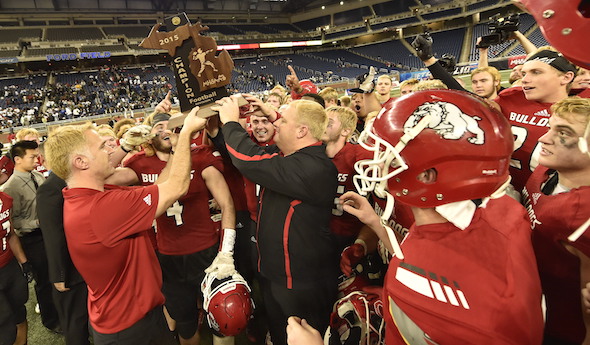
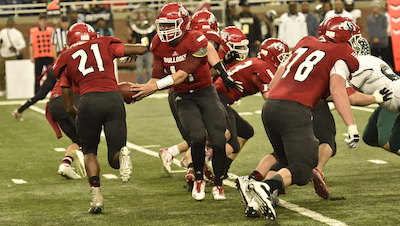
PHOTOS: (Top) Romeo’s coaches and players host their first football championship trophy Saturday at Ford Field. (Middle) Quarterback Paul Hurley hands off to Bradley Tanner (21) during the Division 1 Final.
Dock Putting Dad's Coaching Lessons to Work as Middleville TK Continues Climb
By
Steve Vedder
Special for MHSAA.com
November 3, 2025
MIDDLEVILLE – Denny Dock can't pinpoint the exact moment he thought his football-loving son would follow him into coaching, but the signs were there all along.
 For starters, there were the countless hours spent tossing a football around the backyard. Or when his young son, Jeff – not even old enough for middle school at the time – eagerly joined other Stevensville Lakeshore coaches watching film on weekends.
Maybe it was all those Friday nights spent trekking along the sideline as a ball boy for Lancers teams. Another clue might have been the Saturday afternoons the two spent together watching college football, or taking in the NFL on Sundays.
When Jeff got older, it may have been how he readily absorbed tips that helped him become a better quarterback in high school and then at Grand Valley State. It could have even been an early, uncanny ability to grasp the importance of fundamentals.
Put it all together, and it seemed inevitable coaching football loomed in Jeff Dock's future.
"That's very fair to say," said Denny Dock, who is 19th on the state's list of all-time winningest football coaches while also the winningest high school softball coach in the country. "The younger years in football were really positive for Jeff, and that doesn't happen all the time. There are negative things that can happen."
While there might have been multiple signs the younger Dock would one day join the coaching ranks, he admits it was far from a done deal. There were thoughts of becoming a biology teacher, a pastor or maybe even an orthopedic surgeon.
But coaching? Even with his father as a classic example of the positive impact a good coach could spread, Dock said it took years for him to eventually land in coaching.
"It dawned on me that there were a lot of all three of those things in being a coach," he said. "Growing up in sports is what I knew, and I ended up developing a passion for it."
That passion is actually the highest it's been in years as his Middleville Thornapple Kellogg football team this past weekend improved to 7-3, continuing the program's first winning season since 2020 and the best fall since the Trojans went 7-3 in 2018. The Trojans defeated Hastings 28-20 in a Division 2 playoff opener, and a win this Friday at Lowell would give Middleville its first District championship since 2001.
Denny Dock coached football at Hartford from 1981-83, Dowagiac from 1984-87, and then Lakeshore from 1988-2013, returning to lead the Lancers for one more season in 2020 and all together totaling a 270-79 career record, 15 league titles and five runner-up MHSAA Finals finishes.
He has kept his hand in football in aiding his son's Trojans program. He's at all the games to add support, critique, advice, strategy, tips on how practices can best be organized and long talks discussing how continual improvement can be furthered.
It's a two-way street as an old football coach who never had a losing season, and is a member of the Michigan High School Football Coaches Association Hall of Fame, can remain invested in the game while his son benefits from three decades worth of experience.
Jeff Dock said his father's real value is his ability to spot from the stands the little things that less experienced coaches may miss.
 "Play calling, how players are used, maybe a little bit about strategy," Dock said.
After playing for his father, Dock said there's no doubt he's transferred the best of what he learned into his own coaching. The older Dock was not only a highly successful football coach, he's compiled a 1,319-345-2 record in softball with eight Finals titles.
Whether it's about football or the philosophy Dock stresses in his softball program, the advice accepted from his father – who still attends softball clinics for tips on improving the Lakeshore program – is virtually across the board. It begins, however, with how a coach should treat his players.
"I was a manager growing up, and I saw his intensity and a love of his players," Dock said. "He never pushed me in any direction, but he told me about education. He always let me figure it out. One of the coolest things my parents did in raising me was to allow me to figure things out."
As far as the Xs and Os of coaching, Dock said his father prizes an organized practice. In fact, it could even be argued that both Docks enjoy a spirited and productive practice session over the microscope of Friday Night Lights.
"He never had a losing season, and it was ingrained in us just to go back to work and that that work never stops," he said. "He loves practices and being organized. Rule No. 1 with him was to make sure the players are prepared, and that you have to communicate with them. Dad would never belittle us or cuss us out.
"I saw the work he put in, how he'd wake up every Saturday thinking about the game. I saw the nitty gritty of coaching and how it was going to take work."
It was that seemingly endless work, in fact, that Denny Dock made sure his young son understood. Denny had no illusions over the pitfalls of coaching, and the pros and the cons. But before he could teach that to his son the coach, he made sure his son the quarterback understood how athletics worked.
There were challenges as a player and now for his son as a coach.
"He was always a quarterback because I think he liked the ball in his hands," Denny Dock said. "I think he liked the leadership part of the game, understanding the team part, and knowing what he had to do. That always challenged him."
While the challenge of playing is long gone for the younger Dock, the next challenge is building a program which is annually competitive. To do that, Jeff Dock said he accepts what his father knew 30 years ago.
"I'm willing to learn anything from anyone at any time," he said. "I know my dad has always thought about what he can do to become a little better every year. I'm always looking for ways to communicate and do things better. It can always be done better, but how can you get there? How can we do the little things better. That's what I learned."
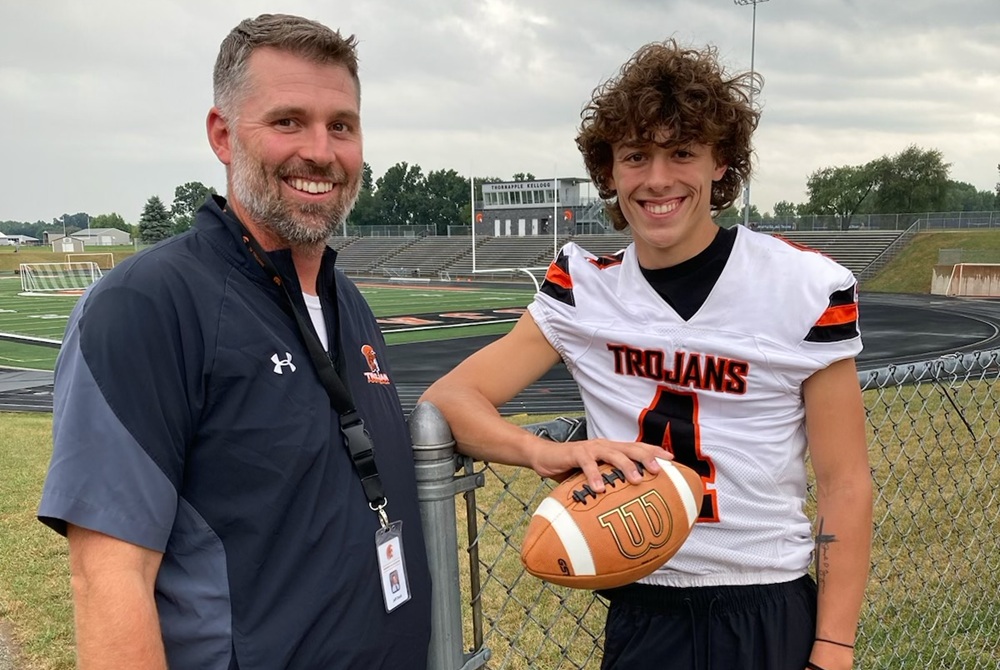
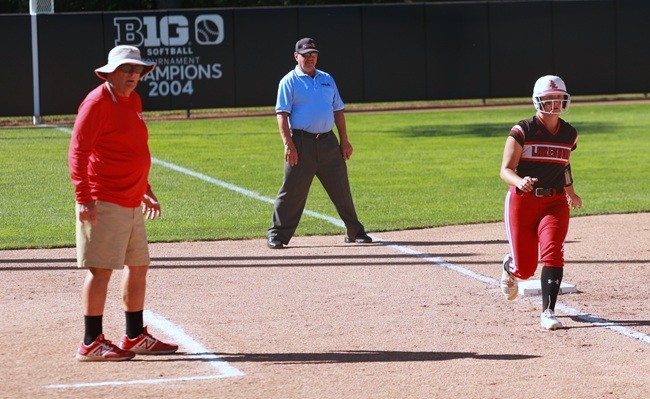
PHOTOS (Top) Jeff Dock, left, and son Micah – Middleville Thornapple Kellogg’s quarterback this season – stand for a photo at their home field. (Middle) Denny Dock, far left, coaches a base runner during Stevensville Lakeshore’s 2022 Semifinal win. (Top photo by Steve Vedder.)