

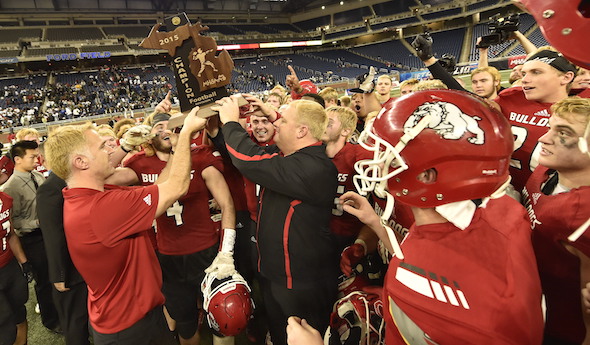
Romeo Raises 1st Champion's Trophy
November 28, 2015
By Bill Khan
Special for Second Half
DETROIT — With a championship on the line and the margin for error too thin, Paul Hurley couldn't have been faulted if he started looking elsewhere to throw the football.
 But Romeo's senior quarterback never lost faith in tight end Mitch Heimbuch, not even after the Western Michigan University recruit dropped two passes while wide open.
"Mitch probably has the best hands on the team, so it was really bizarre for us to see him drop two passes today," Hurley said. "It was never in my head when I was throwing to him. I knew if I was throwing to him, he was catching it."
Heimbuch was sure-handed when it mattered the most, catching three passes for 46 yards on the game-clinching drive, as Romeo beat Detroit Cass Tech, 41-27, in the MHSAA Division 1 championship game Saturday at Ford Field. Heimbuch even grabbed the 2-point pass following Brad Tanner's 16-yard touchdown run with 1:29 remaining in the game.
"Everyone still believed in me. Everyone was still coming up to me telling me to just get over it, forget about it," Heimbuch said. "I just knew I had to make a play if it came back to me. I forget my drops. You can't think too much on them or else they'll kill you."
Romeo scored six touchdowns, blocked a punt and recovered an onside kick to start the second half, but one of the key plays in the Bulldogs' first championship victory was a 12-yard catch by Heimbuch on second-and-13 on the second play of the final drive. That set up a manageable third-and-one and got the drive rolling. He also had catches of 12 and 22 yards on an 11-play, 75-yard march that consumed 5:45 from the clock, leaving Cass Tech little time to produce a miracle comeback similar to Detroit Martin Luther King's in the Division 2 Final on Friday.
Just when it looked like Romeo (13-1) would simply run out the clock, Tanner broke free from 16 yards out for his third touchdown of the game. He finished with a game-high 130 yards on 13 carries.
The drive began after a 36-yard touchdown pass from Aaron Jackson to Donovan People-Jones got Cass Tech within 33-27 with 7:15 remaining.
"I knew I just had to run hard on the play and good things would happen," Tanner said. "On that last drive, the whole time I knew if we just killed the clock, we'd be victorious."
Even before his three key catches on the final drive, Heimbuch made a major contribution to the victory on defense.
He blitzed Jackson and got a sack to force a fumble, which was recovered by Romeo's Austen Malczewski at the Cass Tech 40 with 10:36 left in the second quarter. Four plays later, Tanner's second touchdown run from 31 yards out gave the Bulldogs a 19-7 lead.
"We changed the call at the last second to a two-linebacker blitz," Heimbuch said. "It just opened up. The D-linemen took away their guard and center. I shot the gap. He just lost the ball; he panicked, I think."
Romeo scored on its first three possessions before Heimbuch's first drop on third-and-seven ended the fourth drive. The Bulldogs took that 19-7 lead into halftime.
Taking a page out of Sean Payton's book from the New Orleans Saints' Super Bowl victory in the 2009 season, Romeo's coaches called for an onside kick to start the second half. Kicker Zach Nies recovered his own kick at the Cass Tech 48-yard line. Six plays later, Domenico Bongiorno bulled his way 10 yards up the middle for a touchdown, extending Romeo's lead to 26-14 with 9:49 left in the third quarter.
"They have unbelievable return guys, so we were not supposed to kick it to them at all," Romeo co-coach Curt Rienas said. "We actually thought there was a 70-percent chance we would recover it. When you look at only a 15-yard difference in field position, we thought that was a good gamble on our part."
Recovering onside kicks was a priority in practice all week for Cass Tech (11-3) after it failed to cover three in its Semifinal victory over Canton.
 "That really ticked me off the most, out of anything that happened today," Cass Tech coach Thomas Wilcher said. "As far as trick plays or big plays, that one hurt the most, because we taught the kids what to do. We talked about it, met about it; they just froze. We lost three onside kicks, so that was the most important thing going into the game, just making sure we got all the short kicks."
Special teams had another huge impact when John Verellen blocked a punt and Anthony Quas returned the loose ball 18 yards to the Cass Tech 20. Hurley scrambled for a 20-yard touchdown on the next play, putting Romeo ahead 33-14 with 7:00 left in the third quarter.
One day after Detroit Public School League rival King rallied from 18 points down to win the Division 2 title, Cass Tech provided the host city some hope for another miracle comeback.
Jackson threw a 17-yard touchdown pass to Demetric Vance with 2:14 left in the third quarter, following a Khalid Jordan interception, and a 36-yarder to People-Jones with 7:15 remaining to make it a six-point game.
It was only the second start for Jackson, a sophomore who took over in the Semifinal game when junior starter Rodney Hall was injured. Jackson finished 19 for 27 for 194 yards and two touchdowns Saturday.
"These two starts have really been a big confidence booster for me," Jackson said. "I have a great offense, a great defense. I really love my teammates. These great athletes right here did this; I played a really small role."
Jackson wouldn't get the ball back until Romeo had run the clock down to 1:29 and added eight more points to the deficit.
People-Jones caught eight passes for 85 yards and a touchdown, with his first seven catches going for nine yards or fewer.
"They tackled great," the highly-recruited junior receiver said. "They rallied to the football, which made it harder to escape and make big plays."
To win its first championship, Romeo had to knock off three teams that combined for five of the last six Division 1 titles.
The Bulldogs opened the playoffs by ending Clarkston's two-year reign, 28-14. In the Regional Final, they beat a Detroit Catholic Central team that won the 2009 championship and was runner-up three years in a row from 2011-13. Romeo completed the journey against a Cass Tech squad that won the 2011 and 2012 championships.
It was only the second MHSAA championship for the school, the other won a year ago by the volleyball team.
"The Romeo community was a sea of red," Romeo co-coach Jason Couch said. "I would like to see if anybody else brought as many as Romeo did. If they did, I applaud them. The community shut down. They were here. Businesses were closing. That just shows the support.
"The reason they come out and support the boys is because they're busy in the offseason and in season supporting them with community service and doing other events and activities throughout the community. That's why we graduated from Romeo and we're back in Romeo; it sucks you in. We're proud to be Bulldogs."
The MHSAA Football Finals are sponsored by the Michigan National Guard.
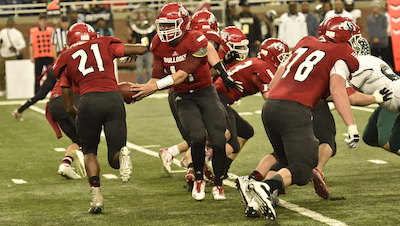
PHOTOS: (Top) Romeo’s coaches and players host their first football championship trophy Saturday at Ford Field. (Middle) Quarterback Paul Hurley hands off to Bradley Tanner (21) during the Division 1 Final.
Western's White Enjoys 'Special' Career
By
Tom Markowski
Special for Second Half
May 4, 2016
WALLED LAKE – Seeking a higher level of performance, many high school athletes have channeled their energy to one sport.
 Many refer to this concentration as specialization – and Cody White, for one, isn’t buying it.
White, a junior at Walled Lake Western, is a three-sport athlete and he loves every minute of it. He plays basketball during the winter, baseball in the spring and football in the fall. During the summer he competes in AAU basketball, travel baseball, 7-on-7 football games with his Western teammates, and he participates in a few summer football camps.
White has played these same sports all throughout high school. His freshman year he competed in track and field, along with baseball. White hasn’t ruled out returning to track and field, in addition to baseball, as a senior – but this season he’s sticking with just baseball.
It’s a hectic schedule but, again, White wouldn’t have it any other way.
“I couldn’t see myself not competing in those sports,” he said. “I love them so much. I want to finish my senior year playing all three.”
White estimates that he’ll have two days off, away from sports, in June. In July he’ll take a week off, between his summer baseball team schedule ending and the start of football practice.
There’s no question White is driven, but it’s more than that. In some high schools, and with some coaches, playing multiple sports can be a challenge. There are some coaches who would prefer the students to play one sport and only one sport.
According to Western football coach Mike Zdebski, that isn’t the case at his school.
“We encourage them to play more than one sport,” Zdebski said. “For one, we want them to get their money’s worth. We have a pay-to-play policy of $425. You play one sport and it costs $425. You play three sports and it costs the same. And, two, playing other sports helps them develop other skills. In basketball you create space. In baseball you chase fly balls, and that helps with depth perception. Besides you get to work with other coaches and other teams.
“We’re lifting weights during the summer. If a kid is playing summer baseball or AAU basketball, if they have time they can come by and lift weights. And what we always tell them, if you’re tired let us know. You can take a break.”
Zdebski – whose team finished 12-1 last fall – was quick to point out some excellent athletes in the past, like former Kansas City Royals outfielder/Oakland Raiders running back Bo Jackson, who were multiple-sport athletes. And, more recently, there’s Luke Glendenning of the Detroit Red Wings. Glendenning was an all-state running back at East Grand Rapids.
 When his high school career is done, White will play football in college. Two months ago he committed to sign with Michigan State this winter. At 6-foot-3 and 200 pounds, White played receiver, defensive back and also returned kicks last fall. He played a big role in Western’s run to the Division 2 Semifinals.
During baseball season, White pitches and plays middle infield and right field. He plays the wing and shooting guard in basketball.
His interest in playing a variety of sports came at an early age and, as is the case with most children, a family member was the one who introduced White to athletics. Former NFL player and Detroit Lions executive Sheldon White is his father, but the first sport White played, at age 3, was baseball. Two years later he began playing football and basketball.
Sheldon White also played three sports at his high school in Dayton, Ohio, (Meadowdale High) and helps his son manage his busy schedule, particularly during the offseason.
“Growing up was a little different (for me) than the usual kid,” Cody White said. “Going to Lions games and just being around football all the time. I think I love the game more because I was around it so much.
“But I think playing three sports helped me, too. The twisting of your hips in baseball, when you swing the bat, you’re using different muscles. And all the jumping you do in basketball. You have to move in tight spaces.
“With football, you’re with the football guys. By doing all three you meet different people.”
Playing multiple sports has definitely been the right road for White to follow. And his busy schedule hasn’t hindered his work in the classroom.
White has a 3.54 grade-point average pending his grades for this semester.
 Tom Markowski is a columnist and directs website coverage for the State Champs! Sports Network. He previously covered primarily high school sports for the The Detroit News from 1984-2014, focusing on the Detroit area and contributing to statewide coverage of football and basketball. Contact him at [email protected] with story ideas for Oakland, Macomb and Wayne counties.
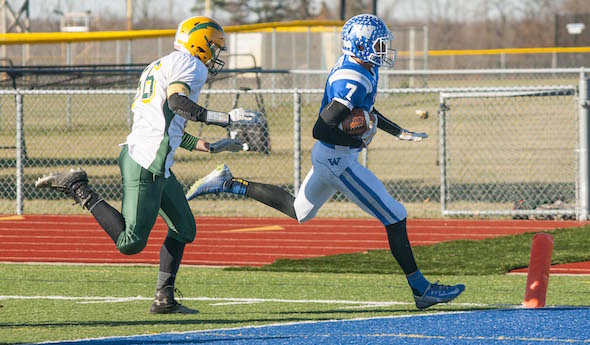
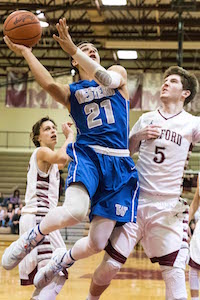
PHOTOS: (Top) Cody White (right) runs away from a Midland Dow defender during their Regional Final this fall. (Middle) White works for a shot against Milford. (Photos by Teresa Presty.)