

Sailors Eye 'Their Turn' after QB Moves On
August 25, 2015
By Dean Holzwarth
Special for Second Half
CUTLERVILLE – With the 2015 season opener against Grand Rapids Christian a few days away, South Christian football coach Mark Tamminga said quarterback isn’t a position that's stressing him out.
That statement might be a bit surprising considering Tamminga graduated this spring one of the most prolific passers in Michigan High School Athletic Association history.
 Jon Wassink capped a banner high school career last fall by guiding the Sailors to a Division 4 championship with a dramatic 28-27 win over Lansing Sexton.
Wassink, a three-year starter, took his talents to Western Michigan University, but not before finishing second all-time in the MHSAA record book for career passing yards with 8,124.
In fact, Wassink’s name appears in the MHSAA record book 17 times despite playing only three varsity seasons. He’s third in career passing attempts (884), second in completions (584) and fifth in touchdown passes (76).
“We’re never going to replace a Jon Wassink; there’s no doubt about that,” Tamminga said after practice last week. “But I have two kids right now fighting for the quarterback position, and whichever one gets the job is going to be a very good high school quarterback. Maybe an all-conference quarterback, I’m not sure, but the quarterback position right now is pretty far down on my worry list.
“We have other things to worry about. Our line, our receivers, but we’re going to be fine with our quarterback. We’re going to score some points.”
Besides Wassink, the Sailors graduated a bevy of talent from a senior class that won 12 straight games after an 0-2 start to win their second MHSAA Final in three seasons.
Eighteen starters are gone, leaving behind a young team stacked with juniors and sophomores.
The only remaining starters are seniors Ezinga, Niewiek, John Masselink (TE/S) and Dylan Brink (RB/LB).
“We lost a great senior class, all the way down,” Tamminga said. “They were such great leaders, and the kids rallied around them. I told this year’s group that it’s their turn. They have to step up. You can win games with underclassmen, but to win consistently you have to have senior leadership, and that’s what I need from those guys. So far they have shown that, and we’re pretty proud of them.”
The person attempting to fill the void left by Wassink was yet to be determined at the start of this week. Junior Eric Dykstra and sophomore Andrew Haan are vying for the starting position.
Dykstra is the frontrunner, but recently suffered a wrist injury. That allowed Haan to take a majority of reps in practice and during the Sailors’ preseason scrimmage.
Tamminga said both have the potential to step in and lead this year’s squad.
“I would say Eric has the upper hand if healthy, but it is so close,” he said. “We don’t lose a beat with Andrew in there either. Both of them realize they have big shoes to fill, but what is so great is they don’t feel they have to be the next Jonny Wassink. They are going to be them, and they are going to be very good high school quarterbacks.”
 South Christian also will miss Wassink’s ability to run the ball. He rushed for 3,252 yards and 50 touchdowns in three seasons.
“He definitely made big plays with his arm and his legs, which I think is going to hurt us the most,” Sailors’ right guard Josh Ezinga said. “He was such a two-dimensional player that defenses had to either prepare for him running-wise or passing-wise.
“And even though as a lineman you try not to miss a block, it happens once in a while, and he would just make a play and make you look like you’re the best in the world because he would make people miss.”
The absence of Wassink will be felt from a leadership standpoint as well. He wasn’t only a playmaker, he was there to help the younger players improve.
“Obviously Jon was a great player, but he also was a great leader,” senior wide receiver Jake Niewiek said. “He helped me a lot when I was getting started with the offense. Being a receiver in the system was a little complicated, but he really took us under his wing and showed us what we had to do.”
But Tamminga said adjustments have been made to atone for Wassink not being on the field in 2015.
“We basically had it pretty easy when he was here, and now we have to step up and coach to our strengths,” he said. “You have to coach differently because Jonny was like having another coach on the field. These kids are not going to be able to do the things that Jonny did. We have to adjust as coaches to compensate for that.”
The key losses by the Sailors have other teams chomping at the bit to dethrone the two-time Ottawa-Kent Gold champions.
But while others may deem this a down year, South Christian hopes to maintain the same tradition of winning to which it has become accustomed.
“I think there are different expectations for us from the public and the media, but I think all the pieces of the puzzle are there and we can still be a great team this year,” Ezinga said. “I definitely think we can win with sophomores and juniors, and they realize they have to go hard every single play.”
Niewiek agreed that this year’s team can still be a formidable challenger.
“Practices have been great and everyone has been working their butts off,” he said. “We obviously have lower expectations than last year, but we hope to surprise some people. We want to keep the bar set high.”
Tamminga said the first goal is to get to six wins, which won’t be easy with three straight playoff teams on the schedule to open the season.
“We want to make the playoffs,” he said. “Just make the playoffs, but what worries me is if we don’t have three good games and go 0-3. I still believe we can go 6-3 and make the playoffs. They have to believe it, and that’s the challenge ahead of us right now.”
 Dean Holzwarth covered primarily high school sports for the Grand Rapids Press and MLive for 16 years and more recently served as sports editor of the Ionia Sentinel and as a sports photojournalist for WZZM. Contact him at [email protected] with story ideas for Allegan, Kent and Ottawa counties.
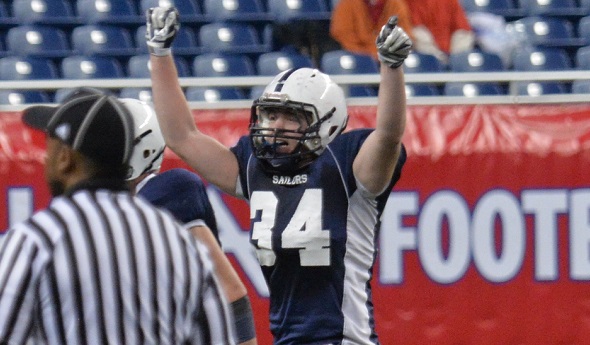
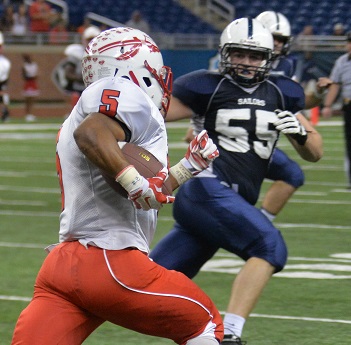
PHOTOS: (Top) South Christian’s Jake Niewiek celebrates a turnover during last season’s Division 4 Final at Ford Field. (Middle) The Sailors’ Jake Elzinga works to stay in front of a Sexton ball carrier; both he and Niewiek return this fall.
1st & Goal: 2025 Week 7 Preview
By
Geoff Kimmerly
MHSAA.com senior editor
October 10, 2025
The MHSAA Football Playoffs don't start for three more weeks. But this weekend definitely feels playoff caliber.
 At least 25 games could end tonight or Saturday with a team celebrating a share or more of a league championship. A few more of our top matchups will set up similar showdowns over the final two weeks of the regular season.
Follow scores for every game across the state this weekend on the MHSAA Scores page, check out standings for every league on those teams' pages, and watch several of those title deciders unfold on the NFHS Network, including all games with “WATCH” linked below.
Bay & Thumb
Millington (5-1) at Elkton-Pigeon-Bay Port Laker (6-0) WATCH
Millington’s loss to Cass City in Week 4 was in league play since 2022, but the Cardinals still can claim a share of the Big Thumb Conference West title with a win over the Lakers, whose only single-digit game this season was an 18-13 win over Cass City in Week 3. Millington won last year’s regular-season matchup 28-0 and then a 42-14 playoff rematch on the way to claiming the Division 7 title. Laker has given up only 47 points this season with impressive shutouts of Ubly and Central Montcalm.
Keep an eye on these FRIDAY Linden (5-1) at Fenton (4-2) WATCH, Bay City John Glenn (4-2) at Freeland (5-1) WATCH, Reese (4-2) at Harbor Beach (6-0) WATCH, Ithaca (5-1) at Saginaw Nouvel Catholic Central (5-1) WATCH.
Greater Detroit
Gibraltar Carlson (6-0) at Brownstown Woodhaven (6-0) WATCH
Carlson brings a combined 34-3 record in Downriver League play this decade as it seeks a fifth-straight league title – and fifth-straight win over Woodhaven, which last won the Downriver in 2019. The Marauders spent their lone nonleague week doubling up reigning Division 5 champion Pontiac Notre Dame Prep 42-21 in Week 3, and a week later they avenged last season’s lone Downriver defeat by edging Trenton 17-14. Woodhaven also working to return to the playoffs for the first time since 2022 and hasn’t had a game closer than 24 points this fall.
Keep an eye on these FRIDAY Clarkston (5-1) at West Bloomfield (5-1) WATCH, Detroit Central (5-1) at Detroit Pershing (4-2), Almont (6-0) at Richmond (6-0) WATCH, Detroit Edison (5-1) at Harper Woods Chandler Park (5-1).
Mid-Michigan
Fowler (5-1) at Pewamo-Westphalia (5-0) WATCH
These longtime rivals have split their last four games against each other, Fowler claiming last year’s 14-11 on the way to the Central Michigan Athletic Conference title. This time they’ll meet in a league schedule finale, with a winner-take-all for the title guaranteed. The lone loss between them this fall was Fowler’s to still-undefeated Hudson in a season opener, and the Eagles have not given up more than seven points in a game since. The Pirates haven’t given up more than six points in a game all season and had an extra week to prepare for this one with an open date last week.
Keep an eye on these FRIDAY Kent City (6-0) at Central Montcalm (5-1) WATCH, Montrose (6-0) at New Lothrop (5-1) WATCH, Grand Ledge (6-0) at DeWitt (6-0) WATCH, Battle Creek Harper Creek (5-1) at Hastings (5-1) WATCH.
Northern Lower Peninsula
Mancelona (4-2) at Charlevoix (6-0) WATCH
Charlevoix has clinched an outright championship in the Northern Michigan Football Conference Leaders division, while Mancelona is tied for first in the Legacy with two league games to play and the big one a Week 9 date with co-leader Maple City Glen Lake. The Rayders certainly will provide some prep as the Ironmen ready for that deciding matchup, but there’s plenty at stake for Charlevoix too as it’s downed Mancelona in eight straight and is one of only six Division 7 teams still undefeated this fall.
Keep an eye on these FRIDAY Kingsley (4-2) at Cheboygan (3-3) WATCH, East Jordan (3-3) at Harbor Springs (3-3) WATCH, LeRoy Pine River (4-2) at Manton (4-2), Bay City Western (3-3) at Traverse City Central (3-3).
Southeast & Border
Hudson (6-0) at Clinton (5-1) WATCH
Undefeated and with all of its games against Division 5, 6 and 7 opponents, Hudson has the highest playoff-point average in Division 8 by a comfortable margin and can add to it against Division 7 Clinton. More importantly, they are the only two teams undefeated in Lenawee County Athletic Association play, and the winner this weekend clinches a share of the championship. They’ve split their last two meetings, Hudson claiming last year’s 22-6 during an outright championship run and after Clinton handed the Tigers their most recent league loss, in 2023.
Keep an eye on these FRIDAY Riverview (4-2) at Monroe St. Mary Catholic Central (6-0), Leslie (4-2) at Napoleon (4-2), Harper Woods (6-0) at Saline (6-0) WATCH, Adrian (5-1) at Ypsilanti Community (3-3).
Southwest Corridor
Portage Northern (5-1) at Portage Central (6-0) WATCH
The winner clinches a share of the Southwestern Michigan Athletic Conference West title. Northern also is seeking its first win in the rivalry since 2022, and they almost assuredly will meet again in the playoffs next month with Central fourth in Division 2 playoff-point average and Northern No. 13. Central also has given up only 10 points this season – all coming over the last two weeks – giving Northern another potential spoiler goal coming off last week’s 42-36 win over St. Joseph and having scored at least that many in four straight games. To that end, Central has yet to score fewer than 41 this season.
Keep an eye on these FRIDAY Kalamazoo Central (3-3) at Battle Creek Central (4-2), Dowagiac (4-2) at Buchanan (4-2) WATCH, Bronson (5-1) at White Pigeon (6-0) WATCH, Springport (6-0) at Quincy (4-2).
Upper Peninsula
Gaylord (6-0) at Escanaba (6-0) WATCH
Neither of these teams made the playoffs in 2024, much less competed for the Big North Conference title. But they did play one of the league’s closest games, a 19-15 Gaylord win, and this time the victor will clinch a share of the league title and keep an undefeated season going. Escanaba is coming off breaking a seven-game losing streak against rival Marquette with last week’s 38-20 victory – while Gaylord started league play with a 28-27 win over the Sentinels a month ago.
Keep an eye on these FRIDAY Iron Mountain (4-1) at Bark River-Harris (4-1) WATCH, L’Anse (4-2) at West Iron County (2-3) WATCH, Petoskey (3-3) at Marquette (3-3) WATCH, Negaunee (4-2) at Menominee (6-0) WATCH.
West Michigan
East Kentwood (5-1) at Hudsonville (6-0) WATCH
East Kentwood faded just a bit from the Ottawa-Kent Conference Red spotlight after a 21-14 Week 4 loss to Rockford, but can reclaim it almost entirely with a win over the Eagles – who themselves are coming off a 35-28 win over the rival Rams. When last these two met, Hudsonville edged East Kentwood 25-23 in a District opener last fall. A Falcons win this time could result in up to four teams being tied for first in the league, while a Hudsonville win would put them one away from clinching a repeat title.
Keep an eye on these FRIDAY Grand Rapids South Christian (3-3) at Zeeland East (4-2), Grand Rapids Catholic Central (6-0) at Holland Christian (4-2) WATCH, Whitehall (4-2) at Ludington (6-0), Belding (5-1) at Muskegon Oakridge (5-1) WATCH.
8-Player
Deckerville (6-0) at Kingston (6-0) WATCH
No one should be stunned if both of these rivals end up playing for 8-player championships next month at Superior Dome; Deckerville is No. 4 in Division 2 playoff-point average, and Kingston is No. 5 in Division 1. But first they must face off in what may turn end up one of the best 8-player games this regular season, with a share of the Big Thumb Conference Blue title on the line. Deckerville swept last year’s meetings, winning by 44 and then 34 points on the way to a perfect season and Division 1 title. Kingston has reached 64 points in four games this season and will face an Eagles defense that hasn’t given up more than 20.
Keep an eye on these FRIDAY Breckenridge (4-2) at Gaylord St. Mary (6-0), Rogers City (4-2) at Mio (5-1) WATCH, Norway (6-0) at Newberry (5-1). SATURDAY Gogebic (6-0) at Lake Linden-Hubbell (5-1) WATCH.
MHSAA.com's weekly “1st & Goal” previews and reviews are powered by MI Student Aid, a division within the Department of Lifelong Education, Advancement, and Potential (MiLEAP). MI Student Aid encourages students to pursue postsecondary education by providing access to student financial resources and information. MI Student Aid administers the state’s scholarship and grant programs that help make college Accessible, Affordable and Attainable for you. Click to connect with MI Student Aid and find more information on Facebook and Twitter @mistudentaid.
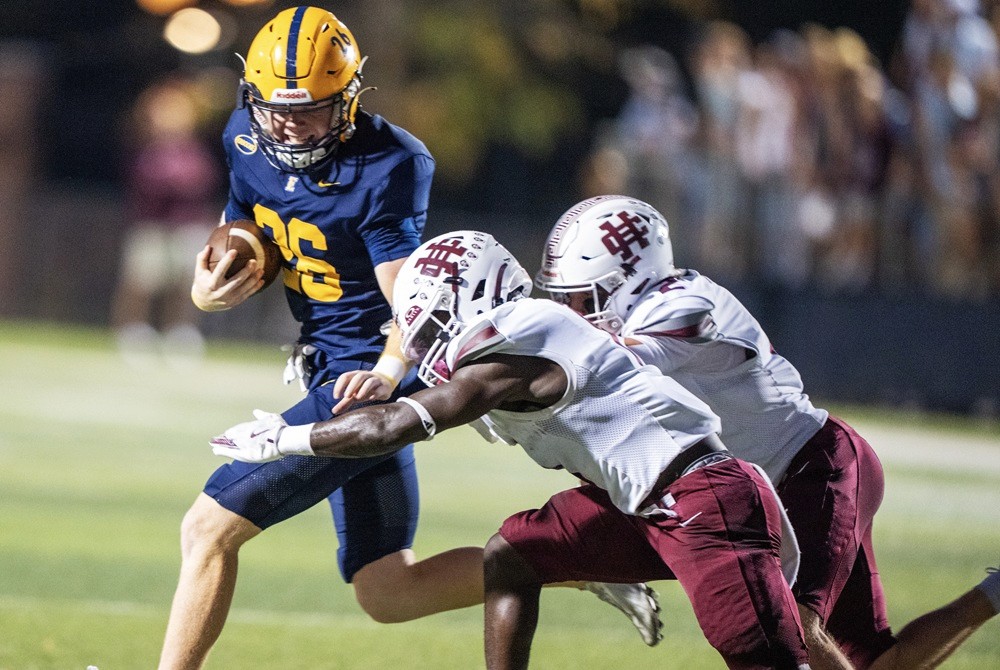
PHOTO A pair of Holland Christian defenders pursue an East Grand Rapids ball carrier during the Pioneers' 41-21 win last week. (Click for more by MI Sports Photo.)