

Sand Creek's Muck Making His Move
August 16, 2018
By Doug Donnelly
Special for Second Half
SAND CREEK – Alec Muck doesn’t take for granted that he’s one of the fastest athletes in the state.
 It just makes him want to become faster.
“I’ve always had speed,” said the Sand Creek senior. “I guess you could say I was blessed with speed. But I train hard, too. I do a lot of stuff on my own, I work with a personal trainer and I lift. It motivates me.”
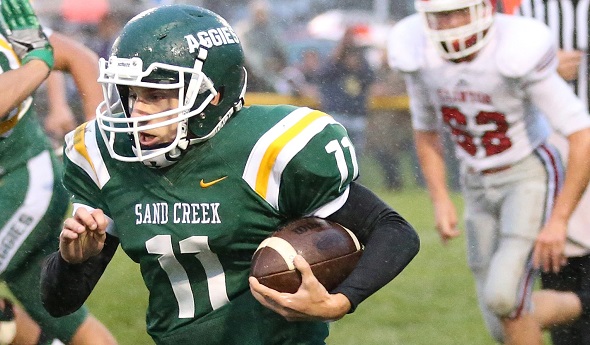
Muck is a five-time MHSAA Finals track champion and has rushed for more than 2,600 career yards for the Aggies’ varsity football team. As he prepares for his senior season on the football field, he said he’s healthy and ready to go out a winner.
“I just want to go out and play hard and give it my all,” he said. “I’m going to do whatever it takes for my team. High school football is so different than anything else. I want to leave it all out there.”
Muck has a future as a college athlete. He’s just not sure in which sport. This summer, he went on a multi-state, multi-campus recruiting tour during which he blazed to a 4.3-second 40-yard time in Columbus, Ohio.
“That definitely caught the attention of a few coaches,” he said. “I kept my time around that 4.3 all summer.”
Other stops on the tour included Louisville, Cincinnati, Findlay and Western Michigan University. The 5-foot-10, 175-pound speedster doesn’t have any formal offers to play college football, but he expects that to change this season.
“I have a passion for both track and football,” he said. “But, I love the grind of football and everything about the game. If I could choose, I’d probably say football. I’ve always wanted to play at the Division I level.”
Muck was part of the Sand Creek varsity football team as a freshman. He blossomed into a weapon as a sophomore. In the third game that season, against Whitmore Lake, he carried the ball 11 times for 277 yards and five touchdowns. It remains his most productive game of his career. In all seven Tri-County Conference games that year, he rushed for at least 100 yards. He went on to rush for 1,505 yards as a sophomore, racking up nearly 2,000 all-purpose yards and 26 touchdowns.
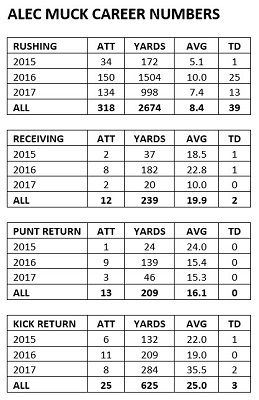 His junior season saw a slight dip in his carries, but he still averaged more than seven yards per rush and came up two yards short of 1,000. He started the season spending some time at quarterback. That experiment ended early in the season, however, and he expects to line up at several different spots on the field this year – but not quarterback.
“I like running back,” he said. “That’s where I’ve played since my Pop Warner days. I like to run and see the whole field. Running with the football is way different than running the track. You have to know when to go only 50 percent, so you know where to make your cut, then explode. You have to have more lateral movement.”
Sand Creek coach Scott Gallagher said the Aggies need to find more and creative ways to get Muck the football.
“He’s explosive,” said Gallagher, in his second season leading the program. “We have to put him in different positions and get him the football in a lot of different ways. He’s had the best camp he’s had since I’ve coached him.”
Muck causes headaches for opposing coaches. He is a threat to score every time he touches the ball.
“Obviously Alec has tremendous speed; however, his ability to take over and change a game is underrated,” said Ottawa Lake Whiteford coach Jason Mensing. “His imprint on the TCC will be lasting.”
Gallagher said Muck sets high expectations for himself.
“He’s hard on himself,” Gallagher said. “He is very driven to be successful, and he wants to that success to rub off on his teammates.”
Muck’s training has involved a lot of speed drills – often on his own. His weightlifting is for strength and maintaining speed, not bulking up.
“My normal warm-ups are low sprints, not long-distance running,” he said. “When I run the short sprints, I set a goal for each sprint and try and beat that time. I run for time.”
Prior to the Regional track meet this spring, Muck injured his hamstring. He took a week off running before the Lower Peninsula Division 4 Finals, but the break didn’t slow him as he won both the 100 and 200 dashes. He won the same events as a sophomore and won the 200 as a freshman. His championship winning times this spring were 10.98 seconds in the 100 and 22.02 in the 200.
“I was really careful warming up at the state meet and, in the preliminaries, I ran easy, just so I could get to the final,” he said. “Once I got there, I knew I could do it.”
Throughout a summer of football camps and 7-on-7s, Muck also attended physical therapy for the hamstring. He said he’s now at 100 percent and ready to start football – and go out with a bang.
“This is the most dedicated the team has been since I’ve been playing,” he said. “The offseason training, the commitment to the weight room, it’s all there. I’m just ready to go out there and lead by example. It’s time to play football.”
 Doug Donnelly has served as a sports and news reporter and city editor over 25 years, writing for the Daily Chief-Union in Upper Sandusky, Ohio from 1992-1995, the Monroe Evening News from 1995-2012 and the Adrian Daily Telegram since 2013. He's also written a book on high school basketball in Monroe County and compiles record books for various schools in southeast Michigan. E-mail him at [email protected] with story ideas for Lenawee and Monroe counties.
PHOTO: Sand Creek running back Alec Muck is a five-time MHSAA Finals track champion with more than 2,600 career rushing yards. He's healthy and ready for a breakout senior year of football. (Photo by Mike Dickie.)
1st & Goal: 2025 Week 7 Review
By
Geoff Kimmerly
MHSAA.com senior editor
October 13, 2025
Football is the only head-to-head MHSAA sport requiring teams to qualify for the playoffs. And that makes October unlike any other month across any of the school year's three seasons.
 Not only are teams competing for and celebrating league championships – see all nine of our "headliners" below and several more games we noted – but several more hopefuls are maneuvering to either break into playoff fields, hold onto spots they've currently earned, or move up on their respective division lists high enough to potentially earn a home game or few when the playoff brackets are selected later this month.
We highlight some of those scenarios below, and will focus on them much more over the final two weeks of the regular season.
Bay & Thumb
HEADLINER Millington 14, Elkton-Pigeon-Bay Port Laker 3 Millington (6-1) battled back from a Week 4 overtime loss to Cass City to clinch a share of the Big Thumb Conference White title – and clinch a share for Cass City as well – by handing Laker (6-1) its only loss this season. All three teams finished tied for first and league champions, Millington after winning the title outright last season. The Cardinals and Lakers have met in the playoffs the last two and could face off again in Division 7. Click for more from the Bay City Times.
Watch list Almont 35, Richmond 14 The Raiders (7-0) over the last two weeks have taken down contenders Armada and Richmond (6-1) by identical 35-14 scores to run their Blue Water Area Conference winning streak to 23 and their league title streak to three by clinching a share of this year’s with this win.
On the move Fenton 46, Linden 41 The Tigers (5-2) ran their Flint Metro League Stars winning streak to 18 games and finished their third-straight perfect run through the league while denying Linden (5-2) a chance at a title share. Harbor Beach 33, Reese 14 The Pirates (7-0) have won all 10 of their BTC Black games over the last two seasons, this time preventing Reese (4-3) and Unionville-Sebewaing from also claiming title shares. Montrose 28, New Lothrop 14 The Rams (7-0) clinched a share of the Mid-Michigan Activities Conference championship after finishing third the last two seasons, and with a second-straight win over rival New Lothrop (5-2).
Greater Detroit
HEADLINER Gibraltar Carlson 27, Brownstown Woodhaven 23 The Marauders followed running back Izaiah Wright to this Downriver League title share-clinching win. Wright scored three touchdowns, his last the game-winner during the final minute. Carlson (7-0) ran its league championship streak to five with a chance to finish this run with the outright title this week at Lincoln Park. Woodhaven (6-1) fell a game back. Click for more from the Southgate News-Herald.
IZAIAH WRIGHT DOING IZAIAH WRIGHT THINGS. The Carlson senior — Purdue commit and Mr. Football candidate — scored three touchdowns, including the game-winner in the final minute as Carlson beats rival Woodhaven 27-23 to stay unbeaten at 7-0. Delivered by @hungryhowies… pic.twitter.com/rKQ3dBZOpj
— STATE CHAMPS! Michigan (@statechampsmich) October 11, 2025
WATCH LIST Harper Woods 41, Saline 32 Harper Woods (7-0) has had its share of notable wins over the last three seasons – especially on the way to winning the Division 4 title in 2023. But downing Division 1 contender Saline (6-1) might be considered the best of the regular season during that time, or at least equal to wins over another Division 1 contender Clarkston in Week 2 and two years ago.
On the move Clarkston 38, West Bloomfield 10 A Wolves loss would have meant a shared Oakland Activities Association Red title between these two, but a win gave Clarkston (6-1) the outright title and its first of any degree since sharing in 2022. Melvindale Academy for Business & Tech 18, Hamtramck 8 The Gators (7-0) won a combined seven games over the last two seasons, and this victory over second-place Hamtramck (4-3) gave ABT the outright championship in the Charter School Conference Silver. Riverview 14, Monroe St. Mary Catholic Central 13 The Huron League title race jumped the tracks a bit as Riverview (5-2) moved into position to potentially earn a share if SMCC (6-1) can defeat leader Monroe Jefferson this week.
Mid-Michigan
HEADLINER Pewamo-Westphalia 37, Fowler 6 The Pirates pulled away over the final three quarters to clinch a share of the Central Michigan Athletic Conference title and also avenge last season’s loss to Fowler (5-2) – P-W’s only league defeat over the last three. The Pirates (6-0) also continued a run of not allowing more than six points in any game this fall, and have surrendered a grand total over 18 over six games. Click for more from the Lansing State Journal.
Watch list Portland 54, Eaton Rapids 6 The Raiders (7-0) ran their Capital Area Activities Conference White winning streak to 25 in clinching a share of a fourth-straight league title. They’ve given up just 31 points over six games played (with the seventh a forfeit win).
On the move DeWitt 59, Grand Ledge 7 The Panthers (7-0) moved within a win of clinching the CAAC Red championship by handing the Comets (6-1) their only defeat. Mount Pleasant 29, Traverse City West 8 The Oilers (7-0) secured a share of the Saginaw Valley League North title and can make it outright this weekend against reigning champion Midland. Belding 28, Muskegon Oakridge 7 The Black Knights (6-1) are in the running for what would be a fourth-straight Ottawa-Kent Conference Silver title, and fit in this win over West Michigan Conference Lakes contender Oakridge (5-2) to hold onto the No. 3 spot in the Division 6 playoff-point rankings.
Northern Lower Peninsula
HEADLINER Gaylord 34, Escanaba 30 The Blue Devils (7-0) played a fourth-quarter comeback into a share of the Big North Conference championship in what was a matchup of first-place teams. Gaylord can make the title outright against Sault Ste. Marie in Week 9. It’s been a great comeback run for both contenders, as Gaylord was 3-6 a year ago and Escanaba (6-1) was 2-7 two years ago before improving to 5-4 last season. Click for more from the Petoskey News-Review.
Watch list LeRoy Pine River 34, Manton 30 The Bucks (5-2) haven’t had a winning season since 2018 and opened this one with two losses. But they’ve strung together five straight victories to guarantee their best finish since 2018 while also moving up to the No. 20 slot on the Division 7 playoff-point list. Manton (4-3) as well has guaranteed its best record since 2022 and with one more win would tie its best since 2014.
On the move Charlevoix 15, Mancelona 12 This was a matchup of league leaders and Charlevoix (7-0) ran its winning streak over Mancelona (4-3) to nine, but not without surviving its closest game this season. Grayling 38, Kalkaska 15 The Vikings (2-5) came out of a tough league run with an impressive win over the Blazers (5-2), who finish with two more strong opponents in Kingsley and Boyne City. Traverse City Central 47, Bay City Western 21 Central (4-3) has fallen out of the Division 2 playoff hunt only once over the last five weeks but is back up to No. 21 on that playoff-points list with a second-straight win coming off an earlier three-game losing streak.
Southeast & Border
HEADLINER Hudson 32, Clinton 16 The Tigers (7-0) clinched a share of the Lenawee County Athletic Association title and avoided a possible three-team share if they’d fallen to Clinton (5-2), which with Ida will hope for help this week from Hillsdale as Hudson plays for the outright title. Click for more from the Adrian Daily Telegram.
Watch list Springport 36, Quincy 20 Springport (7-0) clinched a share of the Big 8 Conference title, against a Quincy team (4-3) enjoying its best season since 2019. The Spartans can make it outright this week against second-place Union City and have given up only 38 points this season over six games (with a forfeit win as well).
On the move Ypsilanti Lincoln 36, Jackson 32 The Railsplitters (6-1) earned their fourth win by one score or less to set up the possibility this week of taking a share of the Southeastern Conference White title from Chelsea, which has clinched a share already. Temperance Bedford 31, Ann Arbor Huron 28 Bedford (4-3) also held on in a close game to gain an opportunity in the SEC Red, as it trails leader Saline by a game and travels to play the Hornets this week. Napoleon 30, Leslie 26 Likewise, Napoleon’s close win sets it up to play Michigan Center this week in a winner-take-all matchup for the Cascades Conference East title.
Southwest Corridor
HEADLINER Portage Central 30, Portage Northern 0 Central added a share of the Southwestern Michigan Athletic Conference West title to a dominating fall, holding Northern scoreless in what was a matchup of first-place teams. The shutout also was Central’s fifth this season, and the Mustangs have given up just 10 points total. They’ll play for an outright championship Week 9 at St. Joseph. Click for more from the Kalamazoo Gazette.
Watch list Dowagiac 40, Buchanan 26 Dowagiac (5-2) made the playoffs last season for the first time this decade, and now has added its first championship in the Lakeland Conference – rebounding from a Week 6 loss to Berrien Springs to take a share from Buchanan (4-3), which previously had clinched a share. Berrien Springs also can claim a share with a win over Niles Brandywine this week.
On the move Kalamazoo Central 31, Battle Creek Central 12 This is the oldest rivalry in Michigan high school football history, starting in 1893, and game 122 between these two ended in Kalamazoo Central (4-3) owning a share of the SMAC East title as Battle Creek Central (4-3) also entered the night undefeated in league play. Battle Creek Harper Creek 29, Hastings 15 This win didn’t clinch the Interstate 8 Athletic Conference title for Harper Creek (6-1), but it was a giant step toward potentially doing so. Hastings (5-2) also hadn’t lost in league play heading into the night. Bronson 32, White Pigeon 6 With this win by Bronson (6-1), Decatur claimed a share of the Southwest 10 Conference championship – although White Pigeon (6-1) can make it a three-team shared title by defeating Decatur this week.
Upper Peninsula
HEADLINER Bark River-Harris 38, Iron Mountain 14 After defeating Iron Mountain in Week 2 for the first time in program history, Bark River-Harris made it a sweep – this time clinching a share of the Western Peninsula Athletic Conference Iron championship as well. The Broncos (5-1) can make the title outright this week against West Iron County, which like Iron Mountain (4-2) has just one loss in league play (as the first Bark River-Harris meeting did not count toward the league standings).
Watch list West Iron County 49, L’Anse 40 In avenging a 20-14 loss to L’Anse from Week 2, West Iron County (3-3) jumped four spots to No. 37 on the Division 8 playoff-points list with two weeks to play. The Wykons had won just three games total over the last two seasons and are seeking their first playoff berth this decade.
On the move Menominee 40, Negaunee 12 This along with Kingsford’s win over Ishpeming Westwood sets up those two to meet for a winner-take-all title matchup this week in the West-PAC Copper. Menominee moved to 7-0, while Negaunee is 4-3. Gladstone 34, Houghton 22 Gladstone (3-4) also bumped up to No. 37 on a playoff-points list, in Division 6, with two games to play and chances to move up significantly. Marquette 27, Petoskey 17 While Marquette (4-3) can’t catch Gaylord in the BNC, the Sentinels did move back into playoff contention at No. 29 on the Division 3 list, sending Petoskey (3-4) to No. 34.
West Michigan
HEADLINER Kent City 46, Central Montcalm 14 In a winner-take-all for the Central State Activities Association Silver title, Kent City (7-0) seized it in a big way. In doing so, the Eagles also avenged losses to Central Montcalm (5-2) that decided last year’s league title and then ended Kent City’s season in the District opener. Click for more from WZZM.
Watch list Ludington 32, Whitehall 7 The Orioles (7-0) clinched a share of the West Michigan Conference Lakes title by avenging the loss that cost them the championship last season. Whitehall (4-3) won’t repeat but remains firmly in the Division 5 playoff hunt at No. 14 on that playoff points list.
On the move Hudsonville 43, East Kentwood 42 The Eagles (7-0) won by the slimmest of margins to pull within one more victory of clinching the Ottawa-Kent Conference Red title, moving past the Falcons (5-2) with a late rally. Grand Rapids Catholic Central 35, Holland Christian 7 The Cougars (7-0) clinched a share of the O-K Black title, improving on last season’s tie for second place. Grand Rapids West Catholic 48, Wayland 19 The Falcons (6-1) locked up a share of the O-K White title, their fourth-straight league championship.
8-Player
HEADLINER Deckerville 22, Kingston 14 Defense reigned as Deckerville clinched a share of the Big Thumb Conference Blue title for the second-straight season. Both teams were held well below their season scoring averages as the Eagles (7-0) added to last year’s regular-season/playoff sweep of the rival Cardinals (6-1). Click for more from the Huron Daily Tribune.
Watch list St. Helen Charlton Heston Academy 47, Hillman 26 Heston’s record for wins in a season over its first 11 was four a year ago, but the Patriots (5-2) bested it in this matchup of North Star League champions – both Heston and Hillman (5-2) have clinched shares of their division titles.
On the move Norway 34, Newberry 14 Norway (7-0) pulled within one more win of claiming a share of the Great Lakes Eight Conference East championship after finishing second a year ago. Gogebic 42, Lake Linden-Hubbell 12 The Miners (7-0) also can clinch a share of a league title this week, in the GLEC West, after handing LL-H (5-2) its only conference loss. Mio 36, Rogers City 22 There are 13 teams in Division 2 with zero or one loss, and Mio (6-1) remains right in the middle of that group on the playoff-points average list with two games against sub-.500 opponents left before the playoffs.
MHSAA.com's weekly “1st & Goal” previews and reviews are powered by MI Student Aid, a division within the Department of Lifelong Education, Advancement, and Potential (MiLEAP). MI Student Aid encourages students to pursue postsecondary education by providing access to student financial resources and information. MI Student Aid administers the state’s scholarship and grant programs that help make college Accessible, Affordable and Attainable for you. Click to connect with MI Student Aid and find more information on Facebook and Twitter @mistudentaid.
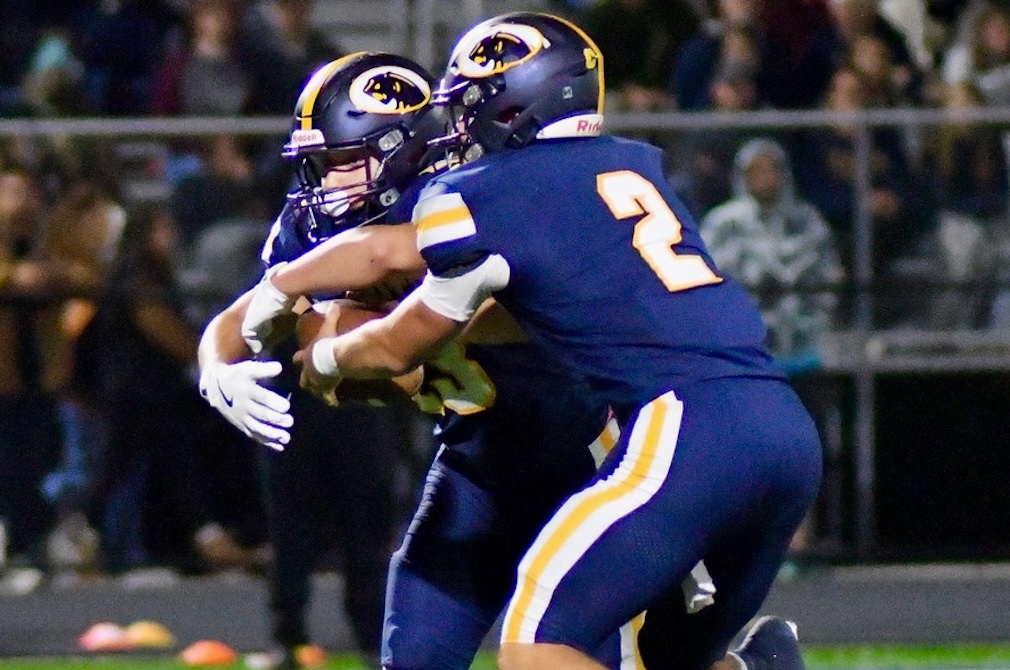
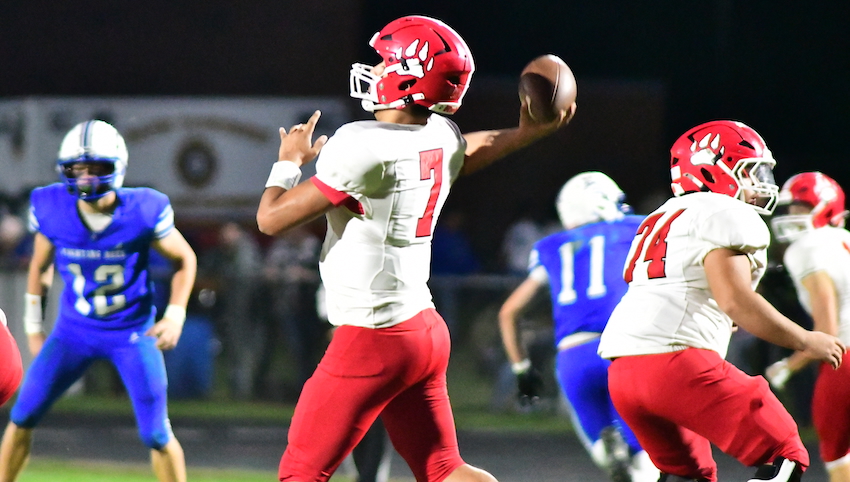
PHOTOS (Top) DeWitt’s backs make a read on a handoff during their team’s 59-7 win over Grand Ledge on Friday. (Middle) Laingsburg’s Julian Smith (7) launches a pass during his team’s 34-14 loss to Bath. (DeWitt/Grand Ledge photo by Terry Lyons. Laingsburg/Bath photo by John Johnson.)