


Scheduling Solution
September 27, 2016
One of our state's consistently best high school football programs needed a ninth game this season but could find no opponent within the state of Michigan. It was able to find a game with an equally prestigious football program in an adjacent state that was having the same problem – the "problem" of being such a formidable program year after year that other schools shied away from scheduling them.
Two different schools in two different states with two different football playoff formats and qualifying procedures, facing the same problem.
This helps to demonstrate that it is not any particular football playoff system that is at the heart of high school football scheduling difficulties. Much more at fault is human nature. One could change the qualifying system or double the number of qualifiers so that even winless teams make the playoffs, and some schools would still refuse to schedule others, which would then have to travel out of state to complete their schedules.
The solution to football scheduling will have very little to do with expanding the playoff field or changing the qualifying criteria. It is only when the scheduling of varsity football games is removed from the local level and assigned to the MHSAA that all teams will play the opponents that are closest to them in enrollment and location. Hard to fathom that will ever occur. But then, no team would have to travel out of state, or even across the state, to complete a varsity football schedule.
DCC's Mach Builds Legacy Sure to Live On
By
Tom Markowski
Special for Second Half
March 20, 2017
NOVI – Tom Mach’s impact on the Detroit Catholic Central football program didn’t end with his retirement Feb. 9.
 The aftershocks will be felt for years to come.
Mach and C.C. football have become synonymous over the past 41 seasons. The double tight end, three-back backfield, sometimes lined up in the T-formation, is the offense we’ve been accustomed to watching game after game, year after year, so much so that it’s become a blue thread woven through the fabric that is high school football in this state.
But times change. Coaches move on, and new ones are hired.
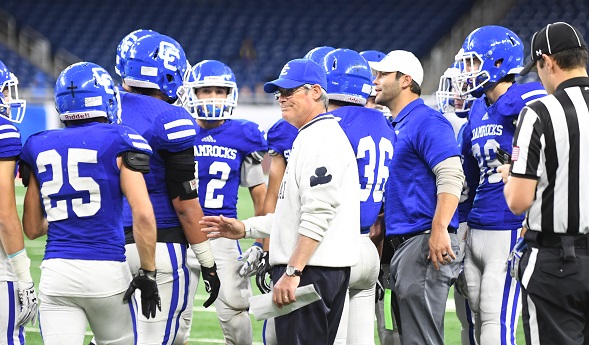
Mach, 69, had been contemplating retirement for some time and the reasons to do so gathered momentum after the Shamrocks lost to Detroit Cass Tech, 49-20, in the Division 1 Final in November.
“You’re not as inspired as you used to be,” Mach said. “I’ve gone back a couple of times on my decision. It wasn’t an easy decision. It was real hard. I prayed real hard that God would tell me what to do. It’s stressful. People count on you. I finally said to myself that you have the confidence that the next guy would carry on with what we did here.
“My first meeting with the players (at C.C.) was in 1976. I remember writing the speech. I thought of that. The 41 years and all of the things that came in between.”
When Mach wrote his last speech he incorporated what C.C. football meant to him and to the players he coached. He tried to reassure the players that the program, and what it is today, will remain so the next day and the day after that.
“The actual doing it was hard,” he said. “It was the hardest speech I’ve ever done.”
Mach was hired in 1976 after gaining experience as an assistant coach at Southgate Aquinas. He never thought administrators at C.C. would hire him. In his mind, why would they? He had no experience as a head coach, and he thought the experience of going through the hiring process would benefit him when he applied somewhere else. To Mach’s surprise, he was hired.
C.C. went 8-1 in Mach’s first season. He said that success was crucial for him and his staff to win over the players and administration. Had C.C. finished below .500, the future might have been different for him. As it was, the players warmed up to his way of coaching, and three years later the Shamrocks won the Class A title, the first of 10 under Mach.
“The first thing I thought of when I got hired was, how am I going to fair against guys like (Birmingham Brother Rice coach) Al Fracassa? If I make it five years, I’ll be happy,” Mach recalled. “What was good for me, the team I inherited was talented. I had written a book on football and my philosophy but there are always questions. I was thankful for that (initial success). Once that happened, the next group would buy into it. I did the same thing. I have a good group of guys coming back. I wanted to leave a good legacy for the next guy. Having that good start made people believe in my philosophy.
“We did it. We never changed anything. We proved it in the way we handled things, and the kids bought into it. We did it the right way.”
Last weeks, DCC did hire that “next guy” – Shamrocks defensive coordinator Dan Anderson, who was promoted to take over the program after working 20 years under the longtime mentor.
But the initial shock of not being the person in charge will take time to sink in for Mach. What he will lean on to make this transition as smooth as possible are his family and friends.
Mach fought with this decision, but what made him make it at this time was his family, notably his wife, Lynn. His wife had knee replacement on Jan. 10, and on April 4 she is scheduled to have the other knee replaced. Whether it’s hip replacement, knee replacement or any similar type of surgery, the process is painstaking, and the person going through it must have someone close to assist in the process.
Being that person, Mach knew this would take time away from coaching his team in the offseason had he chosen to stay. Lynn had physical therapy sessions three days a week, and the other four Mach would assist with the therapy at home.
In the end, it would have been too difficult to do both.
“I have to be her coach,” he said. “After (the knee replacement) I was with her two weeks, every day. I don’t think I’ve ever done that before. Fourteen days. But we did it.”
Mach said Lynn is recovering well and is anxious to have the other one done.
The Machs will spend much of their free time at the summer home just south of Gaylord. Though not a fisherman or hunter, Mach does enjoy the outdoors. Snowshoeing is one hobby he enjoys as well as taking walks, often long walks.
To add to his activities, Mach has a brother who lives in Williamsburg, just outside of Traverse City, and his sister lives near Gaylord.
They will enjoy the peacefulness that place provides, but they’ll remain residents in southeast Michigan. Their two sons, Mike and Joe, both assistant coaches in the football program, live in the Detroit area. The Machs have one granddaughter with another grandchild on the way.
“(Lynn) won’t move anywhere,” Mach said. “We have friends here. This is our home.
“It’s always great when I’m up there, and it’s always tough to leave. Now we’ll have more time to go there and won’t be in such a hurry to leave.”
Mach said he’ll remain in contact with Catholic Central and the people who have been so much a part of his life over the years. He’ll go to games and root for the Shamrocks from his seat in the stands.
To give back to the sport, Mach said he will consider speaking at clinics or schools if asked. He mentioned that Ferris State University and Royal Oak Shrine have made contact with him on such matters.
Mach’s resume is as impressive as any coach. His teams won 10 MHSAA Finals titles and seven other times reached championship games. Those numbers are staggering. In 41 seasons when a Tom Mach-coached team began practice in August, more than 41 percent of the time it would reach the last game of the season.
He also ends third on the list of career coaching victories. His record is 370-94. Only Fracassa (Brother Rice, Shrine) with 430 and John Herrington at Farmington Hills Harrison (425) have more.
But Mach was never keen on talking about his accomplishments. For him, success was measured by the development of his players – physically, mentally and spiritually – and the respect they showed for the game.
“Throughout my life, I’ve been lucky,” he said. “It was a hard decision when you work with people so long. The school is great. The people are great. They all inspired me. It’s the people I’ll miss. You become a coach because you love it.
“I love C.C. I want them to do well. I want them to make sure the kids here have every opportunity to win.”
 Tom Markowski is a columnist and directs website coverage for the State Champs! Sports Network. He previously covered primarily high school sports for the The Detroit News from 1984-2014, focusing on the Detroit area and contributing to statewide coverage of football and basketball. Contact him at [email protected] with story ideas for Oakland, Macomb and Wayne counties.
PHOTO: Detroit Catholic Central retiring football coach Tom Mach led his team to one last MHSAA Division 1 Final in the fall, against Detroit Cass Tech at Ford Field.