

Search Begins Again for 'Greatest Game'
By
Ron Pesch
MHSAA historian
August 27, 2016
There really is no place I’d rather be than in the stands of a high school football stadium on a Friday night. As summer fades to autumn, and leaves begin to fall, the smile on my face grows. It’s football weather. The days shorten and the hue of the evening sky deepens; the air turns crisp; hoodies come out; hot dogs and popcorn bring more joy than a finely catered meal. As the season progresses, hot chocolate becomes a drink to be cherished and appreciated.
As I’ve aged, my interest in the professional game has faded. My fascination with the college game continues to dwindle in direct relation to the increasing prices for a ticket to a game, the marketing hype generated by the changing of brands for overpriced athletic apparel and the escalating dollars involved in signing a coach.
The prep season presents the chance to step outside to enjoy my favorite part of the calendar. I’ll sit beneath lights, watching high school kids struggle with, then grasp, the components of the game. On some nights, I’ll again witness pure athleticism shred the defense of an unprepared squad. On others, I’ll watch a finely schooled team dismantle superior size and speed.
From those prep stands, I’ll continue to see moments where the underdog defeats the favorite; where the ordinary achieves the extraordinary; where tension and excitement erupts into a roar. I’ll stand and cheer as the high school band, enjoying its share of the spotlight, takes the field to play the national anthem and showcase its skills at halftime.
And again this season, I’ll settle in with hopes of finding the game I can call the greatest in state high school history.
My criteria is stringent, perhaps more stringent than the conditions held by others.
1) The margin should be close, ideally through most of the 48 minutes that comprise a contest. I’m really no fan of overtime.
2) The stakes should be high. Hence, this may favor late-season contests, where playoff implications and/or league championships are involved.
3) There should be history, where past battles between the schools have helped to establish a palatable dislike for the other, when the teams line up for a contest. Cross-town rivalries, where bragging rights and perhaps a trophy, are involved, enhance the value in my eyes. At the same time, playoff rivalries, where defeat is balanced between each, or where dominance by a single school is suddenly shattered, augment the importance of such a contest.
4) Weather conditions and controversy should not be a factor.
Over the years, I’ve watched or read about amazing comebacks, decisive thrashings, contests played under vicious weather conditions and marathon overtime battles. Each, some might argue, are challengers to the crown.
But I have yet to find a replacement for the current title-holder – a game played before my birth.
The reigning champ was christened as such by an authority. I’ve seen a small segment of that 1945 season-ending battle between Muskegon High School and Muskegon Heights High School, as captured by a home movie camera. In addition, I’ve viewed a series of amazing still photographs that portray the drama.
I’ll let the legendary Hal Schram set the stage.
“Seldom has one city dominated Michigan high school football as completely as Muskegon does this week,” stated the Detroit Free Press writer later known as “The Swami” for his tongue-in-cheek “all-knowing” ways when it came to predicting high school sports outcomes.
Schram’s Tuesday, November 6 column in the Free Press included his Class A Top Ten rankings. The Top Ten, used to identify the state’s best team based on enrollment classification, win-loss record and strength of schedule, was a relatively new approach to identifying the state’s best. The approach is still in use today.
“One month ago, Muskegon High occupied second place in the Top Ten while Muskegon Heights ranked sixth,” said Schram. “Today, Coach Leo Redmond’s Big Reds with a 16-game winning streak, and the Heights, with the best defensive record in state Class A football, rate first and second respectively.”
A week later, Schram’s ranking in the Free Press reflected the same result in Class A, heading into the season’s final week.
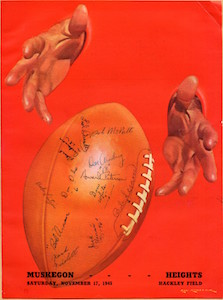 “Twenty-thousand Muskegon fans will watch their high school giants – Muskegon and Muskegon Heights – battle for a mythical Michigan championship Saturday. Only the limited seating capacity of the city’s Hackley Stadium prevents the attendance from reaching 30,000. Reserve seat tickets have been completely sold out for three weeks.
“Muskegon, with its 17-game winning streak, clings to its No. 1 rating among Michigan high schools for the third straight week, but the difference between the Big Reds and the Heights is infinitesimal.
“The Big Reds have scored 191 points to 38 for eight opponents while Muskegon Heights has rolled up 185 points to 37. Both have played almost exactly the same opponents and under identical conditions …
“The Heights will be gunning for its first triumph since 1943 over Muskegon, when the Tigers won, 7-0. The victor will also lay claim to the Southwestern Conference championship.”
It would take 30 years before the MHSAA created a playoff system to determine football state champions. Until that time, state titles were dispensed by the media, and hence were referred to as mythical, since they weren’t settled in a series of head-to-head contests played between contenders.
A total of 18 Big Reds and 23 Tigers would appear in their interscholastic football uniform for the final time. Eight seniors and three juniors would start the game for each team.
While the overall series dating back to 1922 favored Muskegon, in games played since 1930, the two teams were exactly even with each team having six victories and two ties over those previous 14 games. Coach Redmond had led the Big Reds since 1925. Oscar E. “Okie” Johnson took charge of the Heights in 1927 and would guide the Tigers until retirement following the 1963 season. The two coaches had been football teammates at Western State Normal School (today, Western Michigan University). Each coach had led their team to mythical state crowns in years past.
Statewide coverage of the pending heavy-weight battle enticed many from around the state to attend the game. A crowd of 13,500 – still the largest ever to visit Hackley – packed nearly every square inch of the stadium, bleachers and field. Countless others tuned in to the radio broadcast.
Servicemen, recently returned from World War II, helped hoist the flag during pregame ceremonies. The combined marching bands from each school opened the 2 p.m. program with the national anthem, and each entertained the crowd at halftime.
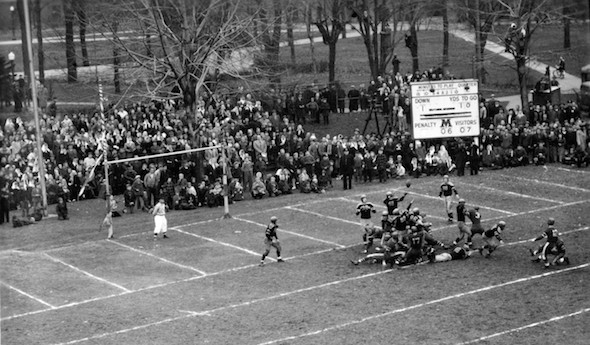
Muskegon won the toss and kicked off. The Heights unleashed their power early. Behind the running of Ed Petrongelli and backfield mate Paul Hulka, the Tigers rolled across mid-field, before a Petrongelli pass was picked off by Bob Clark on the Muskegon 15. The Big Reds were held on downs, and were forced to kick. Muskegon’s Bob Sikkenga, who averaged 30 yards on five punts during the day, gained a mere nine yards on his first kick of the afternoon, allowing the Heights to take control at the Muskegon 27. Petrongelli pounded ahead for four yards to the 23 before Jim Howell skirted the left side on the end around for the first score of the contest. Dorr Grover's placement was accurate, and Okie Johnson's Tigers led 7-0.
Muskegon bounced back, scoring midway through the second quarter of play. Starting at their own 35-yard line, Coach Redmond's backfield of Percy Moore, Bob McNitt and Howard Peterson alternated carries, pushing the ball to the Heights 31-yard line. Facing a 3rd-and-1 situation, Don Ohs replaced McNitt, and broke through off right guard for a first down on the Tiger 14. A Heights penalty advanced the ball to the 9. A pair of plays eked out only a yard, then McNitt was nailed behind the line on third down for a six-yard loss. Facing a 4th-and-goal, Peterson shot a pass toward McNitt at the goal line. Nearly intercepted by Ray McLean of the Tigers, the ball bounced into the waiting hands of the Muskegon back, and the Big Reds were a point away from a tie. But Tom Carr's kick went wide and low, and the Tigers clung to a one-point lead when the teams broke for the halftime intermission.
Much of the third quarter was played in Muskegon territory, with the Heights dominating. Still, neither team scored. As the teams entered the final quarter, a single point still separated victory from defeat.
Midway through the fourth, opportunity knocked for the Tigers as Jim Dotson recovered a Muskegon fumble on the Big Red 43. The Heights fans roared in approval as the Tiger offense lined up for action. But the momentum changed quickly as the Big Reds' Bob Anderson pounced on a Heights' fumble at the Tiger 48 on the first play from scrimmage.
 Redmond's squad went to the air. An incomplete pass was followed by a six-yard gain by Ted Barrett around left end. Another incomplete pass brought fourth down before Peterson found Bob Lintjer at the 30 yard line and he raced to the Heights 9, securing the first down.
The Big Reds were hit for a five-yard penalty on a substitution, so the squad lined up for a 1st-and-goal from the 14. Barrett quickly made up for the penalty, battling to the 4 yard line. On 2nd and goal, Muskegon again went to Barrett, who picked up three yards. Injured on the play, the halfback exited the game with the ball resting on the 1 yard line.
"On (the) last two plays rode the hopes of 13,500 fans, for or against the success of the attacking Big Reds," wrote Muskegon Chronicle sports editor, James F. Henderson. "On those two plays rode both State and Southwestern titles."
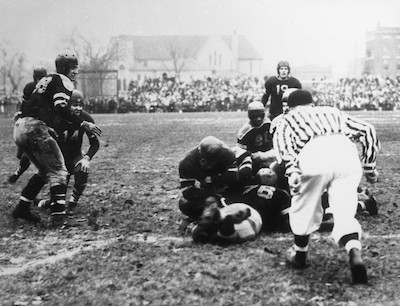
McNitt charged the center of the line on third down, but was stopped three inches from the end zone. Redmond's squad huddled to discuss its final play.
“We decided to go with a quarterback sneak on fourth," recalled Peterson years later. "I decided to use a long, variable, cadence count, in hopes of drawing them offside, in case we needed another shot. To their credit … neither line moved."
"When Jim Dotson, Everett Grandelius, Dick Ghezzi and Gene Hilliard stopped the forward motion of Howard Peterson, the air went dark with the applause of the Heights fans, and the groans of Muskegon's," wrote Henderson. "The ball, three inches from the goal line when play started, still was an inch from the line when it was set down."
“For the second straight year the mythical state high school football title belongs to greater Muskegon, penned Schram following the game. “No longer does the bunting fly over Muskegon High, but it is on display only a few miles away, at Muskegon Heights High. The Tigers laid claim to the title after conquering Muskegon 7 to 6”
As was tradition, following the game the Heights band marched back to its school, leading a victory parade of students celebrating a great day for football.
Seven players from the teams received all-state honors according to The Associated Press. Petrongelli and Dotson from the Heights, and Clark from Muskegon were all named to the first-team squad. Tigers Ghezzi and Howell and Big Reds Barrett and Anderson each earned mention on AP’s second or third all-state teams.
This July, after a long, distinguished career and blessed retirement, Tom Carr, the kicker for the Big Reds, passed away.
As a college student, I had the privilege to meet Carr. Signed to play baseball by the Chicago White Sox out of high school, Carr later earned his Master’s degree at Western Michigan University. Following graduation, he ascended to associate vice president of operations for the University. On the day of our meeting, he smiled, shook my hand, and greeted me with the words, “Hi, I’m Tom Carr – the guy who missed the extra point.”
Long ago, a friend stated that the main difference between male and female athletes is that the boys will carry the agony of defeat into manhood, and it will stay with them until the day they die. While it might have taken years to accept, the game would ultimately become a point of pride for all involved.
Among the crowd of spectators that day was Dick Kishpaugh, who served the MHSAA as high school historian for 50 years. Kishpaugh had come up from Southwest Michigan to attend the game. It was, in the opinion of my mentor, the greatest high school football game ever played in Michigan.
While I wasn’t in attendance, I still share his opinion.
Since that time, 70 years ago, I’d estimate more than 200,000 high school football games have been played in Michigan.
As we kick off another season of high school athletics, I’d love to hear your thoughts on the subject, as well as your candidates for honor of greatest game.
 Ron Pesch has taken an active role in researching the history of MHSAA events since 1985 and began writing for MHSAA Finals programs in 1986, adding additional features and "flashbacks" in 1992. He inherited the title of MHSAA historian from the late Dick Kishpaugh following the 1993-94 school year, and resides in Muskegon. Contact him at [email protected] with ideas for historical articles.
PHOTOS: (Top) Muskegon's Tommy Carr attempts an extra point against Muskegon Heights during their history-making matchup. (Middle) The game program from 1945. (Below) Heights stops Muskegon during its final goal line stand; Big Reds quarterback Howard Peterson is number 19. (Photos provided by Ron Pesch.)
MHSAA Opposes Big Ten Friday Football
November 2, 2016
By Geoff Kimmerly
Second Half editor
The executive director of the Michigan High School Athletic Association said today that he is “disappointed and disheartened” by the Big Ten Conference announcement that it will play and televise football games on Friday nights beginning with the 2017 season.
Friday night football remains one of the strongest and longest-standing traditions in high school athletics, and the MHSAA has fought since the start of this century to keep Friday nights sacred against the overstepping of college football and the damage televised Big Ten games are now expected to cause to attendance and media coverage of the sport at the high school level.
MHSAA Executive Director John E. “Jack” Roberts was contacted by both Big Ten Conference commissioner Jim Delany and Michigan State University athletic director Mark Hollis before the decision was announced. Roberts said he is appreciative of Michigan State and University of Michigan’s low tolerance to be included in this venture – at most, both will host a Thursday or Friday night game during Labor Day weekend and play one Friday night away game during the remainder of a season – but remains frustrated that similar respect for high school football was not shown by the conference as a whole.
Michigan State has played Friday night games during Labor Day weekend the last six seasons, hosting five and playing at Western Michigan University in 2015. However, most Michigan high school games continue to be scheduled and played on the Thursday before Labor Day, relieving holiday travel conflicts in most communities. University of Michigan did play on the Thursday before Labor Day at University of Utah in 2015, but has not played on a Friday night of Labor Day weekend this decade. The Wolverines are one of five Big Ten schools without a Friday night game in 2017.
“We are saddened by this decision. We had hoped that the Big Ten Conference would stay above this. We think this cheapens the Big Ten brand,” Roberts said. “Fans won’t like this. Recruits won’t like this. And high school football coaches won’t like this.
“We are grateful that Michigan State University and the University of Michigan are trying to minimize the effects of this decision by the Big Ten. But overall, this is just the latest step by major college athletics in the pursuit of cash that is just crushing high school sports.”
The MHSAA has shown its opposition to the use of Friday nights for televised collegiate football games for more than 15 years, dating back to 2001 when the NCAA lifted its restrictions on Friday night telecasts, which at first led to the broadcasting of “mid-major conference” games on the same night traditionally reserved for high school athletes.
The MHSAA launched in 2001 its “Save Our Friday Nights” campaign to emphasize the role that Friday night high school athletic events play in communities and to rally MHSAA member schools to contact NCAA member school football coaches, athletic directors and conference commissioners to voice their concerns.
In addition to causing lower attendance at events going up against Big Ten football games, Roberts anticipates that Friday night college games also will leave high school football as a secondary priority in many media markets. More than 80 radio stations statewide cover high school games regularly, but many also carry Michigan State or University of Michigan football. High school football could lose significant time on local TV highlights shows and in print and online coverage as well, as resources are diverted to cover a college game – potentially quieting significantly the positive buzz that comes from the typical high school football Friday night.
“Everyone knows that football is struggling right now,” Roberts said. “It’s getting a lot of bad publicity. Participation is declining. And now this; there couldn’t be worse timing.”
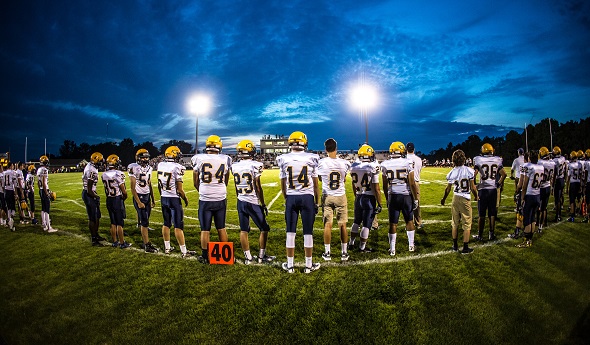
PHOTO: Grand Ledge takes on Okemos under the Friday night lights this season. (Click to see more from HighSchoolSportsScene.com.)