

Shores' QB Stands Tall During 2-0 Start
September 6, 2017
By Tom Kendra
Special for Second Half
Muskegon Mona Shores certainly has a scary offense, with Division I college receiving prospects on the edges, two powerful running backs and a much-improved offensive line.
 If only the Sailors had a taller quarterback.
If seventh-year Mona Shores coach Matt Koziak had a nickel for every time he’s heard some variation of that statement, he’d be an extremely wealthy man.
“People who say things like that don’t know Tristan Robbins,” Koziak said of his 5-foot-10, 173-pound senior quarterback in his second year as the starter. “He is tough, he is fearless and he is a leader – the guys rally around him. We are very happy with our quarterback.”
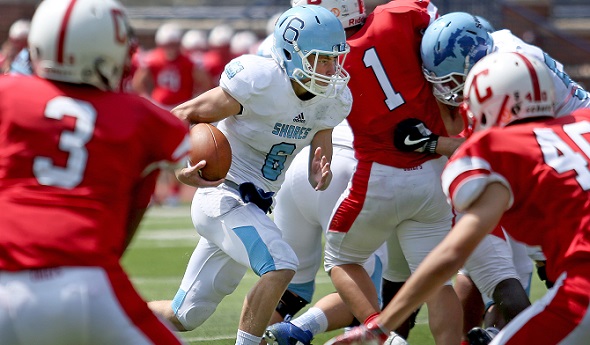
Robbins has come up big in two impressive wins – completing 7 of 11 passes for 137 yards and rushing for another 47 yards in a 41-23 win over Canton at the University of Michigan on Aug. 26, then turning around and completing 7 of 13 passes for 129 yards, with 90 yards rushing, in a come-from-behind, 42-20 win at Zeeland West last week.
Robbins has the chance to prove the doubters wrong again this Friday, in the first of two blockbuster home games on the Mona Shores schedule this fall.
Rockford, the perennial Ottawa-Kent Conference Red powerhouse, comes to the lakeshore this week, led by 6-5 senior quarterback Jason Whittaker, who has committed to continue his career at Northwestern University. On Oct. 13, the Sailors welcome cross-town rival Muskegon, the winningest program in state history, which features a Division I quarterback of its own in 6-2 senior La’darius Jefferson, who has verbally committed to sign with Central Florida.
Robbins is ready to rise to the challenge.
“I just go out there and do what I can with what I’ve been given,” said Robbins, the middle child and only son of Brent and Jane Robbins. “Our offense has been doing great so far. Now we get a home game and it should be a huge crowd, and that will just add to the excitement.”
Robbins was thrust into the starting role in last year’s opening game as a junior after senior starter Drew Switzer broke his collarbone in the preseason scrimmage. Robbins threw four interceptions as the Sailors struggled to a 1-3 start, which ultimately kept them out of the playoffs for the first time in three years. But since that rough beginning, Robbins has thrown 13 TD passes without a single interception, leading Shores to six wins in its last seven games.
“He has grown more and more comfortable in his role,” explains Koziak, who led Shores to the Division 2 championship game in 2015. “We rely on our quarterbacks to make a lot of reads, before the play and during the play, and he’s done a great job.”
 Robbins follows in the footsteps of two standout, pro-style quarterbacks in Tyree Jackson (6-7), who is now the starting quarterback at the University of Buffalo, and Tyler Trovinger (6-1), the starting shortstop on the Oakland University baseball team.
Koziak said Robbins makes up for his lack of size with a series of intangibles.
• First, Robbins is a 4.0 student whose intelligence pays dividends in a complicated offense.
Lining up almost exclusively in the pistol formation, Robbins triggers an offense which features a pair of Division I prospects at wideout in junior Damari Roberson (6-2, 190) and senior Keyshawn Summerville (6-0, 175). Charles Allen and Ke’Sean Sandifer are dangerous in the slot and senior Dee Davis and junior Sincere Dent have been a potent 1-2 punch in the backfield.
Who gets the ball on any given play depends largely on the position of the defense, explains Koziak, and the responsibility of reading the defense falls largely on Robbins.
• Second, he possesses incredible leadership skills.
Understand that Robbins is far from a prima donna quarterback; he’s a wrestler in the winter and played rugby for the first time last spring (“I loved it,” Robbins explained). He regularly inspires his teammates by lowering his shoulder and “laying it out” for his team.
• Third, and perhaps most importantly, what he lacks in size and/or pure athletic ability, he makes up for in an underrated category: grit.
Robbins’ true grit was on display at a critical moment of the Sailors’ victory at Zeeland West on Friday. Holding a slim 21-20 lead midway through the third quarter, Shores faced a crucial 4th-and-4 situation at the Zeeland West 16-yard line. After a timeout, Shores ran its outside veer, where Robbins had the ball with the choice of handing off to Dent, pitching wide to Allen or keeping it himself.
“The linebacker went right for (Dent) and I saw a little room and thought I could get it, so I kept it myself,” explained Robbins. “I was able to get around the corner and make it to the end zone.”
After opening the season with a 340-mile roundtrip to Ann Arbor and 88 miles back-and-forth to Zeeland last Friday, the unbeaten Sailors are expecting a packed house for their showdown with Rockford. This will be the fourth straight season the teams have played; the Rams hold a 2-1 edge in the recent series and won last year 37-23.
Adding to the excitement (and certainly the crowd size), Friday’s game will be the second “Sailor Salute” – a massive tribute to all of those who serve the country and their communities, complete with military responder vehicles, a U.S. Army Lakota Helicopter, 300 motorcycles, elementary students singing the national anthem on the field and even a pre-game performance by a U.S. Army rock band.
Robbins can’t wait to do his “small” part on what could be another huge night for the new-look Mona Shores football program, which made the playoffs for the first time since 2013 but has returned twice and posted four straight winning seasons.
“We do so much work and so much conditioning when no one else is around, which is no fun while you’re doing it, but it pays off on Friday nights,” said Robbins. “I can’t wait for Friday night.”
 Tom Kendra worked 23 years at The Muskegon Chronicle, including five as assistant sports editor and the final six as sports editor through 2011. E-mail him at [email protected] with story ideas for Muskegon, Oceana, Mason, Lake, Oceola, Mecosta and Newaygo counties.
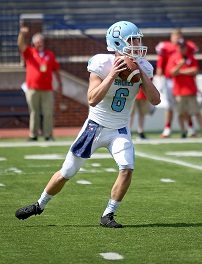
PHOTOS: (Top) Muskegon Mona Shores quarterback Tristan Robbins finds a crease during his team’s Week 1 win over Canton. (Middle) Robbins drops back to pass during that victory. (Photos courtesy of Muskegon Mona Shores High School.)
Off to Fast Start, Gunsells Aspiring to Assemble Lasting Ludington Legacy
By
Tom Kendra
Special for MHSAA.com
September 11, 2025
Cameron Gunsell has been building things at Ludington High School his entire life.
 “One of my earliest memories is making forts with the blocking dummies with my older brother during football practices,” recalled Gunsell of his and older brother Wilson’s adventures.
The Gunsells are now building something much bigger and more permanent at Ludington – with dad, Charlie Gunsell, in his 22nd and final year as the Orioles’ head football coach, Wilson an assistant coach and Cameron the team’s unquestioned leader and senior quarterback.
Cameron has rushed for nine touchdowns and thrown for three more over the first two weeks, leading Ludington to lopsided road wins over Coopersville and rival Mason County Central and heading into Friday’s home and West Michigan Conference Lakes opener against Fremont.
There is a buzz in this small town, best known for its Lake Michigan car ferries, which hasn’t won a football conference title since 1999 and has only one playoff victory in school history, which came during the COVID year of 2020.
“We definitely feel like this is our time,” said Cameron, 18, who is three years younger than his only sibling, Wilson. “Our motto this year is ‘Wake People Up.’ We brought back a ton of playmakers and had the best offseason in the weight room getting ready.”
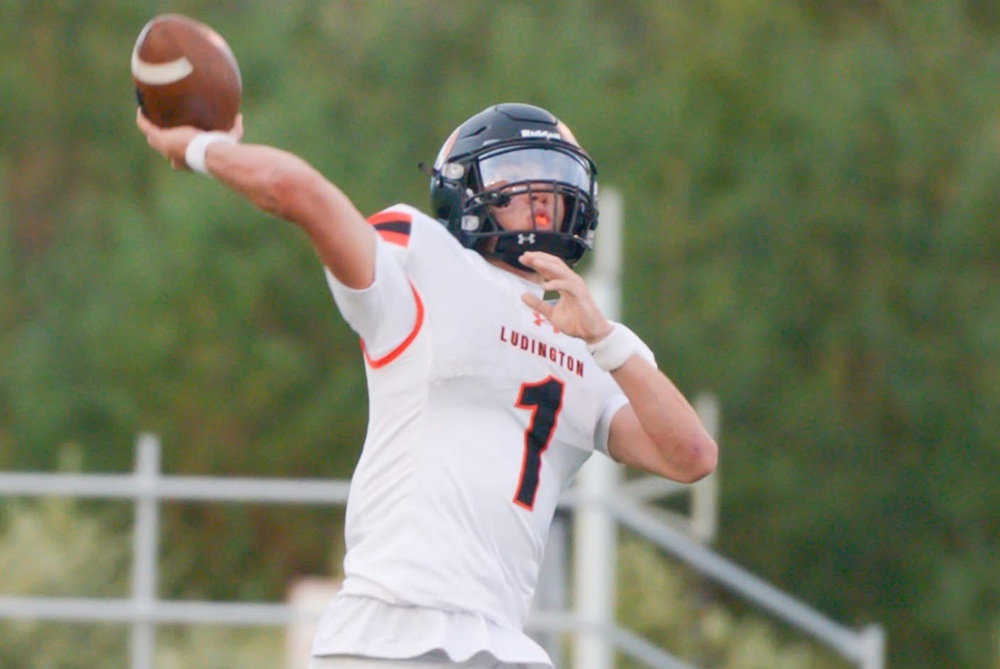
The Orioles started making noise right away at Coopersville, where Cameron carried the ball 34 times for 246 yards and five touchdowns while completing 8-of-11 passes for 116 yards and a TD. He also made a team-high six tackles from his free safety position.
Last week, he was back at it against rival MCC in the Lumberman’s Cup, this time doing more damage through the air completing 8-of-15 passes for 245 yards and two scores while rushing 16 times for 161 yards and four TDs. He again led the team with eight tackles.
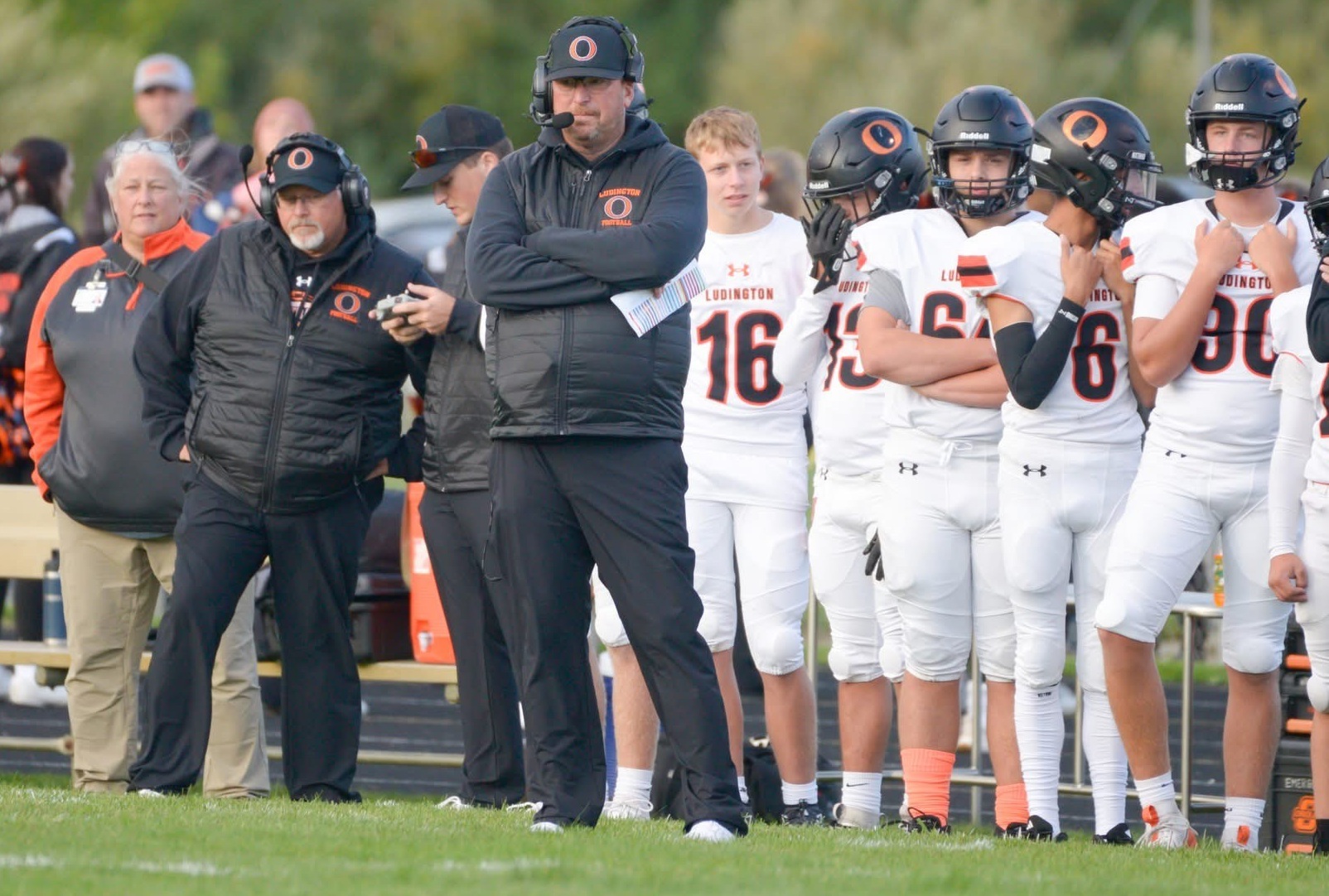
“It’s uncomfortable for me as the head coach talking about my son, but he is really good,” said Charlie Gunsell, a Caro native who was the starting quarterback at Ferris State in 1997. “Cam is so stinking competitive, and 80 percent of what we do offensively is a read through him. He is the guy who makes us click on both sides of the ball.”
 Cameron (6-foor-3, 190 pounds), in his third year as the starting quarterback, is closing in on 4,000 passing yards and 3,000 rushing yards for his career. His play caught the attention of college scouts, drawing scholarship offers from Grand Valley State, Davenport and reigning Division II national champion Ferris.
Gunsell announced last month that he would be following in his dad’s footsteps at Ferris, which he said was not an easy decision.
“I honestly was really close to choosing Grand Valley,” said Cameron, who completed 70 percent of his passes last season. “But, in the end, I have always wanted to be a Bulldog. Just like here at Ludington, I grew up going to football games at Ferris.”
With that choice behind him, Cameron is focused on the immediate goal of helping his team unseat Whitehall, which has won three straight WMC Lakes titles, and then making a run in the Division 4 playoffs.
He knows that defenses are going to be keying on him and stacking the box after his fast start.
“If they want to focus on me, that’s great for us,” explained Cameron, who lines up in the shotgun every play and distributes the ball to the Orioles’ four-wide skill players. “We have a lot of other weapons this year.”
The leading receiver is junior Taj Williams with seven catches for 142 yards over two games, while sophomore Kyle Himes has three catches for 122 yards.
Ludington actually features three Himes brothers, with freshman Mikie Himes the team’s second-leading rusher through two games with 88 yards. Junior Messiah Himes is a dangerous running and receiving threat from his slot position.
“We have a lot of kids who deserve touches, and they will get them as we get into our conference games and everyone tries to take Cam away,” said Gunsell, who is assisted by offensive coordinator Brent Gillett and defensive coordinator JP Deines.
Coach Gunsell points to conference foes like Oakridge, Montague, Orchard View and Whitehall as teams that have had the type of playoff success his team wants to emulate.
In order to make a run, he said the team must get the job done up front, where they are led by seniors Walt Autrey (6-4, 298), Colin Shelton and Connor Chaney.
“We have had talented players before, but our biggest thing up here is, are we tough enough?” said Gunsell. “These kids have worked so hard in the weight room to get stronger and to make that toughness our calling card.”
 Tom Kendra worked 23 years at The Muskegon Chronicle, including five as assistant sports editor and the final six as sports editor through 2011. E-mail him at [email protected] with story ideas for Muskegon, Oceana, Mason, Lake, Oceola, Mecosta and Newaygo counties.
PHOTOS (Top) Ludington quarterback Cameron Gunsell launches a pass during his team’s win over Mason County Central last week. (Middle) Gunsell’s father and head coach, Charlie Gunsell (in headset) monitors the action from the sideline. (Photos by Jason Goorman/Local Sports Journal.)