

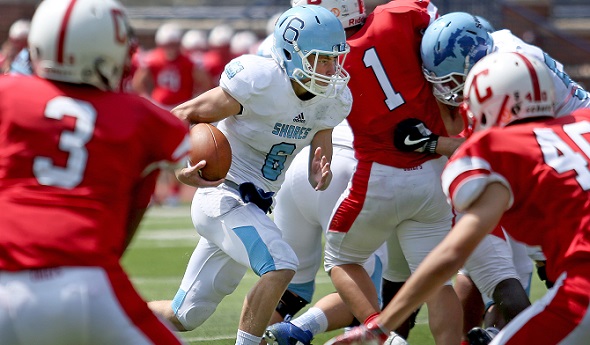
Shores' QB Stands Tall During 2-0 Start
September 6, 2017
By Tom Kendra
Special for Second Half
Muskegon Mona Shores certainly has a scary offense, with Division I college receiving prospects on the edges, two powerful running backs and a much-improved offensive line.
 If only the Sailors had a taller quarterback.
If seventh-year Mona Shores coach Matt Koziak had a nickel for every time he’s heard some variation of that statement, he’d be an extremely wealthy man.
“People who say things like that don’t know Tristan Robbins,” Koziak said of his 5-foot-10, 173-pound senior quarterback in his second year as the starter. “He is tough, he is fearless and he is a leader – the guys rally around him. We are very happy with our quarterback.”
Robbins has come up big in two impressive wins – completing 7 of 11 passes for 137 yards and rushing for another 47 yards in a 41-23 win over Canton at the University of Michigan on Aug. 26, then turning around and completing 7 of 13 passes for 129 yards, with 90 yards rushing, in a come-from-behind, 42-20 win at Zeeland West last week.
Robbins has the chance to prove the doubters wrong again this Friday, in the first of two blockbuster home games on the Mona Shores schedule this fall.
Rockford, the perennial Ottawa-Kent Conference Red powerhouse, comes to the lakeshore this week, led by 6-5 senior quarterback Jason Whittaker, who has committed to continue his career at Northwestern University. On Oct. 13, the Sailors welcome cross-town rival Muskegon, the winningest program in state history, which features a Division I quarterback of its own in 6-2 senior La’darius Jefferson, who has verbally committed to sign with Central Florida.
Robbins is ready to rise to the challenge.
“I just go out there and do what I can with what I’ve been given,” said Robbins, the middle child and only son of Brent and Jane Robbins. “Our offense has been doing great so far. Now we get a home game and it should be a huge crowd, and that will just add to the excitement.”
Robbins was thrust into the starting role in last year’s opening game as a junior after senior starter Drew Switzer broke his collarbone in the preseason scrimmage. Robbins threw four interceptions as the Sailors struggled to a 1-3 start, which ultimately kept them out of the playoffs for the first time in three years. But since that rough beginning, Robbins has thrown 13 TD passes without a single interception, leading Shores to six wins in its last seven games.
“He has grown more and more comfortable in his role,” explains Koziak, who led Shores to the Division 2 championship game in 2015. “We rely on our quarterbacks to make a lot of reads, before the play and during the play, and he’s done a great job.”
 Robbins follows in the footsteps of two standout, pro-style quarterbacks in Tyree Jackson (6-7), who is now the starting quarterback at the University of Buffalo, and Tyler Trovinger (6-1), the starting shortstop on the Oakland University baseball team.
Koziak said Robbins makes up for his lack of size with a series of intangibles.
• First, Robbins is a 4.0 student whose intelligence pays dividends in a complicated offense.
Lining up almost exclusively in the pistol formation, Robbins triggers an offense which features a pair of Division I prospects at wideout in junior Damari Roberson (6-2, 190) and senior Keyshawn Summerville (6-0, 175). Charles Allen and Ke’Sean Sandifer are dangerous in the slot and senior Dee Davis and junior Sincere Dent have been a potent 1-2 punch in the backfield.
Who gets the ball on any given play depends largely on the position of the defense, explains Koziak, and the responsibility of reading the defense falls largely on Robbins.
• Second, he possesses incredible leadership skills.
Understand that Robbins is far from a prima donna quarterback; he’s a wrestler in the winter and played rugby for the first time last spring (“I loved it,” Robbins explained). He regularly inspires his teammates by lowering his shoulder and “laying it out” for his team.
• Third, and perhaps most importantly, what he lacks in size and/or pure athletic ability, he makes up for in an underrated category: grit.
Robbins’ true grit was on display at a critical moment of the Sailors’ victory at Zeeland West on Friday. Holding a slim 21-20 lead midway through the third quarter, Shores faced a crucial 4th-and-4 situation at the Zeeland West 16-yard line. After a timeout, Shores ran its outside veer, where Robbins had the ball with the choice of handing off to Dent, pitching wide to Allen or keeping it himself.
“The linebacker went right for (Dent) and I saw a little room and thought I could get it, so I kept it myself,” explained Robbins. “I was able to get around the corner and make it to the end zone.”
After opening the season with a 340-mile roundtrip to Ann Arbor and 88 miles back-and-forth to Zeeland last Friday, the unbeaten Sailors are expecting a packed house for their showdown with Rockford. This will be the fourth straight season the teams have played; the Rams hold a 2-1 edge in the recent series and won last year 37-23.
Adding to the excitement (and certainly the crowd size), Friday’s game will be the second “Sailor Salute” – a massive tribute to all of those who serve the country and their communities, complete with military responder vehicles, a U.S. Army Lakota Helicopter, 300 motorcycles, elementary students singing the national anthem on the field and even a pre-game performance by a U.S. Army rock band.
Robbins can’t wait to do his “small” part on what could be another huge night for the new-look Mona Shores football program, which made the playoffs for the first time since 2013 but has returned twice and posted four straight winning seasons.
“We do so much work and so much conditioning when no one else is around, which is no fun while you’re doing it, but it pays off on Friday nights,” said Robbins. “I can’t wait for Friday night.”
 Tom Kendra worked 23 years at The Muskegon Chronicle, including five as assistant sports editor and the final six as sports editor through 2011. E-mail him at [email protected] with story ideas for Muskegon, Oceana, Mason, Lake, Oceola, Mecosta and Newaygo counties.
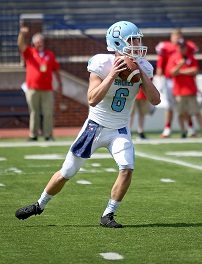
PHOTOS: (Top) Muskegon Mona Shores quarterback Tristan Robbins finds a crease during his team’s Week 1 win over Canton. (Middle) Robbins drops back to pass during that victory. (Photos courtesy of Muskegon Mona Shores High School.)
Kzoo Rivals Unite to 'Crush Cancer'
September 14, 2016
By Geoff Kimmerly
Second Half editor
Kalamazoo football players clad in pink and teal took to Loy Norrix’s football field Friday for one of southwest Michigan’s most anticipated annual rivalry games – but also, with the help of some notable alumni, to continue to spread the word about cancer awareness.
Kalamazoo Central downed Loy Norrix 41-13 in the Cross-town Crush Cancer game, Central wearing pink jerseys symbolic of breast cancer awareness and Loy Norrix in teal signifying ovarian cancer awareness.
The jerseys were provided in large part by a donation by former Loy Norrix stars Tico and Todd “T.J.” Duckett, who served as "ambassadors" for the evening along with another past Loy Norrix star, Little John Flowers, past Kalamazoo Central football standout Duane Young and past Central baseball standout Kevan Hess. Both Duckett brothers, Flowers and Young starred at Michigan State before spending time in the NFL, Young and T.J. Duckett playing professionally for six seasons each. Hess was drafted by the Tigers out of Western Michigan University in 2009 and played three seasons in Detroit’s minor league system.
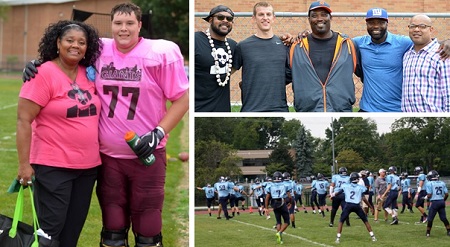 The teal jerseys had particular meaning for Tico and T.J. Duckett, as their mother Jackie Barham died after a fight with ovarian cancer.
“We chose a time such as this because of the anticipated large attendance and the potential for the greatest impact amongst our alma mater’s community members,” said the Duckett brothers in a statement leading up to the game. “Our own mother, Jackie Barham, would have celebrated more birthdays, if there was a cure for cancer. This is just one way that we can honor her memory.”
The jerseys featured the teams’ mascot names and also the Kalamazoo cityscape. Junior varsity players from both schools wore T-shirts with their dates of graduation and the cityscape as well as organizers set a theme of the entire community standing together for a common fight against cancer. The event was organized by a Kalamazoo Central parent committee headed by Terri Benton-Ollie together with administrators and other supporters representing both school communities.
Students from both schools were joined on the field at halftime by 50 cancer survivors from the community, and funds raised will be donated to the West Michigan Cancer Center.
“We know that we must ‘tackle’ so many of our societal ills,” Benton-Ollie said. “Tragedy can be a disastrous one-moment incident or a phenomenon that must be reversed or a disease that lurks amongst us. Let’s create a ripple effect of continuous gestures and action that work in favor of the greater good and crush cancer.”
Click for more from Kalamazoo Public Schools.
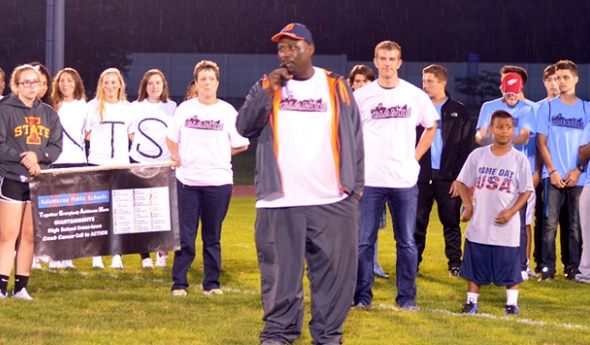
PHOTOS: (Top) Former NFL player Duane Young speaks to the crowd during halftime of the "Crush Cancer" game. (Middle) Supporters and teams wore pink and blue signifying, respectively, breast and ovarian cancer awareness; the game's ambassadors were (from left) T.J. Duckett, Kevan Hess, Duane Young, Little John Flowers and Tico Duckett. (Photos by Walter Hall.)