

Snowbirds Soar Again As 8-Player Power
October 4, 2019
By Chris Dobrowolski
Special for Second Half
GAYLORD — After the first three weeks of the football season, it didn’t look like anyone was going to be able to stop Gaylord St. Mary.
 The Snowbirds, after all, had scored 215 points over three convincing victories during their first season since making the move to compete as an 8-player team.
But that high-powered, explosive offense was ground to a halt over the last two weeks. It wasn’t because of a sudden lack of execution by St. Mary. Nor was it due to a stout defense rising to the occasion. Rather, it was back-to-back forfeits by opponents who weren’t able to field teams that sidelined the Snowbirds’ dynamic attack with an unwanted midseason break.
“Our kids want to play, but unfortunately it is what it is,” said Gaylord St. Mary head coach Kevin O’Connell. “It stunk for the kids because I know they really wanted to look forward to Friday nights, especially homecoming.”
St. Mary tried to turn the two-week pause into a positive. They hit the reset button and went back to focusing on fundamentals, with short periods of live contact during quick, but effective practices.
“Our practices have been nothing short of awesome,” said O’Connell.
St. Mary will find out this week against Suttons Bay if the time off disrupted its offensive flow. But the players are confident the break was not a hinderance.
“I don’t think it broke our rhythm. I think it brought us closer together,” said quarterback Brady Hunter. “We were able to bang heads with each other, get some frustration out.”
Hunter is one of a multitude of weapons the Snowbirds have in their veer option attack. The senior quarterback is joined by a stable of talented running backs in seniors Steven Koscielniak and Logan Murrell, and juniors Christopher Koscielniak and Dominic Keister. Senior center Rory Curran anchors the offensive line.
“I like this offense,” said Steven Koscielniak. “This is what our team is about, quick and fast.”
While the Snowbirds’ scoreboard numbers are eye-popping, the team’s individual stats are more modest – partly because those main threats didn’t play in second halves of two games St. Mary was thoroughly dominating. Also, there is enough talent on board to share the wealth and not miss a beat.
“It’s everybody. There’s not just one player who runs it. It’s the whole team,” said Steven Koscielniak.
 As the quarterback, however, Hunter is thrust into the important role of leading the group, a task he does well. The three-sport standout, who also excels at basketball and baseball, fittingly, has his pilot’s license.
“He’s one of the best leaders,” Steven Koscielniak said. “No doubt about it. He pushes us to the next level. He pushes us in practice, when we’re lifting.”
“He conducts himself the right way in everything,” O’Connell said of his signal caller. “He conducts practices. He speaks respectfully. He’s a great leader.”
Each of St. Mary’s skill players are returning starters, but it’s been a completely different experience this season for the Snowbirds, who were depleted by injuries and suffered through a 2-7 grind a season ago.
“We took our lumps,” said O’Connell, in his seventh year in charge of the Snowbirds. “A lot of that had to do with we were senior-laden the year prior and then a lot of the seniors last year didn’t get quality reps the year prior. High school football is extremely cyclical.”
Still, St. Mary had a good outlook for 2019. It had speed, athleticism, leadership and experience all on its side, plus a better fit as an 8-player team for a school its size.
“We definitely saw it coming,” said Hunter. “Last year we had a little bit of a rough season. Coming into 8-man we had all of our skill players returning. We knew this offensive power was here.”
The offense has been so impressive that it overshadows what the defense can do, but St. Mary is tough on that side of the ball as well. The Snowbirds’ depth allows them to have only a few players who play on both sides of the ball. Kyle Murphy and Chris Grody are disruptive on the defensive line, while Murrell leads the defensive backfield and Christopher Koscielniak – who his coach lauds for his toughness – is an all-state caliber linebacker.
“He’s not physically imposing, but he is so tough,” said O’Connell. “He’s disciplined. He’s good.
“We’re not big in stature. We just have a lot of tough kids.”
The astonishing thing is the Snowbirds have only started to tap their potential on offense. The team hasn’t even utilized some of its capabilities yet.
“We like to spread ourselves so we’re very diverse. If a team comes and stops our run, we’ve got a great spread offense, a great wing set and a lot of stuff we can throw at them,” said Hunter.
The time to introduce some of that could be coming as the schedule ramps up considerably when St. Mary finally steps back onto the field. The matchup at Suttons Bay is a showdown between unbeaten teams and is followed by contests against a pair of current 4-1 teams in Vestaburg and Mio — the latter a rematch from a 48-32 Week 2 game — and 3-2 Brethren.
“It’s definitely going to be fun,” said Hunter. “Those blowout games aren’t really fun for anyone. Suttons Bay’s a great team. Mio, (Vestaburg and Brethren) — they’re all great teams. It’s going to be a good battle towards the end of the season, and it’s really going to prepare us for playoffs.”
 Chris Dobrowolski has covered northern Lower Peninsula sports since 1999 at the Ogemaw County Herald, Alpena News, Traverse City Record-Eagle and currently as sports editor at the Antrim Kalkaska Review since 2016. He can be reached at [email protected] with story ideas for Manistee, Wexford, Missaukee, Roscommon, Ogemaw, Iosco, Alcona, Oscoda, Crawford, Kalkaska, Grand Traverse, Benzie, Leelanau, Antrim, Otsego, Montmorency, Alpena, Presque Isle, Cheboygan, Charlevoix and Emmet counties.
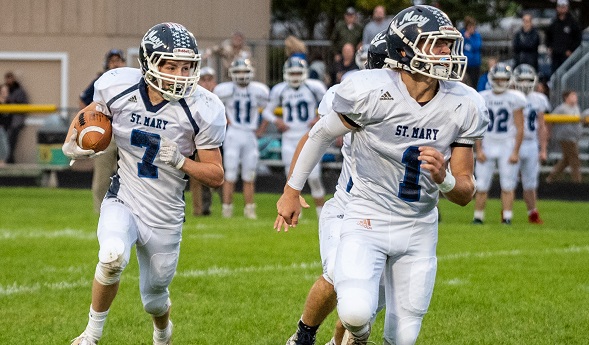
PHOTOS: (Top) Gaylord St. Mary’s Logan Murrell (7) follows Steven Koscielniak (1) and another blocker around the edge during a Week 3 win over Central Lake. (Middle) The Snowbirds bring down the Trojans' T.J. Schultz. (Photos by Sports in Motion.)

Zeeland West Puts 'T' in 3rd MHSAA Title
November 30, 2013
By Bill Khan
Special to Second Half
DETROIT — Danny Bauder would rather trade touches for trophies.
In most other offenses, a player of Bauder's ability would be a featured running back. What team wouldn't want to keep feeding the rock to a kid who ran for 1,796 yards and 28 touchdowns this season?
Bauder did all of that damage, despite the fact he shares the load in the shell game that is Zeeland West's run-oriented Wing-T offense.
He once again had maximum impact on minimal carries, running eight times for 144 yards and a touchdown in West's 34-27 victory over DeWitt in the MHSAA Division 3 championship game Saturday at Ford Field.
Two teammates had more carries than Bauder, as the Dux rolled up 441 rushing yards on 66 carries. Cole Hession had 26 carries for 122 yards, quarterback Casey Brinks had 11 carries for 66 yards and Grant Postma had six carries for 71 yards and two touchdowns.
They all shared in the same accomplishment with their teammates — West's third MHSAA title in the nine-year history of the school. The Dux (13-1) were Division 4 champions in 2006 and 2011.
"I love (our offense), because everyone has a chance to get the ball," said Bauder, who got things rolling with an 80-yard touchdown run on the second play from scrimmage. "We have three backs. We rotate them like every other drive. It's a good team offense. It's a team. I don't mind, just as long as we win."
 Led by its ground attack, West appeared to be on the verge of running away with this one, building a 28-7 halftime lead.
The Panthers wouldn't allow the Dux to coast to the championship that easily, however.
A 56-yard touchdown run by Chris Ruby and a 29-yard scoring strike from Jake Johnson to Josh Borta in a 72-second span got DeWitt within 28-20 with 6:50 left in the third quarter.
West responded with a 25-yard touchdown run by Brinks with 2:57 to go in the third, but an offense that averaged 48.9 points per game coming into the contest wouldn't score again. Junior defensive back Ben Zamiara led DeWitt's defensive charge with a game-high 20 tackles, 11 more than anyone else on either team. The Panthers held West to 1-for-4 on fourth-down conversions.
"I'm pretty sore right now," Hession said. "This is one of the games I've come out of the most sore. I can feel it right now, and my adrenaline is still rushing. Props to them, because they came out and they had three or four series where they stopped us on fourth down. Not many teams can do that. They're just good."
DeWitt closed the deficit to seven points when Johnson rolled left and hit a wide-open Borta for a 75-yard touchdown with 4:25 left in the game.
The Panthers' offense would watch the rest of the game on the sidelines. The Dux milked some clock by getting two first downs before dropping back to punt from its own 48 for the only time in the game. Postma barely got off the punt, but was knocked to the ground when a DeWitt defender caught him on the leg while going for a block. West retained the ball, running out the remaining 32 seconds by taking a knee one time.
"Our punter was already hurt," West coach John Shillito said. "He was on one leg. So, it was a great effort by Grant to get the ball off and it was a break for us. We knew the game was over. You knew that all you had to do was take a knee."
DeWitt coach Rob Zimmerman said going for the block was a risk the Panthers had to take, given the time on the clock and the potential field position.
"If they punt and pin us down at the 10, that's a long way to go," Zimmerman said. "We went for it. Obviously, it didn't turn out in our favor. You have to take chances when you're in that situation."
DeWitt tried in vain to play catch-up all night after falling behind 8-0 when Bauder took the ball around the left side of the Dux line and broke into the clear for an 80-yard touchdown just 45 seconds into the game. West, which attempted (and missed) only one extra-point kick all year, got two points on a pass from Brinks to Zach Poppema.
West scored on four of its five possessions in the first half, failing only on its second series when a fourth-and-five run from the DeWitt 13 came up a yard short.
The Dux shook off that temporary setback and scored on a 7-yard pass from Brinks to Hession on the first play of the second quarter. Hession ran for the 2-point conversion to make it 16-0.
Following a fumble at the West 49, the Dux took a 22-0 lead on an 18-yard run up the middle by Postma with 6:45 left in the first half. Brinks' conversion run failed.
DeWitt (13-1) finally put a drive together and got back in the game on a 4-yard touchdown pass from Johnson to Justice Shankel with 3:15 left in the first half. Cameron West's extra point made it a 22-7 game.
The Dux didn't get away from their ground game with time winding down in the first half, throwing only one pass on a seven-play, 80-yard drive that yielded a 12-yard touchdown run by Postma with 1:04 to go in the half. Postma's 2-point run failed, resulting in a 28-7 halftime lead for West.
"We dug ourselves too deep a hole," Zimmerman said. "I felt if we got one more possession, we had a shot."
Johnson, a junior, was 15 for 24 passing for 289 yards, three touchdowns and two interceptions for DeWitt. Brinks was 3 for 5 for 35 yards and a touchdown for West.
Borta grabbed five passes for 183 yards and two touchdowns.
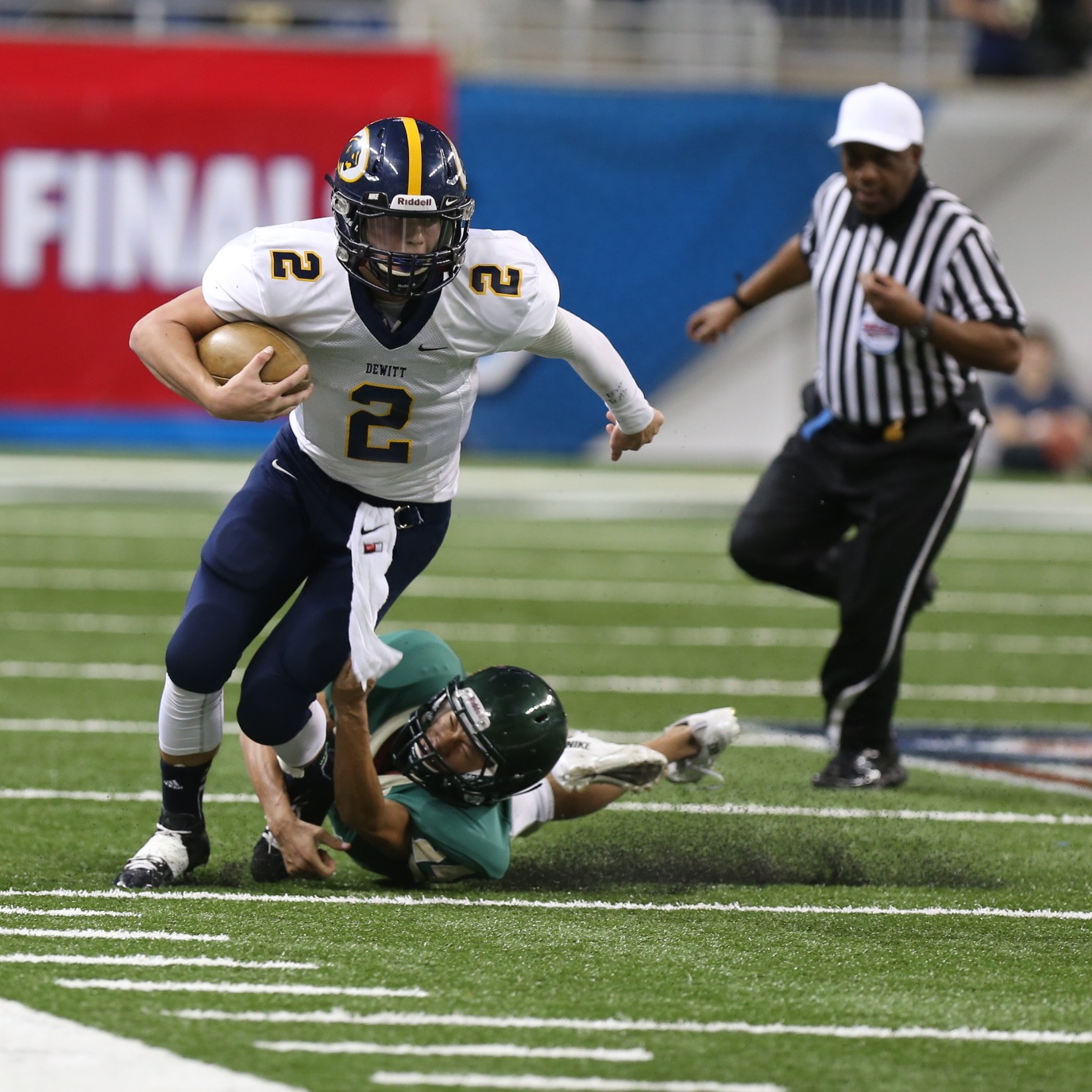
PHOTOS: (Top) Zeeland West running back Danny Bauder scampers ahead during Saturday's Division 3 Final. (Middle) DeWitt quarterback Jake Johnson tries to pull away from a Dux defender's grasp. (Photos by Hockey Weekly Action Photos).