

Snowbirds Soar Again As 8-Player Power
October 4, 2019
By Chris Dobrowolski
Special for Second Half
GAYLORD — After the first three weeks of the football season, it didn’t look like anyone was going to be able to stop Gaylord St. Mary.
 The Snowbirds, after all, had scored 215 points over three convincing victories during their first season since making the move to compete as an 8-player team.
But that high-powered, explosive offense was ground to a halt over the last two weeks. It wasn’t because of a sudden lack of execution by St. Mary. Nor was it due to a stout defense rising to the occasion. Rather, it was back-to-back forfeits by opponents who weren’t able to field teams that sidelined the Snowbirds’ dynamic attack with an unwanted midseason break.
“Our kids want to play, but unfortunately it is what it is,” said Gaylord St. Mary head coach Kevin O’Connell. “It stunk for the kids because I know they really wanted to look forward to Friday nights, especially homecoming.”
St. Mary tried to turn the two-week pause into a positive. They hit the reset button and went back to focusing on fundamentals, with short periods of live contact during quick, but effective practices.
“Our practices have been nothing short of awesome,” said O’Connell.
St. Mary will find out this week against Suttons Bay if the time off disrupted its offensive flow. But the players are confident the break was not a hinderance.
“I don’t think it broke our rhythm. I think it brought us closer together,” said quarterback Brady Hunter. “We were able to bang heads with each other, get some frustration out.”
Hunter is one of a multitude of weapons the Snowbirds have in their veer option attack. The senior quarterback is joined by a stable of talented running backs in seniors Steven Koscielniak and Logan Murrell, and juniors Christopher Koscielniak and Dominic Keister. Senior center Rory Curran anchors the offensive line.
“I like this offense,” said Steven Koscielniak. “This is what our team is about, quick and fast.”
While the Snowbirds’ scoreboard numbers are eye-popping, the team’s individual stats are more modest – partly because those main threats didn’t play in second halves of two games St. Mary was thoroughly dominating. Also, there is enough talent on board to share the wealth and not miss a beat.
“It’s everybody. There’s not just one player who runs it. It’s the whole team,” said Steven Koscielniak.
 As the quarterback, however, Hunter is thrust into the important role of leading the group, a task he does well. The three-sport standout, who also excels at basketball and baseball, fittingly, has his pilot’s license.
“He’s one of the best leaders,” Steven Koscielniak said. “No doubt about it. He pushes us to the next level. He pushes us in practice, when we’re lifting.”
“He conducts himself the right way in everything,” O’Connell said of his signal caller. “He conducts practices. He speaks respectfully. He’s a great leader.”
Each of St. Mary’s skill players are returning starters, but it’s been a completely different experience this season for the Snowbirds, who were depleted by injuries and suffered through a 2-7 grind a season ago.
“We took our lumps,” said O’Connell, in his seventh year in charge of the Snowbirds. “A lot of that had to do with we were senior-laden the year prior and then a lot of the seniors last year didn’t get quality reps the year prior. High school football is extremely cyclical.”
Still, St. Mary had a good outlook for 2019. It had speed, athleticism, leadership and experience all on its side, plus a better fit as an 8-player team for a school its size.
“We definitely saw it coming,” said Hunter. “Last year we had a little bit of a rough season. Coming into 8-man we had all of our skill players returning. We knew this offensive power was here.”
The offense has been so impressive that it overshadows what the defense can do, but St. Mary is tough on that side of the ball as well. The Snowbirds’ depth allows them to have only a few players who play on both sides of the ball. Kyle Murphy and Chris Grody are disruptive on the defensive line, while Murrell leads the defensive backfield and Christopher Koscielniak – who his coach lauds for his toughness – is an all-state caliber linebacker.
“He’s not physically imposing, but he is so tough,” said O’Connell. “He’s disciplined. He’s good.
“We’re not big in stature. We just have a lot of tough kids.”
The astonishing thing is the Snowbirds have only started to tap their potential on offense. The team hasn’t even utilized some of its capabilities yet.
“We like to spread ourselves so we’re very diverse. If a team comes and stops our run, we’ve got a great spread offense, a great wing set and a lot of stuff we can throw at them,” said Hunter.
The time to introduce some of that could be coming as the schedule ramps up considerably when St. Mary finally steps back onto the field. The matchup at Suttons Bay is a showdown between unbeaten teams and is followed by contests against a pair of current 4-1 teams in Vestaburg and Mio — the latter a rematch from a 48-32 Week 2 game — and 3-2 Brethren.
“It’s definitely going to be fun,” said Hunter. “Those blowout games aren’t really fun for anyone. Suttons Bay’s a great team. Mio, (Vestaburg and Brethren) — they’re all great teams. It’s going to be a good battle towards the end of the season, and it’s really going to prepare us for playoffs.”
 Chris Dobrowolski has covered northern Lower Peninsula sports since 1999 at the Ogemaw County Herald, Alpena News, Traverse City Record-Eagle and currently as sports editor at the Antrim Kalkaska Review since 2016. He can be reached at [email protected] with story ideas for Manistee, Wexford, Missaukee, Roscommon, Ogemaw, Iosco, Alcona, Oscoda, Crawford, Kalkaska, Grand Traverse, Benzie, Leelanau, Antrim, Otsego, Montmorency, Alpena, Presque Isle, Cheboygan, Charlevoix and Emmet counties.
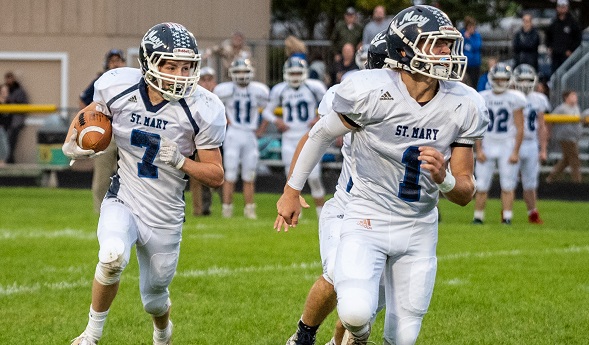
PHOTOS: (Top) Gaylord St. Mary’s Logan Murrell (7) follows Steven Koscielniak (1) and another blocker around the edge during a Week 3 win over Central Lake. (Middle) The Snowbirds bring down the Trojans' T.J. Schultz. (Photos by Sports in Motion.)

Longtime Crew Leader Harrelson Begins 32nd Season on Chains, Amid Cancer Fight
By
Tom Spencer
Special for MHSAA.com
September 11, 2026
First down! Move the chains.
 As a member of the Suttons Bay chain gang, Jim Harrelson doesn’t know how many more times he’ll follow the referee crew’s direction on the Norsemen sideline. Similarly, he has no idea how many times he’s already moved the chains.
But, in the meantime, every time he does, it will undoubtedly be a school record. An unofficial record of course, but a well-earned and appreciated achievement nonetheless.
Harrelson stepped on the field Wednesday night sporting a down marker for the 32nd straight year. This time, it was for the Norse’s middle school contest with Onekama. Harrelson was joined by Curt Murphy and Dave Faught. Mike Gordon, another regular member of the crew, was also on hand to celebrate Harrelson’s 32nd season.
Wednesday’s chain gang team was organized – no surprise – by Harrelson. It’s something he’s done on a volunteer basis for Suttons Bay the last 16 years.
Harrelson’s crews have staffed middle school, junior varsity and varsity football games, including the home contests during the Norsemen’s three straight seasons from 2019-21 that culminated in three trips to 8-Player Division 1 Finals. Harrelson, Faught, Murphy and Gordon are in their 10th season working together.
“The chain gang was always his baby, and he was always able to go find other people to help him out,” said Doug Periard, a long-time member of the Norse football coaching staff and former school athletic director. “Somehow he managed to get some of those who might not have done much in football, to suddenly come on board and enjoy doing it.”
Harrelson, who last spring retired from a coaching career spanning 35 years, has no intentions of letting anything get in the way of holding the down marker for the Norsemen.
 “I've always loved sports, and being a part of the chain gang was always big part of it,” Harrelson said. “The ADs didn’t have to worry about it, knowing it was taken care of.”
Jamie Hawkins, Suttons Bay’s principal and current athletic director, was on hand for Wednesday’s kickoff as well. Hawkins, one of the administrators who has relied on Harrelson, believes the community owes Harrelson a huge thank you, acknowledging he has marked more first downs than anyone could ever comprehend.
“Jim’s years as a coach and chain gang chief are an amazing commitment to our student-athletes, our football program, and the entire Suttons Bay community,” said Hawkins. “His time, energy, and passion have been a part of countless Friday nights and memories for generations of Norsemen.”
Harrelson, now 82, is battling cancer for the second time in his life. He was first diagnosed with colorectal cancer in 2010. Early this year, he was told cancer had returned.
Working with doctors and his wife of 53 years, Brenda, Harrelson picked a six-week treatment plan this summer timing it so he could return to the sidelines for the first football game. He’s awaiting word from his medical team on the outcome of the most recent treatment.
“I haven't let it dominate my life – everybody's going to have trials and tribulations no matter what,” Harrelson said of his cancer return. “Cancer is something that thousands of people find themselves having to deal with, and I'm pretty proud I've been able to function pretty much as normal as could be even though it’s obviously right there in front of me.”
Harrelson’s coaching journey began in 1991 with softball, drawn into the role as his children made their way through the Suttons Bay school system. He went on to serve as an assistant and head volleyball coach from 1996 through 2004.
Eventually he served as an assistant or head coach for Suttons Bay in golf, cross country and track.
 Among the highlights of his time on the volleyball bench was helping guide the 2001 squad all the way to the MHSAA Finals, where the team earned a runner-up finish in Class C.
A short while ago, Harrelson was honored with the Don Lukens Legacy Award at the Traverse City Record-Eagle John Lober Honor Roll Meet for his coaching of student-athletes from all four Leelanau County schools – Maple City Glen Lake, Leland, Lake Leelanau St. Mary’s and Northport (with some of that coaching was made possible through the schools becoming a part of a co-op with Suttons Bay).
Much of Harrelson’s coaching was on a purely volunteer basis – even while serving as a head coach responsible for running an entire program.
Now, Harrelson’s favorite thing is watching his grandchildren grow and compete in sports, while admiring his adult children’s great parenting.
Harrelson points to his first grandchild’s birth 15 years ago as a prime motivator during the first cancer round. The Harrelsons have seven grandchildren now, one of whom was playing volleyball Wednesday night for Suttons Bay’s middle school team – with Grandma in the stands.
And while he’s remembered fondly by Leelanau athletes and athletic directors for his coaching commitment and success, Harrelson has only one thought for his family legacy.
“I just hope if I’m remembered for anything by my grandchildren and my kids is that I handled cancer pretty well without letting it affect me in any way, shape, or form in how I behave, how I coach or whatever,” Harrelson said. “I am pretty doggone proud of the fact that I've been able to put that on the table and still be able to function.”
Periard already views Harrelson as a great student-athlete advocate and solution finder.
“It was an incredible amount of time he put in doing the stuff he did and how much he loved it,” recalled Periard. “Cross country, track, whatever he was called upon, he was there to help out. He's a jack of all trades, a great kids guy at heart.”
 Harrelson’s first paid coaching job was as an assistant for track in 2006. At the time he was hired by Cody Ingils, then the Suttons Bay athletic director and now a senior assistant director for the MHSAA.
Harrelson asked Inglis a decade ago to delivery his eulogy someday upon the veteran coach’s passing.
“Jim also always wanted the best for kids at every turn, and he wanted to be a positive force in kids’ lives – and I think Jim's ultimate takeaway is he met the kids where they were and tried to make sure that they got better,” Inglis said. “Jim was able to work with elite athletes, and he was able to work with kids that had never done that sport before. And that was the beauty of his coaching, is that it applied to anybody and everybody because of his positive way of dealing with kids.”
Harrelson, who points to track as his favorite sport to coach because of the camaraderie, is ready to keep moving the down marker as he battles the return of cancer.
“What I've been experiencing is part of who I am,” Harrelson said. “It’s just the cards I've been dealt. I just want to do it with class if I can.”
 Tom Spencer is a longtime MHSAA-registered basketball and soccer official, and former softball and baseball official, and he also has coached in the northern Lower Peninsula area. He previously has written for the Saginaw News, Bay County Sports Page and Midland Daily News. He can be reached at [email protected] with story ideas for Manistee, Wexford, Missaukee, Roscommon, Ogemaw, Iosco, Alcona, Oscoda, Crawford, Kalkaska, Grand Traverse, Benzie, Leelanau, Antrim, Otsego, Montmorency, Alpena, Presque Isle, Cheboygan, Charlevoix and Emmet counties.
PHOTOS (Top) Suttons Bay football chain gang leader Jim Harrelson plants his down marker on the sideline during Wednesday’s middle school game with Onekama. (2) Harrelson shakes hands with referee Ed Blough. (3) Harrelson stands for a photo with Suttons Bay principal and athletic director Jamie Hawkins, far left, past athletic director and longtime coach Doug Periard, far right, and his chain gang of (from left) Dave Faught, Curt Murphy and Mike Gordon. (4) Harrelson enjoys a break in the shade. (Top and sitting photos by Meredith McNabb Photography. Others by Tom Spencer.)