


Sold Out
December 13, 2016
We are sometimes criticized for limiting the scope of school sports – for restricting long-distance travel and prohibiting national tournaments; but there is no question that we are doing the correct thing by protecting school sports from the excesses and abuses that characterize major college sports.
Across the spectrum of intercollegiate athletics, but especially in Division I football and basketball, there exists an insatiable “keep-up-with-the-Joneses” appetite.
Universities are building increasingly extravagant facilities. They are sending their “students” into increasingly expansive scheduling. But it’s never enough.
There is always another university somewhere building a bigger stadium, a fancier press box or more palatial dressing rooms, practice facilities and coaches quarters.
So-called “students” are sent across the US and beyond to play on any day at any time in order to generate revenue to keep feeding the beast.
The Big Ten knows it’s wrong, admits it, but schedules football games on Friday nights to attract larger rights fees from television.
Feeling used or abused, some of the athletes of Northwestern and then at the University of Wisconsin, talk of creating a union to protect themselves from the obvious, rampant exploitation.
And then occasionally, some college coaches dare to suggest that high schools are wrong to have regulations that reject the road that colleges have traveled, a road that has distanced athletics very far from academics in intercollegiate sports.
The intercollegiate model is not and must not be the interscholastic model. We who are sold out for educational athletics have nothing good to learn from those who have sold out for broadcast revenue.
1st & Goal: 2026 Week 9 Review
By
Geoff Kimmerly
MHSAA.com senior editor
October 26, 2026
Every game counts. Week 9 provided 11 more examples of why.
 As Michigan’s high school football teams concluded their regular-season schedules – and more than 300 took the field for the last time in 2026 – a total of 11 teams earned opportunities to continue playing this week, with 11 also falling out of the final playoff mix.
We detail several of those deciders below, as well as a few final league championship games and others that helped determine how brackets were drawn for our title drives beginning Friday with 11-Player Districts and 8-Player Regionals.
Bay & Thumb
HEADLINER Port Huron 13, Port Huron Northern 10 The Red Hawks stacked memorable accomplishments with this win. They defeated rival Northern for the first time since 2023. They finished the regular season 9-0 for the first time since 1952, according to Michigan-football.com. (Port Huron also was perfect during the COVID-shortened 2020 regular season, over six games). And the Red Hawks held onto the top spot on the Division 3 playoff-points list, giving them home games for the first three rounds.
Watch list Marine City 21, Marysville 6 The Mariners (9-0) capped a perfect regular season for the first time since 2021, and they did so by defeating another league champion in Marysville (5-4) while holding the Vikings to their season-low scoring total.
On the move Goodrich 28, Gladwin 20 The Martians (9-0) ran their regular-season winning streak to 26 going back to Week 1 of 2024, and also did so by defeating another league champion in Gladwin (5-4). Grand Blanc 31, Macomb Dakota 24 The Bobcats’ 9-0 regular-season finish also was their second straight and moved them up to No. 7 on the Division 1 playoff-points list. Ubly 30, Cass City 8 The Bearcats (6-3) bounced back from a Week 8 loss to avenge last season’s 42-6 defeat to Cass City (6-3) and secure the possibility of playing home games this week and next.
Greater Detroit
HEADLINER Bloomfield Hills Brother Rice 31, Detroit Catholic Central 25 (OT) The regular season ended with this Catholic High School League Prep Bowl stunner, as Deondre Hills scored the game-winner in overtime to give the Division 1 Shamrocks (8-1) their only loss. DCC still ended up sharing the CHSL Central championship with Toledo Central Catholic, and the Warriors (7-2) tied for third but jumped six spots to No. 9 on the Division 2 playoff-points list – giving them the possibility of three home playoff games. Click for more from the Detroit Free Press.
UPSET ALERT 💥 BROTHER RICE GETS THE OVERTIME WIN! Powered by @LawrenceTechU https://t.co/FHLinnwnh4
— STATE CHAMPS! Michigan (@statechampsmich) October 25, 2026
Watch list Dearborn Divine Child 28, Jackson Lumen Christi 21 The Falcons (8-1) won a matchup of 2025 Finals champions in another Prep Bowl battle, clinching the CHSL AA title with a second league win by seven points this fall. Divine Child is lined up to host two playoff games, while Lumen Christi (7-2) would be home through its Division 6 Regional Final.
On the move Gibraltar Carlson 17, Allen Park 10 Carlson (9-0) navigated a third win this fall by seven points or fewer to finish a fourth-straight outright championship in the Downriver League and sixth-straight including shared titles. Milford 31, Walled Lake Western 28 Milford (8-1) battled back from a Week 4 loss to South Lyon to share the Lakes Valley Conference title with the Lions, while ending that opportunity for Western (7-2). Romeo 56, Oxford 24 Romeo (9-0) finished its first perfect regular season since 1977, moving up to a tie for No. 2 on the Division 1 playoff-point list, and against an Oxford team that ranks No. 6 at 7-2.
Mid-Michigan
HEADLINER Beal City 29, Ithaca 26 Only one team could finish the regular season undefeated, but both will be championship contenders next month. Beal City clinched the perfect regular season and will be home for the first three rounds at No. 5 on the Division 8 playoff-points list, while Ithaca (8-1) did take the slim loss but fell only one spot to No. 11 on the Division 7 list. Click for more from WJRT.
Beal City Aggies (9-0) take down the Ithaca Yellow Jackets (8-1) 29-26 in the @ABC12WJRT #highlightzone game of the week https://t.co/jD8gPLFhi9
— Justin Dierkes (@DierkesTV) October 24, 2026
Watch list Howell 35, Northville 22 The Highlanders avenged last season’s loss to Northville to claim a third-straight Kensington Lakes Activities Association overall championship – and more. Howell held onto the top spot on the Division 1 playoff-points list, guaranteeing three home playoff games in a bracket that also includes undefeated East Kentwood and Grand Ledge.
On the move Portland 28, Hudsonville Unity Christian 24 The Raiders (9-0) have won 43 straight regular-season games after finishing perfect for the fourth-straight year – and with this their second-closest win this season but third-closest during the 43-game run. Grand Ledge 35, Temperance Bedford 7 The Comets finished 9-0 for the first time since 2015, winning their toughest two games the last two weeks by downing Bedford (7-2) and DeWitt in Week 8. Mason 24, Harper Woods 18 The Bulldogs (8-1) bounced back from a Week 8 loss and avenged last season’s defeat to Harper Woods (7-2), although they could see each other again in a Division 2 Semifinal.
Northern Lower Peninsula
HEADLINER Harbor Springs 34, East Jordan 29 Harbor Springs (8-1) broke a five-game losing streak against the Red Devils (7-2) to clinch a share of the Northern Michigan Football Conference title along with East Jordan, and Maple City Glen Lake as well. The championship was Harbor Springs’ first since 1987, according to the Petoskey News-Review.
Watch list Traverse City West 38, Traverse City Central 27 The annual Patriot Game didn’t disappoint, as West (6-3) was able to clinch a share of the Saginaw Valley League North title and both teams qualified for the Division 2 playoffs on opposite sides of their Regional bracket.
On the move Oscoda 22, Frankfort 21 The Owls (6-3) were 0-6 against Frankfort (5-4) this decade, but they picked a great time for a first win as this one helped secure their spot in the Division 7 playoff field. McBain 29, Fowler 28 McBain (7-2) survived a major challenge from a Fowler team that finished 6-3 with its losses to Division 7 opponents with a combined 23-3 record. Manistee 34, Ludington 28 Manistee (4-5) jumped 11 spots to No. 17 on the Division 7 playoff-point list and earned a home game this week with this impressive win over Division 4 Ludington (7-2), one of seven teams on the Mariners’ schedule to finish with a winning regular-season record.
Southeast & Border
HEADLINER Clinton 52, Monroe Jefferson 28 Over the last three weeks, Clinton has turned away Ida to remain in contention in the Lenawee County Athletic Association, then defeated Adrian Madison to clinch a share of the title, and Friday handed Jefferson (8-1) its only loss in a big way – which also sent the Redwolves (8-1) up to No. 9 on the Division 6 playoff-points list. Huron League champ Jefferson is still set to host three games in Division 5. Click for more from the Adrian Daily Telegram.
Watch list Hudson 39, Berrien Springs 0 The Tigers (8-1) haven’t given up a point in three weeks, and after also clinching a share of the LCAA title in Week 8 handed Berrien Springs (8-1) its only defeat. The Shamrocks entered the game averaging 44 points per contest.
On the move Chelsea 56, Linden 48 Chelsea (9-0) finished its first perfect regular season since 2021, defeating five playoff teams along the way including Linden (6-3). Monroe St. Mary Catholic Central 42, Hanover-Horton 6 SMCC (8-1) missed out on the Huron League title but bounced back from a Week 8 defeat to down Cascades Conference overall champion Hanover-Horton (7-2) – with these two potentially meeting again in a Division 7 Regional Final. Adrian 35, New Boston Huron 22 The Maples (8-1) bumped up to No. 12 on the Division 4 playoff-points list with this win over Division 3 Huron (6-3) and will host league foe Tecumseh to open the postseason.
Southwest Corridor
HEADLINER Portage Central 28, St. Joseph 14 This matchup of Southwestern Michigan Athletic Conference division champions ended with Portage Central (8-1) becoming the first of the pair to win this rivalry game for a second-straight year since St. Joseph claimed four in a row from 2017-20. St. Joseph (7-2) is set to be home for three playoff rounds in Division 3, while Central will be home this week but may travel after as the fourth seed in its Division 1 Regional. Click for more from WSJM.
Watch list Paw Paw 14, Vicksburg 7 They ended up finishing second and third, respectively, in the Wolverine Conference, as Edwardsburg finished an outright championship with a win over Niles. But this did affect who the Eddies see next – they’ll face Vicksburg (7-2) after Paw Paw (8-1) moved past the Bulldogs on the Division 4 playoff-points list.
On the move Decatur 32, Parchment 24 The Raiders (9-0) capped their first perfect regular season since 2002 with their closest win since Week 1. Parchment ended 5-4, a two-win improvement from a year ago. Schoolcraft 35, Lawton 7 Schoolcraft (7-2) finished third in the Southwestern Athletic Conference but fourth on the Division 7 playoff-points list, earning the opportunity to be home for both District rounds including a possible rematch with Lawton (5-4) in two weeks. Stevensville Lakeshore 21, Portage Northern 14 Lakeshore (8-1) has enjoyed a phenomenal comeback season after winning a combined six games over the last two. This avenged last year’s 25-point loss to Northern (5-4).
Upper Peninsula
HEADLINER Kingsford 42, Marquette 26 The Flivvers (9-0) won this matchup of league champions, in doing so finishing off their second perfect regular season over the last three and jumping five spots to No. 3 on the Division 5 playoff-points list. Amazingly, these former Great Northern Conference rivals have split their last 16 games, with Marquette (7-2) last season’s winner. Click for more from Upper Michigan’s Source.
Watch list Iron Mountain 21, Negaunee 20 After opening this season 1-2, Iron Mountain has strung together six straight wins (including a forfeit victory), with this over the Division 5 Miners (5-4) the big one. It helped push the Mountaineers (7-2) past East Jordan on the Division 8 playoff-points list, giving Iron Mountain the home game in their matchup this week.
On the move Menominee 38, Bark River-Harris 30 The Maroons (8-1) bounced back from a league-deciding loss in Week 8 to defeat another league’s champion and will be home in the Division 7 playoffs until Semifinals. Hancock 16, Houghton 10 The Bulldogs (4-5) ended a six-game losing streak against Houghton with this Copper Bowl win, capping a season of improvement after Hancock won a combined three games over the last three years. Calumet 50, L’Anse 8 The Copper Kings (6-3) closed the regular season with three wins over their last four games, this one over another playoff qualifier in L’Anse (4-5).
West Michigan
HEADLINER East Kentwood 42, Hudsonville 14 East Kentwood (9-0) clinched the outright Ottawa-Kent Conference Red championship, ending Hudsonville’s two-year reign and climbing into a tie for the No. 2 spot on the Division 1 playoff-points list, earning the Falcons home games this week and next. East Kentwood broke away during a massive fourth-quarter run to cap its first perfect regular season since 2002 and send the Eagles to 6-3. Click for more from WOOD TV.
Watch list Grand Rapids Kenowa Hills 44, Coopersville 0 Kenowa Hills (8-1) finished a repeat run in the River Cities Alliance in a big way, downing Coopersville (8-1) in a winner-take-all for the championship. Kenowa Hills has given up a combined 67 points over the last eight games after allowing 59 in a season-opening loss to DeWitt.
On the move Spring Lake 35, Zeeland West 26 In upsetting the Dux (7-2), Spring Lake vaulted from No. 35 on the Division 4 playoff-points list into the field tied for the No. 27 spot. Grand Rapids Christian 24, Holland Christian 22 This win gave the Eagles (4-5) a similar jump, from No. 36 on the Division 4 list into the field in the No. 32 slot. Grand Rapids South Christian 42, Grand Rapids Catholic Central 26 These two enter as contenders in their respective playoff divisions, South Christian (8-1) at No. 5 on the Division 4 playoff-points list and Catholic Central (7-2) still holding down the top line in Division 5 by a substantial margin.
8-Player
HEADLINER Mio 26, Rogers City 14 Mio clinched the North Star League Big Dipper championship outright in claiming this winner-take-all, and also jumped from a tie for the No. 16 spot into the field for sure at No. 13. The league title was Mio’s second straight after it shared the Little Dipper championship in 2025. Click for more from the Bay City Times.
Watch list Powers North Central 55, Crystal Falls Forest Park 36 This rivalry added a chapter that won’t soon be forgotten, as North Central’s second-straight win in the annual series improved the Jets to 7-2 and sent Forest Park out of the Division 1 playoff field with a final record of 6-3.
On the move Gaylord St. Mary 54, Indian River Inland Lakes 6 The Snowbirds (9-0) capped their first perfect regular season since 2017 having given up a combined 14 points over eight games played (one win was a forfeit) – and having pushed Inland Lakes (5-4) out of the Division 1 bracket. St. Ignace 62, Central Lake 40 St. Ignace finished off a second 8-1 season over the last four years, moving up to No. 5 on the Division 2 playoff-points list while keeping Central Lake (6-3) from moving into the Division 1 field. Portland St. Patrick 35, Dansville 7 The Aggies (7-2) moved to 8-player football this season and have found great success, but St. Patrick (9-0) earned the win in this first matchup with Dansville since 2011 in 11-player.
MHSAA.com's weekly “1st & Goal” previews and reviews are powered by MI Student Aid, a division within the Department of Lifelong Education, Advancement, and Potential (MiLEAP). MI Student Aid encourages students to pursue postsecondary education by providing access to student financial resources and information. MI Student Aid administers the state’s scholarship and grant programs that help make college Accessible, Affordable and Attainable for you. Click to connect with MI Student Aid and find more information on Facebook and Twitter @mistudentaid.
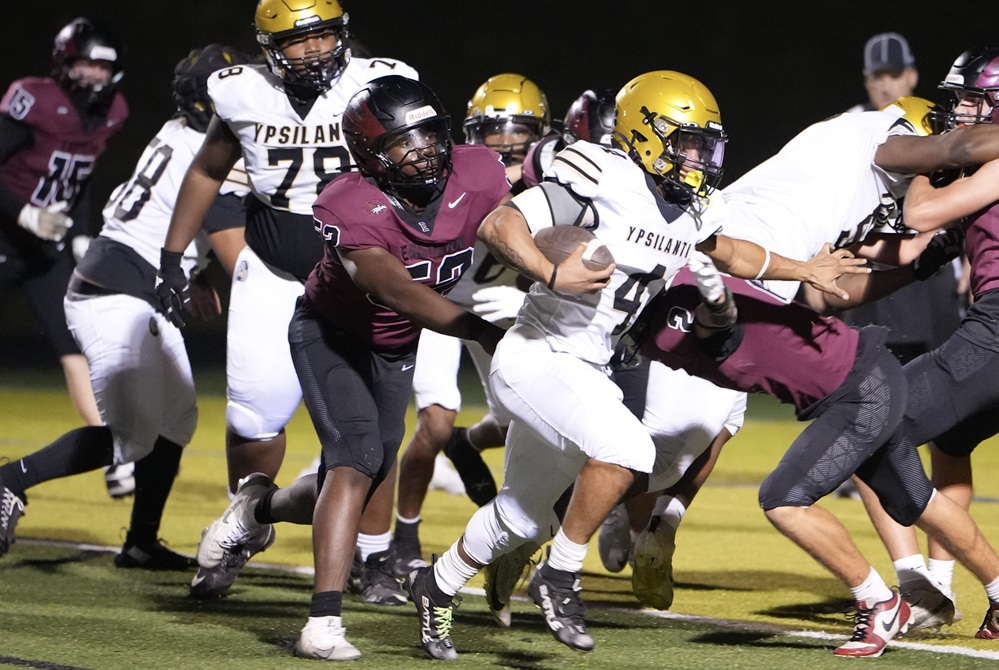
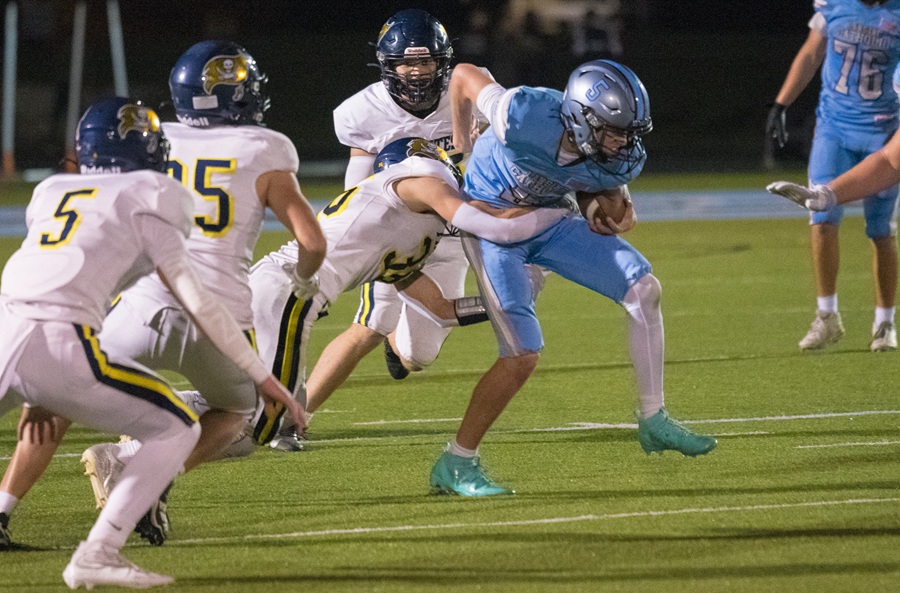
PHOTOS (Top) Ada Forest Hills Eastern defenders close in on a Ypsilanti Community ball carrier during the Hawks' 46-22 win on Friday. (Middle) A Lansing Catholic ball carrier works to break away as Pewamo-Westphalia defenders swarm during a 35-13 victory. (FHE/Ypsilanti photo by Michigan Sports Media. Lansing Catholic/P-W photo by TCP Photography.)