


Sold Out
December 13, 2016
We are sometimes criticized for limiting the scope of school sports – for restricting long-distance travel and prohibiting national tournaments; but there is no question that we are doing the correct thing by protecting school sports from the excesses and abuses that characterize major college sports.
Across the spectrum of intercollegiate athletics, but especially in Division I football and basketball, there exists an insatiable “keep-up-with-the-Joneses” appetite.
Universities are building increasingly extravagant facilities. They are sending their “students” into increasingly expansive scheduling. But it’s never enough.
There is always another university somewhere building a bigger stadium, a fancier press box or more palatial dressing rooms, practice facilities and coaches quarters.
So-called “students” are sent across the US and beyond to play on any day at any time in order to generate revenue to keep feeding the beast.
The Big Ten knows it’s wrong, admits it, but schedules football games on Friday nights to attract larger rights fees from television.
Feeling used or abused, some of the athletes of Northwestern and then at the University of Wisconsin, talk of creating a union to protect themselves from the obvious, rampant exploitation.
And then occasionally, some college coaches dare to suggest that high schools are wrong to have regulations that reject the road that colleges have traveled, a road that has distanced athletics very far from academics in intercollegiate sports.
The intercollegiate model is not and must not be the interscholastic model. We who are sold out for educational athletics have nothing good to learn from those who have sold out for broadcast revenue.
Drive for Detroit: Week 3 Preview
September 6, 2018
By Geoff Kimmerly
Second Half editor
From Calumet at the top of the U.P. to Michigan’s southern border, tonight’s weather is forecast as ideal for high school football.
 And there are plenty of matchups to match.
It’s only the third week of the season, of course, but we could look back at this as the week that decided some of the state’s most high-profile league titles – and previewed some of the most anticipated playoff matchups down the road.
Games below are tonight unless noted; there also are 11 games Saturday featuring Michigan teams. Check out the MHSAA Score Center for the full schedule and results as games are completed. MHSAA.tv will broadcast nine games tonight, including three noted below.
“Drive for Detroit” previews are powered by MI Student Aid.
Bay & Thumb
Saginaw Swan Valley (2-0) at Freeland (2-0)
The Vikings’ early schedule is loaded; they opened with a 21-12 win over Cedar Springs (7-4 last season) and last week won 56-20 over Frankenmuth (12-1 in 2017). Now the reigning Division 5 runner-up gets Tri-Valley Conference Central rival Freeland, which has made the playoffs 10 straight seasons and fell to Swan Valley only 21-14 a year ago. The Falcons are off to a nice start as well with a three-point victory over Marshall and 23-pointer over Carrollton that avenged last season’s District loss.
Others that caught my eye: FRIDAY Davison (2-0) at Flint Carman-Ainsworth (2-0), Ubly (2-0) at Sandusky (2-0), Flint Hamady (2-0) at Flint Beecher (1-1), Carrollton (1-1) at Millington (1-1).
Greater Detroit
Farmington Hills Harrison (2-0) at Oak Park (2-0)
Many eyes are on Harrison as the 18-time MHSAA champion plays its final season before the school closes next spring. This matchup could determine if the Hawks are league champions one more time; last year, Harrison split the Oakland Activities Association White title with both Oak Park and Birmingham Groves. Oak Park beat Groves last week and Utica Eisenhower in Week 1 and will present the Hawks’ their first major challenge after back-to-back 41-0 victories. Harrison won last year’s meeting 17-14.
Others that caught my eye: FRIDAY Clinton Township Chippewa Valley (2-0) at Utica Eisenhower (1-1), St. Clair (1-1) at Madison Heights Madison (2-0), Canton (1-1) at Plymouth (2-0), Sterling Heights Stevenson (2-0) at Romeo (1-1).
Mid-Michigan
Grand Ledge (0-1) at East Lansing (2-0)
East Lansing is regarded as one of the intriguing teams emerging early from the capital area, especially after avenging a 2017 loss by defeating Dearborn Divine Child on the road last week. Grand Ledge had to replace a giant senior class this fall and opened with a loss to Hudsonville before a bye in Week 2 – but the Comets are still three-time reigning Capital Area Activities Conference Blue champions. East Lansing shared that title in 2016, and tonight could show itself to be the biggest obstacle to newcomer DeWitt becoming the next league champion.
Others that caught my eye: FRIDAY Williamston (2-0) at Fowlerville (2-0), Lansing Sexton (0-2) at Portland (2-0), Harrison (1-1) at Clare (2-0), Leslie (1-1) at Lake Odessa Lakewood (1-1).
Northern Lower Peninsula
Alpena (2-0) at Gaylord (2-0)
These two have played in the Big North Conference together for nearly two decades, but it’s been a long time since this matchup potentially meant this much. Alpena is 2-0 for the first time since 2004 – the last time it won more than four games in a season – and got here in part with a Week 1 win over 2017 Division 4 semifinalist Escanaba. Gaylord opened at Lansing Sexton and came back with a win and then went to 2-0 last week by beating a Gladstone team that like the Big Reds also made the playoffs a year ago. Gaylord, which last made the postseason in 2015, has won four of the last five against the Wildcats.
Others that caught my eye: FRIDAY Traverse City St. Francis (2-0) at Benzie Central (2-0), Kingsley (2-0) at Grayling (1-1), Lake City (2-0) at McBain (1-1), Beaverton (1-1) at Houghton Lake (1-1).
Southeast & Border
Ida (2-0) at Brooklyn Columbia Central (2-0)
A loss to Columbia Central foiled Ida’s attempt at a league title three-peat last season, and both were among four teams to represent the Lenawee County Athletic Association in the playoffs. Last week’s 28-22 win over reigning two-time Genesee Area Conference Red champion Lake Fenton was a good sign the Bluestreaks will be back in the mix. Columbia Central’s Week 1 shutout of reigning Cascades Conference co-champion Napoleon means the Eagles will be there too – with tonight playing a big part in how the rest of the LCAA race unfolds.
Others that caught my eye: FRIDAY Reading (2-0) at Concord (2-0), Hudson (2-0) at Dundee (2-0), Coldwater (1-1) at Jackson Lumen Christi (2-0), Addison (1-1) at Michigan Center (2-0).
Southwest Corridor
Portage Central (1-1) at Portage Northern (2-0)
Kalamazoo Central took some bite out of this rivalry matchup last week by handing Portage Central an unanticipated 30-14 defeat. But there’s still plenty of story here. Portage Northern has its own stadium for the first time after 53 years of playing home games at Portage Central, and is coming off avenging a 2017 loss by shutting out Stevensville Lakeshore last week. Central has beaten Northern in four straight, and ending that streak would be a memorable way for the Huskies to celebrate their new home.
Others that caught my eye: FRIDAY Paw Paw (2-0) at Edwardsburg (2-0), Three Oaks River Valley (2-0) at Martin (1-1), Fennville (2-0) at Delton Kellogg (2-0), Mattawan (2-0) at St. Joseph (1-1).
Upper Peninsula
Ishpeming Westwood (2-0) at Calumet (2-0)
The Patriots are making it difficult to focus elsewhere in the Upper Peninsula. They’ve followed up a school record nine wins in 2017 with a pair this fall including 34-7 last week over Iron Mountain. But Westwood should receive its toughest challenge yet from Calumet, a playoff team 12 of the last 13 seasons. This will be the first meeting between the teams; they also are in a league for the first time, as two of the contenders in the Western Peninsula Athletic Conference “large school” division.
Others that caught my eye: FRIDAY Norway (2-0) at Ishpeming (2-0), Gladstone (1-1) at Menominee (0-2), Hancock (2-0) at Negaunee (0-2), SATURDAY Detroit Loyola (2-0) at Escanaba (1-1).
West Michigan
Holland West Ottawa (2-0) at Rockford (1-1)
West Ottawa’s record-setting 2017 included its first win over Rockford since 2002 and then a second defeat of the Rams in a Division 1 District Final. The Panthers are off to another great start, following last season’s 10 victories with two more against Stevensville Lakeshore and last week by a point over Grand Rapids Forest Hills Central. Rockford opened with a loss to Illinois power Wilmette Loyola, but bounced back in a big way with a 36-0 shutout of Lowell – no doubt picking up momentum to carry into this highly anticipated rematch.
Others that caught my eye: FRIDAY Hudsonville (2-0) at Grand Haven (2-0), Zeeland East (2-0) at Grand Rapids Catholic Central (1-1), Manistee (2-0) at Ludington (2-0), Muskegon (2-0) at East Grand Rapids (1-1).
8-Player
Pickford (2-0) at Crystal Falls Forest Park (1-1)
Pickford’s only loss last season came by two points to Forest Park in an 8-Player Division 2 Semifinal – Forest Park went on to win the championship game by 42. The Panthers have outscored their first two opponents by a combined 114-7 and meet a Forest Park team this time that was stunned by Eben Junction Superior Central in their opener but bounced back with a big win against Carney-Nadeau. These two aren’t in the same league, so this doesn’t mean anything to those hopes – but it definitely could be a preview of a postseason rematch of much significance.
Others that caught my eye: FRIDAY Morrice (2-0) at Mayville (2-0), Camden-Frontier (2-0) at Portland St. Patrick (2-0), Battle Creek St. Philip (2-0) at Webberville (2-0), Bellaire (1-1) at Onekama (2-0).
Second Half’s weekly “Drive for Detroit” previews and reviews are powered by MI Student Aid, a part of the Student Financial Services Bureau located within the Michigan Department of Treasury. MI Student Aid encourages students to pursue postsecondary education by providing access to student financial resources and information, including various student financial assistance programs to help make college more affordable for Michigan students. MI Student Aid administers the state’s 529 savings programs (MET/MESP) and eight additional aid programs within its Student Scholarships and Grants division. Click for more information and connect with MI Student Aid on Facebook and Twitter @mistudentaid.
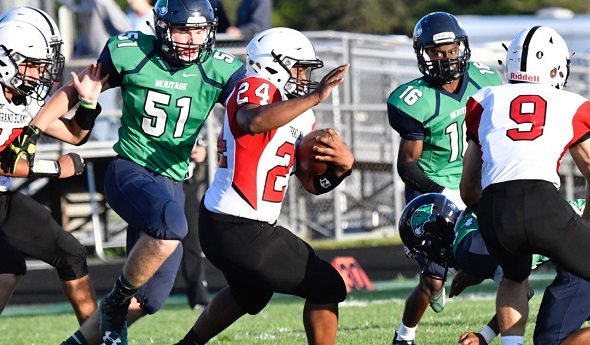
PHOTO: A Grand Blanc ball carrier works against the Saginaw Heritage defense during the Bobcats' 27-20 win last week over the Hawks. (Photo by Terry Lyons.)