

St Mary's Scores 3-Peat on Late TD
By
Tom Markowski
Special for Second Half
November 26, 2016
DETROIT – Orchard Lake St. Mary’s has been bitten before by teams that made last-second winning plays.
This time St. Mary’s bit back.
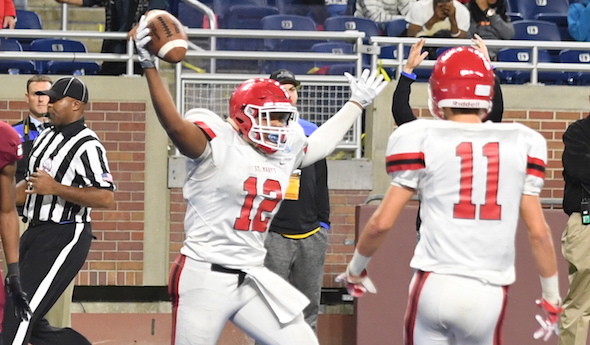
Ky’ren Cunningham’s 18-yard touchdown reception with four seconds left gave the Eaglets a thrilling 29-28 victory over Muskegon in the Division 3 Final on Saturday at Ford Field.
St. Mary’s (10-4) began its last drive on its 20-yard line with 1:55 left. A pass interference penalty by Muskegon and Rashawn Allen’s 22-yard run placed the Eaglets in a good position to go for the winning score.
On 3rd-and-3 from the 22, quarterback Caden Prieskorn scrambled for four yards and a first down. An incomplete pass preceded the winning score.
“It was a pistol right,” Prieskorn said. “All we knew was we were going to have man-on-man coverage.”
Make no mistake. This was desperation, and it was a makeshift play. Cunningham is a starting running back. The last time he lined up as a receiver was in the first game this season against Macomb Dakota. Coach George Porritt ditched that plan afterward. Cunningham would stay in the backfield.
But not this time. St. Mary’s had five wideouts and to confuse matters more, Cunningham went to the slot, then switched spots with Clay Antishin, with Antishin moving inside.
“I play running back,” said Cunningham, a junior. “It was one-on-one and the safety didn’t come over the top. Caden just threw it. He just made the read.
“My body felt so weak (when I caught it). I don’t remember much.”
If Cunningham was stunned, Muskegon was more so.
The only loss the Big Reds (12-2) had this season was to a team from Illinois (Lincolnshire Stevenson). They rolled through the playoffs with their Semifinal game against Edwardsburg (19-8) the only close one.
“I just didn’t do a good enough job of teaching coverage,” Muskegon coach Shane Fairfield said.
“People say we can’t win the big one," he added. "We won a lot of big games to get here. The football game doesn’t define you. It’s what you do and the way you act afterwards that defines you.”
It was Muskegon’s fourth loss in a Final since winning its last title in 2008. Meanwhile, the championship was St. Mary’s third straight and eighth overall.
 Muskegon took a 21-20 lead on its second possession of the second half. It took the Big Reds 1:48 to go 50 yards with senior quarterback/running back Kalil Pimpleton going the final 18 to give Muskegon the lead with 11:21 remaining.
St. Mary’s then went on one of its patented long, time-consuming drives to retake the lead. The Eaglets took 12 plays to go 47 yards, and Ben Fee set an MHSAA Finals record with a 49-yard field goal to give his team a short-lived 23-21 lead with 4:47 left.
Clinton Jefferson, Jr., returned the ensuing kickoff 49 yards to midfield to give the Big Reds great field position, and they made it count. Jefferson carried five times on the drive for 32 yards, including the last three for a touchdown with 1:55 left.
As it turned out, that was too much time to leave for St. Mary’s.
“Cade made some big throws against DeWitt (in a Regional Final),” St. Mary’s coach George Porritt said. “What amazes me is we were 5-4 at one point, and we battled back.”
St. Mary’s is the fifth team to win an MHSAA football title having lost four games.
Muskegon led 14-13 at the end of an entertaining first half.
The Big Reds went 70 yards during the opening drive and took a 7-0 lead on Pimpleton’s 18-yard touchdown run. Pimpleton’s 27-yard pass to Jefferson helped set up the score.
St. Mary’s then went 69 yards, but its drive stalled and Fee kicked a 32-yard field goal.
La’darius Jefferson took over at quarterback for Pimpleton in the second quarter, and Muskegon increased its lead to 14-3 as Jefferson completed an 80-yard drive with a 2-yard touchdown run. He carried five times on the drive for 25 yards. His 54-yard pass to Pimpleton was the key play.
After another Fee field goal, Muskegon had possession late in the half. But on 3rd-and-9 Jefferson handed off to Pimpleton, who threw a halfback pass that was intercepted by Shermond Dabney, who returned it 30 yards to the Muskegon 30. On St. Mary’s 3rd-and-9, Prieskorn threw a 29-yard touchdown pass to Antishin, who made a diving catch in the end zone with 35 seconds left before the break.
Allen was a workhorse in the backfield, and ran with determination. A junior, he rushed for 136 yards on 25 carries, and Cunningham had 15 carries for 46 yards. Prieskorn was 13 of 21 passing for 200 yards and two touchdowns.
For Muskegon, Pimpleton had three receptions for 88 yards, was 3 of 4 passing for 58 and rushed nine times for 56 yards and two touchdowns.
The MHSAA Football Finals are sponsored by the Michigan National Guard.
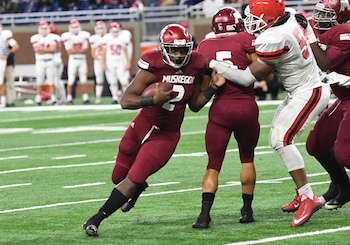
PHOTOS: (Top) St. Mary’s Ky’ren Cunningham (12) celebrates his game-winning touchdown. (Middle) Muskegon’s La’darius Jefferson breaks around his blocker Saturday.
Harris Flies Like a Record-Setting Eagle
By
Geoff Kimmerly
MHSAA.com senior editor
November 30, 2012
Drake Harris may not have expected the full force of the performance he put up Saturday to cap an incredible junior season for Grand Rapids Christian.
But he had a pretty good idea at the start that it could turn into a special night.
When Orchard Lake St. Mary’s attempted to cover him with just one player – and continued to do so frequently throughout the Division 3 Final at Ford Field – the 6-foot-4, 180-pound Harris found himself in a dream come true.
“I kinda figured they would come out like that and play me like that. My coach knew that, and he just put me in the right position to make plays,” Harris said. “And I was happy they came out like that.
“I’m not the type to brag on myself. But when I see that, man-to-man coverage, that’s my dream. I love when people go man, and no safety over the top. It’s just me and the DB. The better man wins.”
Harris gets a Second Half High 5 this week after probably the most victorious day in his young career.
He grabbed eight passes for an MHSAA Finals record 243 yards and a touchdown as the Eagles beat St. Mary’s 40-37 in overtime to claim their first football championship.
Saturday’s numbers gave him, unofficially, 91 catches for 2,015 yards and 25 scores this fall. While those totals still must be confirmed for record book purposes, the yardage will be the most in MHSAA history for one season and rank 12thnationally. His yards per game this fall will rank fourth nationally and his yards per catch sixth. His catches will rank fourth in MHSAA history and his touchdown catches second.
Harris has committed to sign next fall with Michigan State for basketball and then the following February for football too. He’s expected to do big things again this winter for a Grand Rapids Christian basketball team that advanced to the Class A Quarterfinals last season.
Hoops always was his sport – he wasn't sure at one point that he’d even play football in high school. But Harris said Spartans men’s basketball coach Tom Izzo told him he loves players who are on their football teams as well. And Harris said he is starting to realize his football future might be the brighter of the two.
Saturday couldn't have hurt that observation.
Harris caught passes of 49 and 22 yards before hauling in a 74-yard scoring strike early in the second quarter. He had an 85-yarder called back during the third quarter, but caught passes of 24 and 38 yards to set up a touchdown early in the fourth. He then caught his final three passes during the team’s final possession of regulation, gaining a total of 36 yards in helping to set up Joel Schipper’s 28-yard game-tying field goal with four seconds left.
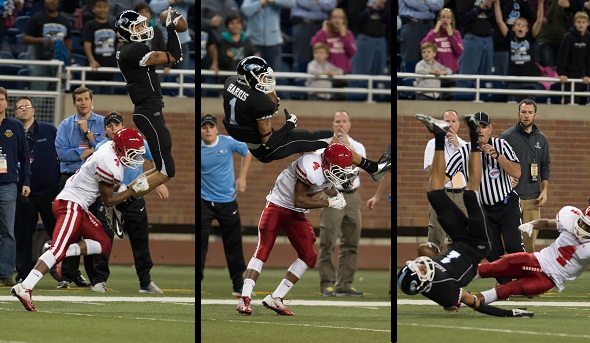
One catch will live on in Finals memory for years to come. In the fourth quarter, Harris went so high as to nearly jump over his defensive back. The defender tackled his legs mid-air, dumping Harris back-first into the turf. But Harris held on, and the Eagles continued to move.
After gaining more than 1,000 yards receiving as a sophomore too, Harris will need only 609 as a senior to set that MHSAA career record. He needs 66 catches and four for touchdowns to tie those records. And if a record was kept for highlight-reel catches, he might already be the holder.
“People don’t necessarily think he’s tough or something. But to have a guy go up 3-4 feet in the air and get flipped, catch the ball and land on his back or head; that’s pretty tough in my book,” Grand Rapids Christian senior quarterback Alex VanDeVusse said. “I’d take him on my team every single day. He’s amazing.”
PHOTO: Drake Harris went high to make this grab during the fourth quarter of Saturday's Division 3 Final against Orchard Lake St. Mary's. (Click for more from Terry McNamara Photography.)