

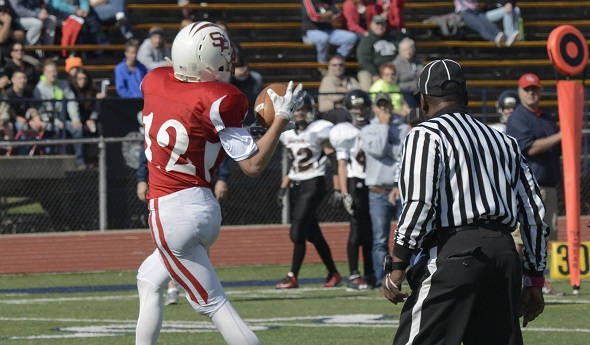
St Phil Football Thrives with 8 on Field
By
Pam Shebest
Special for MHSAA.com
August 22, 2016
BATTLE CREEK — Five years ago, the future of football at Battle Creek St. Philip looked rather bleak.
 The Fighting Tigers had won just three games over the previous two years, and numbers continued to dwindle.
“Our last year of 11-man, I think we had 18 boys out for football,” said Dave Downey, who has coached at St. Phil for more than 20 years. “We were not competitive playing 11-man.
“The kids just weren’t coming out because it wasn’t fun. We were getting beat all the time.”
The school decided to go to 8-player football, and the program has thrived.
Last season, the school’s fourth playing 8-player, St. Phil finished 12-1, losing only 58-33 in the MHSAA 8-player Final to Powers North Central.
“After we went to 8-man (five years ago), we had 28 on the roster,” Downey said. “The program really grew because we went to 8-man. It actually saved the program.”
The transition was not without a few fumbles.
“We didn’t know what we were in for,” Downey said. “That first year we struggled a little bit. We ended the season 7-4, but we learned a lot.
“It was an eye-opener for us. We didn’t know what to expect.”
Although the length of the field for 8-player is still 100 yards, the width is five yards fewer on each side.
 That first season, Downey said he had confidence his 8-player team could play on an 11-man regulation field – but soon found out why the field is not as wide.
“Our first year, we didn’t move the markers in and we couldn’t cover the field, especially anyone with speed who would get on the outside and go,” he said.
“Our first game, we lost bad because we thought we could play on a big field, which we couldn’t.”
This year’s nine seniors have played 8-player all four years, but it gets even better than that for St. Phil.
“They’ve actually played 10 playoff games already (over four years), so they’ve already played (the equivalent of) four seasons,” Downey said.
“This is almost like their fifth season. Experience-wise, this group of seniors is really valuable.”
Success and motivation
Last Thursday, St. Phil scrimmaged Lawrence and then Big Rapids Crossroads to get game experience before opening the season this Friday at Kingston.
“We didn’t keep score, but it went well,” Downey said. “It was good experience for some of the younger kids, especially the freshmen, to play and learn.”
He said the veterans, especially the co-captains, are like having extra coaches on the field.
“They know exactly what our schemes are and our blocking patterns and they really help us out,” he said. “Our line is coming back. We’re solid up front.
“We have Noah Ellinger, our captain; Grant Hallacy who started last year as our other guard; Andy Forche at center and all of them played a lot last year on the line.”
Senior co-captain Grayson Obey has played football since fourth grade and said going from the traditional 11-player in Rocket youth football and middle school football to 8-player was no big deal.
 “I think going from middle school to high school, not 11-man to 8-man, was harder,” he said.
Obey said last year’s success is a great motivator.
“We got a taste of a really good team last year, so it’s good motivation to work hard and try to push to get that again this year,” he said.
Ellinger agrees that the transition to 8-player was not a big deal.
“It’s two less linemen and I’m a lineman, so it’s just kind of shortening it up a little bit,” he said.
Playing both ways on the field takes some getting used to at the beginning of the season, Ellinger said.
“The first couple games it’s pretty hard,” he said. “You’ve got to learn to manage your time. It’s kind of tiring, but you get used to it.”
Downey said the parents like 8-player because “it is a little bit safer.
“We don’t have as many big kids on the field as 11-man. When you have the big kids, the little kids are the ones who seem to be getting hurt all the time.”
St. Phil lost all-state quarterback Brendan Gausselin to graduation, but Downey is eyeing sophomore Ryan Reincke and freshman Connor Gausselin for the position while senior Drew Lantinga recovers from a basketball injury.
“Last year Drew played wide receiver and linebacker,” Downey said. “He was the leading tackler on the team last year at linebacker.”
Connor Gausselin is Brendan’s brother.
“My brother played football and was pretty good, so I want to follow in his legacy,” Connor Gausselin said. “He’s helped me a lot. In every sport I play, I like being in control like a leader, so quarterback is a leader on the field and I like that.
“I’m very excited. My brother said high school football is the best part of high school, being under the Friday night lights. It will be fun.”
8-player grows statewide
Enrollment numbers are key to 8-player football in Michigan.
Of St. Phil’s 140 students, 21 are on the football team.
 While Michigan has 564 schools playing 11-player, the state had 40 playoff-eligible 8-player teams last season. Currently, 48 teams are eligible for the postseason heading into this fall's first games.
Only Class D schools are eligible for playoffs, and enrollment must be 206 or fewer this year.
Class C schools or those with larger enrollments (cutoff was 212 students for the 2015 season) may compete in 8-player but they are not eligible for postseason play.
This fall, four Class C schools are competing in 8-player: Kingston, which was Class D last year; Dryden, Rudyard and Grand Traverse Academy. The latter two fielded 11-player teams last season.
Burton Madison Academy was Class C last year but dropped to Class D this year and is now eligible for postseason play.
St. Phil plays in the Southern Michigan 8-Man League with Tekonsha, Burr Oak, Camden Frontier, Waldron and Litchfield.
Other seniors on the Tigers are Tim Minier, Mike Scriber, Ben Swagler, Alex Yacovoni and Jordan Snyder. The other juniors are Justice Steiner and Morgan Bohannon.
Other sophomores are Chris Kubasiak, JC Downey, Nolan Kersten and Brodie Landstra. Other freshmen are Marcel Williams, Charley Harrington and Gus Strenge.
Assistant coaches are Jack Brown, Marc Pessetti and Jeff Minier.
 Pam Shebest served as a sportswriter at the Kalamazoo Gazette from 1985-2009 after 11 years part-time with the Gazette while teaching French and English at White Pigeon High School. She can be reached at [email protected] with story ideas for Calhoun, Kalamazoo and Van Buren counties.
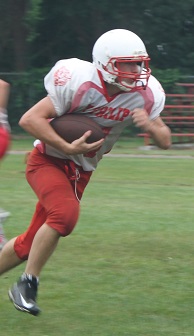
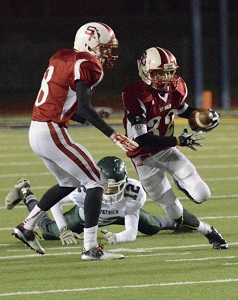
PHOTOS: (Top) Battle Creek St. Philip’s Drew Lantinga hauls in a pass last season; he’s moving to quarterback this fall. (Middle top) Dave Downey, Noah Ellinger, Grayson Obey. (Middle below) Senior Tim Minier surges after taking a hand-off during practice earlier this month. (Below) Ben Swagler pushes ahead during the Tigers’ 2015 win over Portland St. Patrick. (Photos from 2015 courtesy of Battle Creek St. Philip; practice photo and head shots by Pam Shebest.)
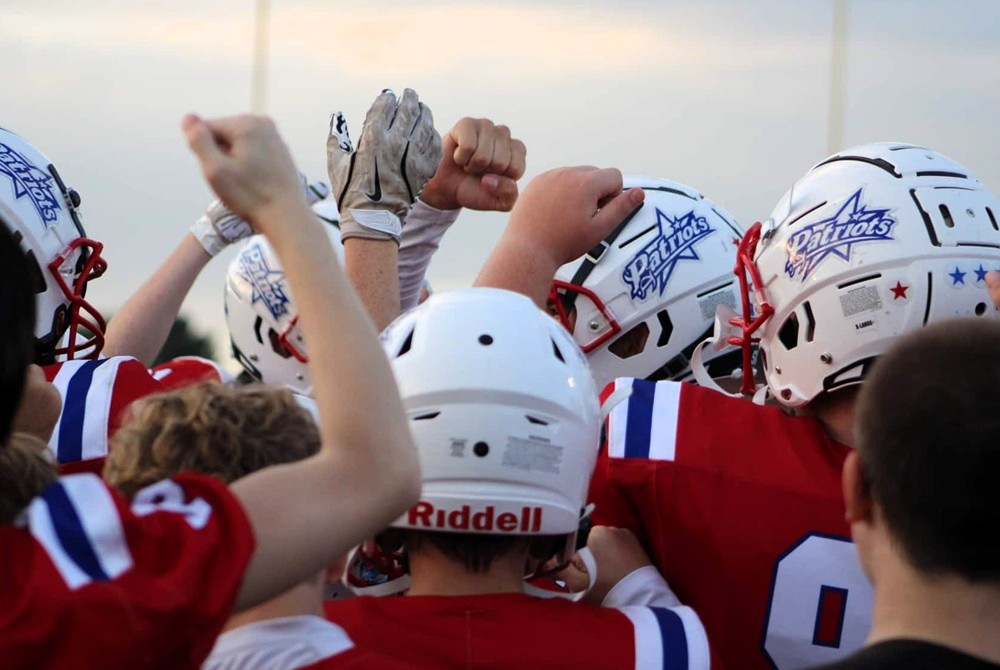
Heston Football Celebrates 1st League Title as Seniors Cap Extraordinary Rise
By
Tom Spencer
Special for MHSAA.com
November 5, 2025
St. Helen Charlton Heston Academy finished this football season with a five-game winning streak and in possession of a trophy representing the school’s first North Star League Big Dipper championship in any sport.
 The feat is especially incredible considering where the Patriots’ football program stood just four years ago.
Those Patriots welcomed a new assistant coach who would soon take over the program, but also five freshmen – Dylan Chichowski, Owen Romancky, Corbin Greenless, Desyln Klumpp and Tiernan Hinmon – in the starting lineup.
“If you rewind the clock, and go back to, like 2022, we went four straight games without even scoring a point,” said third-year head coach Matt Whelchel, who joined the staff that fall. “So to come from that and fast forward to this year, those (five) have been assistant coaches almost to me. They've really led this program to where it is right now.”
Those five seniors were part of a team than snapped a 43-game program losing streak as sophomores. They then led the Patriots to a 4-5 finish last year and 6-2 overall record this fall – with an undefeated run through league play. Heston was not eligible for the MHSAA Playoffs in 8-player because its enrollment exceeds the 215-student maximum to compete in the postseason. But Whelchel noted that the school remains ecstatic about what the team accomplished.
 Before turning the program around last year, the Patriots found wearing jerseys to school on game days more than a little difficult.
“We would not get made fun of, but when we talked about having a football game or had our jerseys on and we were in that losing situation, it wasn't a very prideful thing,” noted Klumpp, the team’s kicker, running back and receiver. “You're wearing a football jersey, and everyone else thinks that you're just a joke because we never win.
“And being able to turn that around, people, you know, just mentioning how fun the football games have been to watch. It's also been something we had to fight through.”
Klumpp, Greenless, Romancky and Chichowski also experienced a winless season as eighth-graders as Whelchel served the school as the middle school head coach and varsity assistant. Whelchel took over the varsity program in 2023.
The players credit Whelchel with instilling an offseason work ethic. The focus on studying film, spending time in the weight room and dedication to maintaining mental and physical health were also among keys to the Patriots’ turnaround.
“Our senior class had it extra hard starting out from middle school,” said Romancky, who played on both the offensive and defensive lines. “I think after our freshman year, once we lost every game, the drive to win the first one just became very apparent and we really took that step forward.”
Whelchel is quick to point out the school had had a good deal of talent over its 11 years of football history. Dedication, though, is at an all-time high for the Patriots.
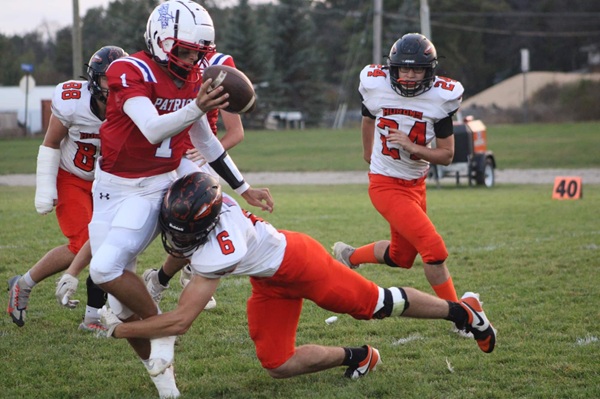
 “I have no doubts in my mind that we had players in the past that wanted to win, but you've got to have more than that,” said Whelchel, who also serves as an elementary physical education teacher. “We had talent sometimes – we just didn't have the drive. You've got to have more than the will to win. You got to spend time in the weight room and keep grades up – and it takes a lot of dedication.”
Whelchel also credits his coaching staff for much of the Patriots’ success. The assistant coaches are Jory Klumpp, Graham Church, Liam McKeage and Nathaniel Snyder.
Heston always has found community support for football, but things are a little different nowadays. The varsity players are often asked for autographs from youth football kids.
“The community has always had our back — even last year, coming into some of our home games without a winning season — we always had our stands full and stuff,” said Chichowski, the team’s quarterback. “And this year, as I work out of school during the day, everybody who comes in is asking about the game, when it starts, and just telling us that they're going to be there and stuff. It's awesome.”
Chichowski racked up 1,076 passing yards and threw 12 touchdown passes. He also had four rushing TDs and 308 yards rushing for 1,384 total offensive yards. He was named to the Big Dipper’s all-conference team, as was Klumpp, Romancky, Tiernan Hinmon and Corbin Greenless.
Greenless, a senior lineman, led team in tackles with 114 plus six sacks. He added defensive touchdowns via a blocked punt and an interception.
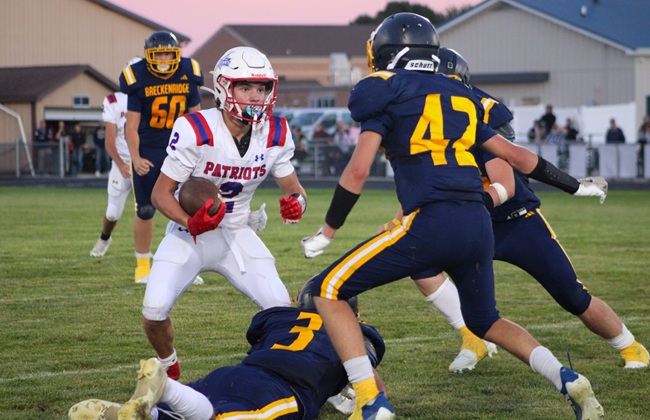
Hinmon, also a senior, led the team in touchdowns scored with 18. Twelve were on the ground, where he compiled 780 rushing yards. He also came through with a pick six against Au Gres-Sims in the fourth quarter of Heston’s 43-6 season-concluding victory.
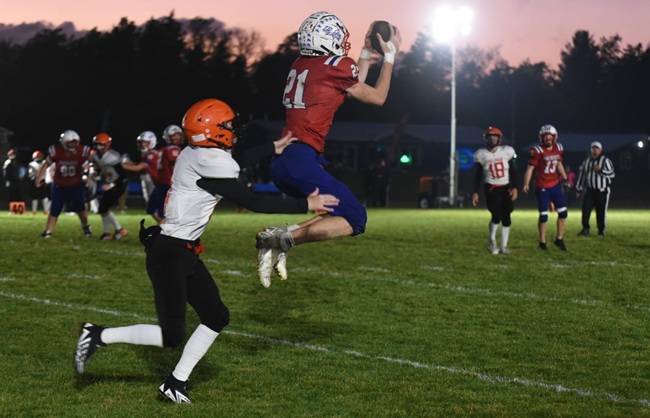 Romancky, who also had interception return touchdowns against Hillman and Whittemore-Prescott, admitted losing wore on the Patriots.
“I think all the losing left a bad taste in the mouth, and we just wanted to like clear it out and get that winning feeling,” he said. “All the losses that piled up fueled the drive to win.”
The Patriots had eight seniors this fall, but Whelchel is not at all thinking about a rebuilding year in 2026.
“We're going to lose a lot of talent for sure. But we had some really talented sophomores this year, and the only reason they didn't see the field a lot is because we had a lot of those guys playing ahead of them,” Whelchel said. “The seniors obviously had talent on the field, but they're leaders off the field too. And so they've set an example for next year’s seniors and juniors. I think we'll pick up – maybe not exactly where we left off – it might take some growing pains.”
Hinmon believes these seniors have paved the way for future Patriots football players to keep the winning tradition alive.
“Everybody used to call us the pity-party Patriots,” Hinmon indicated. “They never thought we were good, and now this season, we really proved ourselves. We worked hard. I think our next season, the younger ones are going to have a great season.”
“I think it's a thing of standards,” Klumpp added. “It just sets at the bar even higher for everyone else that's going to go through this program.”
 Tom Spencer is a longtime MHSAA-registered basketball and soccer official, and former softball and baseball official, and he also has coached in the northern Lower Peninsula area. He previously has written for the Saginaw News, Bay County Sports Page and Midland Daily News. He can be reached at [email protected] with story ideas for Manistee, Wexford, Missaukee, Roscommon, Ogemaw, Iosco, Alcona, Oscoda, Crawford, Kalkaska, Grand Traverse, Benzie, Leelanau, Antrim, Otsego, Montmorency, Alpena, Presque Isle, Cheboygan, Charlevoix and Emmet counties.
PHOTOS (Top) St. Helen Charlton Heston players huddle on a game day this season. (2) Patriots quarterback Dylan Chichowski works to elude a Rogers City defender. (3) Owen Romancky (21) leaps to haul in a pass against Hillman. (4) Tiernan Hinmon sets up to make his move while carrying the ball against Breckenridge. (Owen Romancky photo by Ashley Patti/Houghton Lake Resorter. All other photos submitted by Jessica Romancky.)